


Is HFM a Scam? Complaints, Regulatory Warnings & Withdrawal Issues
Is HFM a scam? The available evidence does not support treating HFM as an anonymous or entirely unregulated broker, as HF Markets entities appear on official regulatory registers, including CySEC and the FCA. However, regulation does not eliminate risk: HFM's public record includes a historical CySEC penalty and a Philippine SEC warning over local authorization. Traders have also reported withdrawal delays, account restrictions, profit disputes, and execution issues online. These complaints are not automatically proof of misconduct, so this review separates regulator-confirmed facts from user allegations that have not been independently verified.
Table of Contents
What Negative Records Should You Know About HFM?
HFM's negative record includes different levels of risk, from a confirmed regulatory penalty to jurisdiction-specific warnings and unverified user complaints. The table below separates these issues by evidence level so traders can distinguish documented regulatory action from allegations that still require case-by-case assessment.
| Date | What Happened? | Evidence Level | Source | What It Means Today |
|---|---|---|---|---|
| 2016 | CySEC fined HF Markets (Europe) Ltd €105,000. | Level 1: Confirmed regulatory penalty | CySEC | A confirmed historical compliance issue, but not a recent penalty. |
| Dec. 2025 | The Philippine SEC warned that HFM lacked the authorization required to solicit investments in the Philippines. | Level 2: Regulatory warning | Philippine SEC | A jurisdiction-specific authorization risk, not proof that HFM is illegal worldwide. |
| 2024 | The FCA warned about unauthorized websites impersonating HF Markets. | Level 3: Clone-firm warning | FCA | A scam and impersonation risk, not misconduct by the genuine HFM entity. |
| Recent | Users have reported withdrawal disputes, account restrictions, profit cancellations, and execution issues. | Level 4: User complaints | Trustpilot, Forex Peace Army, WikiFX and other forums | Potential risk signals that must be assessed individually and are not automatically proof of misconduct. |
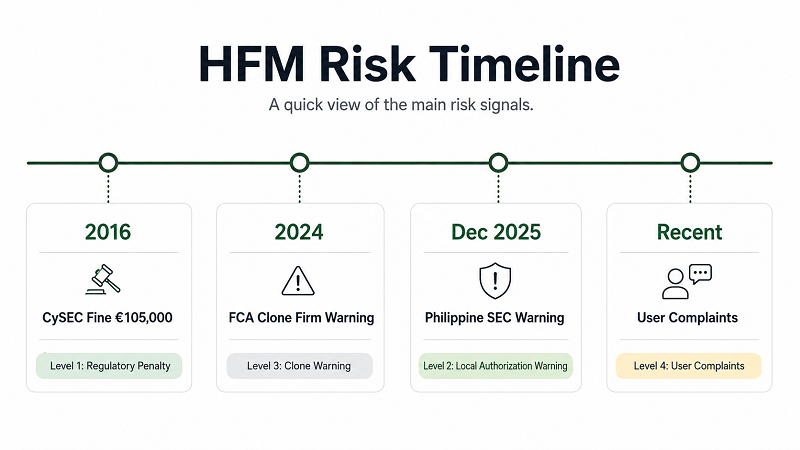
The evidence should therefore be read in order of strength. The CySEC fine is a confirmed enforcement action, while the Philippine SEC warning concerns local authorization. FCA clone-firm alerts involve third parties impersonating HF Markets, and online complaints remain user allegations unless independently verified or confirmed by a regulator.
What Regulatory Actions or Warnings Has HFM Faced?
HFM's official regulatory record includes three very different types of issues: a historical CySEC administrative fine, a Philippine SEC warning over local authorization, and FCA warnings about third parties impersonating HF Markets. Only the CySEC case discussed below was an administrative penalty imposed directly on an HF Markets regulated entity. The other warnings need to be interpreted in their specific regulatory context.
Why Did CySEC Fine HF Markets €105,000?
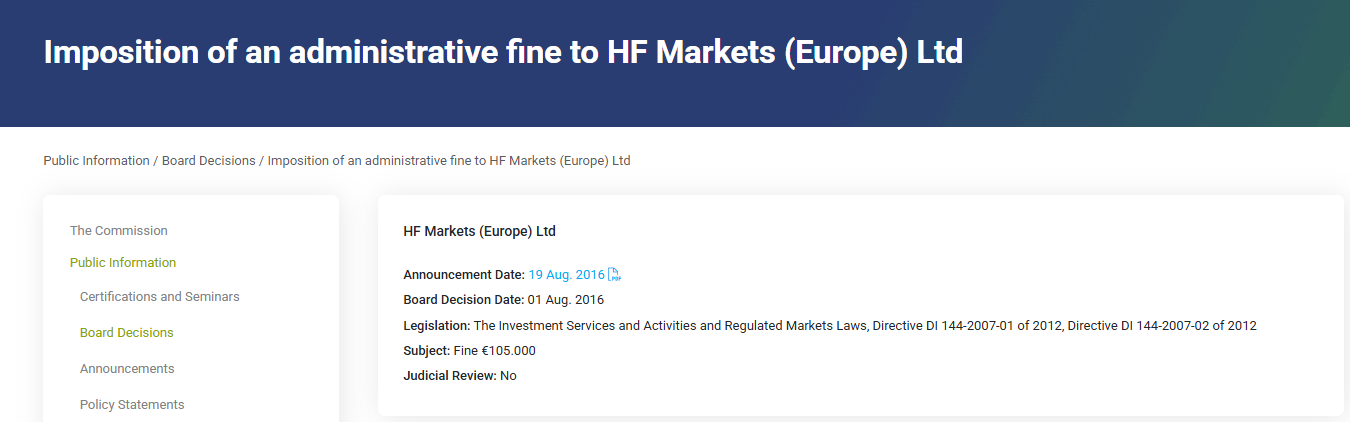
CySEC fined HF Markets (Europe) Ltd €105,000 over compliance failures involving recordkeeping, outsourced customer support, client interests, and the quality of risk information provided to clients. The Cyprus Securities and Exchange Commission lists August 1, 2016 as the board decision date and August 19, 2016 as the announcement date. The case involved the Investment Services and Activities and Regulated Markets Law and CySEC Directives DI 144-2007-01 and DI 144-2007-02.
| Fine | CySEC Finding |
|---|---|
| €10,000 | Inadequate compliance policies and business records, including missing records of telephone conversations and services provided by an outsourced provider. |
| €10,000 | Insufficient supervision of outsourced marketing and customer-support activities. |
| €20,000 | Failure to act fairly, honestly, and professionally in accordance with clients' best interests in relation to the provider's practices. |
| €30,000 | Client information was not sufficiently fair, clear, and non-misleading; CySEC specifically found that the provider's employees had downplayed the risk of trading losses. |
| €15,000 | Clients and potential clients were not given sufficiently appropriate and complete information to understand the nature and risks of the investment services and financial instruments offered. |
| €20,000 | Required records relating to client agreements and the essential rights and obligations of the parties were not properly maintained. |
The most relevant findings for prospective traders concern client communications and risk disclosure. CySEC found that employees of the outsourced provider downplayed the risk of losses and that information available to clients was not sufficient for them to reasonably understand the nature and risks of the products being offered.
CySEC also recorded corrective action. HF Markets terminated its relationship with the provider and reviewed its agreements with introducing brokers and other service providers, including clarifying that service-provider employees could not provide investment advice to HF Markets clients. The regulator also noted that the company had not committed a similar violation previously.
This is a historical 2016 enforcement action, not a recent CySEC fine against HFM. As of August 2026, CySEC's current register still lists HF Markets (Europe) Ltd as a Cyprus Investment Firm under license number 183/12, originally granted on November 20, 2012.
Source: Cyprus Securities and Exchange Commission, checked August 19, 2026.
Why Did the Philippine SEC Issue a Warning About HFM?
The Philippine SEC warned about HFM/HF Markets because it was soliciting Filipino investors without the registrations and local authorization required by the Philippine regulator. The advisory was issued on December 12, 2025. This was a regulatory warning, not a reported €- or peso-denominated administrative fine against HFM.
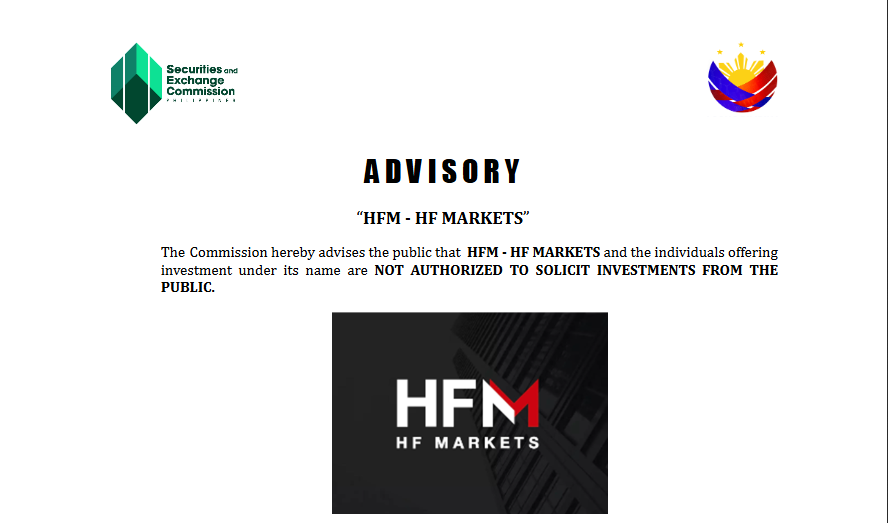
According to the SEC advisory and reports based on it, HFM promoted access to CFDs covering forex, commodities, bonds, metals, energies, shares, and indices. The regulator said Filipino residents could create accounts and trade through HFM, while promotional activity was being conducted through websites, social media, and mobile applications.
The SEC identified several local authorization issues:
- HFM/HF Markets was not registered as a corporation in the Philippines.
- The investment products being offered to the Philippine public were not registered with the SEC.
- HFM did not hold the local secondary license required to sell or offer securities or operate as a broker or dealer in the Philippines.
The important limitation is geographic. The Philippine warning does not establish that HFM is an illegal broker in every jurisdiction. The SEC's own advisory materials acknowledged that HF Markets-related entities hold registrations or regulatory licenses outside the Philippines. The issue was whether HFM had permission to solicit and provide the relevant investment products to residents of the Philippines.
For traders, this illustrates an important regulatory distinction: a broker being licensed in one country does not automatically authorize it to market or provide investment services in every other country.
Source: Philippine Securities and Exchange Commission advisory dated December 12, 2025.
What Does the FCA's HFM Clone Firm Warning Mean?
The FCA's HFM-related clone warnings are not penalties against the genuine HF Markets (UK) Limited. They concern unauthorized operators that copied the identity or regulatory details of the legitimate FCA-authorized firm.
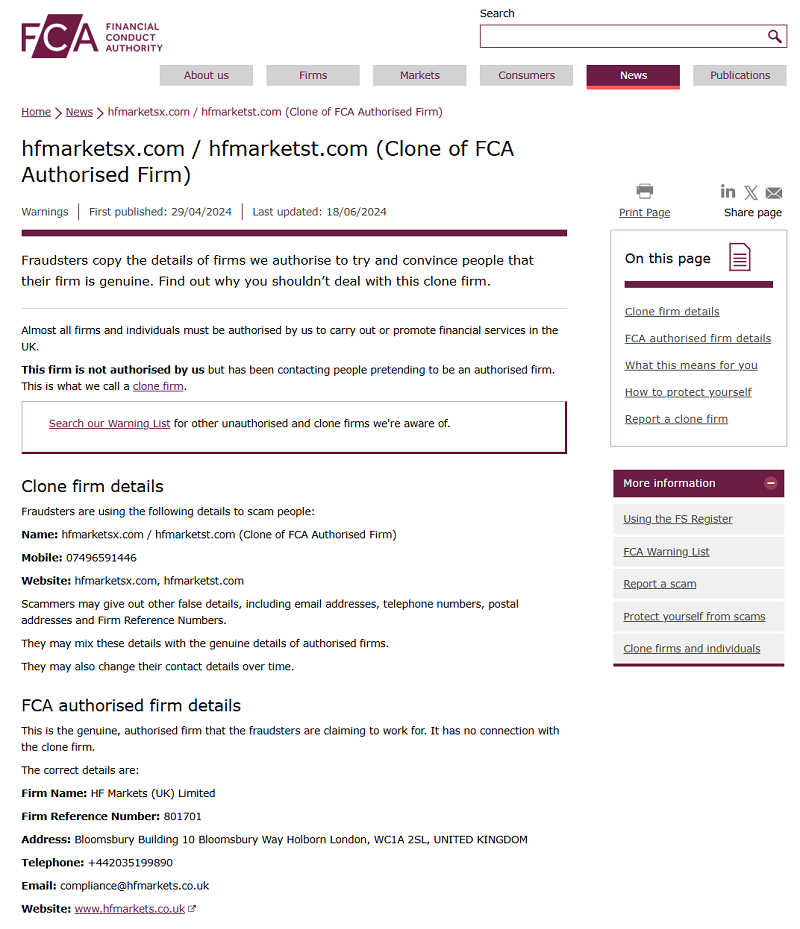
For example, on April 29, 2024, the FCA warned about hfmarketsx.com and hfmarketst.com. A second warning published on September 30, 2024 concerned “HotForexMarket” and the domain hotforexltd.com. In both cases, the FCA identified HF Markets (UK) Limited as the genuine authorized company and explicitly stated that it had no connection with the clone firms.
| Check | Genuine HF Markets | Clone Firm |
|---|---|---|
| Company | HF Markets (UK) Limited | Unauthorized third party |
| FCA FRN | 801701 | No matching authorization |
| Official Website | hfmarkets.co.uk | Examples include hfmarketsx.com, hfmarketst.com and hotforexltd.com |
| FCA Status | Genuine authorized firm | Clone-firm warning |
This distinction matters if an HFM offer arrives through Facebook, Telegram, WhatsApp, an investment group, or an unfamiliar registration link. A familiar logo or even a copied FCA reference number is not enough. Traders should compare the website domain, legal company name, FCA FRN, contact details, and the entity named in the account-opening agreement against the regulator's official register.
Overall, these three records should not be described as the same type of regulatory problem. The €105,000 CySEC case was a historical administrative penalty against HF Markets (Europe) Ltd; the Philippine SEC advisory concerned authorization to solicit investments in a specific jurisdiction; and the FCA warnings concerned clone firms impersonating the genuine HF Markets business. None of these records, by itself, amounts to a regulator declaring HFM a scam.
What Are HFM Users Complaining About, and How Has HFM Responded?
Recent HFM complaints mainly fall into four categories: withdrawal delays, account restrictions, canceled profits, and trade-execution disputes. These reports are worth examining, but they remain user allegations unless independently confirmed. In several cases, HFM has publicly responded or the complainant later reported that the dispute was resolved.
Have Users Reported HFM Withdrawal Problems?
Yes. Some users have reported HFM withdrawals remaining pending or not reaching their payment account within the expected period. On August 18, 2026, an Indonesian Trustpilot reviewer said a BEP20 withdrawal had been marked successful but had still not arrived after two weeks. No public HFM reply was visible when checked. Another reviewer reported a $2,000 withdrawal dating from July 2026; HFM replied that it could not identify a matching client record from the details provided and requested more information.
Not every delayed-withdrawal case remained unresolved. A Forex Peace Army user reported on June 2, 2026 that a $9,000 withdrawal requested on May 28 was still pending. On June 8, the same user said HFM had been unable to contact him by phone; after supplying a new number and speaking with a representative, he stated that the issue had been resolved.
HFM's published withdrawal rules vary by payment method and entity. Its current funding pages show processing ranging from instant or within 24 hours for some methods to 2–10 business days for cards or bank transfers. HFM also states that it may request additional documents, reject a particular withdrawal method, or require funds to be returned through the same funding method. Therefore, a delay is not automatically evidence that HFM is refusing to pay, although cases extending beyond the stated processing window deserve closer scrutiny.
Have Users Reported HFM Accounts Being Restricted or Closed?
Yes. Account termination complaints often involve HFM alleging prohibited trading rather than unexplained KYC failure. On August 12, 2026, a South African Trustpilot reviewer claimed that positions were closed, the account was terminated, and funds were frozen. HFM publicly responded that its investigation found a breach of its prohibited-trading rules and that the business relationship had therefore been terminated. HFM also denied confiscating profits and said the client had been permitted to withdraw the funds.
HFM's current client agreement does give the company broad powers to suspend access, freeze or close accounts, request additional documentation, and terminate a client relationship under specified circumstances. That contractual authority does not prove HFM applied the rules correctly in this individual case, and no regulator ruling was located confirming misconduct by either side.
Have Users Reported HFM Canceling Profits or Deducting Funds?
Yes. Profit cancellation is one of the more serious HFM complaints because it can overlap with account closure and withdrawal disputes. In a January 7, 2026 Forex Peace Army case, a trader alleged that HF Markets (SV) Ltd removed $789.27 in profits after accusing the account of prohibited trading and bonus abuse. The trader disputed those allegations. Two days later, however, the same user said the dispute had been resolved and asked for the complaint to be removed; the public thread does not disclose the settlement terms.
A July 2026 Trustpilot reviewer separately claimed that roughly $2,000 in profits had been reset. HFM responded that the account had been closed following violations of its terms and conditions.
HFM's current Client Agreement contains provisions covering pricing errors, latency, arbitrage, system exploitation, suspicious activity, and other forms of prohibited trading. Depending on the circumstances, the agreement allows HFM to reverse profits or close accounts. The key issue in an individual dispute is therefore whether the user's actual trading activity met those contractual definitions. Without an independent regulatory ruling, a user complaint alone cannot establish that a profit cancellation was improper.
Have Users Reported HFM Spread, Slippage, or Execution Problems?
Yes. Some users have complained about slippage, rejected orders, widened spreads, and stop-loss execution. A July 30, 2026 Trustpilot reviewer alleged abnormal execution delays, rejected requests, and severe slippage during a July 29 trading incident. HFM replied on August 3, apologized for the experience, and said its team would contact the client, but its public response did not confirm the user's technical allegations.
A separate Forex Peace Army dispute involved XAUUSD trading during the November 2025 CME disruption. The trader alleged abnormal pricing and a $540 loss. According to the complainant's published case summary, HFM denied a pricing-feed or platform fault, maintained that the trades had been executed under market-execution rules, and offered a $109.05 goodwill settlement without admitting liability. The user rejected the offer, and no mutually accepted resolution was reported.
HFM's Seychelles Order Execution Policy explicitly warns that slippage can occur in rapidly changing markets. It also allows orders to execute at the first available price during news, opening gaps, volatility, or insufficient liquidity and states that spreads may widen during highly volatile events. These clauses explain why wider spreads or slippage can occur, but they do not prove that every disputed execution was correct.
In a sample of six recent one-star Trustpilot cases with specific withdrawal, account, profit, or execution allegations, HFM had posted a public response to five when checked. Three responses provided at least a contractual or payment-related explanation, while two mainly requested more information or promised further investigation. Separately, the two Forex Peace Army cases reviewed above show why follow-up matters: the $9,000 withdrawal complaint and the $789.27 profit dispute were both later marked resolved by their original posters. Overall, withdrawal delays, account termination, profit eligibility, and execution are recurring complaint themes, but the available evidence does not show that every allegation was independently verified by a regulator.
Is HFM a Scam? Final Risk Assessment
The evidence reviewed does not support labeling the genuine HFM/HF Markets group as a proven scam. However, HFM does have regulatory history and user complaints that prospective traders should consider before deciding whether the remaining risks are acceptable.
Some concerns are officially confirmed. CySEC imposed a €105,000 administrative fine on HF Markets (Europe) Ltd in 2016 for compliance failures involving recordkeeping, outsourced activities, client interests, and risk disclosures. The Philippine SEC also issued a warning in December 2025 concerning HFM's lack of the local authorization required to solicit investments in the Philippines. These are documented regulatory matters, although they differ significantly in scope and severity.
Other concerns remain allegations rather than regulatory findings. Public complaints reviewed for this investigation include delayed withdrawals, account restrictions or termination, canceled profits, and disputes over spreads, slippage, and order execution. The complaints themselves are real public records, but that does not mean every allegation has been independently proven. HFM has disputed some complaints, cited contractual provisions such as prohibited-trading rules in others, and some users later reported that their cases were resolved.
So, has a regulator officially declared HFM a scam? In the regulatory records reviewed for this investigation as of August 19, 2026, we found no major regulator formally classifying the genuine HFM/HF Markets regulated entities as a fraudulent or scam broker. CySEC continues to list HF Markets (Europe) Ltd under license 183/12, while FCA warnings using HFM or HotForex-related names reviewed here concerned clone firms impersonating the genuine business rather than a fraud finding against HF Markets itself.
That conclusion does not erase HFM's 2016 CySEC penalty, the Philippine authorization warning, or the complaints reported by traders. Instead, prospective clients should focus on three questions before opening an account:
- Confirm the exact HF Markets entity holding your account. Do not assume that seeing FCA or CySEC regulation on the HFM group means your own account is protected by that regulator. Check the legal entity named in your account agreement.
- Read the withdrawal and dispute provisions carefully. Pay particular attention to withdrawal conditions, additional verification, account suspension, prohibited trading, profit adjustments, termination rights, and the formal complaint procedure.
- Use only verified HFM channels. FCA clone-firm cases show why a familiar HFM name or logo is not enough. Match the website domain, legal company name, regulatory license number, and entity named in your contract before depositing funds.
In short, the available evidence does not justify treating HFM as a regulator-confirmed scam, but neither should regulation be interpreted as proof that every client will have a problem-free experience. The more useful question is whether the regulatory entity, contractual terms, complaint record, and jurisdiction applicable to your account match the level of risk you are willing to accept.

Hottest



Copyright © 2026 FastBull Ltd


Risk Warning
FX trading is of high risk and may not be suitable for all investors. Leverage will create additional risks and loss. Before trading, please carefully consider your investment objectives, experience level and risk tolerance. You may lose part or all of your initial investment; do not invest money that you cannot afford. Educate yourself about the risks associated with FX trading. If you have any questions, please consult an independent financial or tax advisor. Any data and information are provided "as is" and only for information purpose, not for trading or recommendations. Past performance does not predict future results.
Disclaimer
The data contained in this website may not be real-time and accurate. The data and prices on this site are not necessarily provided by the market or exchange, but may be provided by market makers, so prices may be inaccurate and differ from actual market prices. Namely, this price is indicative price only to reflect market trend, and is unfavorable for trading purpose. The provider of the data contained in the Website shall not be liable for any loss incurred by you as a result of your trading activities or reliance on the information contained in the Website.