


China CSRC Plans to Confiscate All Illegal Gains from Tiger Brokers, Futu and Longbridge

On May 22, the China Securities Regulatory Commission announced plans to impose strict penalties on the offshore and onshore entities linked to Tiger Brokers, Futu Securities and Longbridge Securities over alleged illegal cross-border securities business activities in mainland China.
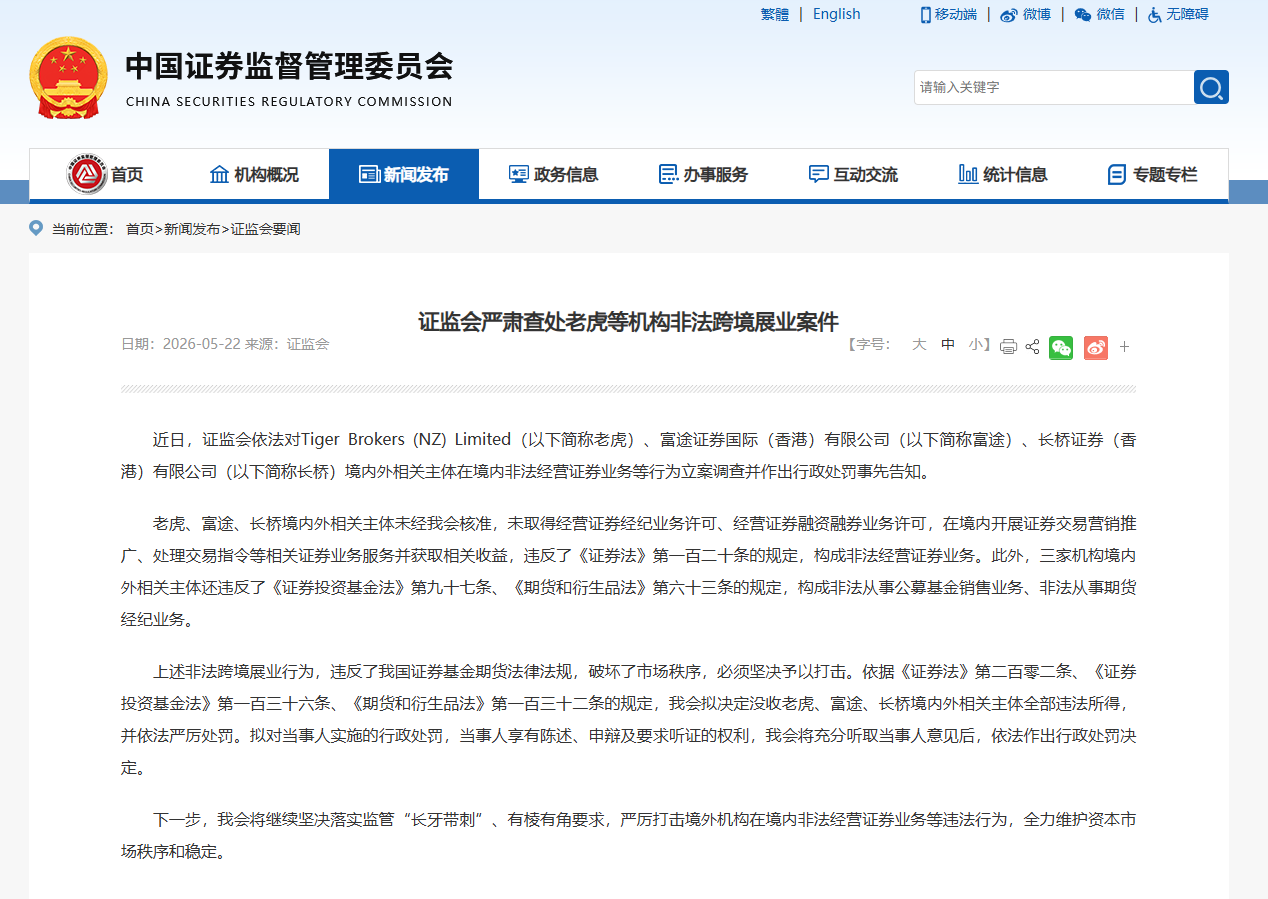
According to the regulator, the three firms did not obtain the required mainland licenses for securities brokerage, margin financing or related financial services. Despite this, they allegedly used affiliated domestic entities, mobile apps and online platforms to provide mainland Chinese investors with services such as overseas stock account opening, order processing and fund transfers involving Hong Kong and U.S. equities.
The regulator stated that the activities may have violated multiple Chinese financial laws, including the Securities Law.
On the same day, the China Securities Regulatory Commission and seven other government agencies jointly released a two-year campaign plan aimed at eliminating illegal cross-border securities, futures and fund business operations.
Under the new plan, starting from May 2026, affected offshore brokers will no longer be allowed to provide mainland investors with “buy” trading functions or fund deposit services. Existing users will only be permitted to sell holdings and withdraw funds during a transition period running until May 2028 — a policy widely described as “out only, no new inflows.”
After the transition period ends, the platforms will be required to shut down mainland-facing websites, trading apps and related servers.
Authorities emphasized that investors’ existing accounts, stocks, funds and cash assets will not be forcibly liquidated or canceled, and that investor rights and asset safety will remain protected during the rectification process.
The announcement triggered sharp market reactions. Shares of UP Fintech Holding, the parent company of Tiger Brokers, fell as much as 45% in pre-market trading in the United States, while Futu Holdings dropped more than 30%.



Hottest





Copyright © 2026 FastBull Ltd


Risk Warning
FX trading is of high risk and may not be suitable for all investors. Leverage will create additional risks and loss. Before trading, please carefully consider your investment objectives, experience level and risk tolerance. You may lose part or all of your initial investment; do not invest money that you cannot afford. Educate yourself about the risks associated with FX trading. If you have any questions, please consult an independent financial or tax advisor. Any data and information are provided "as is" and only for information purpose, not for trading or recommendations. Past performance does not predict future results.
Disclaimer
The data contained in this website may not be real-time and accurate. The data and prices on this site are not necessarily provided by the market or exchange, but may be provided by market makers, so prices may be inaccurate and differ from actual market prices. Namely, this price is indicative price only to reflect market trend, and is unfavorable for trading purpose. The provider of the data contained in the Website shall not be liable for any loss incurred by you as a result of your trading activities or reliance on the information contained in the Website.