


eToro, Interactive Brokers and BGC Push AI Deeper Into Trading Workflows
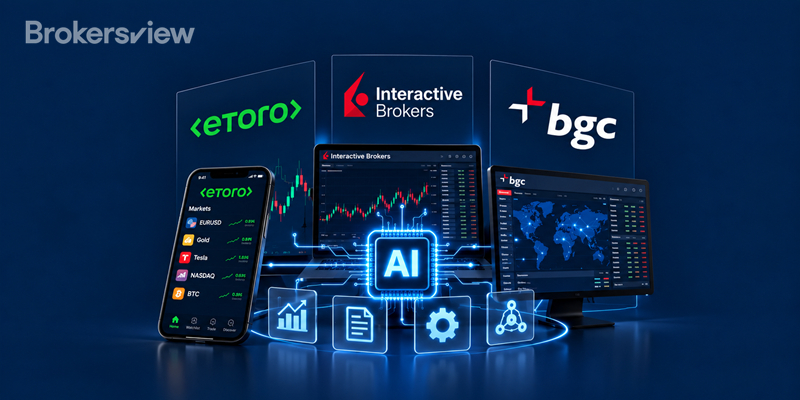
Artificial intelligence is moving deeper into brokerage platforms, with eToro, Interactive Brokers, Capital.com and BGC Group deploying AI across research, portfolio analysis and trading workflows.
The trend is moving beyond basic chatbots, but the level of automation and human oversight varies significantly between platforms.
eToro Puts Tori at the Centre of Its New App
eToro said on September 22 that it will begin gradually migrating users to its redesigned mobile app from October 4.
The new app puts Tori, eToro's AI assistant, at the centre of the experience. Tori can proactively surface information related to assets users hold or follow.
Existing accounts, login details and portfolios will remain unchanged during the automatic migration. eToro has not disclosed a country-by-country rollout schedule.
Brokers Explore Different AI Models
Other brokers are taking AI further into the trading workflow.
Interactive Brokers introduced direct integration with Claude in June, allowing clients to research securities, analyse portfolios and generate trade instructions. It later expanded its AI integrations to ChatGPT and Grok and added support for options, futures and futures options.
Importantly, Interactive Brokers says clients must approve trades before they are submitted.
Capital.com has taken a similar approach through its MCP Server. The integration connects compatible AI environments, including Codex, Claude Desktop and Cursor, with market data, open positions, portfolio exposure and other account information.
The system can also initiate orders, but Capital.com requires a preview and confirmation before execution.
At the institutional level, BGC Group announced Fenics AI on September 10 after its subsidiary Aurel BGC completed what the company described as its first fully AI-brokered institutional trade in listed equity derivatives.
BGC said Fenics AI handled the September 3 transaction in Eurex-listed Swiss SMI options from price discovery through execution. This remains a company-reported milestone rather than an independent assessment of AI trading performance.
AI Moves From Research Toward Execution
The cases illustrate different stages of AI adoption.
eToro primarily uses AI to deliver portfolio-related information. Interactive Brokers and Capital.com allow AI systems to interact more closely with account data and trading workflows while retaining client confirmation. BGC has demonstrated autonomous AI within an institutional brokerage workflow.
Industry research suggests adoption is already producing operational benefits.
An Acuiti survey reported on September 22 found that 44% of firms using AI in investment research or portfolio management reported significant and quantifiable time or cost savings, while another 42% reported benefits they had not yet quantified.
However, governance remains uneven. The survey covered members of Acuiti's Derivatives Expert Network rather than the entire global brokerage industry, so the figures should not be interpreted as global broker AI adoption rates.
The broader direction is nevertheless clear: AI is expanding from research and information retrieval toward portfolio interaction, workflow automation and execution infrastructure.
For brokers, this also increases the importance of controls around account access, data security, trade authorisation and human oversight.
Investor Reminder
AI-generated research, portfolio insights or trade instructions should not be treated as guarantees of accuracy or investment performance. Investors should understand what an AI tool can access and execute, verify important information independently, and confirm that they are using the broker's official platform before providing account credentials or authorising transactions.
For more information on broker licences, regulatory status and trading platform risks, visit our Brokers section.






Copyright © 2026 FastBull Ltd


Risk Warning
FX trading is of high risk and may not be suitable for all investors. Leverage will create additional risks and loss. Before trading, please carefully consider your investment objectives, experience level and risk tolerance. You may lose part or all of your initial investment; do not invest money that you cannot afford. Educate yourself about the risks associated with FX trading. If you have any questions, please consult an independent financial or tax advisor. Any data and information are provided "as is" and only for information purpose, not for trading or recommendations. Past performance does not predict future results.
Disclaimer
The data contained in this website may not be real-time and accurate. The data and prices on this site are not necessarily provided by the market or exchange, but may be provided by market makers, so prices may be inaccurate and differ from actual market prices. Namely, this price is indicative price only to reflect market trend, and is unfavorable for trading purpose. The provider of the data contained in the Website shall not be liable for any loss incurred by you as a result of your trading activities or reliance on the information contained in the Website.