行情
新聞
分析
使用者
快訊
財經日曆
學習
數據
- 名稱
- 最新值
- 前值


VIP跟單
所有跟單
所有比賽


日本短觀小型製造業前景指數 (第四季度)公:--
預: --
前: --
日本短觀大型非製造業前景指數 (第四季度)公:--
預: --
前: --
日本短觀大型製造業前景指數 (第四季度)公:--
預: --
前: --
日本短觀小型製造業景氣判斷指數 (第四季度)公:--
預: --
前: --
日本短觀大型製造業景氣判斷指數 (第四季度)公:--
預: --
前: --
日本短觀大型企業資本支出年增率 (第四季度)公:--
預: --
前: --
英國Rightmove住宅銷售價格指數年增率 (12月)公:--
預: --
前: --
中國大陸工業產出年增率 (年初至今) (11月)公:--
預: --
前: --
中國大陸城鎮失業率 (11月)公:--
預: --
前: --
沙地阿拉伯CPI年增率 (11月)公:--
預: --
前: --
歐元區工業產出年增率 (10月)公:--
預: --
前: --
歐元區工業產出月增率 (10月)公:--
預: --
前: --
加拿大成屋銷售月增率 (11月)公:--
預: --
前: --
加拿大全國經濟信心指數公:--
預: --
前: --
加拿大新屋開工率 (11月)公:--
預: --
美國紐約聯邦儲備銀行製造業就業指數 (12月)公:--
預: --
前: --
美國紐約聯邦儲備銀行製造業指數 (12月)公:--
預: --
前: --
加拿大核心消費者物價指數 (CPI) 年增率 (11月)公:--
預: --
前: --
加拿大製造業未完成訂單月增率 (10月)公:--
預: --
前: --
美國紐約聯邦儲備銀行製造業物價獲得指數 (12月)公:--
預: --
前: --
美國紐約聯邦儲備銀行製造業新訂單指數 (12月)公:--
預: --
前: --
加拿大製造業新訂單月增率 (10月)公:--
預: --
前: --
加拿大核心消費者物價指數 (CPI) 月增率 (11月)公:--
預: --
前: --
加拿大截尾均值CPI年增率 (季調後) (11月)公:--
預: --
前: --
加拿大製造業庫存月增率 (10月)公:--
預: --
前: --
加拿大CPI年增率 (11月)公:--
預: --
前: --
加拿大CPI月增率 (11月)公:--
預: --
前: --
加拿大CPI年增率 (季調後) (11月)公:--
預: --
前: --
加拿大核心消費者物價指數 (CPI) 月增率 (季調後) (11月)公:--
預: --
前: --
加拿大CPI月增率 (季調後) (11月)公:--
預: --
前: --
聯準會理事米蘭發表演說
美國NAHB房產市場指數 (12月)--
預: --
前: --
澳洲綜合PMI初值 (12月)--
預: --
前: --
澳洲服務業PMI初值 (12月)--
預: --
前: --
澳洲製造業PMI初值 (12月)--
預: --
前: --
日本製造業PMI初值 (季調後) (12月)--
預: --
前: --
英國三個月ILO就業人數變動 (10月)--
預: --
前: --
英國失業金申請人數 (11月)--
預: --
前: --
英國失業率 (11月)--
預: --
前: --
英國三個月ILO失業率 (10月)--
預: --
前: --
英國三個月含紅利的平均每週工資年增率 (10月)--
預: --
前: --
英國三個月剔除紅利的平均每週工資年增率 (10月)--
預: --
前: --
法國服務業PMI初值 (12月)--
預: --
前: --
法國綜合PMI初值 (季調後) (12月)--
預: --
前: --
法國製造業PMI初值 (12月)--
預: --
前: --
德國服務業PMI初值 (季調後) (12月)--
預: --
前: --
德國製造業PMI初值 (季調後) (12月)--
預: --
前: --
德國綜合PMI初值 (季調後) (12月)--
預: --
前: --
歐元區綜合PMI初值 (季調後) (12月)--
預: --
前: --
歐元區服務業PMI初值 (季調後) (12月)--
預: --
前: --
歐元區製造業PMI初值 (季調後) (12月)--
預: --
前: --
英國服務業PMI初值 (12月)--
預: --
前: --
英國製造業PMI初值 (12月)--
預: --
前: --
英國綜合PMI初值 (12月)--
預: --
前: --
歐元區ZEW經濟景氣指數 (12月)--
預: --
前: --
德國ZEW經濟現況指數 (12月)--
預: --
前: --
德國ZEW經濟景氣指數 (12月)--
預: --
前: --
歐元區貿易帳 (未季調) (10月)--
預: --
前: --
歐元區ZEW經濟現況指數 (12月)--
預: --
前: --
歐元區貿易帳 (季調後) (10月)--
預: --
前: --
美國零售銷售月增率 (不含汽車 ) (季調後) (10月)--
預: --
前: --


無匹配數據
Ethereum’s scaling game took another hit.
Starknet, one of the leading Layer-2 networks built to speed up and cheapen Ethereum transactions, went offline for nearly three hours on Tuesday – its second major outage in just two months.
The disruption followed the much-anticipated Grinta upgrade, raising questions about whether high-performance blockchain networks can deliver on reliability as they race to decentralize.
Network Goes Down After Major Upgrade
Starknet, Ethereum’s seventh-largest Layer-2 blockchain with $548 million locked in its ecosystem, suffered a two-hour, 44-minute outage early Tuesday.
The disruption followed the rollout of Grinta (v0.14.0), a major network upgrade meant to overhaul Starknet’s architecture. The network’s sequencer, which manages the order of transactions, failed to process activity, halting block production and leaving users unable to complete transactions.
A blockchain reorganization was triggered from block 1,960,612, meaning an hour’s worth of activity had to be rolled back. Users were asked to resubmit all transactions made during that window.
Second Outage in Two Months
This is the second time in two months that Starknet has faced downtime. Back in July, the network stalled for about 13 minutes due to slow block creation.
The repeat incidents raise questions about whether Ethereum’s Layer-2 networks, often promoted as a solution for scaling, can deliver both speed and stability.
Team Response
The Starknet team recently confirmed that the network was “fully operational” again.
“Block production is back to normal. Most RPC providers are up-and-running, and the remaining ones will upgrade shortly,” the team said in a post on X, adding that a full timeline and technical explanation will be shared soon.
Starknet@StarknetSep 02, 2025Starknet is back online and fully operational.
Block production is back to normal. Most RPC providers are up-and-running, and the remaining ones will upgrade shortly.
To restore service, transactions submitted between 2:23am and 4:36am UTC were not processed.
A reorg from block… https://t.co/nrziivCiuK
High Ambitions, Growing Pains
The Grinta upgrade was designed to make Starknet more decentralized, with changes to its sequencer, fee system, and mempool. Starknet has also announced plans to integrate Bitcoin staking following overwhelming community approval of proposal SNIP-31.
But as today’s incident shows, major network upgrades come with risk.
FAQs
What caused Starknet’s recent outage?The outage, which lasted for nearly three hours, was triggered by a sequencer failure following the Grinta (v0.14.0) upgrade. The sequencer, which orders transactions, became unable to process activity.
What is a blockchain sequencer?A sequencer is a component in a Layer-2 blockchain that gathers and orders transactions into batches before submitting them to the main Layer-1 blockchain (like Ethereum).
What is a blockchain reorganization, and why was it necessary?A blockchain reorganization is when a chain’s history is rewritten to remove a temporary, incorrect branch. The network re-established the correct transaction history by rolling back about an hour’s worth of activity.
Is this Starknet’s first major outage?No. This is the second major outage in two months. In July, the network also stalled for about 13 minutes due to slow block creation, raising concerns about its stability.
Crypto company The Ether Machine secured $654 million in a private financing round, collecting 150,000 Ether from prominent Ethereum advocate Jeffrey Berns.
The funds will be transferred to the company’s wallet later this week, according to a Tuesday report by Reuters. Berns, known for his early investments in Ethereum infrastructure and Web3 initiatives, will join the board of directors.
The raise is part of the company’s broader strategy to build a substantial Ether (ETH) treasury ahead of its anticipated Nasdaq debut later this year.
The Ether Machine was formed through a merger between the Ether Reserve and blank-check firm Dynamix Corporation. While the initial goal was to raise over $1.5 billion from investors, including Blockchain.com, Kraken and Pantera Capital, the firm has since adjusted its strategy.
Ether Machine to go public with 495,000 ETH
The Ether Machine is now expected to go public while holding over 495,000 ETH, valued at about $2.16 billion, and an additional $367 million earmarked for future ETH acquisitions, per Reuters.
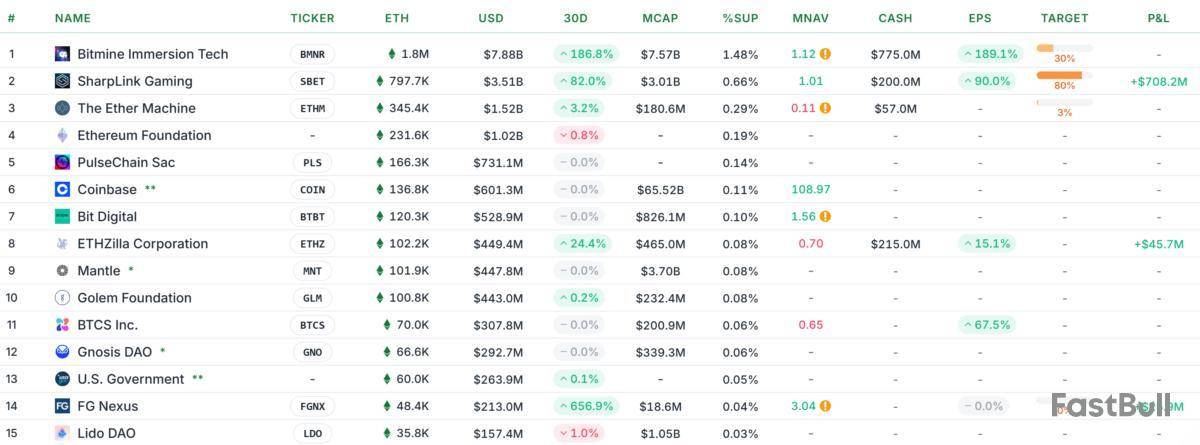
According to StrategicETHReserve data, The Ether Machine is currently the third-largest corporate holder of ETH with over 345,400 coins, outdistancing the Ethereum Foundation’s reported 231,600 ETH.
Treasury companies like Ether Machine often utilize convertible debt and preferred equity to raise capital while preserving their net asset value per share. According to co-founder and chairman Andrew Keys, the company’s onchain yield generation strategy is expected to outperform traditional exchange-traded funds (ETFs).
“Between debt issuance and yield mechanics, we believe we can maintain a market premium over our net asset value indefinitely,” Keys told Reuters.
Ether Machine is also launching a third capital raise led by Citibank. Keys said the new round is targeting at least $500 million and will commence on Wednesday.
$11 billion Bitcoin whale rotates into Ether
A mysterious Bitcoin whale worth more than $11 billion has steadily rotated funds into Ether. The investor recently sold $215 million worth of Bitcoin to acquire $216 million in spot Ether via Hyperliquid, bringing their total ETH holdings to 886,371 ETH, now valued at over $4 billion.
The whale first began rotating funds on Aug. 21, exchanging $2.59 billion in BTC for a $2.2 billion ETH spot position and $577 million in ETH perpetual longs. After closing part of the leveraged position with $33 million in profit, the investor resumed buying spot Ether.
Fast-growing fantasy and sports gaming firm Underdog has partnered with Crypto.com Derivatives North America, a CFTC-registered exchange and clearinghouse and an affiliate of Crypto.com, to offer sports prediction markets in 16 states.
The solution will prioritize states where legal sports betting has not been adopted, such as California and Texas, the companies told CNBC on Tuesday, with Underdog becoming the first sports gaming operator to offer prediction markets. It is designed to provide millions of people a federally compliant way to predict the outcome of their favorite sports events via the Underdog app, according to a subsequent statement from Crypto.com.
"Prediction markets are one of the most exciting developments we've seen in a long time," Underdog founder and CEO Jeremy Levine said. "While still new and evolving, one thing is clear — the future of prediction markets is going to be about sports — and no one does sports better than Underdog."
Following the launch, fans will be able to trade on sports outcomes across major leagues like the NFL, NBA, MLB, and college football, the companies explained. Prices update in real time, letting them react instantly and share their views on every play via the gaming licensed operator.
"We are thrilled to partner with Underdog to enhance the sports experience for customers nationwide with the ability to now trade using Underdog’s technology — all in one app," Travis McGhee, Managing Director, Global Head of Capital Markets at Crypto.com, said. "We were the first to offer sports events contracts, and our technology partnership with Underdog will provide more access to CDNA's innovative offerings."
Crypto.com and Underdog's predictions market joins the likes of Polymarket, Kalshi, and Robinhood in offering sports events contracts, enabling traders to buy and sell sports outcomes, with odds set by the market, not a bookmaker.
The CFTC and federal courts are still debating whether sports prediction markets count as gambling, infringe on state authority, or violate the Indian Gaming Regulatory Act. In May, the CFTC moved to dismiss an appeal against Kalshi after a federal judge ruled the agency had overstepped its authority in attempting to stop the crypto predictions platform from allowing users to trade contracts.
Disclaimer: The Block is an independent media outlet that delivers news, research, and data. As of November 2023, Foresight Ventures is a majority investor of The Block. Foresight Ventures invests in other companies in the crypto space. Crypto exchange Bitget is an anchor LP for Foresight Ventures. The Block continues to operate independently to deliver objective, impactful, and timely information about the crypto industry. Here are our current financial disclosures.
© 2025 The Block. All Rights Reserved. This article is provided for informational purposes only. It is not offered or intended to be used as legal, tax, investment, financial, or other advice.
DeFi platforms are under increasing pressure as hackers find new ways to exploit vulnerabilities. Recent incidents have sent shockwaves through the crypto community, raising concerns about security and user safety.
Venus Protocol Account Loses $27M
A major account on the Venus Protocol, a leading lending platform on the BNB Chain, was compromised, losing about $27 million in a hack. Blockchain analysts believe the user’s interaction with the Core Pool Comptroller contract allowed attackers to steal tokens like vUSDC and vETH.
The stolen funds from Venus Protocol are still stuck in the attacker’s contract. Blockchain security firms Cyvers Alerts and Peckshield flagged the suspicious activity.
PeckShieldAlert@PeckShieldAlertSep 02, 2025#PeckShieldAlert A user of @VenusProtocol has been drained ~$27M in crypto after falling for a #phishing scam.
The victim approved a malicious transaction, granting token approval to the attacker's address (0x7fd8…202a) for asset transfer. pic.twitter.com/NwkVlDxxOZ
$27M Drained in Social Engineering Attack
The victim unknowingly approved a malicious transaction, giving the attacker’s wallet full access to their tokens, including $19.8M in vUSDT, $7.15M in vUSDC, $146K in vXRP, $22K in vETH, and even 285 BTCB.
Crypto Jargon notes that this was purely a social engineering attack, showing how one careless approval can drain a fortune instantly. He emphasized staying safe online by avoiding random links, double-checking transactions, revoking approvals regularly, and using hardware wallets.
Venus Protocol Paused For Precaution
Venus Protocol confirmed that a user’s wallet was drained, but the platform’s smart contracts remain secure. The protocol has been paused as a precaution while the team investigates the incident.
Venus Protocol@VenusProtocolSep 02, 2025To clarify, Venus Protocol has NOT been exploited. A user has been attacked. Smart contract is safe. https://t.co/ijgelbgVQE
The team also clarified that Venus itself has not been exploited and assured the community that they are actively monitoring the situation.
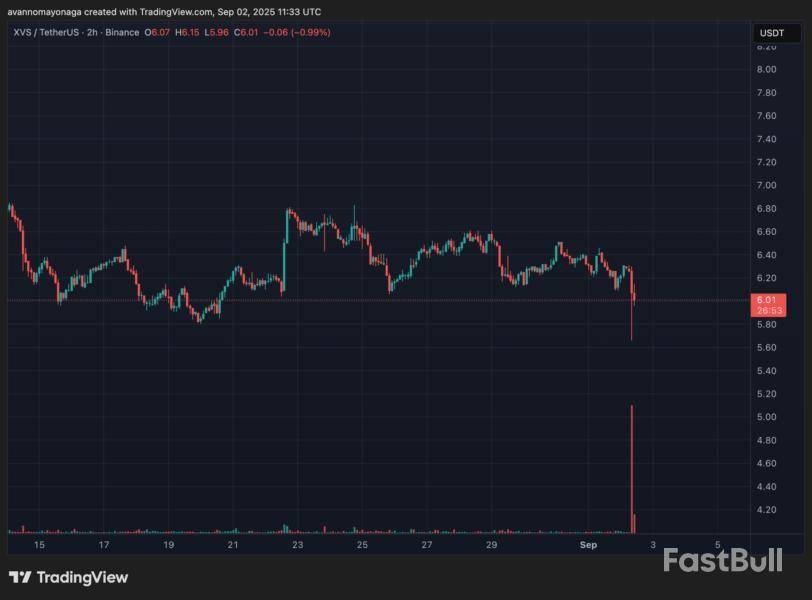
Venus’s token XVS has dropped to $5.97, down 6% in the last 24 hours.
Bunni Exchange Hit by $2.4M Exploit
Meanwhile, decentralized exchange Bunni also suffered a $2.4 million exploit today. Attackers manipulated its Ethereum-based smart contracts, draining funds to a wallet holding $1.33M in USDC and $1.04M in USDT.
CertiK Alert@CertiKAlertSep 02, 2025We have identified a $2.3M exploit on the @bunni_xyz BunniHub contract.https://t.co/lZB0vzSMQx
The exploiter has exfiltrated funds to 0xe04efd87f410e260cf940a3bcb8bc61f33464f2b.
Stay Vigilant!
All smart contract functions have been paused as a precaution while the team investigates. These two incidents highlight the biggest risks in DeFi: users falling for scams and vulnerabilities in smart contracts.
Crypto hacks have surged in August, with $163 million stolen across 16 attacks. Cybersecurity experts warn that hackers are shifting focus to exchanges and wealthy individuals, signaling rising threats in the booming market.
FAQs
What happened in the Venus Protocol hack?A user’s wallet was drained of $27M in vUSDT, vUSDC, and other tokens via a social engineering attack, not a protocol exploit. Venus paused operations as a precaution.
How did the attacker steal the funds?The victim approved a malicious transaction, granting the attacker full access to their tokens. The stolen funds remain trapped in the attacker’s contract.
A large user of Venus Protocol, a decentralized finance lender, was drained of about $27 million after apparently signing a malicious transaction that granted token approvals to an attacker, blockchain security firms said on Tuesday.
Responding to the incident, Venus has paused its platform pending an investigation. “We are aware of the suspicious transaction and are actively investigating,” the team wrote on X. “Venus is currently paused following security protocols.”
PeckShield said the victim “approved a malicious transaction,” allowing address “0x7fd…6202a” to transfer assets out of the wallet. CertiK added that the wallet had called an updateDelegate function to approve the attacker before funds were siphoned, sharing a transaction record on BNB Chain.
Also, Venus Protocol moderators told users in a Telegram message that the protocol itself “remains untouched,” though engineers are double-checking to be sure. "To clarify, Venus Protocol has NOT been exploited. A user has been attacked. Smart contract is safe," the project's X account shared amid speculation that the platform itself was exploited.
Launched in 2020, Venus Protocol is a decentralized lending market best known for its deployment on BNB Chain and additional rollouts on Ethereum, opBNB, Arbitrum, Optimism, and zkSync. It lets users supply collateral, borrow assets, and mint the VAI stablecoin, with governance via the XVS token. XVS fell as much as 9% amid the issue, before slightly recovering as of writing, Tradingview data shows.
Venus XVS token falls after a phishing scammer exploits a user. Image: TradingView
The suspected attack vector echoes a common issue in DeFi failure. Phishing scammers trick users into signing token approvals that let third parties move assets. Once granted, those allowances can be used to drain funds until permissions are revoked. According to blockchain security firm CertiK's mid-year report, phishing attacks accounted for $410 million in losses from crypto users in the first half of 2025 across 132 incidents. A separate report from Hacken, another Web3 security firm, estimates $600 million in losses specifically from phishing and social engineering schemes during the same period.
Disclaimer: The Block is an independent media outlet that delivers news, research, and data. As of November 2023, Foresight Ventures is a majority investor of The Block. Foresight Ventures invests in other companies in the crypto space. Crypto exchange Bitget is an anchor LP for Foresight Ventures. The Block continues to operate independently to deliver objective, impactful, and timely information about the crypto industry. Here are our current financial disclosures.
© 2025 The Block. All Rights Reserved. This article is provided for informational purposes only. It is not offered or intended to be used as legal, tax, investment, financial, or other advice.
Bitget has entered an exclusive partnership with the consumer-grade blockchain Morph, officially upgrading its exchange token BGB into the native gas and governance token of the Morph ecosystem. While it takes on new roles in Morph’s infrastructure, BGB will also continue its familiar exchange functions like Launchpool participation and trading fee discounts. Following the news, BGB surged 14%.
BGB Token Burn and Supply Overhaul
220 million BGB tokens have been destroyed in a single transaction, marking one of the largest burns in the exchange’s history. The remaining 220 million tokens governed by Bitget have been transferred to the Morph Foundation and will stay locked, unlocking gradually at 2% per month. These funds will be allocated toward liquidity incentives, ecosystem growth, and user education.
Adding to this supply shift, the Morph Foundation is rolling out a new burn mechanism directly linked to network activity. Over time, this will compress BGB’s total supply to just 100 million, creating scarcity while tying its value closely to usage on the Morph chain.
Morph Blockchain Partnership Expands BGB Utility
BGB’s new role goes far beyond tokenomics. Bitget and Bitget Wallet will integrate Morph as their payment backbone and PayFi settlement layer, paving the way for stablecoin issuers and payment providers to join the ecosystem. This effectively migrates 120 million Bitget users into the Morph network, turning BGB into a practical payment and consumption tool for a massive user base.
Community voices have also been quick to weigh in. On-chain watcher 0xshun.eth noted how the 440 million BGB transfer split between burn and lockup reshaped the token’s trajectory. He stressed its shift from a fee discount token into a full-fledged governance and payment asset, while also raising curiosity about the role Morph’s native $MORPH token will play.
A New Era for Bitget BGB Holders
The move hasn’t gone unnoticed by analysts and crypto users alike. Another user, Zh0u, highlighted that BGB’s integration into Morph could explain recent unexpected developments, like the early close of the Zootosis vault with Mitosis.
With one of the biggest burns in its history, a shrinking supply model, and fresh on-chain responsibilities, BGB is stepping into a new era as the backbone of Morph’s blockchain economy.
FAQs
What is the Bitget and Morph partnership?Bitget partnered with Morph blockchain, upgrading BGB to become Morph’s native gas/governance token while retaining its exchange utility like fee discounts.
How did the token burn impact BGB’s supply?220M BGB were burned (one of Bitget’s largest burns), and 220M were locked for gradual release. Total supply will eventually reduce to 100M via usage-based burns.
Bitget said it will upgrade its exchange token, BGB, to the native asset of the Ethereum Layer 2 blockchain, Morph, where it will serve as both gas and governance, while preserving all existing exchange utilities, such as fee discounts and Launchpool access.
The “exclusive strategic partnership” aims to push BGB on-chain and broaden its role beyond the exchange. Morph, meanwhile, highlighted Bitget and Bitget Wallet’s combined 120 million users as a distribution channel while promising performance upgrades, faster settlement, and a push into consumer “PayFi” use cases.
Morph touts itself as a consumer-oriented Layer 2 network designed to lower costs and speed settlement for retail-style dApps. As of today, Morph holds roughly $18 million in total value locked, according to DefiLlama.
As part of the shift, 440 million BGB, worth approximately $2.3 billion and governed by Bitget, was transferred to the Morph Foundation. Of that amount, 220 million was destroyed immediately, and the remaining 220 million is locked with a 2% monthly unlock for liquidity, ecosystem, and education initiatives, the crypto exchange said on X.
The Morph Foundation will also revise BGB’s burn mechanics to link reductions to onchain activity with a long-term target of shrinking total supply from 1.1 billion to 100 million. Trading on Bitget and in Bitget Wallet will continue to support BGB through the transition, the team added.
Karry Cheung, CEO of Bitget Wallet, also said to expect more collaborations between both projects over the next year. "Over the next 12 months, we will see an acceleration of BGB migration onto Morph Layer and deeper partnerships between Morph and Bitget Wallet."
Bitget describes BGB as a utility token launched on Ethereum in 2021 that powers trading fee discounts, Launchpool access, and staking programs. The exchange has previously executed large burns and adopted a recurring buyback-and-burn policy tied to activity, promising to cut total supply by 40% with quarterly burns.
Price reaction was positive following the Morpho partnership news. BGB rose about 15% intraday after the announcement, according to The Block’s price page.
Disclaimer: The Block is an independent media outlet that delivers news, research, and data. As of November 2023, Foresight Ventures is a majority investor of The Block. Foresight Ventures invests in other companies in the crypto space. Crypto exchange Bitget is an anchor LP for Foresight Ventures. The Block continues to operate independently to deliver objective, impactful, and timely information about the crypto industry. Here are our current financial disclosures.
© 2025 The Block. All Rights Reserved. This article is provided for informational purposes only. It is not offered or intended to be used as legal, tax, investment, financial, or other advice.
交易股票、貨幣、商品、期貨、債券、基金等金融工具或加密貨幣屬高風險行為,這些風險包括損失您的部分或全部投資金額,所以交易並非適合所有投資者。
做出任何財務決定時,應該進行自己的盡職調查,運用自己的判斷力,並諮詢合格的顧問。本網站的內容並非直接針對您,我們也未考慮您的財務狀況或需求。本網站所含資訊不一定是即時提供的,也不一定是準確的。本站提供的價格可能由造市商而非交易所提供。您做出的任何交易或其他財務決定均應完全由您負責,並且您不得依賴通過網站提供的任何資訊。我們不對網站中的任何資訊提供任何保證,並且對因使用網站中的任何資訊而可能造成的任何交易損失不承擔任何責任。
未經本站書面許可,禁止使用、儲存、複製、展現、修改、傳播或分發本網站所含數據。提供本網站所含數據的供應商及交易所保留其所有知識產權。