


- EURUSD
- XAUUSD
- XAGUSD
- WTI
- USDX


















Una opción de venta otorga al comprador el derecho, pero no la obligación, de vender un activo subyacente a un precio predeterminado dentro de un plazo específico. Los inversores utilizan las opciones de venta para beneficiarse de la caída de los precios, proteger sus posiciones en acciones o generar ingresos mediante la venta de contratos. Es fundamental comprender el funcionamiento de ambas partes antes de operar.
¿Qué es una opción de venta?
Una opción de venta es un contrato financiero que otorga al comprador el derecho a vender un activo subyacente, como una acción o un ETF, a un precio específico denominado precio de ejercicio. El contrato también tiene una fecha de vencimiento, que determina cuándo finalizan los derechos de ejercicio del comprador.
Las opciones de venta suelen asociarse con expectativas bajistas en el mercado, ya que su valor generalmente aumenta cuando el precio del activo subyacente baja, si todo lo demás permanece constante. Sin embargo, los inversores también pueden utilizarlas para protegerse contra posibles pérdidas en una cartera existente.
Cada opción de venta tiene dos lados:
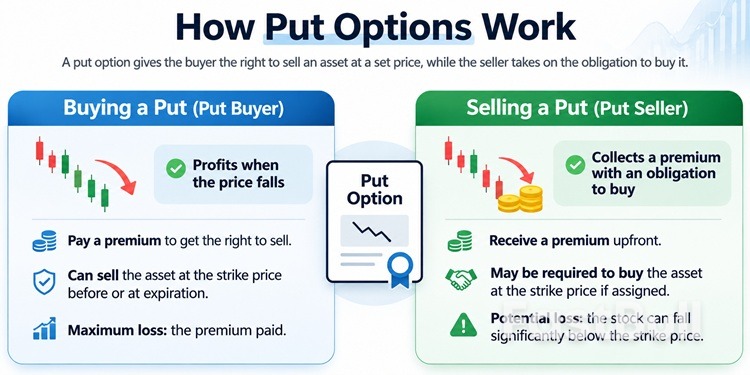
- Comprador de una opción de venta: Paga una prima y recibe el derecho a vender el activo subyacente al precio de ejercicio. El comprador puede ejercer la opción, pero no está obligado a hacerlo.
- Vendedor de opciones put: Recibe la prima y asume la obligación de comprar el activo subyacente al precio de ejercicio si se le asigna la opción.
En el caso de las opciones sobre acciones estadounidenses estándar, un contrato suele representar 100 acciones del activo subyacente. Sin embargo, operaciones corporativas como desdoblamientos de acciones y fusiones pueden dar lugar a contratos ajustados con importes diferentes. Las especificaciones de opciones sobre acciones de Options Clearing Corporation ofrecen más detalles sobre las condiciones contractuales estándar.
Cómo una opción de venta le da el derecho a vender
La característica principal de una opción de venta es el derecho a vender un activo a un precio predeterminado, incluso si su precio de mercado cae por debajo de ese nivel.
Por ejemplo, supongamos que una acción cotiza actualmente a 50 dólares y un inversor compra una opción de venta con un precio de ejercicio de 50 dólares. Si la acción cae a 40 dólares antes del vencimiento, el inversor aún puede vender las acciones a 50 dólares ejerciendo la opción. La diferencia entre el precio de ejercicio y el precio de mercado es de 10 dólares por acción.
Este derecho se vuelve valioso cuando el precio de mercado cae por debajo del precio de ejercicio. Si, por el contrario, la acción sube por encima de los 50 dólares, el comprador generalmente no tiene motivos para ejercer la opción de venta, ya que vender acciones a 50 dólares sería menos atractivo que venderlas al precio de mercado más alto.
Es importante destacar que comprar una opción de venta no implica automáticamente que el inversor sea propietario de las acciones subyacentes. Los inversores pueden comprar opciones de venta para especular con una caída del precio sin poseer las acciones, aunque ejercer el contrato implica vender las acciones subyacentes y puede generar una posición corta si el inversor no las posee.
Términos clave que necesitas comprender
Antes de operar con opciones de venta, conviene comprender cinco términos básicos:
- Precio de ejercicio: El precio predeterminado al que el comprador de la opción de venta puede vender el activo subyacente.
- Premium: The price paid by the buyer and received by the seller for the option contract. For standard stock options, quoted premiums are generally multiplied by 100 to calculate the cost of one contract.
- Expiration Date: The date when the option contract expires and its exercise rights end.
- Underlying Asset: The stock, ETF, index, or other financial instrument on which the option is based.
- Exercise and Assignment: Exercise occurs when the buyer uses the option's rights. Assignment occurs when the seller is selected to fulfill the corresponding obligation.
How Do Put Options Work?
Put options work differently depending on whether an investor buys or sells the contract. Buyers generally seek to benefit from falling prices or protect their holdings, while sellers collect premiums in exchange for accepting the obligation to purchase the underlying asset if assigned.
Buying a Put Option
Buying a put option is a common strategy for investors who expect a stock's price to decline. The buyer pays a premium upfront and gains the right to sell the stock at the strike price during the contract's exercise period.
For example, an investor buys a put option on a stock trading at $60, with a strike price of $55 and a premium of $2 per share. Assuming one standard contract, the initial cost is $200.
If the stock falls to $45 at expiration, the put has $10 per share of intrinsic value. Its total expiration value is $1,000, giving the buyer a net profit of $800 before fees and commissions.
If the stock remains above $55 at expiration, the option expires without intrinsic value, and the buyer loses the $200 premium. This is why the buyer's maximum loss on a standalone long put is generally limited to the premium paid. The investor may also sell the option before expiration to close the position rather than exercise it.
Buying puts can also serve as portfolio insurance. For example, an investor holding 100 shares of a company may buy a put with a strike price below the current stock price. If the stock declines sharply, the put can help offset some of the losses in the shares.
Selling a Put Option
Selling a put option, also called writing a put, involves receiving a premium upfront in exchange for agreeing to buy the underlying asset at the strike price if assigned.
This strategy is generally used by investors who are neutral to moderately bullish on a stock and are willing to own it at a predetermined price.
For example, suppose a stock trades at $50, and an investor sells a put with a $45 strike price for a premium of $2 per share. The seller receives $200 for one standard contract.
- If the stock stays above $45 at expiration: The option may expire worthless, allowing the seller to keep the $200 premium.
- If the stock falls below $45: The buyer may exercise the put, and the seller may be assigned to purchase 100 shares at $45 each.
In a cash-secured put strategy, the seller keeps enough cash available to cover the potential stock purchase. This approach allows investors to collect premiums while potentially buying shares at a lower effective cost. However, the stock can fall well below the strike price, resulting in substantial losses.
Unlike buyers, put sellers do not have the right to decide whether to fulfill the contract after assignment. They must meet their contractual obligations. American-style options can be exercised before expiration, so assignment may happen earlier than expected. The Options Industry Council's explanation of options assignment provides further details.
What Happens When a Put Option Expires?
When a put option reaches expiration, its value depends on the underlying asset's market price relative to the strike price. Options are generally classified into three categories:
| Option Status | Stock Price vs. Strike Price | Meaning for the Put Buyer |
|---|---|---|
| In the Money (ITM) | Stock price below strike price | Has intrinsic value and may be exercised. |
| At the Money (ATM) | Stock price approximately equal to strike price | Has little or no intrinsic value. |
| Out of the Money (OTM) | Stock price above strike price | Has no intrinsic value and generally expires worthless. |
For example, if a put has a $50 strike price, it is in the money when the stock trades at $45, at the money when the stock is around $50, and out of the money when the stock trades at $55.
However, being in the money does not necessarily mean the buyer has made a profit. The option's intrinsic value must exceed the premium paid for the trade to be profitable at expiration, excluding transaction costs.
At expiration, an in-the-money put may be exercised according to the contract and brokerage procedures. The seller may then be assigned and required to purchase the underlying shares. An out-of-the-money put generally expires without value, leaving the buyer with the premium paid as a loss and allowing the seller to retain the premium.
Put Option Examples: Buying vs. Selling
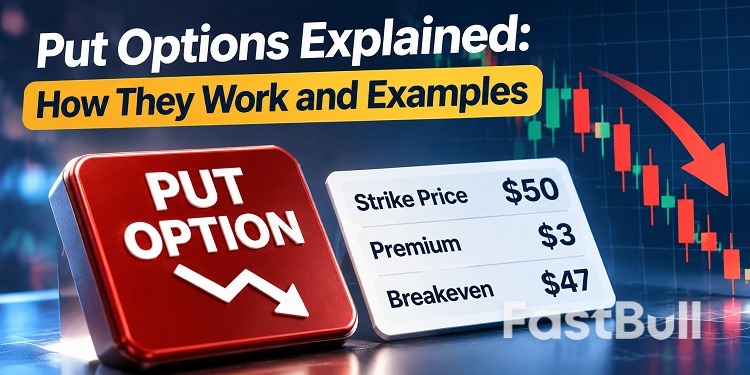
To understand how put options work in practice, consider a stock trading at $50. An investor buys or sells a put option with a $50 strike price and a premium of $3 per share. Since one standard stock option contract typically represents 100 shares, the total premium is $300.
The same contract creates different outcomes for the buyer and seller depending on the stock price at expiration.
| Stock Price at Expiration | Put Buyer's Profit/Loss | Put Seller's Profit/Loss |
|---|---|---|
| $40 | +$700 | -$700 |
| $47 | $0 | $0 |
| $50 | -$300 | +$300 |
| $55 | -$300 | +$300 |
These results assume the positions are held until expiration, one standard 100-share contract is used, and transaction costs are excluded.
When the stock falls to $40: The put buyer can sell the shares for $50 even though their market value is only $40. The option has $10 per share of intrinsic value, or $1,000 for the contract. After subtracting the $300 premium, the buyer earns $700. The seller experiences the opposite result, losing $700.
When the stock falls to $47: The put has $3 per share of intrinsic value, exactly matching the $3 premium. The buyer breaks even, and the seller also breaks even before transaction costs.
When the stock stays at $50 or rises to $55: The put expires without intrinsic value. The buyer loses the $300 premium, while the seller keeps the entire amount.
This comparison shows why buying a put is generally attractive when an investor expects a significant price decline, while selling a put can be suitable for someone willing to purchase the stock at a lower effective price.
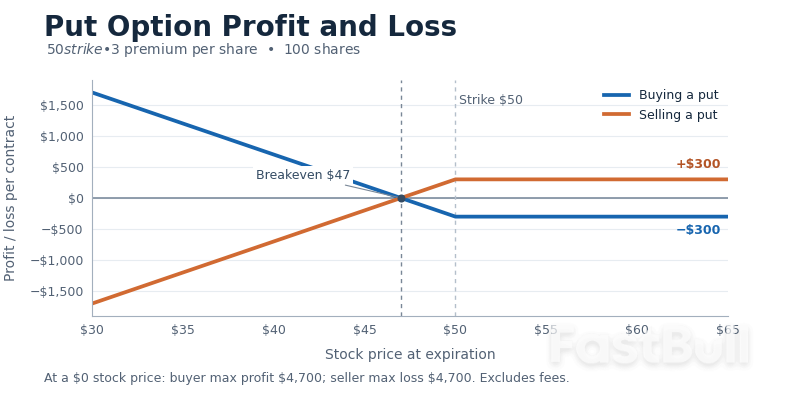
Put Option Profit, Loss, and Breakeven
Calculating the potential profit or loss of a put option requires comparing its strike price, premium, and the underlying stock price at expiration. The calculation differs depending on whether the investor buys or sells the contract.
Put Option Breakeven and Profit Formulas
For a standard stock put option, the buyer's profit or loss at expiration can be calculated as:
Put Buyer Profit/Loss = [Max(Strike Price - Stock Price at Expiration, 0) - Premium] × 100
The seller's result is the opposite:
Put Seller Profit/Loss = [Premium - Max(Strike Price - Stock Price at Expiration, 0)] × 100
These formulas assume one standard contract representing 100 shares. For adjusted contracts, the actual contract deliverable must be used instead.
The key figures for each position are:
- Breakeven Price: Strike Price - Premium. For the $50 strike put with a $3 premium, the breakeven price is $47.
- Buyer's Maximum Loss: Premium × 100. In this example, the buyer can lose up to $300 if the option expires worthless.
- Buyer's Maximum Profit: (Strike Price - Premium) × 100, assuming the stock price falls to zero. Here, the maximum profit is $4,700.
- Seller's Maximum Profit: Premium × 100. The seller can earn up to $300 if the option expires worthless.
- Seller's Maximum Loss: (Strike Price - Premium) × 100, assuming the stock price falls to zero. Here, the maximum loss is $4,700.
The buyer's potential profit is limited because a stock price cannot fall below zero. The seller's potential loss is also technically limited for a standard equity put, but it can still be substantial if the underlying stock declines sharply.
These breakeven and maximum profit or loss figures describe the position at expiration. Before expiration, an option's market value can also change with time remaining, implied volatility, and other pricing factors.
Put vs. Call Options: Key Differences
Put and call options are two basic types of options contracts. Both give buyers the right, but not the obligation, to trade an underlying asset at a predetermined strike price. The main difference is the direction of the transaction: a put gives the buyer the right to sell, while a call gives the buyer the right to buy.
| Feature | Put Option | Call Option |
|---|---|---|
| Buyer's Right | Right to sell | Right to buy |
| Seller's Obligation | Buy the asset if assigned | Sell the asset if assigned |
| Typical Buyer Outlook | Bearish | Bullish |
| Buyer Benefits When | Asset price falls | Asset price rises |
| Buyer's Maximum Loss | Premium paid | Premium paid |
| Seller's Main Risk | Having to buy the asset at the strike price | Having to sell the asset at the strike price |
For example, if an investor expects a stock to fall from $50 to $40, buying a put may provide an opportunity to profit from the decline. If the investor instead expects the stock to rise from $50 to $60, buying a call may be more appropriate.
Investors can also sell puts or calls to collect premiums, but doing so creates different obligations and risks. The choice depends on the investor's market outlook, willingness to hold the underlying asset, and ability to manage potential losses.
Risks of Buying and Selling Put Options
Put options can help investors manage market exposure or pursue specific trading opportunities, but they also involve risks. The potential outcomes depend on the underlying asset's price movement, time remaining until expiration, implied volatility, and the investor's position.
Risks of Buying Put Options
Although the maximum loss for a standalone long put position is generally limited to the premium paid, several factors can cause the option to lose value:
- The stock does not fall as expected: If the stock stays above the strike price until expiration, the put may expire worthless, and the buyer loses the entire premium.
- Time decay: Options lose time value as expiration approaches, all else being equal. Even if the stock price remains relatively stable, the put can become less valuable over time.
- Implied volatility declines: A drop in expected market volatility can reduce an option's premium, potentially causing a loss even when the stock moves in the expected direction.
- Insufficient price movement: A stock may fall but not enough to offset the premium paid. In this case, the buyer can still lose money.
Buyers should consider the strike price, expiration date, premium, and potential price movement before entering a trade. A correct bearish outlook alone does not guarantee a profitable put position.
Risks of Selling Put Options
La venta de una opción de venta genera ingresos por prima por adelantado, pero el vendedor asume la obligación de comprar el activo subyacente si se le asigna. Los principales riesgos incluyen:
- Riesgo significativo a la baja: si el precio de las acciones cae bruscamente, el vendedor podría verse obligado a comprar acciones a un precio de ejercicio muy superior a su valor de mercado actual.
- Asignación anticipada: Las opciones de estilo americano pueden ejercerse antes de su vencimiento. Por lo tanto, un vendedor de opciones de venta puede ver su opción asignada antes de lo previsto.
- Requisitos de capital: Los vendedores de opciones de venta con garantía en efectivo necesitan suficiente liquidez para adquirir las acciones en caso de ser asignadas. Otras estrategias de venta de opciones de venta pueden implicar requisitos de margen y riesgos adicionales.
- Potencial de crecimiento limitado: El beneficio máximo generalmente se limita a la prima recibida, incluso si el precio de las acciones sube sustancialmente.
- Brechas de mercado: Los anuncios inesperados de ganancias, las noticias económicas u otros eventos pueden provocar una caída brusca de las acciones, aumentando la pérdida potencial del vendedor.
Antes de vender opciones de venta, los inversores deben considerar si se sienten cómodos manteniendo las acciones subyacentes al precio efectivo de compra, calculado como el precio de ejercicio menos la prima recibida. También deben asegurarse de poder cumplir con la posible obligación financiera.
Las opciones de venta (puts) pueden tener diferentes propósitos según su uso. Comprar puts puede brindar protección contra pérdidas o salvaguardar la cartera, mientras que vender puts puede generar ingresos adicionales para los inversores dispuestos a comprar el activo subyacente. Comprender la rentabilidad, el punto de equilibrio y los riesgos de cada posición es fundamental antes de operar.