- XAUUSD
- XAGUSD
- WTI
- USDX


Cotizaciones
Análisis
Usuario
24/7
Calendario económico
Educación
Datos
- Nombres
- Último
- Anterior









Lee esta reseña de Lucid Trading para conocer sus reglas, tipos de cuenta, pagos, comisiones, puntuación en Trustpilot y si esta empresa de negociación de futuros es legítima en 2026.
Lucid Trading es una firma de trading de futuros de rápido crecimiento, diseñada para traders que buscan acceso a operaciones financiadas sin necesidad de abrir una cuenta de corretaje tradicional. Este análisis de Lucid Trading explica qué ofrece la firma, cómo funcionan sus reglas, dónde pueden surgir complicaciones con los pagos y las comisiones, y si es una opción viable para los traders de futuros en 2026.
En esta reseña de Lucid Trading, cubriremos lo siguiente:
Lucid Trading es una firma de trading de futuros fundada en 2025. Ofrece programas de evaluación y cuentas financiadas para operadores de futuros, a diferencia de las cuentas de corretaje tradicionales donde los usuarios depositan y operan con su propio capital. Los operadores pagan por el acceso a la cuenta, siguen las reglas de riesgo de Lucid Trading y pueden optar a comisiones si cumplen con los requisitos de rendimiento de la firma.
Los documentos legales públicos identifican a la entidad operativa como Lucid Trading Group LLC, aunque la empresa no divulga de forma destacada información sobre el fundador en su sitio web público. Esto facilita la verificación de la entidad legal en comparación con la trayectoria del fundador o la gerencia, aspectos que los operadores deben tener en cuenta al evaluar la empresa.
El interés de búsqueda en Lucid Trading creció rápidamente en 2025 y 2026, principalmente debido a la presencia de la marca en sitios web de afiliados, reseñas en YouTube, páginas de comparación de empresas de trading, búsquedas de códigos de descuento y comunidades de trading. Gran parte de esta atención provino de traders que buscaban comprobantes de pago, códigos de descuento, explicaciones de reglas y comparaciones con empresas de trading de futuros consolidadas como Topstep, Apex y Tradeify.
Lucid Trading parece ser una empresa de trading de futuros real, pero no es un bróker regulado tradicional. Una buena puntuación en Trustpilot es una referencia útil, pero no debe interpretarse como prueba de que todos los traders recibirán pagos ni de que la empresa cuente con la protección regulatoria propia de un bróker.
Los documentos legales de Lucid Trading identifican a Lucid Trading Group LLC como la empresa detrás del servicio. Su modelo de negocio se basa en programas de negociación de futuros por cuenta propia, cuentas simuladas, reglas de cuenta y criterios de elegibilidad para el pago, en lugar de los servicios de corretaje estándar.
Este es el punto regulatorio clave: los operadores no deben evaluar Lucid Trading como si fuera un bróker de forex o de futuros que gestiona depósitos de clientes. En la mayoría de los modelos de empresas de trading por cuenta propia, los operadores pagan por el acceso a un programa de evaluación o de financiación, y los pagos dependen de los términos del contrato, el cumplimiento de las normas y el estado de la cuenta. Esto no elimina el riesgo; simplemente cambia su ubicación.
Antes de adquirir una cuenta, los operadores deben consultar los Términos de uso, el acuerdo de cuenta, la política de pagos, los países restringidos y las páginas de reglas en las Directrices de reglas de Lucid Trading .
As of June 23, 2026, the reviewed Trustpilot snapshot showed Lucid Trading with 4,309 reviews, a 4.6 out of 5 rating, and a category listing under Alternative Financial Service. That is a strong public-review profile for a newer prop firm, but it still needs context.
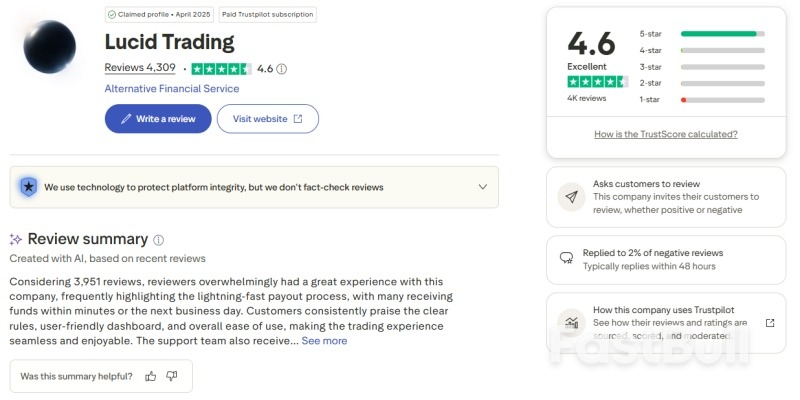
Positive reviews commonly focus on fast payouts, clear rules, a smooth lucid trading dashboard, ease of use, and responsive support. These are important because prop firm users care less about traditional spreads and more about whether the account is understandable, the platform works, and payout requests are handled quickly.
Lower-rated reviews should not be ignored. In prop firm reviews, complaints often involve verification checks, support delays, payout disputes, rule misunderstandings, or disagreement over whether a trading rule was breached. That does not automatically mean the firm is unsafe, but it does mean traders should read the negative reviews as carefully as the five-star comments on Lucid Trading Trustpilot reviews.
The smartest way to judge Lucid Trading is to verify the current rules before paying, because prop firm terms can change faster than old reviews or social media videos. A trader should not rely only on a discount page, influencer review, or one payout screenshot.
| What to Check | Why It Matters |
|---|---|
| Account rules | Drawdown, daily loss limits, and trading restrictions can determine whether the account survives. |
| Country restrictions | Some locations may be blocked or limited, even if a trader can access the website. |
| Payout conditions | Minimum profit, trading days, verification, and payout cycles affect how quickly money can be withdrawn. |
| Consistency rule | A large winning day may delay or reduce payout eligibility if it exceeds the account's allowed percentage. |
| Platform and data fees | Trading platform access, data feed costs, or activation charges can change the real cost of starting. |
| Refund and reset policy | Reset fees, chargeback rules, and refund limits can matter if the account is breached or unused. |
| Identity verification | KYC or payout verification issues can slow down withdrawals if documents do not match account details. |
For the latest account terms, traders should review the Lucid Trading Help Center before purchasing any lucid funded trading account.
Lucid Trading offers several account paths, and the best choice depends on whether you want a lower-cost evaluation, a straight-to-funded model, or an invite-only live capital program. The main options are LucidFlex, LucidPro, LucidDirect, and LucidMaxx.
| Account Type | Best For | Core Structure | Key Rule Difference |
|---|---|---|---|
| LucidFlex | Traders who want a flexible evaluation path | Evaluation first, then funded-style simulated account | LucidFlex funded accounts currently advertise no daily loss limit, no funded-stage consistency rule, and EOD trailing drawdown. |
| LucidPro | Traders who want a more traditional prop firm evaluation model | Evaluation account with upgrade to funded account after meeting objectives | LucidPro funded payouts use a 40% consistency percentage and may include buffer balance requirements. |
| LucidDirect | Traders who want to skip the evaluation phase | Straight-to-funded simulated account | LucidDirect has payout goals, a 20% consistency percentage, and daily loss limit rules on larger accounts. |
| LucidMaxx | Experienced traders invited into a higher-tier live path | Invite-only live futures prop account | LucidMaxx is positioned around instant live capital, daily uncapped payouts, and no daily loss limit. |
LucidFlex is the more flexible evaluation-style route for traders who want to prove consistency before moving into a funded-style account. According to Lucid Trading's Help Center, LucidFlex evaluation accounts use profit targets, max loss limits, and a 50% consistency requirement during the evaluation stage.
The important difference comes after funding. LucidFlex funded accounts are described as simulated futures trading accounts with a 90/10 profit split, EOD trailing drawdown, no daily loss limit, no funded-stage consistency percentage, and no payout buffer. That makes LucidFlex more attractive for traders who dislike strict daily loss limits but can still manage end-of-day drawdown risk.
LucidPro is better suited to traders who are comfortable with a more structured prop firm model. It uses an evaluation-to-funded path and has payout requirements that include minimum profit, consistency rules, and buffer balance thresholds.
The key rule to understand is the LucidPro consistency percentage. LucidPro funded accounts require the largest single-day profit to be no more than 40% of total profit during the payout cycle. This can be fair for steady traders, but it can delay payout eligibility for traders who make most of their profit in one unusually large day.
LucidDirect is the straight-to-funded option. Instead of passing an evaluation first, traders purchase a LucidDirect account and begin building simulated capital toward payout eligibility immediately.
This account type can appeal to confident traders who do not want a separate challenge phase. The trade-off is that LucidDirect has stricter payout math than it may first appear: the Help Center lists a 20% consistency percentage, payout profit goals, minimum payout requirements, and daily loss limit rules for larger account sizes.
LucidMaxx is not a standard account that every new user can simply choose at checkout. Lucid describes it as an invite-only live futures prop account designed for selected traders.
The main appeal is clear: LucidMaxx is positioned around instant live capital, daily payout requests, no payout caps, up to five accounts, no daily loss limit, and end-of-day drawdown. Because it is invite-only, traders should not treat LucidMaxx as the normal starting point for a lucid funded trading journey.
The best Lucid Trading account depends on your trading style, risk tolerance, and payout expectations. Most traders should choose based on rules first, price second.
For most newer traders, LucidFlex will likely be easier to understand than LucidDirect because the payout structure is less punishing once the funded account is reached. For aggressive traders, however, any account can become difficult if position sizing ignores drawdown, daily loss limits, or the consistency rule.
Lucid Trading rules matter because they determine whether profits are actually withdrawable. A trader can be profitable on the chart and still fail to qualify for a payout if the account violates drawdown limits, daily loss limits, consistency requirements, trading-time rules, or prohibited-strategy rules.
The safest approach is to read the latest Lucid Trading rules before buying an account or requesting a payout.
Lucid Trading's main risk controls work in different ways. Drawdown protects the account from total loss, the daily loss limit controls how much can be lost in one session, and the consistency rule checks whether profits were earned steadily instead of from one oversized trading day.
| Rule | What It Controls | Why It Affects Payouts |
|---|---|---|
| EOD drawdown | The account's maximum loss limit based on end-of-day balance calculations | If the account hits the max loss limit, the account may be liquidated or fail. |
| Daily loss limit | The maximum amount a trader can lose in one trading session | In Lucid's current wording, daily loss limit breaches can restrict trading until the next session if the max loss limit has not been reached. |
| Consistency percentage | The share of total profit made on the biggest winning day | If one day accounts for too much profit, the trader may need to keep trading before becoming payout eligible. |
Here is the simple consistency-rule trap. If a LucidPro trader has $4,000 in account profit and the largest single-day profit is $1,000, the consistency percentage is 25%. That is under the LucidPro 40% limit. But if the largest day is $2,000 out of $4,000 total profit, the percentage is 50%, so the trader may need more qualifying profit before requesting a payout.
This is why the answer to "does Lucid Trading have a consistency rule" is not one-size-fits-all. LucidPro, LucidDirect, LucidFlex evaluation accounts, and LucidMaxx rules can differ. Traders should verify the current LucidPro consistency percentage and LucidFlex drawdown rules before trading.
Lucid Trading appears more flexible than some futures prop firms on news trading, but it still restricts strategies that look unrealistic or system-abusive. Its Help Center says news trading is allowed, while traders remain responsible for volatility, slippage, and execution outcomes during news-driven markets.
Scalping is more nuanced. Genuine scalping is permitted, but microscalping is prohibited when it appears designed to exploit simulated fills rather than reflect realistic market activity. Lucid's Help Center says accounts may be flagged when more than 50% of profits come from trades held for five seconds or less.
Overnight positions depend on account status. For LucidPro, LucidFlex, and LucidDirect accounts, Lucid states that all positions must be closed by 4:45 PM EST Monday through Friday, and open positions may be automatically closed. LucidLive accounts are different: swing trading and overnight holds may be allowed if the trader meets live-account margin and onboarding requirements.
Older Lucid Trading reviews may be outdated because the firm has changed account structures, live-trading paths, payout terms, and legacy account pages over time. A video or blog post from early 2025 may not reflect the current LucidFlex, LucidPro, LucidDirect, or LucidMaxx rules.
This matters most before paying, resetting, upgrading, or requesting a payout. A trader who follows an old rule summary may misunderstand the current consistency percentage, payout goal, allowed trading times, or live-account transition process.
Before relying on any lucid trading review, discount page, or social media claim, traders should check the latest articles in the Lucid Trading Help Center. If you are using an older LucidFlex structure, also check whether any LucidFlex legacy rules still apply to your account.
Lucid Trading payouts are one of the firm's biggest selling points, but the real answer depends on account type, payout cycle, consistency rules, and whether the account falls under newer or legacy terms. Traders should read the current payout page before assuming every profit dollar is immediately withdrawable.
Lucid Trading's current funded account payout structure is generally a 90/10 split, meaning the trader keeps 90% of approved payouts and Lucid Trading keeps 10%.
The "first $10,000 rule" needs careful wording. According to LucidPro payout terms, accounts purchased or reset before November 28, 2025 at 3:00 PM EST may still be eligible for 100% of the first $10,000. Newer accounts should not assume that legacy benefit applies unless the lucid trading dashboard or official account terms confirm it.
| Payout Term | What It Means | Why Traders Should Care |
|---|---|---|
| 90/10 split | Trader keeps 90% of approved payout amounts. | This is the standard structure for many current Lucid funded trading accounts. |
| First $10,000 rule | Legacy LucidPro accounts may keep 100% of the first $10,000. | This appears tied to older purchase or reset dates, not every new account. |
| Minimum payout | Several account types list a $500 minimum payout request. | Small profits may not be withdrawable until minimum thresholds are met. |
A payout cycle at Lucid Trading is not just "make money, click withdraw." The account must meet payout rules, stay above required thresholds, and avoid violations before the request is approved.
| Cycle | What the Trader Does | What Can Delay the Payout |
|---|---|---|
| Cycle 1 | Build enough profit to meet the minimum payout goal and trading-day requirements. | A single oversized winning day may break the consistency percentage. |
| Cycle 2 | Repeat the payout requirements after the previous payout resets the cycle. | Trading after requesting a payout may cause denial if profits drop below the required level. |
| Cycle 3 | Continue building payout history while staying within drawdown and trading restrictions. | Max payout caps, account-size limits, or rule breaches can reduce or block withdrawal eligibility. |
For example, a LucidPro trader may hit the profit goal but still be ineligible if the largest single-day profit is more than 40% of total profit in that payout cycle. A LucidDirect trader may face an even tighter 20% consistency percentage, so the same trading result could qualify on one account type and fail on another.
Lucid Trading markets itself around fast payouts, but withdrawal speed depends on both account approval and payout method. The Help Center lists Plaid for instant bank transfers for U.S.-based traders, WorkMarket by ADP for U.S. and international traders, and crypto options for international traders.
| Account Type | Payout Timing Notes | Main Watchout |
|---|---|---|
| LucidFlex | Up to 5 payouts may be taken from each LucidFlex account before moving live. | Maximum payout requests are limited by account size and may be capped at 50% of profit up to a dollar limit. |
| LucidPro | Payouts depend on minimum profit, consistency, and buffer rules. | The 40% consistency rule can delay payout eligibility. |
| LucidDirect | No fixed payout window is listed after all eligibility criteria are met. | The 20% consistency rule and profit goals are stricter than many traders expect. |
| LucidMaxx | LucidMaxx is positioned around daily, uncapped payout requests. | It is invite-only and should not be treated as a normal beginner account. |
Lucid Trading does not appear to rely on monthly rebilling for its main simulated account fees, but the real cost can still be higher than the checkout price. The hidden cost is usually not a surprise subscription; it is the cost of resets, missed payout eligibility, account-rule mistakes, and trading conditions that force a trader to keep working before withdrawal.
Lucid Trading's Help Center says LucidPro Evaluation and LucidDirect accounts use a one-time fee model with no subscription and no automatic rebilling. It also says there is no activation fee to upgrade a LucidPro Evaluation to a LucidPro Funded account.
That is good for traders who dislike recurring fees. The catch is that resets are not automatic or free, and some payout models include buffer or profit-over-balance requirements. In plain English, a trader may pass the headline challenge but still need enough profit cushion to request and receive a payout safely.
The biggest hidden cost in Lucid Trading is time. A trader may make enough profit on paper but still need more trades because the largest winning day is too large relative to total profit.
Example: if a LucidPro trader makes $4,000 total profit and $2,000 came from one day, the largest day equals 50% of total profit. Since LucidPro's newer funded consistency rule is 40%, the trader may need to keep trading before becoming eligible. That extra trading creates new risk because losses can reduce profit, hit drawdown, or push the account below payout requirements.
Lucid Trading promo code searches are common because prop firm pricing changes often. A lucid trading code may reduce the upfront account price, but it does not change the rule structure unless the official checkout terms say so.
Traders should compare the discounted price against the full economic cost:
A discount helps only if the account rules match the trader's actual strategy. A cheaper account with stricter payout rules can be more expensive than a higher-priced account with cleaner withdrawal conditions.
Lucid Trading is strongest for futures traders who value fast account activation, flexible account choices, and a modern dashboard. Its main weaknesses are rule complexity, payout conditions, and the fact that it is a prop firm rather than a regulated broker.
| Pros | Cons |
|---|---|
| Multiple account types for different trading styles | Rules vary by account type and can confuse beginners |
| 90/10 profit split on many current funded accounts | Legacy 100% first $10,000 terms may not apply to newer accounts |
| No monthly rebilling on listed simulated account fees | Resets are not free or automatic |
| LucidFlex funded accounts currently have no daily loss limit and no funded consistency percentage | Other accounts may have strict consistency percentages and payout goals |
| News trading is allowed under current permitted-activity guidance | Microscalping, hedging, and HFT are prohibited |
| Strong public-review profile on Trustpilot | Trustpilot reviews do not replace reading official account agreements |
Lucid Trading is best for futures traders who already understand prop firm risk controls and can adapt their strategy to payout rules. It is not ideal for traders who want unrestricted trading, broker-level protections, or guaranteed withdrawals after one big winning day.
Lucid Trading competes in a crowded futures prop firm market where payout rules matter more than advertising claims. Topstep is the older and more established brand, Apex is known for aggressive account access and frequent promotions, and Tradeify markets itself around clear rules and live-capital progression.
| Firm | Best Known For | Payout Structure | Rule Style | Best Fit |
|---|---|---|---|---|
| Lucid Trading | Fast payouts, multiple account types, LucidFlex and LucidDirect options | Commonly 90/10, with some legacy first-$10,000 terms for older accounts | Rules vary heavily by account type | Traders who want account flexibility and can read payout terms carefully |
| Topstep | Established futures prop firm brand and structured trader development | Commonly 90/10 under newer terms, with payout milestones in funded accounts | More standardized and reputation-driven | Traders who prefer a mature brand and clearer long-term pathway |
| Apex Trader Funding | Large account access, frequent discounts, and fast challenge-style entry | Often promoted around 100% requested rewards or legacy 100% first-$25,000 terms depending on product | Promotion-heavy, with detailed payout and safety-net rules | Traders who want low upfront pricing and can manage strict payout conditions |
| Tradeify | Simple messaging, EOD drawdowns, and live-capital positioning | Often positioned around 90% split depending on product | Markets itself around no hidden rules and clear account paths | Traders who want a newer alternative with simpler public messaging |
Lucid Trading wins when traders want flexibility. LucidFlex, LucidPro, LucidDirect, and LucidMaxx serve different trader profiles, and the firm has built strong search interest around fast payouts, dashboard usability, and funded futures access.
Lucid does not win for every trader. Its account structure can feel complex, and the best account depends heavily on consistency rules, payout caps, drawdown style, and whether the trader is in a simulated or live phase. Topstep may feel safer for traders who value brand history, Apex may appeal to discount-driven traders, and Tradeify may appeal to traders who want simpler marketing and rule presentation.
The practical verdict is simple: choose Lucid Trading only if the specific account rules match your trading style. Do not choose it only because of a lucid trading promo code, a high Trustpilot score, or one fast payout screenshot.
Yes, Lucid Trading appears to be a real futures prop firm, but it is not a traditional regulated broker. Traders should verify the latest legal terms, payout rules, and account restrictions before buying any account.
The cost to start depends on the account type, account size, and any active Lucid Trading promo code. The real cost can also include resets, platform or data-related fees, and the time needed to meet payout rules.
Lucid Trading payouts can be fast after the account meets all eligibility rules and the request is approved. Withdrawal speed depends on the account type, verification status, and payout method such as Plaid, WorkMarket, or crypto.
A Lucid Trading payout can be denied if the trader violates rules, misses the profit goal, fails the consistency percentage, drops below required balance levels, or trades after submitting a request and loses eligibility. Payout requests are usually final once submitted, so traders should check every requirement first.
LucidFlex is likely the best Lucid Trading account for many traders because its funded stage has no daily loss limit, no consistency rule, and no payout buffer under current terms. LucidPro suits structured evaluation traders, LucidDirect suits traders who want to skip evaluation, and LucidMaxx is only for invited traders.
Lucid Trading es una opción a considerar en 2026 si buscas una firma de trading de futuros con pagos rápidos, múltiples tipos de cuenta y un panel de control moderno, pero no es un atajo sin riesgos para operar con fondos. La firma parece legítima como empresa de trading de futuros en funcionamiento, pero los operadores aún deben comprender las reducciones máximas, los límites de pago, las reglas de consistencia y las restricciones específicas de cada cuenta antes de invertir.
El perfil ideal es el de un operador de futuros disciplinado que pueda operar con regularidad, evitar tácticas prohibidas y verificar las últimas reglas directamente en Lucid Trading antes de solicitar un pago. Si su estrategia depende de grandes ganancias diarias, posiciones nocturnas, coberturas o ejecuciones simuladas ultracortas, Lucid podría resultar restrictivo, incluso si el precio inicial parece atractivo.
Acerca de esta reseña: Esta reseña de Lucid Trading se elaboró de forma independiente y se contrastó con fuentes oficiales, los términos de la cuenta y las opiniones de los usuarios. Lucid Trading no nos pagó y la empresa no tuvo ningún control editorial sobre este artículo. Siempre verifique las reglas, comisiones, condiciones de pago y restricciones por país más recientes en el sitio web oficial de Lucid Trading antes de adquirir una cuenta.

728 RM B 7/F GEE LOK IND BLDG NO 34 HUNG TO RD KWUN TONG KLN HONG KONG





El riesgo de pérdida en el comercio de activos financieros como acciones, divisas, materias primas, futuros, bonos, ETF o criptomonedas puede ser considerable. Puede sufrir una pérdida total de los fondos que deposita con su corredor. Por lo tanto, debe considerar cuidadosamente si dicha negociación es adecuada para usted tomando en cuenta sus circunstancias y recursos financieros.
No se debe considerar invertir sin llevar a cabo, su propia diligencia de manera minuciosa o consultar con sus asesores financieros. Nuestro contenido web puede no ser adecuado para usted, ya que no conocemos su situación financiera ni sus necesidades de inversión. Es posible que nuestra información financiera tenga latencia o contenga inexactitudes, por lo que usted debe ser completamente responsable de cualquiera de sus transacciones y decisiones de inversión. La empresa no se hará responsable de su capital perdido.
Sin obtener el permiso del sitio web, no se le permite copiar los gráficos, textos o marcas comerciales del sitio web. Los derechos de propiedad intelectual sobre los contenidos o datos incorporados a este sitio web pertenecen a sus proveedores y comerciantes de intercambio.
No conectado
Inicia sesión para acceder a más funciones


Iniciar sesión
Registrarse