





- XAUUSD
- XAGUSD
- WTI
- USDX












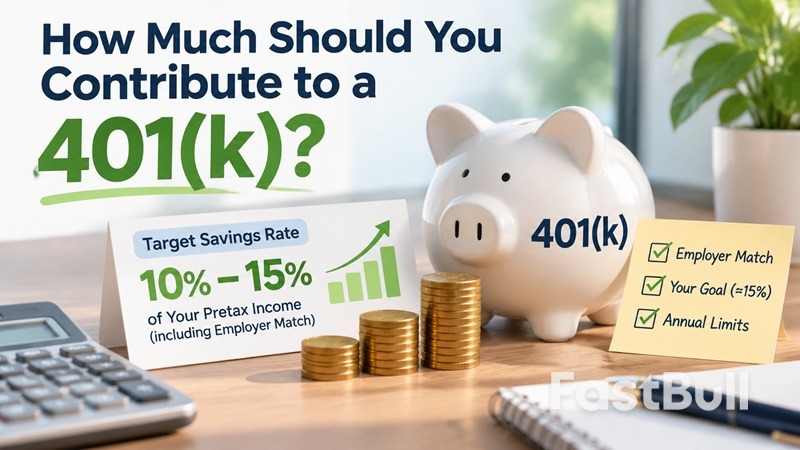
¿Cuánto debería aportar a un plan 401(k)? Un buen punto de partida es aportar lo suficiente para recibir la contribución máxima de su empleador y, a partir de ahí, ahorrar aproximadamente el 15 % de sus ingresos brutos para la jubilación, incluyendo las aportaciones del empleador. Su objetivo dependerá de su edad, ahorros actuales, ingresos y metas para la jubilación.
¿Qué porcentaje de tu salario deberías aportar a un plan 401(k)?
Un objetivo común es ahorrar el 15% de tus ingresos brutos para la jubilación cada año, incluyendo tanto tus propias aportaciones como las de tu empleador. Esto no significa que debas aportar el 15% de tu salario a tu plan 401(k). Tu aportación personal puede ser menor si tu empleador realiza aportaciones adicionales o si también ahorras en una cuenta IRA.
Comience por obtener la contribución completa del empleador.
Si tu empleador iguala las contribuciones a tu plan 401(k), intenta aportar lo suficiente para recibir la contribución máxima, siempre que tu presupuesto lo permita. De lo contrario, podrías dejar parte de tu beneficio sin utilizar.
Por ejemplo, supongamos que usted gana 80.000 dólares y su empleador iguala el 50% de sus contribuciones hasta un máximo del 6% de su salario.
| Contribución | Su contribución anual | Contribución del empleador |
|---|---|---|
| 3% | $2,400 | $1,200 |
| 6% | $4,800 | $2,400 |
| 8% | $6,400 | $2,400 |
Con una tasa de contribución del 6%, usted recibe la aportación máxima equivalente de $2,400. Aumentar su contribución al 8% añade otros $1,600 de su propio dinero, pero en este ejemplo no aumenta la aportación equivalente del empleador.
Consulta la fórmula de aportaciones de tu plan y el calendario de adquisición de derechos. El calendario de adquisición de derechos determina cuándo las contribuciones del empleador pasan a ser tuyas.
Trabaje para lograr una tasa de ahorro para la jubilación del 15%.
La guía de ahorro para la jubilación de Fidelity recomienda ahorrar al menos el 15 % de los ingresos brutos para la jubilación, incluyendo las contribuciones del empleador. Este es un objetivo a alcanzar, no una regla que se aplique a todos. El 15 % puede incluir el dinero que deposite en una cuenta IRA; no es necesario que todo vaya a su plan 401(k).
Por ejemplo, si usted gana $80,000, el 15% equivale a $12,000 al año. Si su empleador aporta $2,400 mediante un programa de contrapartida, usted necesitaría ahorrar otros $9,600 en sus cuentas de jubilación para alcanzar esa meta.
¿Qué ocurre si no puedes permitirte contribuir con esa cantidad?
No es necesario alcanzar el 15 % de inmediato. Empiece con una cantidad que pueda mantener y auméntela cuando su presupuesto mejore. Si es posible, aproveche primero la aportación máxima de su empleador. También puede aumentar su contribución en un punto porcentual tras un aumento de sueldo y utilizar las deducciones automáticas de nómina para ahorrar de forma constante.
Cómo calcular su contribución al plan 401(k)
La mayoría de las contribuciones al plan 401(k) se calculan como un porcentaje del salario elegible. Para calcular su contribución anual, multiplique su salario por su tasa de contribución.
Contribución anual del empleado = Salario anual × Tasa de contribución
Por ejemplo, si ganas 80.000 dólares y aportas el 8%, ahorrarías 6.400 dólares al año. Si te pagan cada dos semanas, o 26 veces al año, eso equivale a unos 246,15 dólares por nómina.
Calcula tu contribución en función de tu salario.
The table shows how different contribution rates affect savings on an $80,000 salary. It assumes 26 paychecks per year and does not include employer matching.
| Contribution Rate | Annual Contribution | Biweekly Contribution |
|---|---|---|
| 3% | $2,400 | $92.31 |
| 5% | $4,000 | $153.85 |
| 8% | $6,400 | $246.15 |
| 10% | $8,000 | $307.69 |
| 12% | $9,600 | $369.23 |
| 15% | $12,000 | $461.54 |
Your actual take-home pay will depend on whether you use a traditional or Roth 401(k), your tax situation, and how your plan calculates eligible compensation.
Estimate Your Contribution Per Paycheck
Use the calculator to estimate your employee contribution, amount per paycheck, employer match, and combined annual contributions. It assumes a flat employer match percentage up to the salary percentage you enter. Some plans use tiered formulas, so check your plan documents for an exact match calculation.
401(k) Contribution Calculator
Annual Employee Contribution: $6,400.00
Contribution Per Paycheck: $246.15
Estimated Annual Employer Match: $2,400.00
Total Annual Contributions: $8,800.00
Note: This calculator provides estimates and does not account for IRS contribution limits, vesting schedules, tiered employer matching formulas, or payroll rounding.
How Should Your 401(k) Contribution Change With Age and Income?
The right contribution rate depends partly on how long your savings have to grow and how much you have already accumulated. Someone who starts in their 20s has more time to invest than someone who begins in their 40s or 50s.
Starting Early vs. Catching Up Later
Starting early gives contributions more time to benefit from compounding. If you begin in your 20s or early 30s, working toward a 15% retirement savings rate, including employer contributions, can be a useful benchmark.
If you start later, you may need to save a larger share of your income, work longer, or adjust your retirement spending expectations. Workers aged 50 and older may also be eligible for catch-up contributions, subject to plan rules and annual IRS limits.
Adjusting Contributions Based on Your Retirement Goals
Income affects the dollar amount you save. A 10% contribution from a $60,000 salary is $6,000 a year; the same rate on a $100,000 salary is $10,000. But income alone does not determine whether you are on track. Consider your current retirement balance, planned retirement age, expected expenses, and other income sources such as Social Security, a pension, an IRA, or taxable investments.
What Are the 401(k) Contribution Limits for 2026 and 2027?
The IRS sets annual limits on employee 401(k) contributions and on total additions to a defined contribution plan. The 2027 limits were announced in November 2026.
Employee Contribution Limits and Catch-Up Contributions
For 2026, employees can defer up to $24,500 into traditional and Roth 401(k) accounts combined. For 2027, the limit increases to $25,500. Employees aged 50 or older may be able to contribute an additional catch-up amount if their plan permits it.
| Age Group | 2026 Employee Limit | 2027 Employee Limit |
|---|---|---|
| Under 50 | $24,500 | $25,500 |
| 50–59 and 64+ | $32,500 | $34,000 |
| Ages 60–63 | $35,750 | $37,250 |
The age 60–63 limit includes the higher catch-up amount instead of the standard catch-up; it is not added on top of it. Traditional and Roth 401(k) salary deferrals share the same employee limit. If you participate in more than one 401(k) or 403(b) plan during the year, your employee deferrals generally count toward the same annual limit.
How Employer Contributions Affect the Annual Limit
Employer matching and nonelective contributions do not count toward the regular employee deferral limit, but they do count toward the overall annual additions limit.
For most defined contribution plans, that limit is the lesser of 100% of eligible compensation or:
| Tax Year | Overall Annual Additions Limit |
|---|---|
| 2026 | $72,000 |
| 2027 | $75,000 |
Catch-up contributions that qualify under IRS rules are generally excluded from this overall limit. Check your plan rules before trying to maximize contributions. Your employer may impose plan-specific restrictions, and the plan must permit catch-up contributions.
For the official figures, see the IRS announcement of the 2027 contribution limits and IRS Notice 2026-66.
Should You Increase or Max Out Your 401(k)?
Maxing out your 401(k) can help build retirement savings faster, but it is not automatically the best choice for every household. Consider your income, cash reserves, debt, employer benefits, and other financial goals before increasing contributions.
When It Makes Sense to Increase Your Contributions
Increasing contributions can make sense when your salary rises, essential expenses are covered, and you have enough emergency savings. You may also want to increase your rate if you are behind on your retirement target or want to make full use of the annual limit.
A practical approach is to raise your contribution gradually rather than making a large change that strains your monthly budget. Check how much you have already contributed during the year so you do not accidentally exceed the applicable limit.
When Other Financial Priorities Come First
If you have no emergency savings or carry high-interest credit card debt, putting every available dollar into your 401(k) may not be sensible. Consider keeping cash for unexpected expenses and paying down expensive debt while contributing enough to receive the full employer match when possible.
You do not have to choose one goal exclusively. A balanced plan can maintain retirement contributions while improving your short-term financial stability.
Is a 401(k) Enough for Retirement?
Un plan 401(k) puede ser una fuente importante de ingresos para la jubilación, pero su suficiencia depende de la tasa de ahorro, el rendimiento de las inversiones, la edad de jubilación y las necesidades de gasto. Muchas personas combinan un plan 401(k) con la Seguridad Social, una cuenta IRA, una pensión u otras inversiones.
Revisa tus ahorros y tu tasa de aportación periódicamente, sobre todo después de un cambio de sueldo o un acontecimiento importante en tu vida. El objetivo es acumular suficientes recursos para mantener el estilo de vida que deseas durante tu jubilación, no simplemente alcanzar el límite máximo de aportación cada año.


