- GBPUSD
- XAUUSD
- XAGUSD
- WTI



行情
分析
使用者
快訊
財經日曆
學習
數據
- 名稱
- 最新值
- 前值



















 行情
行情 Nubank, Latin America’s largest digital bank, is reportedly planning to integrate dollar-pegged stablecoins and credit cards for payments.
The move was disclosed by the bank’s vice-chairman and former governor of Brazil’s central bank, Roberto Campos Neto. Speaking at the Meridian 2025 event on Wednesday, he highlighted the importance of blockchain technology in connecting digital assets with the traditional banking system.
According to local media reports, Campos Neto said Nubank intends to begin testing stablecoin payments with its credit cards as part of a broader effort to link digital assets with banking services.
"What the data shows is that people aren't buying to transact, they're buying as a store of value, he reportedly said. “And we need to understand why this is happening. I think it's changing a bit, but we need to understand it."
He also noted that the challenge for banks is finding a way to accept deposits in tokenized forms and use these assets to issue credit for clients.
Founded in São Paulo in 2013, Nubank is a Brazilian digital bank serving more than 100 million customers across Brazil, Mexico and Colombia. The bank first entered the digital asset space in 2022 by allocating 1% of its net assets to Bitcoin and rolling out crypto trading for its customers.
In March 2025, Nubank broadened its crypto lineup with the addition of four altcoins, giving customers access to Cardano (ADA), Cosmos (ATOM), Near Protocol (NEAR), and Algorand (ALGO).
Stablecoin adoption surges in Latin America
Stablecoin adoption has been surging in Brazil. In February, the president of the Central Bank of Brazil told attendees at a Bank for International Settlements event that 90% of crypto activity in the country was linked to stablecoins.
Dollar-pegged digital assets have also gained traction in Argentina, where inflation has exceeded 100% in recent years.
According to a March 2025 report from Bitso, USDt (USDT) and USDC (USDC) accounted for 50% and 22% of all cryptocurrency purchases in the country in 2024, respectively. The same report found that stablecoins made up 39% of all purchases on its platform across the region in 2024.
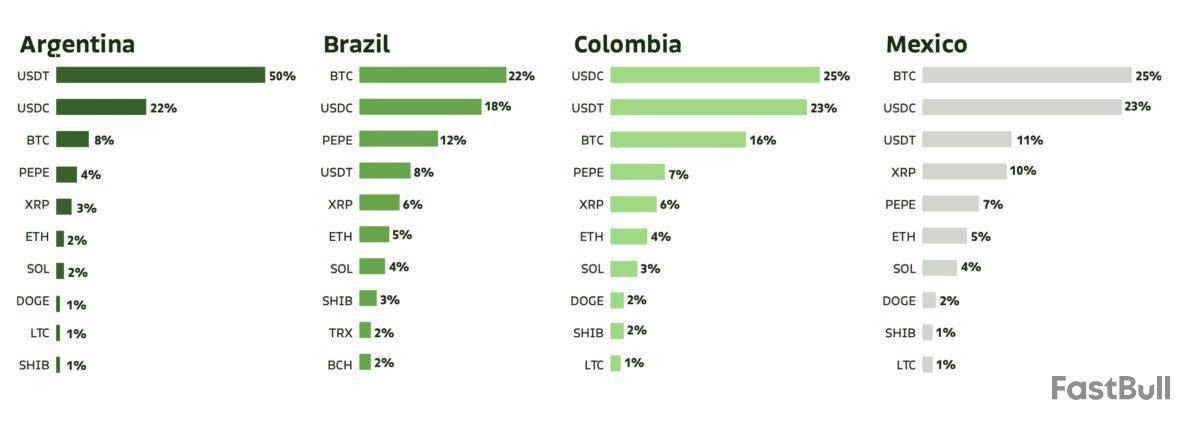
Stablecoin adoption has also been growing in other Latin American countries.
In July 2025, the Central Bank of Bolivia signed an agreement with El Salvador to promote crypto as a “viable and reliable alternative” to fiat. Since lifting its crypto ban in June 2024, Bolivia has allowed banks to process Bitcoin and stablecoin transactions.
In Venezuela, where inflation hit 229% in May, stablecoins like USDt have started to replace the bolívar in daily commerce, from groceries to salaries. Chainalysis data shows they made up 47% of all crypto transactions under $10,000 in 2024.
Magazine: Legal Panel: Crypto wanted to overthrow banks, now it’s becoming them in stablecoin fight

728 RM B 7/F GEE LOK IND BLDG NO 34 HUNG TO RD KWUN TONG KLN HONG KONG





交易股票、貨幣、商品、期貨、債券、基金等金融工具或加密貨幣屬高風險行為,這些風險包括損失您的部分或全部投資金額,所以交易並非適合所有投資者。
做出任何財務決定時,應該進行自己的盡職調查,運用自己的判斷力,並諮詢合格的顧問。本網站的內容並非直接針對您,我們也未考慮您的財務狀況或需求。本網站所含資訊不一定是即時提供的,也不一定是準確的。本站提供的價格可能由造市商而非交易所提供。您做出的任何交易或其他財務決定均應完全由您負責,並且您不得依賴通過網站提供的任何資訊。我們不對網站中的任何資訊提供任何保證,並且對因使用網站中的任何資訊而可能造成的任何交易損失不承擔任何責任。
未經本站書面許可,禁止使用、儲存、複製、展現、修改、傳播或分發本網站所含數據。提供本網站所含數據的供應商及交易所保留其所有知識產權。