


- WTI
- XAUUSD
- XAGUSD
- USDX



Kutipan
Analisis
Pengguna
24/7
Kalender Ekonomi
Pendidikan
Data
- Nama
- Nilai Terbaru
- Sblm.










Apa itu kebijakan moneter, dan bagaimana cara kerjanya? Pelajari bagaimana bank sentral menggunakan suku bunga untuk mengendalikan inflasi, memengaruhi perekonomian, dan mendukung pertumbuhan.
Kebijakan moneter adalah cara bank sentral memengaruhi suku bunga dan kondisi keuangan untuk menjaga inflasi tetap terkendali dan perekonomian tetap stabil. Ketika harga naik terlalu cepat, pinjaman mungkin menjadi lebih mahal. Ketika pertumbuhan ekonomi melemah, biaya pinjaman mungkin turun. Keputusan-keputusan ini memengaruhi segala hal, mulai dari hipotek dan tabungan hingga lapangan kerja dan investasi bisnis.
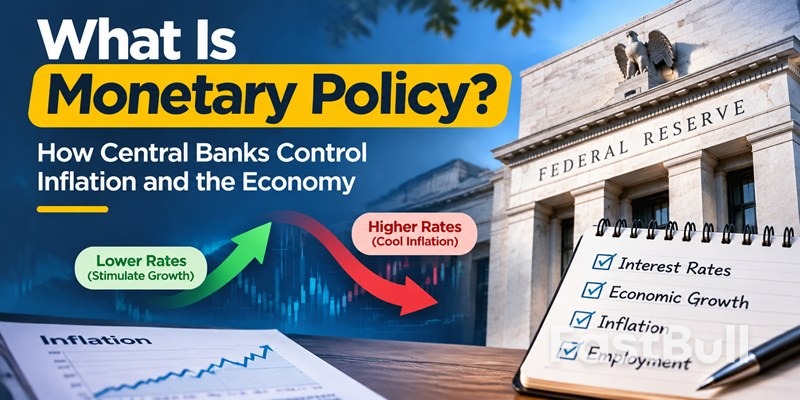
Kebijakan moneter merujuk pada tindakan yang diambil bank sentral untuk memengaruhi biaya dan ketersediaan uang dan kredit dalam suatu perekonomian. Tujuannya adalah untuk menjaga stabilitas harga dan mendukung aktivitas ekonomi yang berkelanjutan.
Bank sentral tidak secara langsung mengendalikan harga yang dibayar konsumen atau jumlah pekerja yang dipekerjakan oleh perusahaan. Sebaliknya, mereka memengaruhi kondisi keuangan, terutama melalui suku bunga, yang memengaruhi seberapa banyak orang meminjam, membelanjakan, menabung, dan berinvestasi.
Perhatikan contoh sederhana. Jika inflasi meningkat karena konsumen dan bisnis membelanjakan uang lebih cepat daripada kemampuan ekonomi untuk memasok barang dan jasa, bank sentral dapat menaikkan suku bunga. Biaya pinjaman yang lebih tinggi dapat menghambat pengeluaran dan mengurangi tekanan pada harga. Jika ekonomi melambat dan pengangguran meningkat, bank sentral dapat menurunkan suku bunga untuk mendorong pinjaman dan investasi.
Keputusan-keputusan ini adalah contoh nyata kebijakan moneter.
Tujuan utama kebijakan moneter adalah untuk menjaga stabilitas ekonomi, meskipun tanggung jawab spesifik berbeda di setiap negara.
Di Amerika Serikat, Federal Reserve memiliki dua tujuan kebijakan moneter utama, yang biasa disebut mandat ganda :
Bank Sentral AS (Federal Reserve) menargetkan inflasi sebesar 2% dalam jangka panjang, yang diukur dengan indeks harga Pengeluaran Konsumsi Pribadi (Personal Consumption Expenditures/PCE). Ini tidak berarti harga harus turun sebesar 2% atau tetap tidak berubah sama sekali. Ini berarti tingkat harga secara keseluruhan harus naik dengan kecepatan yang relatif lambat dan dapat diprediksi.
Tujuan-tujuan ini terkadang dapat saling bertentangan. Suku bunga yang lebih rendah dapat mendukung perekrutan tenaga kerja tetapi juga meningkatkan inflasi. Suku bunga yang lebih tinggi dapat mengendalikan inflasi tetapi melemahkan lapangan kerja. Para pembuat kebijakan harus mempertimbangkan dampak-dampak ini daripada mengejar satu tujuan tanpa mempertimbangkan tujuan lainnya.
Kebijakan moneter umumnya dikelola oleh bank sentral suatu negara, bukan langsung oleh pemerintahnya.
Di Amerika Serikat, Federal Reserve menjalankan kebijakan moneter. Komite Pasar Terbuka Federal (FOMC) menentukan kisaran target untuk suku bunga dana federal, sebuah patokan yang memengaruhi biaya pinjaman di seluruh perekonomian.
Other central banks perform similar functions, including the European Central Bank (ECB) in the euro area and the Bank of England (BoE) in the United Kingdom. Their mandates and policy frameworks differ, but controlling inflation is a central responsibility.
Governments influence the economy through taxation and public spending. Those decisions belong to fiscal policy, which is different from monetary policy.
Monetary policy works by changing financial conditions rather than directly ordering businesses to adjust prices or consumers to spend less.
Interest rates are the main channel. When a central bank changes its policy rate, the effects spread through financial markets, commercial banks, household borrowing, and business investment. These changes influence demand for goods and services, which eventually affects employment and inflation.
Suppose inflation is running above the central bank's target. Raising interest rates makes borrowing more expensive. Some households delay purchasing homes or cars, while businesses reconsider expansion plans that depend on loans.
As spending and investment slow, demand puts less pressure on the economy's productive capacity. Businesses may find it harder to raise prices without losing customers, allowing inflation to ease.
The process generally follows this pattern:
Higher interest rates → More expensive borrowing → Slower spending and investment → Weaker demand → Lower inflationary pressure.
Lower interest rates generally work in the opposite direction. They can encourage borrowing and spending, supporting economic growth when demand is weak.
However, monetary policy does not produce immediate or guaranteed results. It can take months or longer for interest rate changes to affect economic activity and inflation. Longer-term borrowing rates also depend on expectations about future rates, inflation, and financial risks.
There are limits to what interest rates can achieve. For example, if oil prices rise because of a disruption in global supply, raising rates cannot produce more oil. It can reduce broader demand and prevent inflation from spreading, but it cannot directly resolve the shortage.
Another important distinction is that lower inflation does not necessarily mean lower prices. If inflation falls from 6% to 2%, prices are still rising, just more slowly than before.
The effects of monetary policy extend beyond inflation statistics. They influence financial decisions that households and businesses make every day.
These effects are connected. A business facing higher loan costs may postpone opening another location. That decision reduces demand for equipment, construction services, and additional workers.
Monetary policy therefore affects employment and economic growth indirectly, even though the central bank does not determine individual wages, loan rates, or hiring decisions.
Central banks adjust monetary policy according to economic conditions. When growth is weak, they may try to stimulate spending and investment. When inflation is persistently high, they may try to reduce demand.
These two approaches are known as expansionary monetary policy and contractionary monetary policy.
Expansionary monetary policy is generally used when economic activity is weak, unemployment is rising, or inflation is below the central bank's target.
Central banks can lower policy interest rates or use other measures to ease financial conditions. The aim is to make borrowing and investment more attractive, encouraging households and businesses to increase spending.
For example, during an economic downturn, a company might delay expanding because sales are falling. Lower financing costs can make new investment more affordable, especially if the company expects demand to recover.
However, lower rates cannot guarantee stronger growth. If businesses are pessimistic about future sales or consumers are worried about losing their jobs, they may avoid borrowing even when credit is inexpensive.
Expansionary policy also carries inflation risks. If demand rises faster than the economy can increase production, prices may begin climbing too quickly.
Contractionary monetary policy is used when inflation is too high or economic demand is growing at an unsustainable pace.
Central banks typically raise policy interest rates or tighten financial conditions through other tools. This discourages some borrowing and spending, helping bring demand closer to the economy's available supply.
For example, if strong consumer demand is allowing businesses to raise prices repeatedly, higher borrowing costs can reduce purchases financed by credit. As demand moderates, businesses may have less room to increase prices.
The trade-off is slower economic activity. If monetary policy becomes too restrictive, businesses may reduce investment, hiring may weaken, and the economy could enter a recession.
The difference between the two approaches is summarized below.
| Feature | Expansionary Policy | Contractionary Policy |
|---|---|---|
| Main Purpose | Stimulate economic activity | Reduce inflationary pressure |
| Typical Conditions | Weak growth, rising unemployment, or low inflation | High inflation or excessive demand |
| Interest Rate Direction | Generally lower | Generally higher |
| Borrowing and Spending | Encouraged | Discouraged |
| Employment Impact | May support hiring | May slow hiring |
| Main Risk | Excessive inflation | Recession and higher unemployment |
Neither approach is inherently better. The appropriate policy depends on whether the economy needs stronger demand or relief from inflationary pressure. Central banks may also keep policy unchanged while assessing whether earlier decisions are having their intended effects.
Central banks use several tools to influence interest rates, credit conditions, and the amount of liquidity in the financial system. The exact tools vary by country, but interest rates and open market operations are among the most important.
The main monetary policy tool used by the Federal Reserve is its target range for the federal funds rate. This is the interest rate banks charge each other for overnight loans of reserve balances.
Although the Fed does not directly set mortgage rates, credit card rates, or business loan rates, changes in the federal funds rate influence borrowing costs across financial markets. Banks adjust their lending and deposit rates as funding conditions change.
The Fed uses several mechanisms to keep short-term market rates within its target range. These include:
Another important tool is open market operations. These involve the Federal Reserve buying or selling government securities, or conducting short-term repurchase agreements, to manage liquidity and support its interest rate targets.
For example, when the Fed buys securities, it adds reserve balances to the banking system. When it conducts operations that absorb reserves, it reduces available liquidity. These operations help the Fed implement its monetary policy decisions.
When adjusting short-term interest rates is not enough to influence financial conditions, central banks can use other measures, including quantitative easing (QE) and quantitative tightening (QT).
QE is generally used when an economy needs additional monetary support, particularly when short-term interest rates are already very low. QT is more commonly used when policymakers want to gradually withdraw some of the monetary support provided through earlier asset purchases.
Other tools include the discount window, through which eligible banks can borrow directly from the Federal Reserve to address short-term funding needs, and forward guidance, which communicates the central bank's likely future policy direction to influence market expectations.
One distinction is important when looking at U.S. monetary policy: although reserve requirements are often listed in traditional explanations of central bank tools, the Federal Reserve reduced reserve requirement ratios to zero in March 2020. They are not a primary tool in its current operating framework.
The Fed also ended its balance sheet reduction process on December 1, 2025. Therefore, QT is useful to understand as a monetary policy tool, but it should not be confused with an ongoing Fed policy as of November 2026.
For a complete overview, see the Federal Reserve's monetary policy tools.
The Federal Reserve does not raise or lower interest rates simply because inflation changes in one month. Its policymakers examine a range of economic indicators to determine whether the economy needs tighter or looser financial conditions.
The Federal Open Market Committee (FOMC) is responsible for setting the direction of U.S. monetary policy. It holds eight regularly scheduled meetings each year to review economic conditions and decide whether to change its policy stance.
Several factors influence these decisions:
The Fed must also consider how long monetary policy takes to work. An interest rate increase may affect new borrowing relatively quickly, but its full impact on consumer spending, business investment, hiring, and inflation can take much longer to appear.
This is why policymakers look at both current economic data and the likely direction of the economy. Raising rates too aggressively can weaken employment and growth, while waiting too long to address persistent inflation can allow price pressures to become more entrenched.
As of November 13, 2026, the Federal Reserve's latest monetary policy decision was announced on October 28, 2026. The FOMC voted 10–2 to maintain the federal funds rate target range at 3.75% to 4.00%.
The Committee said economic activity was expanding at a strong pace, supported by resilient domestic spending, productivity growth, and business investment. Job gains had kept pace with the workforce, while inflation remained elevated relative to the Fed's 2% goal.
The decision was not unanimous. Two FOMC members, Lisa D. Cook and Beth M. Hammack, preferred to raise the target range by another 0.25 percentage point rather than leave rates unchanged.
This decision illustrates an important point: monetary policy is not determined by inflation alone. The Fed must weigh price stability against employment and economic growth, particularly when different indicators suggest different policy responses.
Future rate decisions will depend on incoming economic data and how inflation and employment develop. The Fed does not follow a fixed schedule of rate increases or cuts simply because a particular number of months has passed.
You can check the October 28, 2026 FOMC statement for the official decision and its economic assessment.
Monetary policy and fiscal policy are two major ways governments influence economic activity, but they work through different channels and are controlled by different institutions.
Kebijakan moneter dikelola oleh bank sentral suatu negara dan terutama memengaruhi suku bunga, kondisi kredit, dan likuiditas keuangan. Kebijakan fiskal ditentukan oleh pemerintah melalui perpajakan, pengeluaran publik, dan pinjaman.
Di Amerika Serikat, Federal Reserve mengelola kebijakan moneter, sementara Kongres dan Pemerintah membuat keputusan kebijakan fiskal.
| Fitur | Kebijakan Moneter | Kebijakan Fiskal |
|---|---|---|
| Siapa yang Mengontrolnya? | Bank sentral, seperti Federal Reserve | Pemerintah, termasuk Kongres dan Administrasi di AS |
| Alat Utama | Suku bunga, operasi pasar terbuka, dan pembelian aset | Pajak, pengeluaran pemerintah, dan transfer |
| Fokus Utama | Stabilitas harga dan lapangan kerja | Pertumbuhan ekonomi, layanan publik, dukungan pendapatan, dan lapangan kerja. |
| Bagaimana Hal Itu Mempengaruhi Ekonomi | Mengubah biaya pinjaman, kondisi kredit, dan insentif pengeluaran. | Mengubah pendapatan rumah tangga, insentif bisnis, dan permintaan publik. |
| Contoh | The Fed menaikkan suku bunga untuk mengurangi tekanan inflasi. | Pemerintah meningkatkan belanja infrastruktur untuk mendukung aktivitas ekonomi. |
Kedua kebijakan tersebut dapat berjalan beriringan, tetapi juga dapat menarik perekonomian ke arah yang berbeda.
Sebagai contoh, selama resesi, pemerintah dapat meningkatkan pengeluaran publik untuk mendukung lapangan kerja dan permintaan konsumen, sementara bank sentral menurunkan suku bunga untuk mendorong pinjaman dan investasi swasta. Kedua tindakan tersebut dapat mendukung pemulihan ekonomi.
Namun, jika pemerintah meningkatkan pengeluaran secara signifikan sementara inflasi sudah tinggi, bank sentral mungkin perlu mempertahankan suku bunga yang lebih tinggi atau memperketat kebijakan moneter untuk mencegah peningkatan permintaan yang mendorong harga naik.
Singkatnya, kebijakan moneter memengaruhi biaya dan ketersediaan uang dan kredit, sementara kebijakan fiskal secara langsung mengubah pendapatan dan pengeluaran pemerintah. Keduanya memengaruhi pertumbuhan ekonomi, tetapi melalui mekanisme yang berbeda.
Untuk detail lebih lanjut, lihat penjelasan Federal Reserve tentang perbedaan antara kebijakan moneter dan kebijakan fiskal .
Kebijakan moneter memengaruhi inflasi, lapangan kerja, dan pertumbuhan ekonomi dengan mengubah suku bunga dan kondisi keuangan. Memahami bagaimana bank sentral menggunakan instrumen ini membantu menjelaskan mengapa keputusan mereka memengaruhi pinjaman, tabungan, investasi bisnis, dan perekonomian secara lebih luas.

728 RM B 7/F GEE LOK IND BLDG NO 34 HUNG TO RD KWUN TONG KLN HONG KONG


Berdagang Instrumen Keuangan Seperti Saham, Mata Uang, Komoditas, Kontrak Berjangka, Obligasi, Dana, Atau Mata Uang Kripto Adalah Perilaku Berisiko Tinggi, Termasuk Kehilangan Sebagian Atau Seluruh Jumlah Investasi Anda, Sehingga Perdagangan Tidak Cocok Untuk Semua Investor.
Anda Harus Melakukan Uji Tuntas Anda Sendiri, Menggunakan Penilaian Anda Sendiri, Dan Berkonsultasi Dengan Penasihat Yang Memenuhi Syarat Saat Membuat Keputusan Keuangan Apa Pun. Konten Situs Web Ini Tidak Ditujukan Kepada Anda, Situasi Keuangan Atau Kebutuhan Anda Juga Tidak Diperhitungkan. Informasi Yang Terdapat Di Situs Web Ini Belum Tentu Tersedia Secara Waktu Nyata, Juga Belum Tentu Akurat. Setiap Pesanan Atau Keputusan Keuangan Lainnya Yang Anda Buat Sepenuhnya Menjadi Tanggung Jawab Anda Dan Anda Tidak Boleh Bergantung Pada Informasi Apa Pun Yang Disediakan Melalui Situs Web. Kami Tidak Memberikan Jaminan Apa Pun Untuk Informasi Apa Pun Di Situs Web Dan Tidak Bertanggung Jawab Atas Kerugian Transaksi Apa Pun Yang Mungkin Timbul Dari Penggunaan Informasi Apa Pun Di Situs Web.
Dilarang Menggunakan, Menyimpan, Menggandakan, Menampilkan, Memodifikasi, Menyebarluaskan Atau Mendistribusikan Data Yang Terdapat Dalam Situs Web Ini Tanpa Izin Tertulis Dari Situs Web Ini. Semua Hak Kekayaan Intelektual Dilindungi Oleh Pemasok Dan Bursa Yang Menyediakan Data Yang Terdapat Di Situs Web Ini.
Tidak Masuk
Masuk untuk mengakses lebih banyak fitur


Masuk
Daftar


