


MH Markets Review 2026: Regulation, Trading Costs and Withdrawal Risks
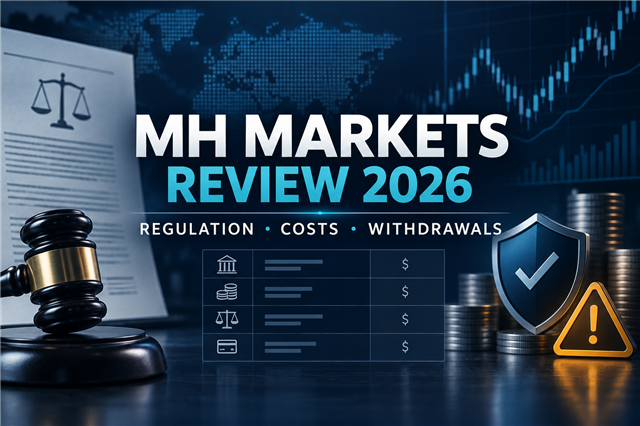
MH Markets is a multi-entity CFD brand rather than one company operating under one universal rulebook. That distinction matters more than the number of licences shown on a marketing page: the company named in the client agreement determines who holds the account, which regulator can hear a complaint, whether leverage is capped, and what protection may apply if a payment dispute or insolvency occurs.
Bottom line: MH Markets combines MetaTrader access, a relatively low entry threshold and offshore leverage with a regulatory structure that requires careful entity checking. The Australian, Mauritius, South African and United Arab Emirates connections do not provide identical permissions. In particular, the UAE Securities and Commodities Authority states that MH Markets Financial Services LLC is authorised for financial consultation and introduction, not for executing derivatives or spot-FX trades. International clients should therefore confirm the actual contracting and payment entities instead of assuming that a Dubai office is the trading counterparty.
MH Markets at a glance
| Question | Practical answer |
|---|---|
| Business model | Multi-entity retail CFD broker using MT4 and MT5 |
| Common global entity | Mohicans Markets (Ltd), Mauritius |
| Entry account | Standard account, commonly advertised from US$50 |
| Headline leverage | Up to 1:1,000 on current public profile data; entity and product limits vary |
| Main cost choices | Spread-only Standard/Prime pricing or raw-spread ECN pricing with commission |
| Main strengths | MetaTrader ecosystem, EA/hedging support, broad CFD categories, low entry barrier |
| Main risks | Offshore onboarding, entity confusion, high leverage, variable execution costs and mixed withdrawal feedback |
Who regulates MH Markets?
Mauritius: the entity many international clients must examine first
The MH Markets client agreement identifies Mohicans Markets (Ltd) as a Mauritius company and sets out the contractual framework for trading, complaints and account operation. Offshore regulation can establish a legal operating framework, but it should not be treated as equivalent to the leverage caps, compensation arrangements and local dispute channels available under some major onshore regimes. Before funding, download the agreement shown during onboarding and compare the company name with the beneficiary on the deposit page.
Australia: verify the licence holder and the account relationship
MH Markets materials refer to Mohicans Markets Capital Pty Ltd and Australian Financial Services Licence number 455388. The important question is not merely whether the licence number exists, but whether the applicant is actually being onboarded by that Australian licensee. Australian retail rules normally impose tighter leverage limits and product-intervention protections. An account offering offshore leverage is a strong signal that the contract may sit elsewhere.
United Arab Emirates: active licence, limited activity scope
The UAE SCA register lists MH Markets Financial Services LLC as active for financial consultations and introduction. The regulator also carries an explicit notice that the company is not licensed to conduct brokerage in derivatives, unregulated commodity contracts or spot foreign exchange. This does not make the entity unlicensed; it means the permission is narrower than a trading-execution licence. Readers should not describe the Dubai company as the broker executing their CFD orders unless their documents prove that role.
South Africa: check the exact FSP and permitted categories
Where an FSCA-related company is presented, confirm the legal name, FSP number, licence categories and current status directly against the regulator's register. A company-registration number is not a substitute for an authorised financial-services permission, and a regional affiliate does not automatically protect accounts booked by another group company.
Accounts and the real trading cost
MH Markets commonly promotes Standard, Prime and ECN-style choices. The labels are useful only after converting all charges into the same unit. A spread-only account may look expensive during liquid hours but avoid a separate commission; a raw account may show 0.0 pips at times while charging approximately US$7 per round-turn standard lot. The cheaper result depends on the live spread, trade size, execution price, holding period and swaps.
| Account | Typical positioning | Published entry level | How to calculate cost |
|---|---|---|---|
| Standard | Lower entry barrier, no separate FX commission | Commonly from US$50 | Spread + slippage + swap |
| Prime | Narrower spread for more active manual trading | Higher than Standard | Live spread + any disclosed account charge + swap |
| ECN | Rawer pricing for high-frequency or automated strategies | Commonly around US$1,000 | Spread + roughly US$7 round-turn commission/lot + slippage + swap |
For one standard lot of EUR/USD, one pip is usually about US$10. A 1.3-pip spread therefore costs roughly US$13 before slippage. An ECN quote at 0.2 pip plus a US$7 round-turn commission costs about US$9. The ECN account wins in that example, but not if its spread widens, the order is small, or the required capital would otherwise remain unused. “From 0.0” is a minimum quote, not a guaranteed average.
Leverage: why 1:1,000 changes more than the margin number
High leverage reduces the margin needed to open a position; it does not reduce the dollar gain or loss generated by that position. At 1:1,000, a small balance can control a very large notional exposure, so an ordinary price move may consume free margin rapidly. Leverage can also vary by entity, instrument, equity tier and market conditions. Traders should size from the maximum acceptable loss and stop distance, not from the largest volume the platform permits.
Australian retail accounts, if genuinely opened under the Australian licensee, would normally face much lower regulatory caps than an offshore account. A user who expected Australian protections but receives 1:1,000 leverage should pause and inspect the agreement before depositing.
MT4, MT5 and execution quality
MH Markets supports MetaTrader 4 and MetaTrader 5, including desktop, web and standard MetaQuotes mobile access. MT4 remains useful for legacy EAs and indicators; MT5 adds more timeframes, order functions and a broader multi-asset workflow. Platform familiarity, however, says nothing by itself about the liquidity source, slippage distribution or server stability.
Positive user feedback often mentions familiar software, acceptable execution during normal hours and responsive account support. Critical feedback points to wider spreads during volatility, order outcomes that users dispute, and account reviews after profitable activity. A fair test uses a small live account: record requested and filled prices during ordinary and event-driven sessions, and compare the result with the account specification rather than with an advertised minimum.
Deposits and withdrawals: what to verify before sending money
- Confirm that the beneficiary is the contracting company or a payment processor disclosed by it.
- Use a bank card, account or wallet in the same name as the trading account.
- Complete identity, address and source-of-funds checks before a withdrawal is urgent.
- Read the return-to-source sequence when several payment methods are used.
- Keep receipts, wallet hashes, emails, support tickets and the version of the client agreement.
- Test one modest withdrawal after normal trading and before materially increasing the balance.
Advertised processing times describe the broker's internal handling, not necessarily the total time until money reaches the customer. Banks, card schemes and crypto-network checks can add delay. A compliance review is not automatically evidence of misconduct, but changing explanations, requests for unrelated additional payments, or an inability to cite the relevant contract clause are reasons to stop adding funds and escalate in writing.
How should traders interpret complaints?
Public comments are mixed and should be treated as leads rather than verdicts. Positive posts describe smooth deposits, stable MetaTrader access and successful withdrawals. Negative posts allege delayed payouts, post-profit account reviews, bonus disputes and execution problems. Some complaints are incomplete and cannot be independently verified; repetition still matters because it identifies the clauses and processes a prospective client should test.
Particular care is needed for bonus users, multi-account setups, hedging across brokers, latency-sensitive EAs, arbitrage and news trading. If the agreement permits the broker to classify activity as abusive, the definition, evidence standard and financial consequence should be understood before the strategy is deployed.
If an account or withdrawal dispute occurs
- Stop increasing the balance and do not pay a separate “release”, “tax” or “verification” fee.
- Export the complete MT4/MT5 history and preserve payment evidence.
- Send a dated formal complaint stating the amount, timeline and requested remedy.
- Ask the broker to identify the legal entity and exact contractual clause relied upon.
- Escalate to the regulator or dispute body that actually covers the contracting company.
- Be wary of recovery agents demanding an advance fee or wallet credentials.
Who may find MH Markets suitable?
Potentially suitable: experienced traders who prefer MT4/MT5, understand offshore entity risk, need EA or hedging support, and can test execution and withdrawals with limited capital.
Less suitable: beginners attracted primarily by maximum leverage, investors requiring a statutory compensation scheme, traders who need a clearly onshore contract, or users who will not read strategy restrictions and payment rules.
Seven checks before opening an account
- Legal company name and licence number in the agreement
- Regulator's permitted activity, not just licence status
- Website domain and onboarding route tied to that entity
- Payment beneficiary and return-to-source policy
- All-in spread, commission, swap and conversion cost
- Leverage, margin-call, stop-out and negative-balance rules
- A successful small withdrawal before committing more capital
Frequently asked questions
Is MH Markets regulated?
The group refers to regulated or licensed entities in several jurisdictions, but their permissions and customer protections differ. The relevant regulator is the one covering the company in the signed client agreement.
Does the UAE licence cover forex and CFD execution?
The UAE SCA says MH Markets Financial Services LLC is licensed for financial consultation and introduction and is not licensed to execute derivatives or spot-FX brokerage. The distinction should be stated clearly.
Is an ECN account automatically cheaper?
No. Raw spreads must be combined with round-turn commission, slippage and swaps. It is cheaper only when the all-in cost for the user's actual volume and holding period is lower.
Is 1:1,000 leverage suitable for beginners?
Generally not. It makes it easy to create excessive notional exposure on a small balance, so routine volatility may trigger rapid losses or forced liquidation.
Final verdict
MH Markets offers a practical MetaTrader environment, multiple pricing structures and flexible offshore leverage. Its central weakness is not the absence of any regulatory footprint, but the risk that clients mistake group-level affiliations for the permissions and protections of their own account. The UAE entity's limited licence scope illustrates why entity-level analysis matters.
A disciplined prospective client should verify the contract, calculate all-in cost, cap leverage independently, review restricted-strategy clauses and complete a small withdrawal. For updated regulatory records, account information and user feedback, consult the MH Markets broker profile as part of that due-diligence process.



Copyright © 2026 FastBull Ltd


Risk Warning
FX trading is of high risk and may not be suitable for all investors. Leverage will create additional risks and loss. Before trading, please carefully consider your investment objectives, experience level and risk tolerance. You may lose part or all of your initial investment; do not invest money that you cannot afford. Educate yourself about the risks associated with FX trading. If you have any questions, please consult an independent financial or tax advisor. Any data and information are provided "as is" and only for information purpose, not for trading or recommendations. Past performance does not predict future results.
Disclaimer
The data contained in this website may not be real-time and accurate. The data and prices on this site are not necessarily provided by the market or exchange, but may be provided by market makers, so prices may be inaccurate and differ from actual market prices. Namely, this price is indicative price only to reflect market trend, and is unfavorable for trading purpose. The provider of the data contained in the Website shall not be liable for any loss incurred by you as a result of your trading activities or reliance on the information contained in the Website.