


Illusionary Profit vs. Real Debt: How a Programmer Lost $46,000 to an "Arbitrage Mentor"
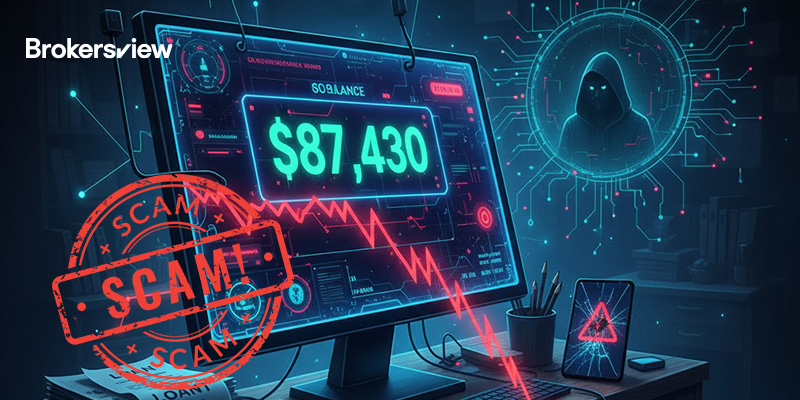
"If your account reaches $50,000, the platform will match it with $50,000." This enticing promise completely captivated Daniel, a software engineer who was previously rational and cautious. From an initial conservative deposit of $3,000 to ultimately taking out high-interest loans to invest $46,000, he fell victim to a meticulously planned "mentor-led trading" scam. While his screen displayed a fictional balance of $87,430, he was left facing credit collapse and a long road to debt repayment.
The Start of the Trap: "Scientific Wealth" Packaged in Technical Jargon
Daniel was not easily fooled. As a 29-year-old software developer, he earned a stable after-tax salary of $4,500 per month and had sound savings habits, even diligently investing in index funds. However, during the lockdowns, the pervasive narrative of sudden wealth on social media triggered severe Fear Of Missing Out (FOMO).
It was in this state of anxiety that he encountered the concept of "risk-limited arbitrage." This mathematically and technically sophisticated-sounding idea, coupled with professional phrases like "statistical edge" and "asymmetric risk," precisely targeted the vulnerabilities of this tech professional. After paying a hefty mentor fee of $997, he was introduced to a Telegram group of over 200 members and a seemingly professional real-time trading platform.
Initially, he was very cautious, committing only $3,000 from his $12,000 savings to test the waters. The early experience was flawless; following the mentor's signals, his first three trades yielded profits of 3.2%, 2.1%, and 4.5%, respectively. Within a week, his account grew to nearly $3,500. To further build trust, the platform even allowed him to successfully withdraw $1,000. This smooth, small withdrawal completely lowered his guard.
Descending into Debt: High-Interest Loans for "VIP Status"
As trust solidified, the trap tightened. The mentor informed Daniel that reaching an account balance of $25,000 would unlock the "managed VIP tier." Blinded by the promise of high returns, Daniel not only increased his deposits but also took out a $10,000 personal loan from his bank, claiming it was for "home improvements." At this point, his total deposits reached $20,000, and the on-screen account balance soared to $41,000.
The climax of the scam arrived with the introduction of the "profit share model." The platform promised that if his principal reached $50,000, they would match it with an equal $50,000 capital injection. Desperate to seize this "once-in-a-lifetime" opportunity, Daniel lost all rationality. He maxed out his credit cards, applied for a second personal loan, and even borrowed $7,000 from a close friend.
Ultimately, his total deposits reached $46,000. Gazing at the massive sum of $87,430 displayed on the screen, he believed financial freedom was imminent, unaware it was the final moment before the collapse.
The Moment of Truth: Unwithdrawable Balance and Real Debt
When Daniel attempted to withdraw $20,000 to repay his friend and one of the loans, a cold rejection notice popped up. The account was flagged as "under compliance review," and the platform demanded he deposit an additional $10,000 "security deposit" to unlock withdrawals.
At this point, all attempts to withdraw smaller amounts ($5,000 or $1,000) failed. Subsequently, the previously active Telegram group abruptly switched to "read-only mode," the mentor vanished, and the platform's website soon disappeared entirely.
Daniel was left with a genuine loss of $46,000—comprising $18,000 of his savings, $21,000 in high-interest personal loans, and $7,000 borrowed from a friend. His credit score plummeted, forcing him to move to a cheaper apartment, sell his beloved PlayStation, and take on freelance coding projects to service the debt. The road to repayment is expected to take him several years.
BrokersView Alert
- Beware of the "Successful Withdrawal" Lure: Scammers often permit victims to make small, initial withdrawals. This is a crucial step in building trust, designed to encourage much larger subsequent deposits.
- Steer Clear of "Capital Matching" Schemes: Any trading platform that promises to "match what you deposit" is almost certainly a fraudulent setup designed to trick users into investing their entire principal.
- Debt-Financed Investment is Fatal: Never borrow money or max out credit cards to invest based on so-called "insider opportunities" or "mentor strategies."
If you have experienced a similar trading scam, immediately stop any further transfers (including for alleged security deposits or taxes) and submit a complaint to BrokersView as soon as possible.



Copyright © 2026 FastBull Ltd


Risk Warning
FX trading is of high risk and may not be suitable for all investors. Leverage will create additional risks and loss. Before trading, please carefully consider your investment objectives, experience level and risk tolerance. You may lose part or all of your initial investment; do not invest money that you cannot afford. Educate yourself about the risks associated with FX trading. If you have any questions, please consult an independent financial or tax advisor. Any data and information are provided "as is" and only for information purpose, not for trading or recommendations. Past performance does not predict future results.
Disclaimer
The data contained in this website may not be real-time and accurate. The data and prices on this site are not necessarily provided by the market or exchange, but may be provided by market makers, so prices may be inaccurate and differ from actual market prices. Namely, this price is indicative price only to reflect market trend, and is unfavorable for trading purpose. The provider of the data contained in the Website shall not be liable for any loss incurred by you as a result of your trading activities or reliance on the information contained in the Website.