


FastBull Expert Advisor Q&As | Lewis: Systematize Your Process and Restrain "Overconfidence" in Gold Trading
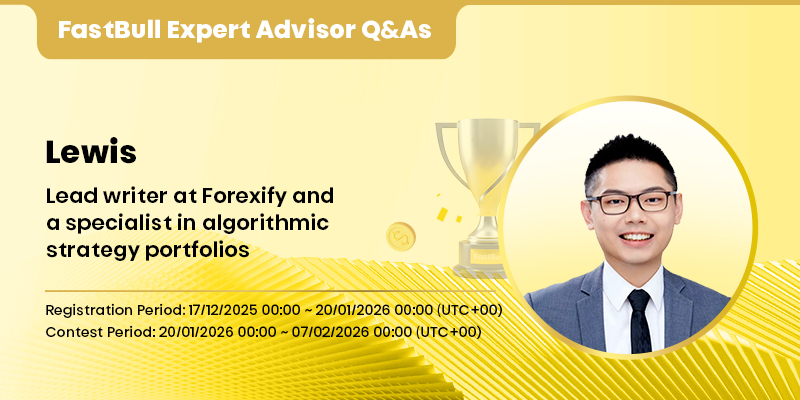
Is short-term gold trading an art of intuition or a rigorous science? In this episode, we sit down with Lewis, lead writer at Forexify and a specialist in algorithmic strategy portfolios. As a top prize winner at the Taiwan Futures Exchange, Lewis breaks down his winning roadmap for this 18-day sprint:
✅ Key Insights:
Strategy Selection: In a contest setting, high-turnover short-term strategies outperform swing trading.
Winning Tool: If limited to one indicator, Moving Averages paired with price breakouts offer the most reliable edge.
Fatal Pitfall: Beware of "Overconfidence." Mismanaging positions due to excessive bias is the fastest way to ruin an account.
Expert Advice: Move away from high-risk gambles; transform your trading into a rational, scientific workflow.
Translation of Lewis' interview:
Q1: Hello Lewis, thank you for joining this interview with FastBull! As a "Trading Expert Advisor" for the 2026 FastBull GOLD Global S1 Short-Term Gold Trading Contest, what do you think is the greatest value of such trading competitions for traders?
I believe the biggest value of trading competitions lies in the opportunity for traders to practice and test their strategies in real-time. The relatively high-pressure environment of a competition allows traders to quickly evaluate whether their mindset is stable during trading and assess the execution of their strategies. In fact, it can also help traders reflect on whether their trading logic and style truly suit their personality and trading approach. I think this is where trading competitions can provide significant benefits for traders.
Q2: The competition lasts only 18 days. Should traders trade more in the first few days to get a feel for the market, or trade less to assess the market direction?
For the second question, since the competition lasts only 18 days, I think the key in the first few days is to clearly analyze the overall trend direction of the asset. For example, with gold as a trading asset, it's essential to determine whether the trend aligns across different timeframes—short-term, medium-term, and long-term. If the trend directions are inconsistent across these timeframes, it can significantly impact whether we should adopt a range-bound strategy or a trend-following breakout strategy during the competition.
Q3: If you could only rely on one technical indicator for short-term gold trading, based on your backtesting experience, which one would you recommend?
For the third question, if I had to choose only one technical indicator for short-term gold trading, I would recommend using moving averages. In simple terms, moving averages still provide a relatively stable directional guide. By combining moving averages with some basic price action breakout techniques, we can capture decent trading opportunities during a strong upward trend in gold.
Q4: You have developed many algorithmic trading strategies. In the context of the competition, what are the key criteria for selecting strategies?
As for the strategies I've developed, in the context of a competition, I believe the key criterion for selecting strategies is their turnover rate. In other words, does the strategy allow us to execute more trades and create more opportunities within a short time frame? Since competitions are based on results achieved in a limited period, we can't afford to rely on longer-term strategies. Instead, we should focus on short-term strategies that provide more frequent trading opportunities.
Q5: Do short-term competitions help to test the effectiveness of algorithmic strategies? Why or why not?
Next, regarding whether short-term competitions are suitable for testing the effectiveness of algorithmic strategies, I believe short-term competitions are somewhat limited in terms of evaluating a strategy's effectiveness. To be honest, trading is inherently a long-term endeavor. Even if the market conditions in the short term are unfavorable for your strategy, it doesn't mean that the strategy is ineffective in real trading. We still need to understand how a strategy behaves during various market conditions, including bullish, bearish, or range-bound phases. Evaluating it in this manner is much more reasonable.
Q6: What realistic expectations should participants have about algorithmic trading after this competition?
For the next question, about what realistic expectations participants should have regarding algorithmic trading after this competition, I think this competition provides an opportunity for traders to turn their trading strategies into a rational, scientific process. In practice, you can gain a more logical expectation from trading, where you can clearly define your entry and exit points. For me, trading strategies are essentially a set of steps that guide the execution of trades. So, this competition could help you solidify the idea of turning trading into a process, making it a more comfortable and systematic experience.
Q7: In a short-duration competition with clear rules, what do you think is the most common mistake traders make?
For the seventh question, regarding the most common mistakes traders make in a short-duration competition with clear rules, I would say the biggest mistake is overconfidence. In simple terms, traders may become too confident about the direction of the asset and overly sure of their position, leading to poor risk management and a lack of proper stop-loss measures. This could lead to significant losses in the trading account.
Q8: If you could give one piece of general advice to participants to help them maintain consistent performance during the competition, what would you emphasize?
Finally, if I could offer one piece of advice to help participants maintain stable performance during the competition, I would emphasize the importance of the process. Many traders may feel compelled to make high-risk trades due to the competitive nature of the event, but high-risk trades often come with unrealistic expectations of high returns, which may not be sustainable. I believe the key is to keep the trading process steady, focus on executing your strategy systematically, and remain disciplined. This will be far more beneficial for achieving consistent performance and results in the competition.
I'm Lewis from Forexify, and I wish everyone the best of luck in the competition!
Ready to test your trading workflow? Registration for 2026 FastBull GOLD Global S1 is closing soon! Contest starts Jan 20!
Previous Interviews:
Hottest







Copyright © 2026 FastBull Ltd


Risk Warning:
FX trading is of high risk and may not be suitable for all investors. Leverage will create additional risks and loss. Before trading, please carefully consider your investment objectives, experience level and risk tolerance. You may lose part or all of your initial investment; do not invest money that you cannot afford. Educate yourself about the risks associated with FX trading. If you have any questions, please consult an independent financial or tax advisor. Any data and information are provided "as is" and only for information purpose, not for trading or recommendations. Past performance does not predict future results.
Disclaimer:
The data contained in this website may not be real-time and accurate. The data and prices on this site are not necessarily provided by the market or exchange, but may be provided by market makers, so prices may be inaccurate and differ from actual market prices. Namely, this price is indicative price only to reflect market trend, and is unfavorable for trading purpose. The provider of the data contained in the Website shall not be liable for any loss incurred by you as a result of your trading activities or reliance on the information contained in the Website.