


DOJ Seizes Crypto Fraud Domain Posing as Tickmill, Operated from Burma Scam Compound
The U.S. Department of Justice (DOJ) has seized the domain tickmilleas.com, which was used to defraud Americans through cryptocurrency investment scams. The site was operated from Burma’s Tai Chang compound, also known as Casino Kosai, and is linked to the Democratic Karen Benevolent Army (DKBA) and the Trans Asia International Holding Group Thailand Company Limited (Trans Asia).
The domain posed as a legitimate trading platform, tricking victims into depositing funds while displaying falsified trades and fake account balances. Despite being registered only in November 2025, the Federal Bureau of Investigation (FBI) has already identified multiple victims who lost money through the site in the last month.
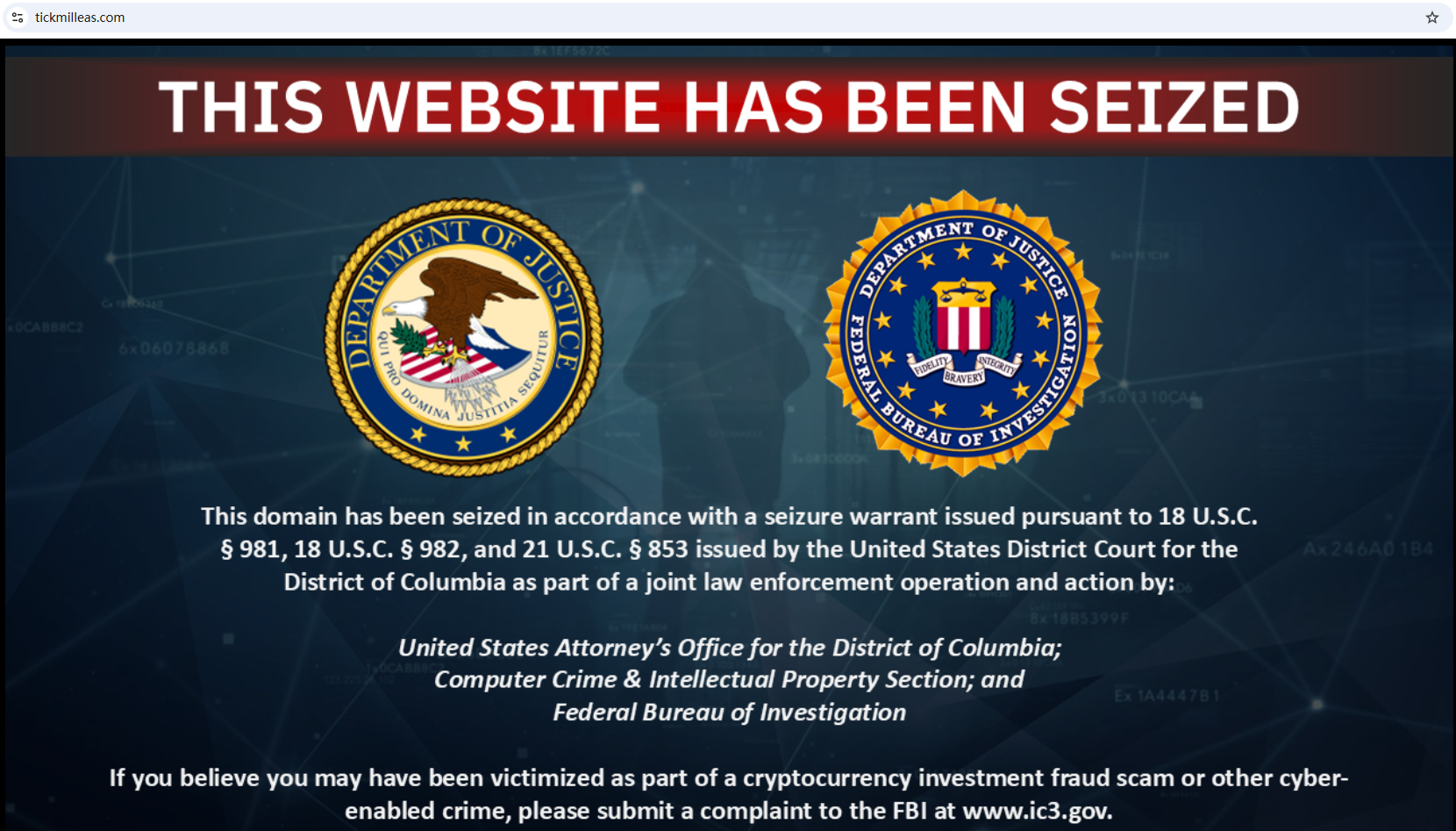
Currently, a seizure splash page warns visitors that the domain has been taken down by law enforcement. Based on its spelling, BrokersView believes that tickmilleas.com was likely impersonating the legitimate broker Tickmill. Fraudulent schemes often misuse the names and logos of regulated companies to mislead and defraud unsuspecting investors.
Investigators found the site also directed users to download fraudulent mobile apps from Google Play and Apple’s App Store. Several apps have since been removed after the FBI notified Google and Apple. Meta has also voluntarily taken down more than 2,000 scam-linked accounts following FBI intelligence on the Tai Chang scam compound.
The action comes less than three weeks after the DOJ launched the District of Columbia U.S. Attorney’s Office’s (D.C. USAO) “Scam Center Strike Force” and seized two other crypto scam domains also tied to the Tai Chang compound.
The FBI’s Internet Crime Complaint Center (IC3) received over 41,000 complaints in 2024, with losses exceeding $5.8 billion from crypto investment scams. These schemes often begin with unsolicited contact via dating apps, social media, or messaging apps, where fraudsters build trust before directing victims to purchase cryptocurrency and invest it on fraudulent platforms.
In June, the U.S. Department of Justice (DOJ) filed a civil forfeiture complaint against more than $225.3 million in cryptocurrency allegedly linked to an investment fraud network that involved “pig butchering” tactics.





Copyright © 2026 FastBull Ltd


Risk Warning
FX trading is of high risk and may not be suitable for all investors. Leverage will create additional risks and loss. Before trading, please carefully consider your investment objectives, experience level and risk tolerance. You may lose part or all of your initial investment; do not invest money that you cannot afford. Educate yourself about the risks associated with FX trading. If you have any questions, please consult an independent financial or tax advisor. Any data and information are provided "as is" and only for information purpose, not for trading or recommendations. Past performance does not predict future results.
Disclaimer
The data contained in this website may not be real-time and accurate. The data and prices on this site are not necessarily provided by the market or exchange, but may be provided by market makers, so prices may be inaccurate and differ from actual market prices. Namely, this price is indicative price only to reflect market trend, and is unfavorable for trading purpose. The provider of the data contained in the Website shall not be liable for any loss incurred by you as a result of your trading activities or reliance on the information contained in the Website.