


BV Assessment: Guiding You to Brokers with Exceptional Trading Speed and Stability

Recently, the BV Assessment conducted a comprehensive assessment of 32 brokers on trading speed, stability, liquidity, spread, slippage, and overnight interest. In this article, we will delve into the evaluation results of execution speed and stability for these platforms.
Comparison in Trading Speed
The trading speed of a platform serves as a crucial gauge of the local network environment and the trading server environment. It provides insights into the network conditions, execution efficiency, and the liquidity of the trading server, which has a significant impact on the occurrence of slippage. To enhance trading speed for customers, brokers not only deploy multiple sets of servers globally but also establish connections with liquidity providers offering better liquidity and faster execution speed.
(Figure 1)
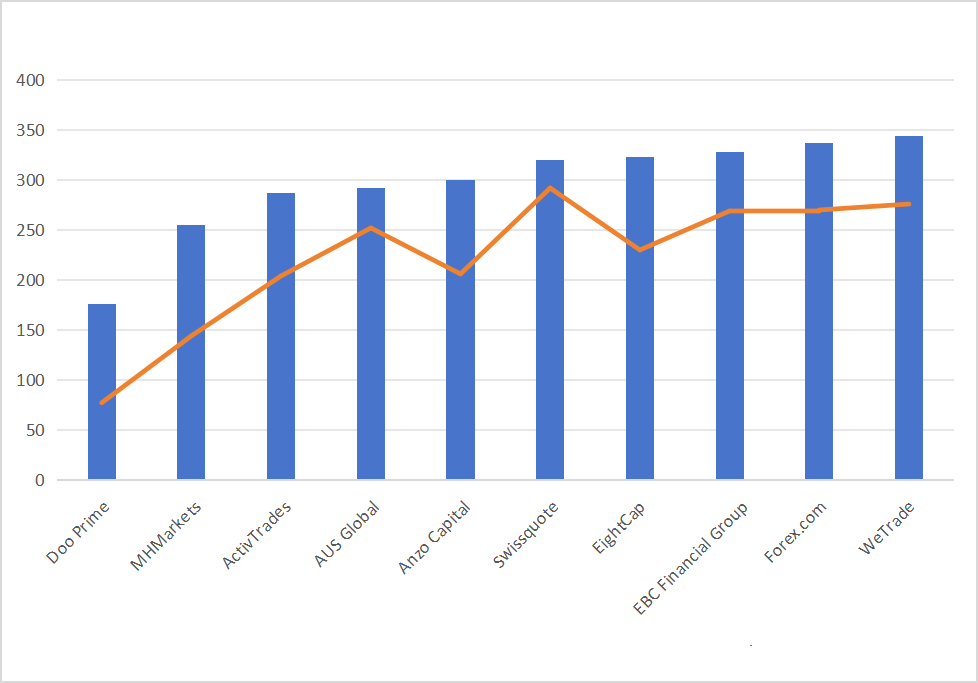
Figure 1 displays the top 10 brokers in terms of trading speed out of the 32 brokers evaluated. The blue column represents the "average trading speed" in milliseconds, while the orange line represents the "optimal speed" in milliseconds.
Figure 1 shows that Doo Prime boasts the best average trading speed, enabling it to complete orders in the shortest time. MHMarkets and ActivTrades are not far behind Doo Prime with excellent performance. Doo Prime achieves the optimal single speed of 77 milliseconds, while MHMarkets achieves an impressive speed of 144 milliseconds.
Comparison in Stability
A broker's stability is typically assessed by the frequency of disconnections between the local MT4/5 terminal and the trading server, as well as the time it takes to reconnect after being disconnected. This metric holds significant importance, particularly during volatile market fluctuations, as a platform with poor stability can lead to customers missing out on numerous trading opportunities.
(Figure 2)
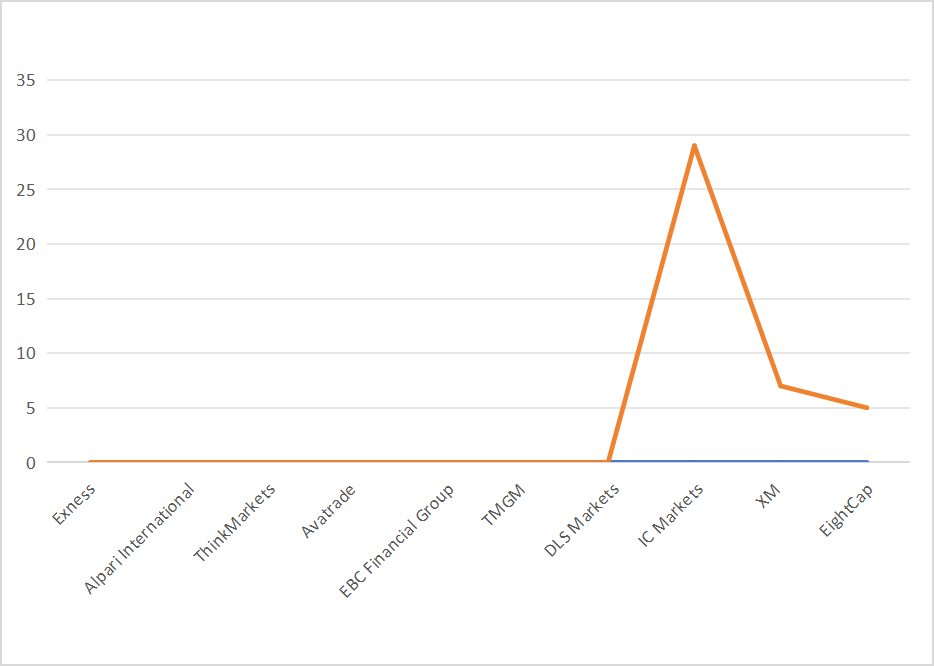
Figure 2 illustrates the top 10 most stable brokers out of the 32 brokers. The orange line denotes the "average number of disconnections per day", while the green curve represents the "average reconnection time", measured in "seconds".
From Figure 2, the "average number of daily disconnections" for these ten brokers is uniformly 0.0. Regarding the "average reconnection time," except for IC Markets' 29 seconds, XM's 7 seconds, and EightCap's 5 seconds, the remaining brokers all show a reconnection time of 0, suggesting comparable stability among these platforms.
Based on the above data, apart from excelling in trading speed and stability, a top-tier broker should bolster its overall capabilities and offer traders a valuable experience. This is the key to gaining popularity and achieving success in the market. That’s it for this sharing and we trust that the BV Assessment can provide you with valuable insights.
Our next assessment will encompass additional indicators, more brokers, and a wider range of areas, so stay tuned! If you have a specific broker in mind that you'd like us to test, or if you'd like your broker to be included in the review, please feel free to reach out to us.


Hottest


Copyright © 2026 FastBull Ltd


Risk Warning
FX trading is of high risk and may not be suitable for all investors. Leverage will create additional risks and loss. Before trading, please carefully consider your investment objectives, experience level and risk tolerance. You may lose part or all of your initial investment; do not invest money that you cannot afford. Educate yourself about the risks associated with FX trading. If you have any questions, please consult an independent financial or tax advisor. Any data and information are provided "as is" and only for information purpose, not for trading or recommendations. Past performance does not predict future results.
Disclaimer
The data contained in this website may not be real-time and accurate. The data and prices on this site are not necessarily provided by the market or exchange, but may be provided by market makers, so prices may be inaccurate and differ from actual market prices. Namely, this price is indicative price only to reflect market trend, and is unfavorable for trading purpose. The provider of the data contained in the Website shall not be liable for any loss incurred by you as a result of your trading activities or reliance on the information contained in the Website.