


ATFX Review: Is ATFX a Good Broker? Pros, Cons & Top Alternatives
Is ATFX a safe broker or just another average trading platform? ATFX offers strong regulation, stable MT4 performance, and beginner-friendly features, but spreads and overall costs may not be the most competitive. In this ATFX review, we break down its fees, safety, platforms, and whether it’s the right choice for your trading needs.
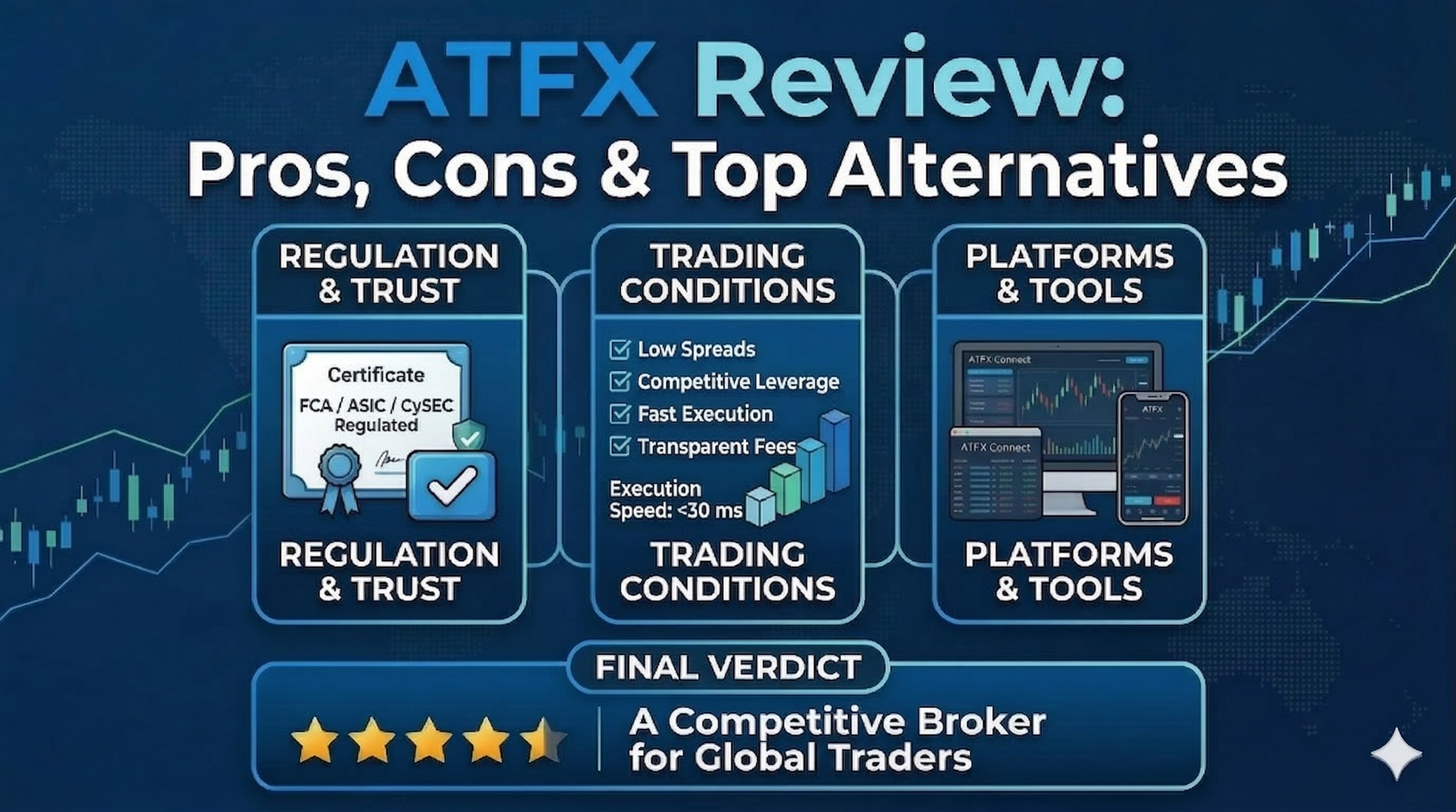
Table of Contents
Is ATFX a Safe and Trustworthy Broker?
What Is ATFX Broker? Company Background
ATFX is a globally regulated forex and CFD broker, but it is better suited for beginners than traders seeking ultra-low costs or advanced tools.
Founded in 2014, ATFX is part of the AT Group and has expanded across Europe, Asia, and the Middle East. The broker offers access to forex, indices, commodities, and CFDs through the atfx trading platform, mainly powered by MetaTrader 4. Features like the atfx demo account and educational resources make it accessible for new traders, while its global presence helps support localized services.
However, what is atfx in practice depends on the entity you register under, as trading conditions, leverage, and protections can vary significantly by region.
View Full ATFX Broker Profile→
Is ATFX Legit and Safe?
ATFX is a legitimate broker with multiple regulatory licenses, but its safety level depends on which entity you trade with.
ATFX Regulation
ATFX is regulated by FCA, ASIC, FSCA, CySEC, and SCA.
- FCA (UK) – License No. 760555
- ASIC (Australia) – License No. 418036
- FSCA (South Africa) – License No. 44816
- CySEC (Cyprus) – License No. 285/15
FCA and ASIC are considered top-tier regulators with strict oversight, while others provide regional regulatory coverage.
You can verify on the ASIC official register or check on the FSCA official website to confirm licensing details.
ATFX is regulated by FCA and ASIC, but regulatory protections may vary depending on the entity.
Client Fund Protection
ATFX uses segregated accounts to keep client funds separate from company funds, which helps reduce the risk of misuse. This is a standard but essential protection mechanism for regulated brokers.
Negative Balance Protection
ATFX offers negative balance protection for retail traders under certain entities, meaning you cannot lose more than your account balance even during extreme market volatility.
Investor Compensation
Under FCA regulation, eligible clients are covered by the Financial Services Compensation Scheme (FSCS), with protection up to £85,000 if the broker becomes insolvent.
ATFX User Reviews, Trustpilot Score & Restricted Countries
ATFX shows generally positive but mixed user sentiment, indicating a reliable broker with some cost-related concerns.
As of March 2026, ATFX holds a Trustpilot rating of approximately 3.5/5 from around 80 reviews, suggesting overall satisfaction but not top-tier performance.
- Positive feedback: fast account setup, responsive support, and stable MT4 performance
- Common complaints: relatively high atfx spread, occasional atfx withdrawal delays, and limited advanced features
This balance of feedback suggests ATFX is reliable but not the cheapest broker in the market.
For more user insights, you can see ATFX reviews on Trustpilot.
ATFX does not accept clients from certain jurisdictions, including the United States and other restricted regions, which may limit access for some traders.
ATFX Account Types, Fees and Trading Costs
ATFX Account Types & Minimum Deposit
ATFX offers simple account structures, but it may not provide the flexibility that advanced traders look for.
The broker mainly provides Standard and Edge accounts, along with Islamic (swap-free) options in certain regions. The atfx minimum deposit typically starts from around $100 for standard accounts, making it accessible for beginners.
| Account Type | Minimum Deposit | Spread Type | Commission |
|---|---|---|---|
| Standard | $100 | From ~1.0 pips | No |
| Edge | $5,000+ | Raw spreads | Yes |
For beginners testing the platform, the atfx demo account is also available, allowing risk-free practice before committing real funds.
ATFX Trading Fees
ATFX trading costs are average overall, but spreads can be slightly higher than top low-cost brokers.
Spreads
The atfx spread on major pairs like EUR/USD typically starts from around 1.0 pips on standard accounts. While this is acceptable for casual trading, it is not the most competitive compared to leading low-spread brokers.
Commission Fees
Standard accounts are commission-free, while Edge accounts charge a fixed commission per lot traded in exchange for tighter spreads.
Swap / Overnight Fees
ATFX applies swap fees on positions held overnight, which vary depending on the instrument and market conditions. Islamic accounts are available for traders who want to avoid swap charges.
ATFX Non-Trading Fees
ATFX keeps non-trading fees relatively low, but some costs still apply depending on account activity and payment methods.
- Inactivity Fees: May apply after a prolonged period of no trading activity
- Deposit Fees: Generally free, though third-party charges may apply
- Withdrawal Fees: Most methods are free, but delays in atfx withdrawal are occasionally reported by users
- Currency Conversion: Charges apply when trading in a different base currency
Overall, this ATFX review finds that the broker offers fair but not industry-leading pricing, making it a reasonable choice for beginners but less attractive compared to some atfx alternative brokers focused on ultra-low costs.
ATFX Trading Platforms, Markets & Tools
Trading Platforms: MT4, MT5 & ATFX App
ATFX focuses on reliable and familiar platforms, but it lacks broader platform diversity compared to some competitors.
The broker primarily offers MetaTrader 4, which remains one of the most widely used platforms globally. Traders can access the platform via desktop, web, or mobile, and the atfx mt4 download process is straightforward. MT4 supports automated trading, custom indicators, and stable execution, making it suitable for both beginners and experienced users.
In some regions, MT5 and a proprietary mobile app are also available, but MT4 remains the core atfx trading platform offering.
What Can You Trade on ATFX?
ATFX provides a solid range of CFD products, though it is not the most extensive in the market.
- Forex (major, minor, and exotic pairs)
- Indices (S&P 500, NASDAQ, FTSE)
- Commodities (gold, oil, silver)
- Shares CFDs
While the selection covers most retail trading needs, some atfx alternative brokers offer a wider range of assets, including cryptocurrencies and ETFs.
Leverage, Margin & Order Execution
ATFX offers flexible leverage, but limits depend on regulation and region.
Retail clients under strict regulators like FCA typically receive leverage up to 1:30, while offshore entities may offer higher ratios. Order execution is generally fast and stable, with minimal slippage under normal market conditions.
However, like most brokers, execution quality can vary during high volatility events.
Educational Resources & Research Tools
ATFX provides strong educational support, making it a good choice for beginner traders.
Resources include webinars, trading guides, market analysis, and a fully functional atfx demo account for practice. These tools help users understand what is atfx and how trading works before risking real capital.
However, advanced research tools and in-depth analytics are somewhat limited compared to premium brokers.
Customer Support & Contact Options
ATFX offers responsive customer support, but availability may vary by region.
Support channels include live chat, email, and phone, with multilingual assistance in key markets. Response times are generally fast, and most user feedback highlights helpful service.
Overall, this ATFX review finds that the broker delivers stable platforms and solid beginner tools, but may fall short for traders seeking advanced features or a wider asset range.
ATFX Broker Review: Pros, Cons & Who It's Best For?
ATFX Broker Advantages & Disadvantages
ATFX is a well-regulated broker with solid platform stability, but its pricing structure may not appeal to cost-sensitive traders.
| Pros | Cons |
|---|---|
| Regulated by FCA, ASIC and other authorities | Spreads are higher than low-cost competitors |
| Low atfx minimum deposit for easy entry | Limited advanced trading tools |
| Stable MT4 environment with reliable execution | No access for US traders |
| Beginner-friendly with atfx demo account support | Asset range is relatively limited |
Who Is ATFX Best For?
ATFX is best suited for traders who value regulation, simplicity, and MT4 reliability, but it may not meet the needs of high-frequency or cost-focused strategies.
Is ATFX a Good Choice for Beginner Traders?
ATFX is a practical starting point for beginners thanks to its low barrier to entry and straightforward account setup. The availability of an atfx demo account, combined with educational resources and a simple interface, makes it easier for new users to understand market basics.
That said, beginners should still be aware that trading costs like the atfx spread are not the lowest in the industry, which may affect long-term profitability.
Overall, ATFX works well for beginners who prioritize ease of use and regulation over ultra-low trading costs.
Is ATFX Suitable for MT4-Focused Traders?
ATFX performs strongly for traders who rely on MetaTrader 4 as their primary platform. The broker provides stable execution, smooth atfx mt4 download access, and compatibility with automated strategies and custom indicators.
However, traders looking for more advanced platforms or integrated analytics may find the offering somewhat limited compared to brokers with broader platform ecosystems.
In general, ATFX is a solid choice for MT4-focused traders who value reliability over platform variety.
Is ATFX Competitive for Scalping or Low-Cost Trading?
ATFX is less competitive for scalpers and traders who depend on tight spreads and minimal fees. The atfx spread on standard accounts is typically higher than ECN-style brokers, which can reduce efficiency for short-term strategies.
While Edge accounts offer improved pricing, the added commission still makes ATFX less attractive compared to some atfx alternative brokers designed specifically for low-cost or high-frequency trading.
For traders focused on minimizing costs or executing frequent trades, ATFX may not be the most optimal option.
Compare ATFX with Other Popular Brokers
ATFX vs XM
ATFX offers stronger top-tier regulation through FCA and ASIC, while XM review provides a broader global presence with multiple licenses and more flexible account options.
In terms of costs, XM generally offers tighter spreads on standard accounts, whereas the atfx spread tends to be slightly higher, especially for casual traders. XM also provides more bonuses and promotional offers compared to ATFX.
ATFX focuses on simplicity and stable MT4 execution, while XM is more beginner-oriented with extensive educational tools and lower entry barriers.
ATFX is better for regulation and platform stability, while XM is more suitable for beginners and lower trading costs.
ATFX vs PU Prime
ATFX stands out for its stronger regulatory framework, while PU Prime review offers more flexible trading conditions with higher leverage options.
PU Prime typically provides lower spreads and more competitive pricing, making it more attractive for active traders. In contrast, ATFX offers a more conservative trading environment with a focus on compliance and risk control.
PU Prime also supports more advanced features such as copy trading, while ATFX remains more focused on traditional MT4-based trading.
ATFX is better for regulation-focused traders, while PU Prime is more suitable for high-leverage and cost-sensitive traders.
ATFX vs IUX
ATFX provides stronger regulatory credibility, while IUX is known for offering lower spreads and more aggressive trading conditions.
IUX generally appeals to traders looking for tight spreads and fast execution, whereas ATFX prioritizes stability and a more structured trading environment. The atfx minimum deposit is accessible, but IUX often offers even more flexible entry conditions.
While ATFX is a safer choice in terms of regulation, IUX is more competitive for traders focused on cost efficiency and short-term strategies.
ATFX is better for safety and regulation, while IUX is more suitable for low spreads and aggressive trading strategies.
FAQs about ATFX Broker
How long does it take to withdraw money from ATFX broker?
ATFX withdrawals typically take 1–3 business days depending on the payment method and verification process. Delays may occur during high demand or additional compliance checks.
How to Open an ATFX Account?
You can open an ATFX account by registering online, submitting identity documents, and completing verification. Once approved, you can fund your account and start trading immediately.
What are the withdrawal options on ATFX?
ATFX supports withdrawals via bank transfer, credit/debit cards, and selected e-wallets. The availability of methods may vary depending on your region.
What is the minimum deposit for ATFX?
The atfx minimum deposit typically starts from $100 for a standard account. Higher-tier accounts may require larger deposits depending on the trading conditions.
How does ATFX work?
ATFX works by providing access to CFD trading through platforms like MT4, where users can trade forex, indices, and commodities. Traders speculate on price movements without owning the underlying assets.
Where is ATFX located?
ATFX is headquartered in London, United Kingdom, with offices in Europe, Asia, and the Middle East. Its global presence supports clients across multiple regions.
ATFX Broker Quick Verdict
This ATFX review finds that ATFX is a well-regulated broker with stable MT4 performance and beginner-friendly features. It offers solid reliability and global coverage, but spreads are not the most competitive. Overall, ATFX is a safe and practical choice for beginners and regulation-focused traders, but less ideal for low-cost or high-frequency trading strategies.
Editorial Transparency: This ATFX review is based on information from the official ATFX website, regulatory filings (FCA, ASIC, FSCA, CySEC), and independent third-party sources such as Trustpilot. We cross-checked trading conditions, fees, and user feedback to ensure accuracy and objectivity. This content is for educational purposes only and does not constitute financial advice. Last updated: March 2026.



Hottest



Copyright © 2026 FastBull Ltd


Risk Warning
FX trading is of high risk and may not be suitable for all investors. Leverage will create additional risks and loss. Before trading, please carefully consider your investment objectives, experience level and risk tolerance. You may lose part or all of your initial investment; do not invest money that you cannot afford. Educate yourself about the risks associated with FX trading. If you have any questions, please consult an independent financial or tax advisor. Any data and information are provided "as is" and only for information purpose, not for trading or recommendations. Past performance does not predict future results.
Disclaimer
The data contained in this website may not be real-time and accurate. The data and prices on this site are not necessarily provided by the market or exchange, but may be provided by market makers, so prices may be inaccurate and differ from actual market prices. Namely, this price is indicative price only to reflect market trend, and is unfavorable for trading purpose. The provider of the data contained in the Website shall not be liable for any loss incurred by you as a result of your trading activities or reliance on the information contained in the Website.