


Gold Extends Rebound Above $3,630 as Softer Dollar and Tech Recovery Lift Prices
Key Takeaways
-Gold traded near $3,630.44, up $64.14 or 1.80%, after reaching a high of $3,637.00.
-A softer US dollar and a rebound in technology and AI shares supported the move.
-Traders are watching $3,637-$3,640 as immediate resistance, with $3,600-$3,605 as first major support.
-US employment data and the 9 December Federal Reserve decision are the next major catalysts.

Gold advanced on Friday, 27 November, extending its recovery after a volatile week. The metal pushed out of the earlier $3,560-$3,580 consolidation range, with several strong green candles carrying it through $3,600 and $3,620 and leaving prices above the rising nine-period moving average.
The latest move reflects a softer dollar and improving sentiment towards technology shares. However, the speed of the advance leaves gold vulnerable to profit-taking as it approaches the recent high.
Why Traders Are Watching Gold
The main obstacle to the rebound is the possibility of further US interest rate increases. Minutes from the Federal Reserve's October meeting showed that almost all participants considered additional tightening likely to be appropriate under their baseline outlook, keeping inflation and employment data central to gold's direction.
Trump's recent tariff proposal adds another layer of uncertainty. Tariffs could encourage demand for defensive assets, but they could also reinforce inflation concerns and expectations of tighter monetary policy. Traders are weighing which effect will prove stronger: demand for protection or the prospect of higher rates.
Key factors influencing gold include:
-Fed policy: Whether the 9 December decision and updated projections point to further tightening in early 2027.
-Labour data: The 1 December JOLTS report and 4 December employment report could reshape rate expectations.
-Dollar and yields: Continued dollar weakness and lower Treasury yields could sustain the rebound, while a reversal in either would make gains harder to hold.
-Equities: Stabilisation in technology shares could ease pressure on investors to sell liquid assets to cover losses elsewhere.
-Trade policy: Tariff announcements could influence both defensive buying and inflation expectations.
Key Trading Levels
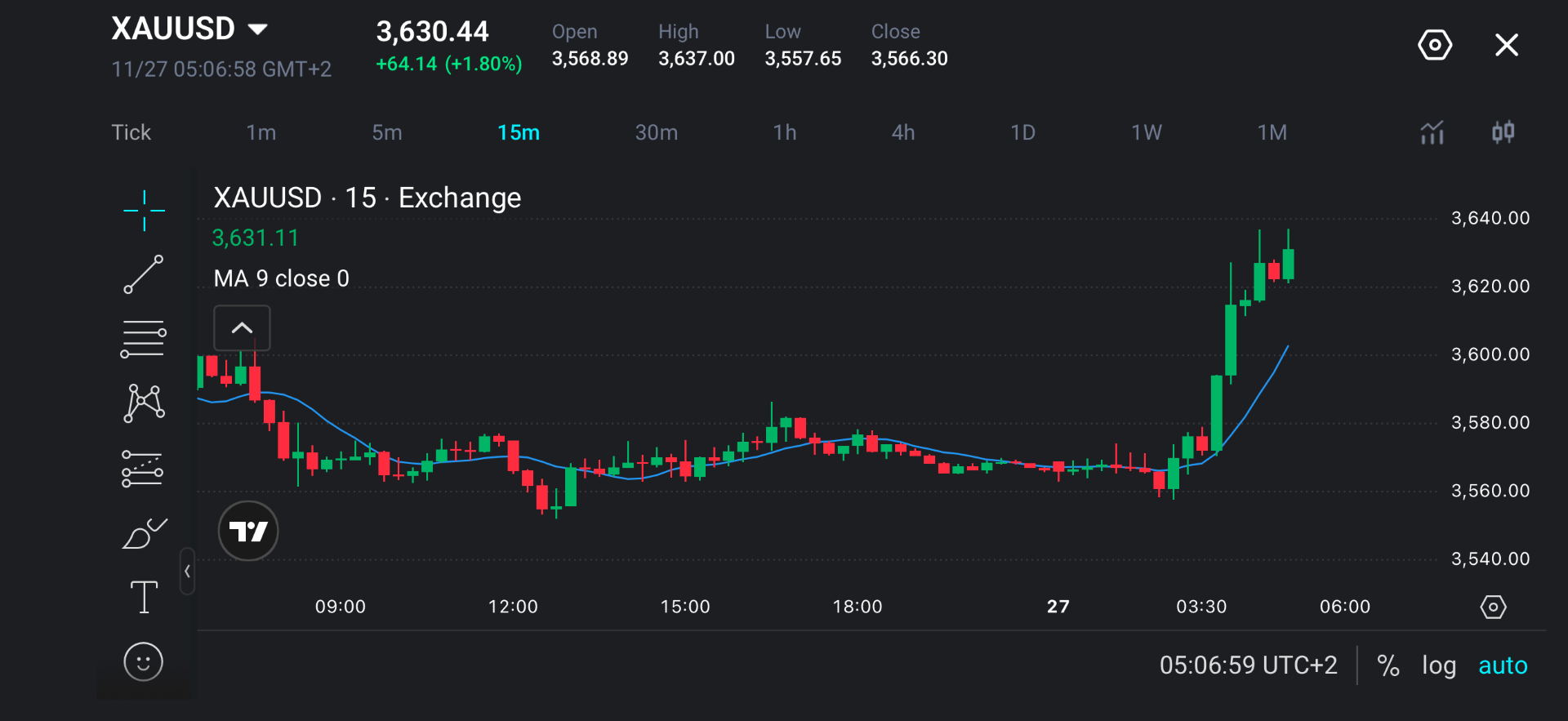
Gold is consolidating around $3,630.44, well above the nine-period moving average, which sits near $3,600-$3,605. The sharp advance has widened the gap between price and the average, suggesting scope for consolidation as traders assess whether buying momentum can be sustained.
A 15-minute close above $3,637-$3,640, followed by a successful retest, would suggest improving momentum and could open the way towards the $3,650 psychological level. Higher lows, supported by a weaker dollar and lower yields, would strengthen that view. A controlled pullback that holds $3,600-$3,605 and closes back above $3,620 would also show buyers remain active.
On the downside, rejection at $3,637-$3,640 followed by a 15-minute close below $3,600 would suggest the rebound is losing momentum. A failed recovery beneath $3,600-$3,605 could expose $3,580, and a sustained break below $3,575-$3,580 could extend selling into the $3,560-$3,570 base, just above the session low of $3,557.65.
Gold Prediction: Can the Rebound Hold?
Gold's next move depends on whether softer dollar conditions outweigh the risk of prolonged tightening.
A recovery could continue if gold holds above $3,620-$3,630 on a retest, with $3,640 and $3,650 as the next targets. However, firm employment figures or rising Treasury yields could cap gains, shifting focus back to $3,600 support and then $3,580.
For a deeper analysis of gold's technical levels, rate outlook and potential scenarios, read this article.
Hottest





Copyright © 2026 FastBull Ltd


Risk Warning
FX trading is of high risk and may not be suitable for all investors. Leverage will create additional risks and loss. Before trading, please carefully consider your investment objectives, experience level and risk tolerance. You may lose part or all of your initial investment; do not invest money that you cannot afford. Educate yourself about the risks associated with FX trading. If you have any questions, please consult an independent financial or tax advisor. Any data and information are provided "as is" and only for information purpose, not for trading or recommendations. Past performance does not predict future results.
Disclaimer
The data contained in this website may not be real-time and accurate. The data and prices on this site are not necessarily provided by the market or exchange, but may be provided by market makers, so prices may be inaccurate and differ from actual market prices. Namely, this price is indicative price only to reflect market trend, and is unfavorable for trading purpose. The provider of the data contained in the Website shall not be liable for any loss incurred by you as a result of your trading activities or reliance on the information contained in the Website.