


- GBPUSD
- XAUUSD
- XAGUSD
- WTI
- USDX


견적
분석
사용자
7x24
경제 일정
교육
데이터
- 이름
- 최신 값
- 이전











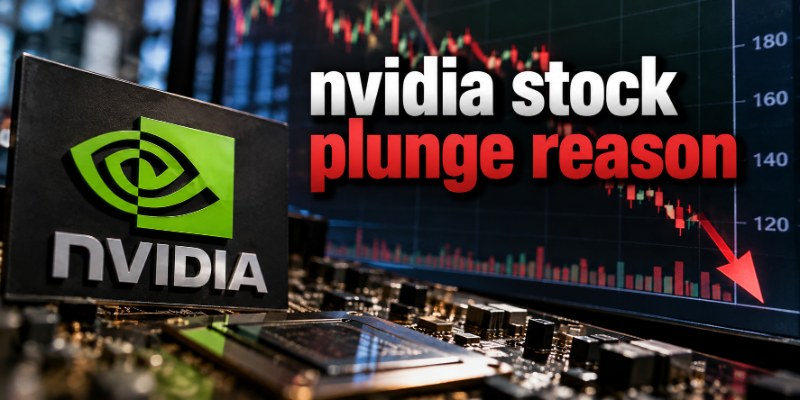
2026년 엔비디아 주가가 급락하는 이유는 무엇일까요? 중국의 반도체 규제, AI 투자 우려, 경쟁 심화, 그리고 기업 가치 평가 위험 등 엔비디아(NVDA) 주가 하락의 주요 원인을 분석해 보세요.
2026년 10월 엔비디아 주가가 하락세를 보이면서 투자자들은 인공지능(AI) 붐의 최대 수혜자 중 하나인 엔비디아가 왜 어려움을 겪는지 의아해하고 있습니다. 그 원인은 단순히 한 가지 실망스러운 헤드라인 때문만은 아닙니다. 중국의 수출 제한, 심화되는 경쟁, 인플레이션 우려, 그리고 AI 투자에 대한 불확실성 등이 엔비디아의 사업 기반은 지속적으로 성장하고 있음에도 불구하고 주가에 부담을 주고 있습니다.
목차
엔비디아 주가 하락의 주된 원인은 회사 고유의 위험 요소와 기술주 전반에 걸친 압력이 복합적으로 작용한 결과입니다.
10월 14일, 엔비디아 주가는 오후 거래에서 약 3.6% 하락했습니다. 예상보다 높은 미국 인플레이션 데이터로 인해 국채 수익률이 상승한 데다, 엔비디아의 중국 칩 출하량 감소와 대체 AI 프로세서와의 경쟁 심화에 대한 보고서도 투자자들의 반응에 영향을 미쳤습니다.
이러한 상황 전개로 인해 투자자들은 엔비디아의 미래 수익에 대해 얼마를 지불할 의향이 있는지 다시 생각해 보게 되었습니다.
엔비디아 주가는 2026년 10월 6일 약 243.37달러로 52주 최고가를 기록했습니다. 10월 29일 종가 기준으로 주가는 약 213.66달러로, 최고가 대비 약 12.2% 하락했습니다.
이는 의미 있는 조정이지만, 20% 하락이라는 약세장 수준에는 미치지 못합니다.
이러한 구분이 중요한 이유는 엔비디아의 주가 하락이 반드시 사업 축소를 의미하는 것은 아니기 때문입니다. 투자자들은 단순히 주가 급등 이후 기대치를 조정하고 있을 수도 있습니다.
| 요인 | NVDA에게 중요한 이유 |
|---|---|
| 중국 수출 제한 조치 | 엔비디아의 주요 AI 칩 시장 접근을 제한하라 |
| 화웨이와의 경쟁 및 맞춤형 칩 | 시장 점유율과 가격 결정력을 위협한다 |
| 높은 주식 가치 평가 | 이는 주가가 성장 기대치 변화에 취약하게 만든다. |
| 인플레이션과 금리 | 고평가된 기술주에 압력을 가하세요 |
| AI 지출 우려 | 반도체 수요의 지속가능성에 대한 의문을 제기합니다. |
| 이윤폭 압박 | 매출 호조에도 불구하고 수익 성장률이 둔화될 수 있다. |
이러한 위험들은 서로 연결되어 있습니다. 투자자들이 미래 성장에 대한 확신이 약해지면, 당장 실적이 악화되지 않더라도 엔비디아의 기업 가치를 낮게 평가할 가능성이 있습니다.
중국은 인공지능 컴퓨팅 하드웨어의 중요한 시장으로 남아 있지만, 엔비디아가 자사의 최첨단 칩을 중국에 판매하는 데에는 미국의 수출 규제가 제약을 가해왔습니다.
IDC 데이터를 기반으로 한 보고서에 따르면 엔비디아는 2026년 상반기에 중국에 약 67만 8천 대의 AI 가속기를 출하했는데, 이는 전년 동기 대비 44% 감소한 수치입니다.
Its reported share of China's AI chip market fell to 34%, while Huawei gained ground with a share of approximately 28%.
These figures highlight a problem that extends beyond short-term revenue.
If Chinese technology companies build their AI infrastructure around domestic processors, Nvidia may struggle to regain customers even if export restrictions eventually ease.
This creates two risks for investors: lost sales today and potentially weaker competitive positioning tomorrow.
The concern is not that Nvidia has lost its global leadership in AI chips. It is that geopolitical restrictions could permanently reduce its opportunity in one of the world's largest technology markets.
Nvidia's extraordinary growth has been supported by massive investment in AI infrastructure.
Microsoft, Alphabet, Amazon, Meta, and other technology companies have spent heavily on data centers, GPUs, networking equipment, and computing capacity.
That spending has been enormously beneficial for Nvidia.
However, investors increasingly want evidence that AI infrastructure investments will generate attractive financial returns.
Building AI data centers is expensive. Companies must pay for hardware, electricity, cooling, networking, and ongoing operations.
If AI-related revenue fails to grow quickly enough, major customers could eventually slow their capital expenditure plans.
Even a moderate slowdown could affect Nvidia because its valuation reflects expectations of continued strong growth.
This does not mean the AI investment cycle is ending. It means the market is paying closer attention to whether spending can remain elevated over several years.
Nvidia remains the leading supplier of high-performance AI accelerators, supported by its CUDA software ecosystem and integrated computing platforms.
But its customers are also developing alternatives.
Google has its Tensor Processing Units, Amazon develops Trainium processors, and Microsoft has invested in its Maia AI chip family.
AMD is another competitor targeting the AI accelerator market.
Custom chips can be attractive for large cloud companies because they may offer lower costs or better efficiency for specific workloads.
They do not need to outperform Nvidia across every application to become commercially meaningful.
If hyperscalers shift some AI workloads to their own processors, Nvidia could face slower growth in certain product categories.
The key issue is not whether competitors will completely replace Nvidia. It is whether Nvidia can maintain its market share, pricing power, and margins as customers gain more choices.
Nvidia's share price is also influenced by economic conditions that have little to do with chip demand.
Higher inflation can push bond yields upward and reduce expectations for interest-rate cuts.
That matters particularly for growth stocks.
When interest rates rise, investors generally place a lower present value on earnings expected far into the future. Companies trading at elevated earnings multiples can therefore experience larger price declines.
This dynamic was visible during the October 14 selloff, when stronger inflation data contributed to broad weakness across technology and semiconductor stocks.
Nvidia is especially sensitive to changes in market sentiment because investors expect it to deliver substantial earnings growth for years.
Even strong companies can experience sharp corrections when financial conditions become less favorable.
One of Nvidia's biggest stock-market challenges is that investors already expect exceptional results.
Strong earnings alone may not be enough to push NVDA higher.
The company often needs to exceed forecasts, deliver convincing guidance, and reassure investors that future demand remains robust.
Consider two possible situations:
In either case, the stock could decline despite impressive headline results.
This is the difference between a successful company and a successful investment at a particular price.
A business can continue expanding while its stock falls because the market previously priced in even faster growth.
Despite the stock decline, Nvidia's latest reported financial results show that demand for its AI products remains strong.
According to Nvidia's official second-quarter fiscal 2027 earnings release, the company reported record revenue for the quarter ended July 26, 2026.
| Financial Metric | Q2 FY2027 Result | Year-over-Year Change |
|---|---|---|
| Total revenue | $96.2 billion | +106% |
| Data Center revenue | $89.0 billion | +117% |
| GAAP net income | $59.7 billion | +126% |
| GAAP gross margin | 75.0% | +2.6 percentage points |
| GAAP diluted EPS | $2.46 | +128% |
The numbers do not suggest an immediate collapse in Nvidia's core business. Revenue more than doubled year over year, while Data Center sales continued to dominate its growth.
Management also projected approximately $108 billion in revenue for the following quarter, although that outlook excluded Data Center compute revenue from China.
That last detail is important. Nvidia is still growing rapidly, but the company is planning around significant geopolitical limitations.
Investors buy stocks based on future expectations, not simply past performance.
Nvidia's recent results demonstrate substantial demand for AI infrastructure. However, the stock market must also consider how long that demand can continue and whether future profits justify the share price.
If earnings grow more slowly than expected, Nvidia's valuation multiple could contract.
For example, a stock trading at 35 times expected earnings would be worth roughly 20% less at 28 times earnings, assuming the earnings forecast remained unchanged.
This illustrates how a share price can fall sharply without a comparable decline in company profits.
A recovery is possible, particularly if Nvidia continues delivering strong earnings and investors regain confidence in long-term AI spending.
However, the timing and size of any rebound will depend on several developments.
In a bullish scenario, Nvidia maintains its leadership in AI computing while demand for advanced chips continues expanding.
The company benefits from increased AI inference workloads, the rollout of newer architectures, and continued investment by major cloud providers.
Strong revenue growth and stable profit margins could encourage investors to assign Nvidia a higher valuation again.
An improvement in export conditions would provide another potential catalyst, although it is not necessary for Nvidia to continue growing outside China.
Nvidia could continue reporting impressive financial results while its share price moves sideways or experiences additional corrections.
This would be consistent with a market gradually adjusting its valuation expectations.
Revenue growth might remain strong but moderate from exceptionally high levels. Meanwhile, concerns about interest rates, competition, and AI infrastructure spending could limit near-term gains.
Under this scenario, the company remains financially successful, but investors experience more modest returns than during the earlier AI-driven rally.
The bearish case would become more convincing if major technology companies reduced AI capital expenditure, competitors gained meaningful market share, or Nvidia experienced sustained margin pressure.
Export restrictions could also create further problems if they expand or prevent Nvidia from participating in important overseas markets.
A combination of slower earnings growth and a lower valuation multiple could produce additional stock declines.
These scenarios describe possible outcomes rather than specific price forecasts.
The next major developments will help determine whether Nvidia's recent correction is temporary or signals a more lasting change in market expectations.
| Indicator | Positive Signal | Warning Sign |
|---|---|---|
| Data Center revenue | Continued strong growth | Growth slows more than expected |
| Gross margin | Remains near recent levels | Sustained margin compression |
| AI capital expenditure | Cloud providers maintain spending | Major customers reduce investment |
| China export policy | Improved market access | Additional restrictions |
| AI chip competition | Nvidia maintains leadership | Custom chips capture more workloads |
| Interest rates | Lower yields support valuations | Higher yields pressure growth stocks |
엔비디아의 매출총이익률은 특히 주목할 만합니다. 이 회사는 최근 분기에 GAAP 기준 75.0%의 매출총이익률을 기록했으며, 다음 분기에는 약 74.0%를 예상한다고 밝혔습니다.
소폭 감소가 반드시 심각한 문제를 의미하는 것은 아닙니다. 제품 전환, 제조 비용, 판매 구성 변화 등이 모두 수익성에 영향을 미칠 수 있습니다.
하지만 지속적인 마진 약화와 매출 성장 둔화가 겹친다면 더욱 우려스러운 상황이 될 것입니다.
투자자들은 엔비디아의 공식 재무 보고서와 분기별 실적 발표를 통해 향후 전망, 매출 구성 및 경영진의 논평 변경 사항을 확인할 수 있습니다.
주가가 낮아지면 투자 수익률이 높아질 수 있지만, 그렇다고 해서 주식이 자동으로 저렴해지는 것은 아닙니다.
이번 결정은 엔비디아의 향후 수익이 현재 기업 가치를 뒷받침할 수 있는지 여부와 투자자가 얼마나 추가적인 변동성을 감수할 의향이 있는지에 달려 있습니다.
장기 투자자에게 가장 중요한 질문은 AI 컴퓨팅 수요가 계속 확대될 것인지, 엔비디아가 경쟁 우위를 지킬 수 있을지, 그리고 현재의 기업 가치가 실망스러운 결과를 감수할 여지를 충분히 제공하는지 여부입니다.
단기 투자자들은 다른 어려움에 직면합니다. 엔비디아의 주가 변동은 인플레이션 발표, 실적 발표, 수출 정책 관련 소식, 그리고 나스닥 전반의 시장 분위기에 따라 좌우될 수 있습니다.
급격한 가격 하락은 구매자를 끌어들일 수 있지만, 근본적인 우려가 해결되지 않으면 추가적인 매도가 이어질 수도 있습니다.
따라서 투자자들은 시장 심리에 의해 주로 발생하는 조정과 기업 펀더멘털 악화에 의해 뒷받침되는 조정을 구분해야 합니다.
엔비디아의 재무 성과는 현재 낙관적인 전망을 제시하지만, 경쟁, 지정학적 제약, 그리고 기업 가치 평가는 여전히 중요한 위험 요소로 남아 있습니다.
2026년 엔비디아 주가 폭락은 하나의 대형 사업 실패 때문이 아닙니다.
대신 투자자들은 여러 가지 복합적인 우려에 반응하고 있습니다. 즉, 중국 AI 칩 시장 접근성 약화, 경쟁 심화, 향후 AI 투자에 대한 불확실성, 그리고 고평가된 기술주에 대한 거시경제적 압력 등이 그것입니다.
동시에 엔비디아는 탁월한 매출 성장과 견고한 수익성을 지속적으로 기록하고 있습니다.
이는 중요한 차이점을 만들어냅니다. 엔비디아의 주가는 약세를 보였지만, 핵심 사업은 그에 상응하는 악화를 보이지 않았습니다.
NVDA의 회복 여부는 과거의 성공보다는 성장을 지속하고, 수익성을 보호하며, 투자자들의 기대를 충족시킬 수 있는 능력에 더 크게 달려 있습니다.
현재 핵심 질문은 엔비디아가 여전히 인공지능 분야의 선두 기업인지 여부가 아니라, 투자자들이 그 리더십에 얼마를 지불해야 하는가입니다.
본 기사는 정보 제공 목적으로만 작성되었으며 투자 조언을 구성하지 않습니다.

728 RM B 7/F GEE LOK IND BLDG NO 34 HUNG TO RD KWUN TONG KLN HONG KONG


주식, FX, 상품, 선물, 채권, ETF 또는 암호화폐와 같은 금융 자산 거래의 손실 위험은 상당할 수 있습니다. 중개인에게 자금을 예치할 경우, 이 자금이 전부 손실될 수도 있습니다. 따라서 귀하의 상황과 재정 상황에 비추어 그러한 거래가 귀하에게 적합한지 신중하게 고려해야 합니다.
본인 스스로 나름대로 철저히 조사를 하거나 재무 관련 상담가와 상의하지 않고는 이러한 투자는 고려해서는 안됩니다. 이런 절차 없이 투자할 경우, 귀하의 재정 상태와 투자 요구 사항을 알지 못한 상태에서 하는 투자이기 때문에 당사의 웹 콘텐츠는 귀하에게 적합하지 않을 수 있습니다. 당사의 재무 정보가 최신으로 업데이트 되는 데는 지연이 있을 수 있고, 부정확한 내용이 포함될 수도 있으므로 모든 거래 및 투자 결정에 대한 책임은 투자자 본인의 몫입니다. 회사는 귀하의 자본 손실에 대해 책임을 지지 않습니다.
웹사이트의 허가 없이 웹사이트 그래픽, 텍스트 또는 상표를 복사할 수 없습니다. 이 웹사이트에 포함된 콘텐츠 또는 데이터에 대한 지적 재산권은 해당 공급자 및 거래소 판매자에게 있습니다.




