- WTI
- XAUUSD
- XAGUSD
- USDX


견적
분석
사용자
7x24
경제 일정
교육
데이터
- 이름
- 최신 값
- 이전










이 루시드 트레이딩 리뷰를 읽고 규칙, 계좌 유형, 수익 지급 방식, 수수료, 트러스트파일럿 평점, 그리고 이 선물 거래 회사가 2026년에도 합법적인지 여부를 알아보세요.
루시드 트레이딩(Lucid Trading)은 전통적인 증권 계좌를 개설하지 않고도 자금 지원을 받아 선물 거래를 하고 싶어하는 트레이더들을 위해 설립된 빠르게 성장하는 선물 전업 거래 회사입니다. 이 루시드 트레이딩 리뷰에서는 회사가 제공하는 서비스, 운영 규칙, 수익금 및 수수료 관련 복잡한 사항, 그리고 2026년에도 선물 거래에 적합한 선택지인지에 대해 자세히 살펴봅니다.
이번 Lucid Trading 리뷰에서는 다음 내용을 다루겠습니다.
루시드 트레이딩(Lucid Trading)은 2025년에 설립된 선물 거래 전문 회사입니다. 이 회사는 사용자가 직접 자본을 예치하고 거래하는 기존 증권 계좌와는 달리, 선물 거래자를 위한 평가 및 자금 지원 계좌 프로그램을 제공합니다. 거래자는 계좌 이용료를 지불하고 루시드 트레이딩의 위험 관리 규칙을 준수해야 하며, 회사의 성과 요건을 충족할 경우 수익을 지급받을 수 있습니다.
공개된 법률 문서에 따르면 운영 법인은 Lucid Trading Group LLC로 명시되어 있지만, 회사는 공개 웹사이트에서 설립자 정보를 눈에 띄게 공개하지 않습니다. 따라서 법인 정보는 설립자나 경영진의 배경 정보보다 확인하기 쉬우므로, 투자자들은 회사를 평가할 때 이 점을 유념해야 합니다.
2025년과 2026년에 Lucid Trading에 대한 검색 관심이 급증했는데, 이는 주로 제휴 사이트, YouTube 리뷰, 전업 트레이딩 회사 비교 페이지, 쿠폰 코드 검색, 트레이딩 커뮤니티 등 다양한 곳에서 해당 브랜드가 등장했기 때문입니다. 이러한 관심은 주로 수익 증명, 할인 코드, 규칙 설명, 그리고 Topstep, Apex, Tradeify와 같은 기존 선물 전업 트레이딩 회사와의 비교 정보를 찾는 트레이더들로부터 비롯되었습니다.
Lucid Trading은 실제로 운영 중인 선물 거래 전문 회사로 보이지만, 전통적인 규제 대상 브로커는 아닙니다. Trustpilot에서 높은 평점을 받은 것은 유용한 피드백이지만, 모든 거래자가 수익금을 받을 자격이 있거나 회사가 브로커 수준의 규제 보호를 받는다는 증거로 받아들여서는 안 됩니다.
루시드 트레이딩의 법률 문서에 따르면 해당 서비스의 운영 회사는 루시드 트레이딩 그룹 LLC입니다. 이 회사의 사업 모델은 일반적인 증권 중개 서비스가 아닌, 자체 거래 방식의 선물 거래 프로그램, 모의 계좌, 계좌 규칙 및 수익 지급 자격에 기반합니다.
이것이 핵심적인 규제 사항입니다. 트레이더는 루시드 트레이딩을 고객 예치금을 보유한 외환 브로커나 선물 브로커처럼 평가해서는 안 됩니다. 대부분의 전업 트레이딩 회사에서는 트레이더가 평가 프로그램이나 자금 지원 프로그램에 참여하기 위해 비용을 지불하며, 수익은 계약 조건, 규정 준수 및 계좌 상태에 따라 달라집니다. 이는 위험을 제거하는 것이 아니라, 위험이 발생하는 위치를 바꾸는 것일 뿐입니다.
계좌를 구매하기 전에 거래자는 Lucid 거래 규칙 지침 의 이용 약관, 계좌 계약, 지급 정책, 제한 국가 및 규칙 페이지를 확인해야 합니다 .
As of June 23, 2026, the reviewed Trustpilot snapshot showed Lucid Trading with 4,309 reviews, a 4.6 out of 5 rating, and a category listing under Alternative Financial Service. That is a strong public-review profile for a newer prop firm, but it still needs context.
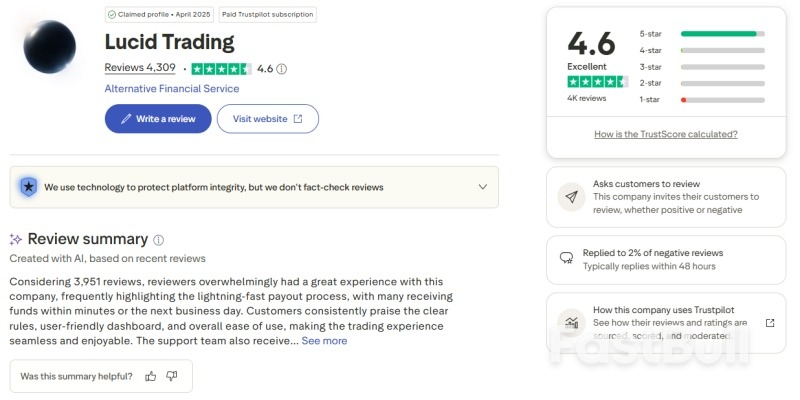
Positive reviews commonly focus on fast payouts, clear rules, a smooth lucid trading dashboard, ease of use, and responsive support. These are important because prop firm users care less about traditional spreads and more about whether the account is understandable, the platform works, and payout requests are handled quickly.
Lower-rated reviews should not be ignored. In prop firm reviews, complaints often involve verification checks, support delays, payout disputes, rule misunderstandings, or disagreement over whether a trading rule was breached. That does not automatically mean the firm is unsafe, but it does mean traders should read the negative reviews as carefully as the five-star comments on Lucid Trading Trustpilot reviews.
The smartest way to judge Lucid Trading is to verify the current rules before paying, because prop firm terms can change faster than old reviews or social media videos. A trader should not rely only on a discount page, influencer review, or one payout screenshot.
| What to Check | Why It Matters |
|---|---|
| Account rules | Drawdown, daily loss limits, and trading restrictions can determine whether the account survives. |
| Country restrictions | Some locations may be blocked or limited, even if a trader can access the website. |
| Payout conditions | Minimum profit, trading days, verification, and payout cycles affect how quickly money can be withdrawn. |
| Consistency rule | A large winning day may delay or reduce payout eligibility if it exceeds the account's allowed percentage. |
| Platform and data fees | Trading platform access, data feed costs, or activation charges can change the real cost of starting. |
| Refund and reset policy | Reset fees, chargeback rules, and refund limits can matter if the account is breached or unused. |
| Identity verification | KYC or payout verification issues can slow down withdrawals if documents do not match account details. |
For the latest account terms, traders should review the Lucid Trading Help Center before purchasing any lucid funded trading account.
Lucid Trading offers several account paths, and the best choice depends on whether you want a lower-cost evaluation, a straight-to-funded model, or an invite-only live capital program. The main options are LucidFlex, LucidPro, LucidDirect, and LucidMaxx.
| Account Type | Best For | Core Structure | Key Rule Difference |
|---|---|---|---|
| LucidFlex | Traders who want a flexible evaluation path | Evaluation first, then funded-style simulated account | LucidFlex funded accounts currently advertise no daily loss limit, no funded-stage consistency rule, and EOD trailing drawdown. |
| LucidPro | Traders who want a more traditional prop firm evaluation model | Evaluation account with upgrade to funded account after meeting objectives | LucidPro funded payouts use a 40% consistency percentage and may include buffer balance requirements. |
| LucidDirect | Traders who want to skip the evaluation phase | Straight-to-funded simulated account | LucidDirect has payout goals, a 20% consistency percentage, and daily loss limit rules on larger accounts. |
| LucidMaxx | Experienced traders invited into a higher-tier live path | Invite-only live futures prop account | LucidMaxx is positioned around instant live capital, daily uncapped payouts, and no daily loss limit. |
LucidFlex is the more flexible evaluation-style route for traders who want to prove consistency before moving into a funded-style account. According to Lucid Trading's Help Center, LucidFlex evaluation accounts use profit targets, max loss limits, and a 50% consistency requirement during the evaluation stage.
The important difference comes after funding. LucidFlex funded accounts are described as simulated futures trading accounts with a 90/10 profit split, EOD trailing drawdown, no daily loss limit, no funded-stage consistency percentage, and no payout buffer. That makes LucidFlex more attractive for traders who dislike strict daily loss limits but can still manage end-of-day drawdown risk.
LucidPro is better suited to traders who are comfortable with a more structured prop firm model. It uses an evaluation-to-funded path and has payout requirements that include minimum profit, consistency rules, and buffer balance thresholds.
The key rule to understand is the LucidPro consistency percentage. LucidPro funded accounts require the largest single-day profit to be no more than 40% of total profit during the payout cycle. This can be fair for steady traders, but it can delay payout eligibility for traders who make most of their profit in one unusually large day.
LucidDirect is the straight-to-funded option. Instead of passing an evaluation first, traders purchase a LucidDirect account and begin building simulated capital toward payout eligibility immediately.
This account type can appeal to confident traders who do not want a separate challenge phase. The trade-off is that LucidDirect has stricter payout math than it may first appear: the Help Center lists a 20% consistency percentage, payout profit goals, minimum payout requirements, and daily loss limit rules for larger account sizes.
LucidMaxx is not a standard account that every new user can simply choose at checkout. Lucid describes it as an invite-only live futures prop account designed for selected traders.
The main appeal is clear: LucidMaxx is positioned around instant live capital, daily payout requests, no payout caps, up to five accounts, no daily loss limit, and end-of-day drawdown. Because it is invite-only, traders should not treat LucidMaxx as the normal starting point for a lucid funded trading journey.
The best Lucid Trading account depends on your trading style, risk tolerance, and payout expectations. Most traders should choose based on rules first, price second.
For most newer traders, LucidFlex will likely be easier to understand than LucidDirect because the payout structure is less punishing once the funded account is reached. For aggressive traders, however, any account can become difficult if position sizing ignores drawdown, daily loss limits, or the consistency rule.
Lucid Trading rules matter because they determine whether profits are actually withdrawable. A trader can be profitable on the chart and still fail to qualify for a payout if the account violates drawdown limits, daily loss limits, consistency requirements, trading-time rules, or prohibited-strategy rules.
The safest approach is to read the latest Lucid Trading rules before buying an account or requesting a payout.
Lucid Trading's main risk controls work in different ways. Drawdown protects the account from total loss, the daily loss limit controls how much can be lost in one session, and the consistency rule checks whether profits were earned steadily instead of from one oversized trading day.
| Rule | What It Controls | Why It Affects Payouts |
|---|---|---|
| EOD drawdown | The account's maximum loss limit based on end-of-day balance calculations | If the account hits the max loss limit, the account may be liquidated or fail. |
| Daily loss limit | The maximum amount a trader can lose in one trading session | In Lucid's current wording, daily loss limit breaches can restrict trading until the next session if the max loss limit has not been reached. |
| Consistency percentage | The share of total profit made on the biggest winning day | If one day accounts for too much profit, the trader may need to keep trading before becoming payout eligible. |
Here is the simple consistency-rule trap. If a LucidPro trader has $4,000 in account profit and the largest single-day profit is $1,000, the consistency percentage is 25%. That is under the LucidPro 40% limit. But if the largest day is $2,000 out of $4,000 total profit, the percentage is 50%, so the trader may need more qualifying profit before requesting a payout.
This is why the answer to "does Lucid Trading have a consistency rule" is not one-size-fits-all. LucidPro, LucidDirect, LucidFlex evaluation accounts, and LucidMaxx rules can differ. Traders should verify the current LucidPro consistency percentage and LucidFlex drawdown rules before trading.
Lucid Trading appears more flexible than some futures prop firms on news trading, but it still restricts strategies that look unrealistic or system-abusive. Its Help Center says news trading is allowed, while traders remain responsible for volatility, slippage, and execution outcomes during news-driven markets.
Scalping is more nuanced. Genuine scalping is permitted, but microscalping is prohibited when it appears designed to exploit simulated fills rather than reflect realistic market activity. Lucid's Help Center says accounts may be flagged when more than 50% of profits come from trades held for five seconds or less.
Overnight positions depend on account status. For LucidPro, LucidFlex, and LucidDirect accounts, Lucid states that all positions must be closed by 4:45 PM EST Monday through Friday, and open positions may be automatically closed. LucidLive accounts are different: swing trading and overnight holds may be allowed if the trader meets live-account margin and onboarding requirements.
Older Lucid Trading reviews may be outdated because the firm has changed account structures, live-trading paths, payout terms, and legacy account pages over time. A video or blog post from early 2025 may not reflect the current LucidFlex, LucidPro, LucidDirect, or LucidMaxx rules.
This matters most before paying, resetting, upgrading, or requesting a payout. A trader who follows an old rule summary may misunderstand the current consistency percentage, payout goal, allowed trading times, or live-account transition process.
Before relying on any lucid trading review, discount page, or social media claim, traders should check the latest articles in the Lucid Trading Help Center. If you are using an older LucidFlex structure, also check whether any LucidFlex legacy rules still apply to your account.
Lucid Trading payouts are one of the firm's biggest selling points, but the real answer depends on account type, payout cycle, consistency rules, and whether the account falls under newer or legacy terms. Traders should read the current payout page before assuming every profit dollar is immediately withdrawable.
Lucid Trading's current funded account payout structure is generally a 90/10 split, meaning the trader keeps 90% of approved payouts and Lucid Trading keeps 10%.
The "first $10,000 rule" needs careful wording. According to LucidPro payout terms, accounts purchased or reset before November 28, 2025 at 3:00 PM EST may still be eligible for 100% of the first $10,000. Newer accounts should not assume that legacy benefit applies unless the lucid trading dashboard or official account terms confirm it.
| Payout Term | What It Means | Why Traders Should Care |
|---|---|---|
| 90/10 split | Trader keeps 90% of approved payout amounts. | This is the standard structure for many current Lucid funded trading accounts. |
| First $10,000 rule | Legacy LucidPro accounts may keep 100% of the first $10,000. | This appears tied to older purchase or reset dates, not every new account. |
| Minimum payout | Several account types list a $500 minimum payout request. | Small profits may not be withdrawable until minimum thresholds are met. |
A payout cycle at Lucid Trading is not just "make money, click withdraw." The account must meet payout rules, stay above required thresholds, and avoid violations before the request is approved.
| Cycle | What the Trader Does | What Can Delay the Payout |
|---|---|---|
| Cycle 1 | Build enough profit to meet the minimum payout goal and trading-day requirements. | A single oversized winning day may break the consistency percentage. |
| Cycle 2 | Repeat the payout requirements after the previous payout resets the cycle. | Trading after requesting a payout may cause denial if profits drop below the required level. |
| Cycle 3 | Continue building payout history while staying within drawdown and trading restrictions. | Max payout caps, account-size limits, or rule breaches can reduce or block withdrawal eligibility. |
For example, a LucidPro trader may hit the profit goal but still be ineligible if the largest single-day profit is more than 40% of total profit in that payout cycle. A LucidDirect trader may face an even tighter 20% consistency percentage, so the same trading result could qualify on one account type and fail on another.
Lucid Trading markets itself around fast payouts, but withdrawal speed depends on both account approval and payout method. The Help Center lists Plaid for instant bank transfers for U.S.-based traders, WorkMarket by ADP for U.S. and international traders, and crypto options for international traders.
| Account Type | Payout Timing Notes | Main Watchout |
|---|---|---|
| LucidFlex | Up to 5 payouts may be taken from each LucidFlex account before moving live. | Maximum payout requests are limited by account size and may be capped at 50% of profit up to a dollar limit. |
| LucidPro | Payouts depend on minimum profit, consistency, and buffer rules. | The 40% consistency rule can delay payout eligibility. |
| LucidDirect | No fixed payout window is listed after all eligibility criteria are met. | The 20% consistency rule and profit goals are stricter than many traders expect. |
| LucidMaxx | LucidMaxx is positioned around daily, uncapped payout requests. | It is invite-only and should not be treated as a normal beginner account. |
Lucid Trading does not appear to rely on monthly rebilling for its main simulated account fees, but the real cost can still be higher than the checkout price. The hidden cost is usually not a surprise subscription; it is the cost of resets, missed payout eligibility, account-rule mistakes, and trading conditions that force a trader to keep working before withdrawal.
Lucid Trading's Help Center says LucidPro Evaluation and LucidDirect accounts use a one-time fee model with no subscription and no automatic rebilling. It also says there is no activation fee to upgrade a LucidPro Evaluation to a LucidPro Funded account.
That is good for traders who dislike recurring fees. The catch is that resets are not automatic or free, and some payout models include buffer or profit-over-balance requirements. In plain English, a trader may pass the headline challenge but still need enough profit cushion to request and receive a payout safely.
The biggest hidden cost in Lucid Trading is time. A trader may make enough profit on paper but still need more trades because the largest winning day is too large relative to total profit.
Example: if a LucidPro trader makes $4,000 total profit and $2,000 came from one day, the largest day equals 50% of total profit. Since LucidPro's newer funded consistency rule is 40%, the trader may need to keep trading before becoming eligible. That extra trading creates new risk because losses can reduce profit, hit drawdown, or push the account below payout requirements.
Lucid Trading promo code searches are common because prop firm pricing changes often. A lucid trading code may reduce the upfront account price, but it does not change the rule structure unless the official checkout terms say so.
Traders should compare the discounted price against the full economic cost:
A discount helps only if the account rules match the trader's actual strategy. A cheaper account with stricter payout rules can be more expensive than a higher-priced account with cleaner withdrawal conditions.
Lucid Trading is strongest for futures traders who value fast account activation, flexible account choices, and a modern dashboard. Its main weaknesses are rule complexity, payout conditions, and the fact that it is a prop firm rather than a regulated broker.
| Pros | Cons |
|---|---|
| Multiple account types for different trading styles | Rules vary by account type and can confuse beginners |
| 90/10 profit split on many current funded accounts | Legacy 100% first $10,000 terms may not apply to newer accounts |
| No monthly rebilling on listed simulated account fees | Resets are not free or automatic |
| LucidFlex funded accounts currently have no daily loss limit and no funded consistency percentage | Other accounts may have strict consistency percentages and payout goals |
| News trading is allowed under current permitted-activity guidance | Microscalping, hedging, and HFT are prohibited |
| Strong public-review profile on Trustpilot | Trustpilot reviews do not replace reading official account agreements |
Lucid Trading is best for futures traders who already understand prop firm risk controls and can adapt their strategy to payout rules. It is not ideal for traders who want unrestricted trading, broker-level protections, or guaranteed withdrawals after one big winning day.
Lucid Trading competes in a crowded futures prop firm market where payout rules matter more than advertising claims. Topstep is the older and more established brand, Apex is known for aggressive account access and frequent promotions, and Tradeify markets itself around clear rules and live-capital progression.
| Firm | Best Known For | Payout Structure | Rule Style | Best Fit |
|---|---|---|---|---|
| Lucid Trading | Fast payouts, multiple account types, LucidFlex and LucidDirect options | Commonly 90/10, with some legacy first-$10,000 terms for older accounts | Rules vary heavily by account type | Traders who want account flexibility and can read payout terms carefully |
| Topstep | Established futures prop firm brand and structured trader development | Commonly 90/10 under newer terms, with payout milestones in funded accounts | More standardized and reputation-driven | Traders who prefer a mature brand and clearer long-term pathway |
| Apex Trader Funding | Large account access, frequent discounts, and fast challenge-style entry | Often promoted around 100% requested rewards or legacy 100% first-$25,000 terms depending on product | Promotion-heavy, with detailed payout and safety-net rules | Traders who want low upfront pricing and can manage strict payout conditions |
| Tradeify | Simple messaging, EOD drawdowns, and live-capital positioning | Often positioned around 90% split depending on product | Markets itself around no hidden rules and clear account paths | Traders who want a newer alternative with simpler public messaging |
Lucid Trading wins when traders want flexibility. LucidFlex, LucidPro, LucidDirect, and LucidMaxx serve different trader profiles, and the firm has built strong search interest around fast payouts, dashboard usability, and funded futures access.
Lucid does not win for every trader. Its account structure can feel complex, and the best account depends heavily on consistency rules, payout caps, drawdown style, and whether the trader is in a simulated or live phase. Topstep may feel safer for traders who value brand history, Apex may appeal to discount-driven traders, and Tradeify may appeal to traders who want simpler marketing and rule presentation.
The practical verdict is simple: choose Lucid Trading only if the specific account rules match your trading style. Do not choose it only because of a lucid trading promo code, a high Trustpilot score, or one fast payout screenshot.
Yes, Lucid Trading appears to be a real futures prop firm, but it is not a traditional regulated broker. Traders should verify the latest legal terms, payout rules, and account restrictions before buying any account.
The cost to start depends on the account type, account size, and any active Lucid Trading promo code. The real cost can also include resets, platform or data-related fees, and the time needed to meet payout rules.
Lucid Trading payouts can be fast after the account meets all eligibility rules and the request is approved. Withdrawal speed depends on the account type, verification status, and payout method such as Plaid, WorkMarket, or crypto.
A Lucid Trading payout can be denied if the trader violates rules, misses the profit goal, fails the consistency percentage, drops below required balance levels, or trades after submitting a request and loses eligibility. Payout requests are usually final once submitted, so traders should check every requirement first.
LucidFlex is likely the best Lucid Trading account for many traders because its funded stage has no daily loss limit, no consistency rule, and no payout buffer under current terms. LucidPro suits structured evaluation traders, LucidDirect suits traders who want to skip evaluation, and LucidMaxx is only for invited traders.
2026년에 빠른 수익 지급, 다양한 계좌 유형, 최신 대시보드를 갖춘 선물 전업 트레이딩 회사를 찾는다면 Lucid Trading을 고려해 볼 만합니다. 하지만 Lucid Trading이 자금 지원 트레이딩에 대한 위험 부담 없는 지름길은 아닙니다. 이 회사는 합법적으로 운영되는 전업 트레이딩 회사처럼 보이지만, 트레이더는 투자하기 전에 손실률, 수익 상한선, 거래 일관성 규칙, 계좌별 제한 사항 등을 충분히 이해해야 합니다.
Lucid Trading에 가장 적합한 투자자는 꾸준한 거래 습관을 갖고, 금지된 전략을 사용하지 않으며, 수익금 지급을 요청하기 전에 Lucid Trading에서 최신 규정을 직접 확인하는 규율 있는 선물 거래자입니다. 만약 투자 전략이 큰 수익을 내는 날, 야간 포지션, 헤징, 또는 초단기 모의 체결에 의존한다면, 표면적인 가격이 매력적으로 보이더라도 Lucid Trading의 제한적인 운영 방식에 부담을 느낄 수 있습니다.
본 리뷰는 루시드 트레이딩(Lucid Trading)에 대한 독립적인 조사 및 검증을 거쳐 작성되었으며, 공식 자료, 계좌 약관, 그리고 사용자 후기를 참고했습니다. 루시드 트레이딩으로부터 어떠한 금전적 대가도 받지 않았으며, 해당 회사는 본 리뷰 작성에 관여하지 않았습니다. 계좌를 구매하기 전에 루시드 트레이딩 공식 웹사이트에서 최신 규정, 수수료, 지급 조건, 그리고 국가별 제한 사항을 반드시 확인하시기 바랍니다.

728 RM B 7/F GEE LOK IND BLDG NO 34 HUNG TO RD KWUN TONG KLN HONG KONG





주식, FX, 상품, 선물, 채권, ETF 또는 암호화폐와 같은 금융 자산 거래의 손실 위험은 상당할 수 있습니다. 중개인에게 자금을 예치할 경우, 이 자금이 전부 손실될 수도 있습니다. 따라서 귀하의 상황과 재정 상황에 비추어 그러한 거래가 귀하에게 적합한지 신중하게 고려해야 합니다.
본인 스스로 나름대로 철저히 조사를 하거나 재무 관련 상담가와 상의하지 않고는 이러한 투자는 고려해서는 안됩니다. 이런 절차 없이 투자할 경우, 귀하의 재정 상태와 투자 요구 사항을 알지 못한 상태에서 하는 투자이기 때문에 당사의 웹 콘텐츠는 귀하에게 적합하지 않을 수 있습니다. 당사의 재무 정보가 최신으로 업데이트 되는 데는 지연이 있을 수 있고, 부정확한 내용이 포함될 수도 있으므로 모든 거래 및 투자 결정에 대한 책임은 투자자 본인의 몫입니다. 회사는 귀하의 자본 손실에 대해 책임을 지지 않습니다.
웹사이트의 허가 없이 웹사이트 그래픽, 텍스트 또는 상표를 복사할 수 없습니다. 이 웹사이트에 포함된 콘텐츠 또는 데이터에 대한 지적 재산권은 해당 공급자 및 거래소 판매자에게 있습니다.