


- GBPUSD
- XAUUSD
- XAGUSD
- WTI
- USDX


견적
분석
사용자
7x24
경제 일정
교육
데이터
- 이름
- 최신 값
- 이전








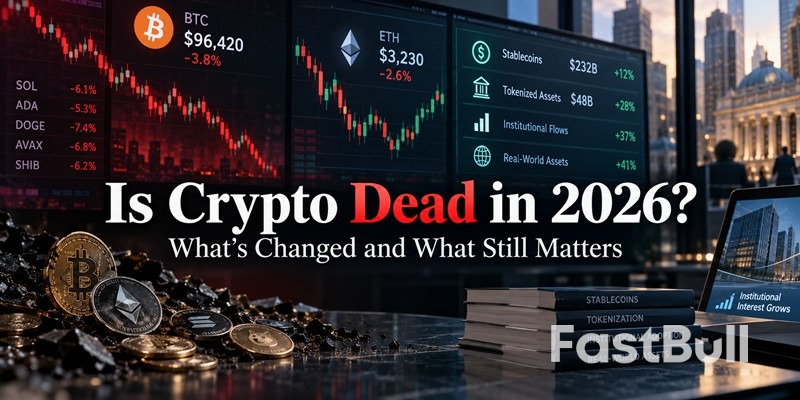
2026년에 암호화폐는 끝장날까요? 알트코인이 고전하는 이유, 스테이블코인과 월스트리트가 시장을 어떻게 바꾸고 있는지, 그리고 암호화폐가 다시 부활할 수 있을지 살펴보세요.
2026년 암호화폐는 반등에 성공했지만, 모두가 그렇게 느낀 것은 아닙니다. 가격은 회복되었지만, 많은 소규모 코인들은 최고가에 한참 못 미쳤고, 거래량도 수요를 따라가지 못했습니다. 그 와중에 스테이블코인과 토큰화된 자산들은 꾸준히 상승세를 보였습니다. 그렇다면 암호화폐는 정말 사양길에 접어든 것일까요, 아니면 투자자들의 예상보다 빠르게 변화하고 있는 것일까요?
목차
아니요, 암호화폐가 죽은 건 아닙니다. 하지만 가격이 반등했다고 해서 모든 게 정상으로 돌아온 건 아니죠.
CoinGecko의 2026년 3분기 보고서 에 따르면 , 전체 암호화폐 시장은 3분기 동안 39.6% 상승하여 9월 말 기준 약 3조 달러에 달했습니다. 이는 2024년 말 이후 가장 강력한 분기별 실적입니다.
하지만 많은 소규모 암호화폐는 이전 최고가를 회복하는 데 어려움을 겪었고, 주요 거래소의 거래 활동은 가격 상승 속도를 따라가지 못했습니다.
이와 동시에 스테이블코인 결제, 토큰화된 투자 상품, 블록체인 기반 금융 서비스가 지속적으로 발전했다.
암호화폐 자체가 사라지는 것은 아닙니다. 다만, 아무 암호화폐나 보유하는 것이 수익성이 있을지는 불확실해지고 있습니다.
소규모 암호화폐를 보유한 투자자들에게는 시장 회복세가 오히려 실망스러울 수 있습니다. 비트코인이 상승하고 몇몇 주요 토큰이 주목을 받지만, 포트폴리오의 대부분은 거의 개선되지 않기 때문입니다.
문제의 일부는 돈이 어디로 가는가에 있다.
비트코인은 잘 구축된 시장과 규제된 ETF 덕분에 투자자들이 쉽게 투자에 접근할 수 있습니다. 반면 규모가 작은 암호화폐들은 투자자들의 관심과 유동성, 그리고 더 큰 위험을 감수할 의향이 있는 매수자를 확보하기 위해 치열하게 경쟁해야 합니다.
또한, 그들은 증가하는 토큰 공급량과 경쟁하고 있습니다. 새로운 프로젝트들이 끊임없이 출시되고 있으며, 기존 프로젝트들은 예정된 언락을 통해 추가 코인을 발행하고 있습니다.
수요가 개선되더라도 과잉 공급은 가격에 부담을 줄 수 있습니다.
일부 알트코인은 여전히 좋은 성과를 보이고 있으며, 특히 활발한 거래가 이루어지는 코인들이 그렇습니다. 하지만 비트코인의 상승세가 다른 모든 코인의 상승세를 보장하는 것은 더 이상 아닙니다.
암호화폐 시장의 회복세가 반드시 알트코인 포트폴리오의 회복세를 의미하는 것은 아닙니다.
2026년과 관련하여 가장 흥미로운 점 중 하나는 가격과 거래 활동이 얼마나 다르게 움직였는지입니다.
3분기 암호화폐의 총 시가총액은 39.6% 상승했습니다. 하지만 상위 10개 중앙 집중식 거래소의 현물 거래량은 전 분기 대비 14.2% 감소한 1조 6,500억 달러를 기록했습니다.
한편, 주요 중앙 거래소의 무기한 선물 미결제 포지션은 40.6% 증가했습니다.
즉, 시장 가격은 상승하고, 현물 거래 활동은 약화되며, 레버리지 노출은 증가하고 있다는 뜻입니다.
That doesn't prove fewer people were trading. The figures measure trading value and outstanding positions, not the number of investors.
But they do explain why a strong rally doesn't always feel like a full-blown bull market.
Prices can rise sharply without the same broad excitement that defined earlier crypto booms.
Remember when almost every new meme coin, NFT collection, or blockchain launch seemed to promise the next big opportunity?
That excitement hasn't vanished. Meme coins still attract traders, and new tokens can still deliver spectacular short-term gains.
What's changed is how selective the attention has become.
Investors have watched countless tokens collapse, NFT collections lose most of their value, and projects disappear once the initial excitement faded.
There is still plenty of speculation in crypto. But the assumption that almost everything will eventually rise together is harder to justify.
And for anyone who bought near the top of a previous cycle, even a strong market rebound may not feel like much of a comeback.
Stablecoins used to be discussed mainly as a convenient way to move money between crypto exchanges.
That's still an important use, but their role is expanding.
As of October 28, 2026, the stablecoin market was worth approximately $299 billion, according to DefiLlama.
One practical example comes from Visa. The payments company reported more than 160 stablecoin-linked card programs worldwide, with payment volume across those programs growing nearly 200% year over year in its fiscal second quarter.
These cards can allow people to spend funds held in stablecoins through familiar payment networks, without merchants needing to accept cryptocurrency directly.
Businesses are also exploring stablecoins for international transfers, supplier payments, and managing funds across borders.
That doesn't mean stablecoins have replaced banks. Most stablecoin activity still involves trading and financial transfers rather than ordinary retail purchases.
But their usefulness no longer depends entirely on people speculating about crypto prices.
Someone might use a stablecoin to move dollars across borders without having any interest in whether Bitcoin will rally next week.
Another change is happening away from the usual crypto trading headlines.
Traditional financial assets, including government bonds and investment funds, are increasingly being brought onto blockchains.
According to RWA.xyz, the market value of distributed tokenized real-world assets reached approximately $39.7 billion on October 28, 2026. Tokenized U.S. Treasury products accounted for around $14.6 billion.
A useful example is Franklin Templeton's OnChain U.S. Government Money Fund.
Instead of issuing an ordinary cryptocurrency with no underlying asset, the fund uses blockchain technology to record ownership of a traditional investment product. Each BENJI token represents one share of the fund.
Investors are buying into a money market fund, not betting on the price of a new speculative coin.
Blockchain technology helps manage ownership records and eligible transfers, while the investment itself remains subject to financial rules and risks.
That's why asset tokenization matters. It offers another way to handle existing financial products, rather than inventing entirely new ones.
There's also an important difference for crypto investors: a tokenized fund can succeed without creating much demand for unrelated cryptocurrencies.
Institutional participation has become a bigger part of crypto, especially through Bitcoin and Ethereum ETFs.
But institutional money isn't an endless source of buying pressure.
On October 21, U.S. spot Bitcoin ETFs recorded approximately $524.8 million in net inflows. The following day, they saw $635.6 million in net outflows, according to Farside Investors.
Those figures reflect net fund share creations and redemptions, not the amount of Bitcoin traded on exchanges. Still, the sharp reversal shows how quickly demand for ETF exposure can change.
Financial institutions are interested in Bitcoin, tokenized funds, stablecoin settlement, and other blockchain services.
That doesn't mean they're interested in buying every altcoin.
A bank can use blockchain technology without holding a large portfolio of speculative tokens. A company can adopt stablecoin payments without investing in the cryptocurrency associated with the network.
Wall Street adopting crypto technology is not the same as Wall Street buying every crypto token.
Bitcoin and Ethereum remain important, although for different reasons.
Bitcoin's appeal comes from its limited supply, global network, and ability to transfer value without relying on a single central issuer.
Supporters see it as a long-term store of value. Critics point to its volatility and question how reliable that role really is.
Ethereum serves a different purpose. It supports smart contracts, stablecoins, decentralized exchanges, lending platforms, and other blockchain applications.
But Ethereum isn't without challenges. Competing networks offer cheaper or faster transactions, while activity moving to layer-2 networks raises questions about how much value ultimately benefits ETH itself.
Neither Bitcoin nor Ethereum is guaranteed to keep its position forever.
What separates them from many smaller projects is that they already have established networks and reasons for people to use them beyond short-term speculation.
This may be the biggest misunderstanding in crypto investing.
A blockchain can become more useful without its token becoming a better investment.
Imagine a financial company launches a successful tokenized investment fund.
Customers use it because they want access to an investment product. The fund manager earns fees, while blockchain technology handles ownership records and transfers.
But does that success require investors to buy and hold a separate cryptocurrency?
Not necessarily.
The same issue appears across crypto. A network might process millions of transactions, yet its token could struggle if transaction fees are tiny, new supply keeps entering circulation, or users have little reason to hold it.
Even growing protocol revenue doesn't automatically solve the problem. Investors still need to understand who receives that revenue and whether the token benefits from it.
That's why partnership announcements and impressive transaction numbers don't always lead to higher prices.
The question isn't simply whether people use a blockchain.
It's how that usage creates lasting demand for the token.
There's a popular belief that investors only need to survive the bear market and wait for the next bull run.
Unfortunately, that doesn't work for every cryptocurrency.
Some tokens reached extraordinary prices because buyers expected even higher prices, not because the projects had built something people needed.
Once the excitement disappears, there may be little reason for buyers to return.
Other projects face more practical problems: declining users, poor liquidity, large upcoming token unlocks, or competitors offering better services.
A token that falls 90% needs a 900% gain just to return to its starting price.
And surviving as a project isn't the same as recovering as an investment.
A development team can keep building while its token continues losing value.
Before assuming a beaten-down coin is a bargain, it's worth checking whether people still use the product without token rewards, how much supply remains locked, and whether growing activity actually benefits the token.
The next bull market may create new winners. It doesn't have to rescue the old ones.
Crypto doesn't necessarily need another groundbreaking invention to rally.
Improving market confidence, easier financial conditions, and stronger demand could be enough to bring buyers back.
Sustained ETF inflows might support major cryptocurrencies, while clearer regulations could make certain crypto products more accessible to financial institutions.
Real-world applications also matter, particularly if stablecoins and blockchain-based financial services continue attracting users.
But these developments won't necessarily move together.
암호화폐 시장은 일상적인 블록체인 도입이 보편화되기 전에 또 다른 투기적 상승장을 경험할 수 있습니다. 반대로 블록체인 도입은 증가하지만 토큰 가격은 기대에 미치지 못할 수도 있습니다.
또 다른 대규모 상승장이 올 가능성이 있습니다. 하지만 2021년과 같은 양상을 보일 것이라는 보장은 없으며, 같은 암호화폐들이 상승장을 주도할 것이라는 보장도 없습니다.
가격 하락만으로는 충분하지 않을 것이다.
더욱 우려스러운 징후는 사람들이 암호화폐를 사용할 이유를 점차 잃어가는 것일 겁니다.
수년간 스테이블코인 이체가 줄어들고, 주요 블록체인 네트워크에서 개발자들이 떠나가고, 토큰화된 금융 상품들이 버려지고, 시장 상황이 개선된 후에도 애플리케이션이 사용자 유지에 실패하는 상황을 상상해 보세요.
이는 단순한 약세장 이상의 더 심각한 문제가 있음을 시사합니다.
몇 달간 거래량이 부진하거나 가격이 하락하는 현상은 거의 모든 투기 시장에서 발생할 수 있습니다.
하지만 실제 사용자 수, 유용한 응용 프로그램, 개발 및 유동성의 지속적인 감소는 훨씬 더 무시하기 어려울 것입니다.
현재로서는 스테이블코인 활동, 토큰화된 투자 상품, 그리고 잘 구축된 블록체인 네트워크들을 고려할 때, 블록체인 산업은 여전히 중요한 역할을 할 수 있을 것으로 보입니다.
2026년에도 암호화폐는 여전히 투자 가치가 있을 수 있지만, 단순히 가격이 크게 떨어졌다는 이유만으로 암호화폐를 매수하는 것은 위험한 전략입니다.
비트코인, 이더리움, 그리고 다른 소규모 토큰들은 용도, 시장 구조, 위험성이 각기 다릅니다. 따라서 모두 똑같이 평가해서는 안 됩니다.
암호화폐를 구매하기 전에 다음 세 가지 질문을 스스로에게 던져보는 것이 좋습니다.
이 질문들은 어떤 동전의 가격이 다음에 오를지 알려주지 않을 겁니다.
하지만 이러한 요소들은 존재 이유가 있는 프로젝트와 새로운 구매자에 거의 전적으로 의존하는 프로젝트를 구분하는 데 도움이 될 수 있습니다.
가격 또한 여전히 중요합니다. 유용한 암호화폐라 할지라도 너무 비싸게 사면 오히려 좋지 않은 투자가 될 수 있습니다.
암호화폐 시장은 많은 투자자들에게 또 한 번 힘든 한 해를 보냈지만, 그렇다고 해서 암호화폐 산업 자체가 사라지는 것은 아닙니다. 비트코인과 이더리움은 여전히 중요한 의미를 지니고 있으며, 스테이블코인은 실용적인 용도를 찾아가고 있고, 전통적인 금융 자산들도 블록체인으로 옮겨가고 있습니다.
달라진 점은 산업 성장과 토큰 가격 간의 연관성입니다. 성공적인 블록체인이 반드시 성공적인 투자를 보장하는 것은 아닙니다. 2026년의 진정한 질문은 암호화폐가 살아남을 것인가가 아니라, 과열된 열기가 식었을 때 어떤 요소들이 여전히 중요하게 남을 것인가입니다.

728 RM B 7/F GEE LOK IND BLDG NO 34 HUNG TO RD KWUN TONG KLN HONG KONG


주식, FX, 상품, 선물, 채권, ETF 또는 암호화폐와 같은 금융 자산 거래의 손실 위험은 상당할 수 있습니다. 중개인에게 자금을 예치할 경우, 이 자금이 전부 손실될 수도 있습니다. 따라서 귀하의 상황과 재정 상황에 비추어 그러한 거래가 귀하에게 적합한지 신중하게 고려해야 합니다.
본인 스스로 나름대로 철저히 조사를 하거나 재무 관련 상담가와 상의하지 않고는 이러한 투자는 고려해서는 안됩니다. 이런 절차 없이 투자할 경우, 귀하의 재정 상태와 투자 요구 사항을 알지 못한 상태에서 하는 투자이기 때문에 당사의 웹 콘텐츠는 귀하에게 적합하지 않을 수 있습니다. 당사의 재무 정보가 최신으로 업데이트 되는 데는 지연이 있을 수 있고, 부정확한 내용이 포함될 수도 있으므로 모든 거래 및 투자 결정에 대한 책임은 투자자 본인의 몫입니다. 회사는 귀하의 자본 손실에 대해 책임을 지지 않습니다.
웹사이트의 허가 없이 웹사이트 그래픽, 텍스트 또는 상표를 복사할 수 없습니다. 이 웹사이트에 포함된 콘텐츠 또는 데이터에 대한 지적 재산권은 해당 공급자 및 거래소 판매자에게 있습니다.





