


- EURUSD
- XAUUSD
- XAGUSD
- WTI
- USDX


















I prodotti a reddito fisso sono investimenti che generano reddito tramite interessi, cedole o altri flussi di cassa contrattuali. Esempi comuni includono obbligazioni governative e societarie, obbligazioni comunali, certificati di deposito (CD) e fondi obbligazionari. Le loro scadenze, le strutture di pagamento, i rischi e il trattamento fiscale variano.
Cosa sono i prodotti a reddito fisso e come funzionano?
I prodotti a reddito fisso sono strumenti finanziari che forniscono un reddito a determinate condizioni. Molti funzionano consentendo agli investitori di prestare denaro a un governo, un'azienda o un istituto finanziario in cambio di interessi e, nella maggior parte dei casi, del rimborso del capitale alla scadenza.
Ad esempio, un'azienda può emettere un'obbligazione per raccogliere capitali e impegnarsi a pagare agli investitori interessi a date prestabilite. Alla scadenza, ci si aspetta che l'obbligazione venga rimborsata al suo valore nominale. Altri prodotti funzionano in modo diverso: i buoni del Tesoro vengono generalmente acquistati a sconto, mentre alcuni prestiti e obbligazioni pagano interessi che variano in base a un tasso di riferimento.
Il termine "reddito fisso" non significa che ogni pagamento o valore di investimento sia garantito. I tassi possono variare, gli emittenti possono risultare insolventi e un titolo venduto prima della scadenza può valere meno del suo prezzo di acquisto.
In che modo i prodotti a reddito fisso generano reddito?
I resi dipendono dalla struttura del prodotto. Le fonti più comuni includono:
- Pagamento delle cedole: le obbligazioni spesso pagano interessi a intervalli regolari, di solito due volte l'anno. Un'obbligazione da 1.000 dollari con una cedola annua del 5% paga 50 dollari all'anno.
- Pagamento degli interessi: i certificati di deposito e molti prestiti prevedono il pagamento di interessi secondo i termini stipulati. Il tasso può essere fisso o variabile.
- Rendimenti a sconto rispetto al valore nominale: i buoni del Tesoro vengono generalmente venduti a sconto o al valore nominale. Alla scadenza, gli investitori ricevono il valore nominale; l'eventuale sconto rappresenta il rendimento.
- Pagamenti a tasso variabile: alcune obbligazioni e prestiti adeguano i propri tassi di interesse a un valore di riferimento, pertanto i pagamenti possono aumentare o diminuire.
- Distribuzioni dei fondi: i fondi obbligazionari percepiscono un reddito dai titoli in portafoglio e possono distribuirlo agli azionisti. Gli importi delle distribuzioni possono variare.
Cosa succede alla scadenza di un prodotto a reddito fisso?
Nel caso di un'obbligazione o di un deposito con data di scadenza, l'emittente o la banca è tenuta a rimborsare il capitale alla scadenza, compatibilmente con la propria capacità di adempiere agli obblighi e con i termini del prodotto. Il pagamento degli interessi generalmente cessa alla scadenza.
Un fondo comune obbligazionario o ETF è diverso. Detiene un portafoglio di titoli e generalmente non ha una data di scadenza prestabilita. Gli investitori vendono le quote del fondo al prezzo di mercato corrente, anziché ricevere un rimborso del capitale promesso in una data specifica.
Quali sono le principali tipologie di prodotti a reddito fisso?
I prodotti a reddito fisso spaziano dai titoli di Stato a breve termine alle obbligazioni societarie e ai fondi comuni di investimento. Le principali differenze riguardano chi li emette, come generano reddito, quando scadono e quali rischi si assumono gli investitori.
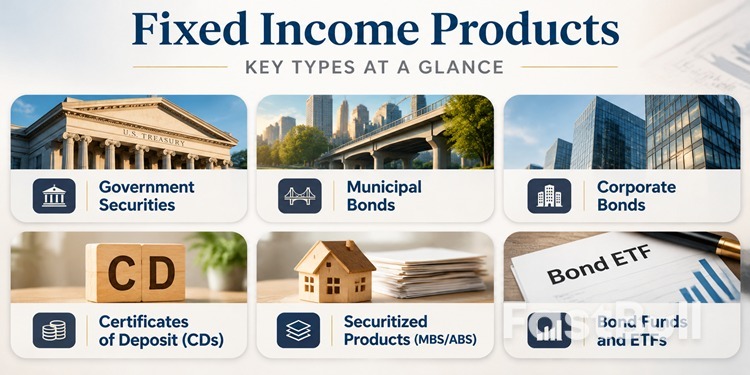
titoli del Tesoro degli Stati Uniti
U.S. Treasury securities are debt instruments issued by the federal government. Common types include:
- Treasury Bills (T-Bills): Short-term securities with maturities of 4 to 52 weeks. They are generally sold at a discount and pay face value at maturity.
- Treasury Notes (T-Notes): Securities with maturities of 2, 3, 5, 7, or 10 years that pay interest every six months.
- Treasury Bonds (T-Bonds): Long-term securities with 20- or 30-year maturities that generally pay interest twice a year.
- Treasury Inflation-Protected Securities (TIPS): Securities whose principal adjusts with changes in the Consumer Price Index for All Urban Consumers (CPI-U). Interest is calculated on the adjusted principal, so payment amounts can change.
Treasury securities are backed by the full faith and credit of the U.S. government. Their interest is generally subject to federal income tax but exempt from state and local income taxes. See TreasuryDirect's overview of marketable securities for product details.
Municipal Bonds
Municipal bonds are issued by states, cities, counties, and public authorities to finance projects such as schools, roads, hospitals, and utilities. Two common types are:
- General Obligation Bonds: Supported by the issuer's taxing power or general revenues.
- Revenue Bonds: Repaid primarily from revenue generated by a specific project or service, such as a toll road or water system.
Interest on many municipal bonds is exempt from federal income tax, and it may also be exempt from state and local taxes for residents of the issuing state. Tax treatment varies: some municipal bond interest is taxable or may affect the alternative minimum tax (AMT). Check the bond's official documents and your tax situation. The IRS guidance on investment income explains the general rules.
Corporate Bonds
Companies issue corporate bonds to finance expansion, acquisitions, refinancing, and operations. Investors receive interest under the bond terms, and the company is expected to repay principal at maturity.
- Investment-Grade Bonds: Have higher credit ratings and generally lower perceived default risk, so they often offer lower yields.
- High-Yield Bonds: Have lower credit ratings and greater default risk. They generally offer higher yields to compensate investors for taking that risk.
A higher yield is not automatically a better deal. It may reflect a greater chance that the issuer will miss interest payments or fail to repay principal.
Certificates of Deposit (CDs)
Certificates of deposit are bank deposits that pay interest in exchange for keeping money deposited for an agreed term. Early withdrawal from a traditional CD may trigger a penalty.
- Traditional CDs: Purchased directly from a bank, usually with a stated interest rate and maturity date.
- Brokered CDs: Issued by banks but purchased through brokerage firms. They may be sold in a secondary market before maturity, and the sale price can be above or below the amount invested.
CDs at FDIC-insured banks are generally covered up to $250,000 per depositor, per insured bank, per ownership category, subject to FDIC rules. Coverage is aggregated with other deposits in the same category at that bank. Brokered CD investors should check the issuing bank and available coverage. The FDIC deposit insurance overview explains the limits and eligible deposits.
Agency Bonds and Securitized Products
Agency bonds are issued by federal agencies or government-sponsored enterprises (GSEs). Their backing varies by issuer, and not all carry the full faith and credit guarantee of the U.S. government.
Securitized products are created by pooling loans or other financial assets and issuing securities backed by the cash flows from those assets. Examples include:
- Mortgage-Backed Securities (MBS): Backed by pools of residential or commercial mortgages. Investor payments come from mortgage principal and interest.
- Asset-Backed Securities (ABS): Backed by assets such as auto loans, credit card receivables, or student loans.
Cash flows can be affected by borrower defaults, early repayments, and changes in interest rates.
Bond Mutual Funds and ETFs
Bond mutual funds and exchange-traded funds pool investors' money to buy portfolios of government, corporate, municipal, or other debt securities. They can provide diversification and access to bonds without requiring investors to select each security themselves.
Bond ETFs trade on exchanges during market hours. Mutual funds generally transact once each business day at their net asset value (NAV). Both can fluctuate in value, charge fees, and make distributions that vary. Unlike an individual bond held to maturity, a typical bond fund does not promise to return a fixed principal amount on a specific date.
Other Fixed Income Instruments
Institutional fixed income markets also include instruments such as:
- Commercial Paper: Short-term, generally unsecured corporate debt used to fund operating expenses and other near-term needs.
- Bank Loans: Loans to businesses. Many institutional loan investments have floating rates, so interest payments can change as benchmark rates move.
Fixed Income Products: Examples and Key Differences
The table below compares common products by how they generate income and what distinguishes them.
| Product | Income Source | Key Characteristic |
|---|---|---|
| Treasury Bills | Discount to face value | Short-term U.S. government debt |
| Treasury Bonds | Coupon payments | Long-term U.S. government debt |
| Municipal Bonds | Interest payments | Potential tax advantages |
| Corporate Bonds | Coupon payments | Credit risk varies by issuer |
| CDs | Interest payments | Bank deposit with a stated term |
| Bond ETFs | Portfolio income and distributions | Diversified bond exposure |
Consider a corporate bond with a $1,000 face value and a 5% annual coupon. It pays $50 in interest each year, often in two $25 installments. If the investor buys it for $950, the current yield is about 5.26% ($50 ÷ $950).
The coupon rate, current yield, and yield to maturity (YTM) measure different things:
- Coupon Rate: Annual coupon interest divided by the bond's face value.
- Current Yield: Annual coupon interest divided by the bond's current market price.
- Yield to Maturity: The estimated annualized return if the bond is held until maturity, taking into account coupon payments and the difference between its purchase price and the amount repaid at maturity, assuming the issuer makes the required payments.
What Risks Should Investors Understand?
Fixed income products can offer more predictable cash flows than some investments, but they are not risk-free. The main risks depend on the issuer, maturity, structure, and market conditions.
Interest Rate Risk
Market interest rates and the prices of existing fixed-rate bonds generally move in opposite directions. When rates rise, older bonds with lower coupons become less attractive and their market prices tend to fall. Longer-maturity bonds are usually more sensitive to rate changes.
Credit and Default Risk
Credit risk is the possibility that an issuer will fail to make interest payments or repay principal. Lower-rated corporate bonds generally carry greater default risk than investment-grade bonds. Credit ratings help assess risk, but they are opinions, not guarantees.
Inflation, Liquidity and Reinvestment Risks
Inflation reduces the purchasing power of fixed payments. Liquidity risk arises when a security is difficult to sell without accepting a lower price. Reinvestment risk occurs when coupon or principal payments must be reinvested at lower rates. Callable bonds and mortgage-backed securities can also expose investors to early repayment, which may force them to reinvest sooner than expected.
How Do You Choose the Right Fixed Income Product?
The right product depends on when you need the money, how much risk you can accept, and whether you prioritize income, liquidity, or tax treatment.
Match the Product to Your Investment Timeline
Investors who need their money soon may compare Treasury bills or short-term CDs. Those seeking longer-term income may consider Treasury notes, corporate bonds, or municipal bonds. Bond funds can provide ongoing exposure without requiring investors to choose individual maturity dates.
Compare Yields, Credit Quality and Tax Treatment
Non confrontare i prodotti basandoti solo sul rendimento nominale. Considera la qualità del credito, la scadenza, le commissioni, la liquidità e il reddito al netto delle imposte. Per le obbligazioni municipali, il rendimento equivalente al netto delle imposte può essere utile per confrontare il reddito esente da imposte con le alternative tassabili, ma il risultato dipende dall'aliquota fiscale dell'investitore e dalle normative fiscali statali.
Obbligazioni individuali vs. fondi a reddito fisso
Le singole obbligazioni hanno termini di pagamento e date di scadenza prestabiliti. Se l'emittente adempie ai propri obblighi e l'investitore detiene l'obbligazione fino alla scadenza, il capitale viene generalmente rimborsato al valore nominale. I fondi obbligazionari offrono diversificazione e un accesso più agevole a un portafoglio, ma i prezzi delle loro quote fluttuano e in genere non hanno una data di scadenza né la promessa di restituire l'investimento iniziale.
Domande frequenti sui prodotti a reddito fisso
Le obbligazioni sono considerate prodotti a reddito fisso?
Sì. Le obbligazioni governative, municipali e societarie sono prodotti a reddito fisso comuni. Generalmente pagano interessi secondo termini prestabiliti e sono concepite per rimborsare il capitale alla scadenza, a seconda della capacità di pagamento dell'emittente.
I prestiti sono considerati reddito fisso?
I prestiti possono rientrare nel mercato obbligazionario quando gli investitori detengono crediti che generano pagamenti contrattuali di interessi e capitale. Alcuni prestiti hanno tassi variabili, quindi i loro pagamenti cambiano in base ai tassi di riferimento.
Che cosa sono i prodotti a reddito fisso nel settore dell'investment banking?
Nel settore dell'investment banking, i prodotti a reddito fisso includono generalmente titoli di debito e strumenti correlati che le istituzioni emettono, strutturano, negoziano o distribuiscono. Esempi includono obbligazioni governative e societarie, debito municipale, titoli garantiti da mutui ipotecari e altri prodotti di credito strutturati.
Che cos'è un fondo a reddito fisso?
Un fondo obbligazionario è un fondo comune di investimento o un ETF che investe principalmente in titoli di debito, come obbligazioni governative, obbligazioni societarie o obbligazioni municipali. Offre un'esposizione a un portafoglio di investimenti a reddito fisso, ma il suo valore di mercato e le distribuzioni possono variare.