


- EURUSD
- XAUUSD
- XAGUSD
- WTI
- USDX


















Vendre une action à découvert consiste à emprunter des actions, à les vendre au prix du marché et à les racheter plus tard à un prix inférieur pour réaliser un profit. Contrairement aux investissements traditionnels, où les investisseurs espèrent une hausse des cours, les vendeurs à découvert visent à profiter de la baisse des cours. Cependant, cette stratégie comporte également des risques importants.
Que signifie vendre à découvert une action ?
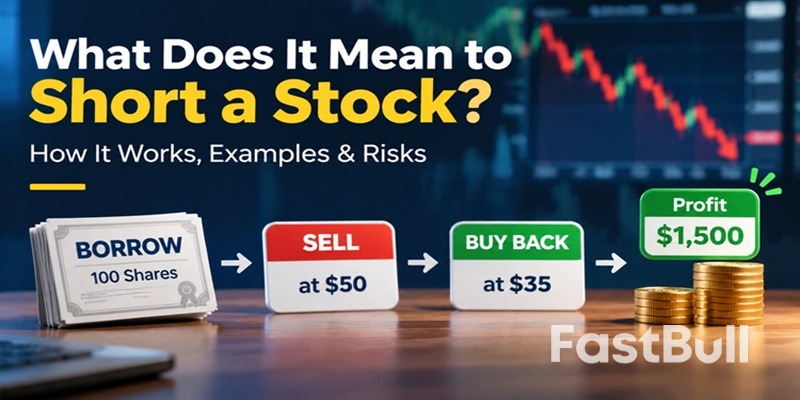
Pour vendre à découvert une action, un investisseur emprunte des actions auprès d'une société de courtage et les vend sur le marché, anticipant une baisse de leur cours. Si le cours baisse, il peut racheter le même nombre d'actions à un prix inférieur, les restituer au prêteur et empocher la différence en tant que profit après déduction des frais.
Cette stratégie est connue sous le nom de vente à découvert ou prise de position courte . Elle inverse le processus habituel qui consiste à acheter d'abord une action et à la vendre ensuite.
Par exemple, supposons qu'une action se négocie à 50 $ l'unité. Un investisseur emprunte 100 actions et les vend pour 5 000 $. Si le cours de l'action chute ensuite à 35 $, l'investisseur peut racheter les 100 actions pour 3 500 $. La différence de 1 500 $ représente le bénéfice brut avant déduction des frais d'emprunt et autres charges.
Vente à découvert vs achat d'actions
La principale différence entre acheter une action et la vendre à découvert réside dans la direction dans laquelle un investisseur anticipe l'évolution de son prix.
| Fonctionnalité | Position longue | Position courte |
|---|---|---|
| Action de base | Achetez d'abord des actions | Emprunter et vendre des actions en premier |
| Attentes du marché | Le prix va augmenter | Le prix va baisser |
| Comment fermer | Vendre les actions | Racheter les actions |
| Comment faire des profits | Vendre à un prix plus élevé | Racheter à un prix inférieur |
| Risque principal | Le cours de l'action chute | Le cours de l'action augmente |
Pour une position longue sans effet de levier, la perte maximale est généralement limitée au montant investi si l'action devient sans valeur. En cas de vente à découvert, les pertes potentielles sont théoriquement illimitées, car le cours d'une action peut continuer à augmenter sans plafond.
Pourquoi les investisseurs vendent-ils des actions à découvert ?
Les investisseurs vendent des actions à découvert pour plusieurs raisons :
- Profitez de la baisse des prix : certains investisseurs estiment qu’une entreprise est surévaluée ou confrontée à des difficultés financières et s’attendent à ce que le cours de son action diminue.
- Couverture des investissements existants : les investisseurs peuvent vendre à découvert une action ou un titre connexe afin de compenser les pertes potentielles d’une position de portefeuille existante.
- Profitez des opportunités de marché : les vendeurs à découvert peuvent identifier les entreprises confrontées à une baisse de leurs bénéfices, à un affaiblissement de la demande ou à d’autres évolutions commerciales négatives.
La vente à découvert ne consiste pas nécessairement à parier sur la faillite d'une entreprise. Il s'agit d'une stratégie de trading fondée sur l'anticipation d'une baisse du cours d'un titre.
Comment fonctionne la vente à découvert ?
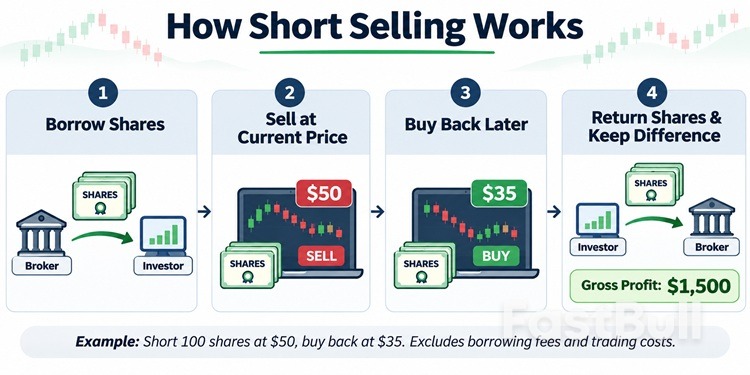
La vente à découvert consiste à emprunter des actions, à les vendre, puis à les racheter pour les restituer au prêteur. Bien que le processus paraisse simple, il nécessite un compte-titres autorisant la vente à découvert et une marge de garantie suffisante.
Voici les quatre principales étapes d'une vente à découvert typique.
Étape 1 : Emprunter des actions par l'intermédiaire d'un courtier
Before selling a stock short, an investor needs to borrow the shares. Individual investors generally arrange this through their brokerage firms rather than contacting stock owners directly.
A broker may obtain shares from its own inventory, other customers' margin accounts, or another securities lender. Share availability depends on whether the stock can be borrowed at the time of the trade.
Most retail investors also need an approved margin account to short stocks. A margin account allows the brokerage firm to manage the collateral and borrowing requirements associated with the position.
Step 2: Sell the Borrowed Shares
Once the shares have been borrowed or arranged for delivery, the investor places a short sale order through the brokerage platform.
For example, if an investor borrows 100 shares of a company trading at $50, selling those shares generates $5,000 in proceeds.
However, this $5,000 is not the investor's profit. The investor still has an obligation to return 100 shares to the lender. The sale proceeds are generally subject to brokerage margin and collateral requirements rather than being freely available for withdrawal.
Step 3: Buy Back Shares to Close the Position
After opening a short position, the investor waits for an opportunity to buy the shares back. This transaction is commonly called buy to cover.
If the stock price falls from $50 to $35, buying back 100 shares costs $3,500. The investor can close the position at a gross profit of $1,500 before fees and other expenses.
If the price rises instead, the investor must spend more to repurchase the shares. For example, buying back 100 shares at $70 costs $7,000, creating a $2,000 gross loss.
Investors can close short positions voluntarily, but a broker may also require a position to be closed under certain circumstances, such as when margin requirements are no longer met or borrowed shares become unavailable.
Step 4: Return the Shares to the Lender
After buying back the shares, the investor uses them to satisfy the borrowing obligation. The brokerage firm handles the return of the equivalent shares to the original lender, completing the short sale.
The investor's final result depends on the difference between the original selling price and the repurchase price, minus applicable costs. These may include stock borrowing fees, interest, commissions, and payments for dividends distributed while the shares were borrowed.
Because borrowing costs can change depending on share availability and market demand, holding a short position for a long time can reduce or even eliminate an otherwise profitable trade.
Short Selling Example: How a Trade Makes or Loses Money
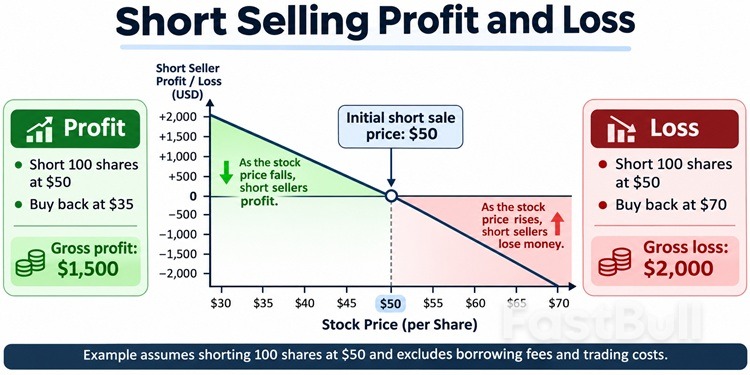
The easiest way to understand how short selling makes money is to follow a trade from the initial sale to the final repurchase. Consider an investor who borrows and sells 100 shares at $50 each.
The initial short sale generates $5,000 in proceeds. What happens next depends on the stock's price movement.
Scenario 1: The Stock Price Falls
Suppose the company's share price declines from $50 to $35. The investor decides to close the short position by buying back 100 shares.
| Transaction | Amount |
|---|---|
| Initial short sale (100 × $50) | $5,000 |
| Repurchase (100 × $35) | -$3,500 |
| Gross profit | $1,500 |
The investor earns $15 per share, resulting in a total gross profit of $1,500. This represents a 30% decline from the original $50 selling price.
Scenario 2: The Stock Price Rises
Now imagine the opposite happens. Instead of falling, the stock rises from $50 to $70. The investor must still buy back 100 shares to close the position.
| Transaction | Amount |
|---|---|
| Initial short sale (100 × $50) | $5,000 |
| Repurchase (100 × $70) | -$7,000 |
| Gross loss | -$2,000 |
In this case, the investor loses $20 per share, or $2,000 in total, before additional costs. The stock only needs to rise by $20 for the investor to lose $2,000 on this trade.
These examples show why short selling requires careful risk management. A falling stock price can generate a profit, but an unexpected rally can quickly turn a short position into a substantial loss.
Real-World Short Selling Examples: Enron and GameStop
Real market events show how short selling can work in practice. The collapse of Enron illustrates how investors can profit from identifying an overvalued company, while the 2021 GameStop rally demonstrates how quickly short positions can turn into major losses.
Enron: How Jim Chanos Identified a Short-Selling Opportunity
One of the best-known examples of research-based short selling involves investor Jim Chanos and Enron, the former U.S. energy company.
Chanos became interested in Enron after examining its financial statements in 2000. He questioned the company's profitability, its complicated related-party transactions, and the lack of transparency in its financial disclosures. He was also concerned about the company's low return on capital and frequent insider stock sales.
According to a U.S. Senate investigation, Chanos began shorting Enron shares in November 2000. The stock remained relatively stable between $70 and $80 through February 2001, but its price began declining steadily in March. Enron eventually filed for bankruptcy protection on December 2, 2001.
This case demonstrates how short sellers can use financial statement analysis to identify companies whose market valuations may not reflect their underlying financial condition. It also shows that a short position may take time to become profitable, even when the original investment thesis is correct. The Senate's investigation into Enron's financial oversight documents Chanos' analysis and short-selling activity.
GameStop: How a Short Squeeze Hurt Short Sellers
GameStop provides a contrasting example of what can happen when a heavily shorted stock rises instead of falls.
In January 2021, GameStop became the center of an extraordinary stock market rally. The company's short interest reached 122.97% of its public float during January, according to the SEC. Short interest can exceed 100% when shares are lent and subsequently lent again by different investors.
As individual investors bought shares and demand increased, the stock price surged. GameStop closed at $347.51 on January 27, 2021, and reached an intraday high of $483 the following day.
This created difficult conditions for short sellers. Investors who had borrowed and sold GameStop shares at much lower prices faced mounting losses as the stock continued rising. Some funds eventually bought shares to close their short positions, realizing significant losses.
This process is known as a short squeeze. When rising prices trigger margin calls or force short sellers to limit their losses, they may rush to buy back shares. Their buying can push prices even higher, creating additional pressure on other short sellers.
However, the SEC's analysis found that short covering represented only a small fraction of total buying activity. Positive investor sentiment, rather than short covering alone, sustained GameStop's price appreciation over several weeks.
The GameStop episode shows why short selling can be dangerous: even when investors believe a company is overvalued, strong buying demand can push its stock price much higher than expected. The SEC's 2021 market structure report provides a detailed account of the event.
What Are the Risks of Shorting a Stock?
Short selling can generate profits when stock prices decline, but it carries several risks that investors should understand before opening a position.
Potentially Unlimited Losses
The biggest risk is that a stock's price can rise indefinitely. When buying a stock, the maximum loss on an unleveraged position is generally limited to the original investment. With short selling, losses can exceed the initial sale proceeds because the investor must eventually buy back the borrowed shares at the prevailing market price.
For example, if an investor shorts 100 shares at $50, the initial sale generates $5,000. If the stock rises to $150, buying back those shares costs $15,000, resulting in a $10,000 gross loss before fees.
Short Squeezes and Margin Calls
A short squeeze can cause a stock to rise rapidly, forcing short sellers to buy back shares at increasingly expensive prices. Rising prices can also trigger margin calls, requiring investors to deposit additional funds or reduce their positions.
If investors cannot meet their broker's margin requirements, their positions may be liquidated. This can turn a temporary price increase into a realized loss.
Borrowing Fees, Dividends, and Other Costs
Short sellers must also account for the costs of maintaining their positions. These can include:
- Stock borrowing fees: The cost of borrowing shares, which can increase when a stock is difficult to borrow.
- Margin interest: Interest charged by the brokerage firm on the borrowing arrangement.
- Dividend payments: If the borrowed stock pays a dividend, the short seller generally must compensate the lender for that payment.
- Trading costs: Commissions and other transaction expenses may reduce the final profit.
These expenses can accumulate over time. Even if a stock eventually declines, a short position may still lose money if borrowing and financing costs outweigh the price difference.
Is Short Selling Legal, and Who Can Short a Stock?
Short selling is generally legal in the United States, but it is subject to securities regulations. Investors also need an appropriate brokerage account and access to shares that can be borrowed.
Is Short Selling Legal in the U.S.?
Yes. Ordinary short selling is legal in the United States and is used by individual investors, hedge funds, and other market participants.
However, short selling to manipulate stock prices is prohibited. For example, deliberately conducting transactions to create misleading trading activity or push a stock price down to influence other investors can violate securities laws.
Another term investors may encounter is naked short selling. This generally refers to selling shares short without borrowing or arranging to borrow them in time for delivery to the buyer. It can result in a failure to deliver shares by the settlement deadline.
Naked short selling is not automatically illegal in every circumstance. However, Regulation SHO imposes locate and close-out requirements, and abusive or deceptive practices may violate securities laws. The SEC's Regulation SHO overview explains the rules governing short sales and delivery requirements.
Can Anyone Short a Stock?
Not every investor can automatically short stocks. Most individual investors need a brokerage account approved for margin trading, and their broker must support short selling.
Investors also need access to shares that can be borrowed. Some stocks are difficult or expensive to borrow, while others may not be available for short selling through a particular broker.
Avant d'ouvrir une position courte, les investisseurs doivent vérifier les coûts d'emprunt, les exigences de marge, la disponibilité des actions et le risque de hausse soudaine des prix. La vente à découvert exige une gestion active des risques et peut ne pas convenir aux débutants ni aux investisseurs ne pouvant supporter des pertes importantes.
Conclusion
Vendre une action à découvert consiste à emprunter des actions, à les vendre, puis à les racheter plus tard dans l'espoir de réaliser un profit grâce à la baisse de leur cours. Bien que cette pratique offre une alternative pour investir en bourse, les pertes potentielles illimitées, les coûts d'emprunt et le risque de « short squeeze » la rendent considérablement plus risquée que l'investissement traditionnel en actions.