


Bloomberg Says Only 4% of Prop Traders Profit, Industry Voices Push Back Against Narratives
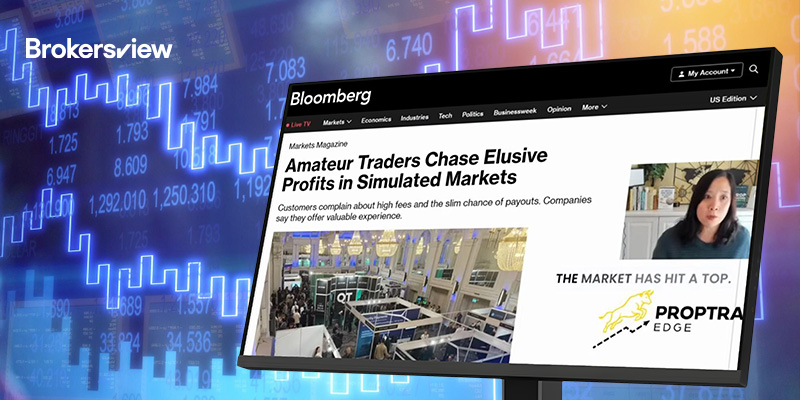
Bloomberg recently published a piece focusing on the rapidly growing prop trading industry, opening with the claim that only a very small fraction of participants actually turn a profit. The article cites data from FPFX Technologies, reporting that just about 4% of traders successfully withdraw earnings, while the vast majority fail in simulated funding challenges, leaving only the sunk cost of repeated fees. User feedback highlighted in the article paints prop trading as a high-fee, low-return model with outsourced risk.
However, the report immediately sparked pushback from industry insiders. Kathy Lien of BK Traders and Prop Trader Edge released a video addressing the article point by point. She argues that while Bloomberg accurately reported certain risk statistics, it overlooks the more nuanced structure and development of the industry. Crucially, she notes, the markets themselves are not simulated—prices of the Nasdaq, gold, and other assets are fully real. The only "virtual" element is the capital provided in the challenge phase, not the trading environment. By framing prop trading as a "virtual game," the article risks misleading the public.
On the issue of fees, Lien acknowledges that challenge fees are a major revenue source for many platforms, but calling them "predatory" is unfair. Compared with risking thousands of dollars of one's own money, paying tens of dollars to participate in a challenge can be a low-cost way to learn risk management and trading discipline. Bloomberg's focus on unsuccessful participants overlooks those who treat the challenge as an educational investment and use it to systematically improve their trading strategies.
Bloomberg also highlights that strict risk control rules make success for newcomers unlikely. Daily loss limits, maximum drawdowns, minimum trading days, and other requirements are seen in the report as mechanisms that artificially suppress profitability. Lien, however, sees these rules as simulating institutional risk management rather than hindering earnings. Many platforms have gradually relaxed restrictions, eliminating minimum trading days and adopting fixed drawdowns instead of trailing ones, lowering barriers for professional-style trading. Platforms like Think Capital and Axi Select are cited as examples of operators reducing unnecessary constraints in response to market feedback.
The article features extreme cases, such as traders spending over $10,000 on repeated challenges without reaching a funded account. For critics, these stories appear as evidence of exploitation. Lien invites viewers to consider another perspective: if some traders willingly repeat dozens or even hundreds of challenges, it indicates the model has its appeal. In her view, the cost of learning is limited to challenge fees, avoiding direct losses of thousands of dollars in personal capital. One trader, Armash, for example, has reportedly failed many challenges but ultimately accumulated over $1 million in payouts, viewing challenge fees as a business expense.
Regulatory attention is also rising. Bloomberg quotes the UK's FCA warning that prop trading promotions suggesting easy profits could mislead young investors, creating a "gamified" psychological risk. This has fueled further scrutiny over whether platforms downplay risk. In response, some leading operators are adjusting their strategies. As reported, FTMO stopped accepting U.S. clients and revised promotional materials to emphasize that trading involves simulated capital, while also acquiring the regulated U.S. broker OANDA to pursue a compliant operational model.
In her video, Lien does not deny that problems exist, including withdrawal delays, rule changes, and marketing exaggeration. However, she believes Bloomberg frames these issues as reflective of the industry's essence, ignoring the educational and talent-development aspects of prop trading. The industry has grown from just a few firms ten years ago to hundreds today, attracting university competitions, professional training programs, and broker-backed initiatives. Many participants view it as a potential career path rather than a mere "pay-to-play" game.
Bloomberg's coverage raises valid risk awareness, but industry responses highlight different experiences and realities. The narrative gap underscores a rapidly expanding, lightly regulated, and controversial sector. Debates over transparency, fee structures, and risk management rules are likely to continue, leaving the future trajectory of prop trading uncertain.






Copyright © 2026 FastBull Ltd


Risk Warning
FX trading is of high risk and may not be suitable for all investors. Leverage will create additional risks and loss. Before trading, please carefully consider your investment objectives, experience level and risk tolerance. You may lose part or all of your initial investment; do not invest money that you cannot afford. Educate yourself about the risks associated with FX trading. If you have any questions, please consult an independent financial or tax advisor. Any data and information are provided "as is" and only for information purpose, not for trading or recommendations. Past performance does not predict future results.
Disclaimer
The data contained in this website may not be real-time and accurate. The data and prices on this site are not necessarily provided by the market or exchange, but may be provided by market makers, so prices may be inaccurate and differ from actual market prices. Namely, this price is indicative price only to reflect market trend, and is unfavorable for trading purpose. The provider of the data contained in the Website shall not be liable for any loss incurred by you as a result of your trading activities or reliance on the information contained in the Website.