


- EURUSD
- XAUUSD
- XAGUSD
- WTI
- USDX



















Опцион пут дает покупателю право, но не обязанность, продать базовый актив по заранее определенной цене в течение указанного периода. Инвесторы используют опционы пут для получения прибыли от падения цен, защиты существующих позиций по акциям или получения дохода от продажи контрактов. Понимание принципов работы обеих сторон имеет важное значение перед началом торговли.
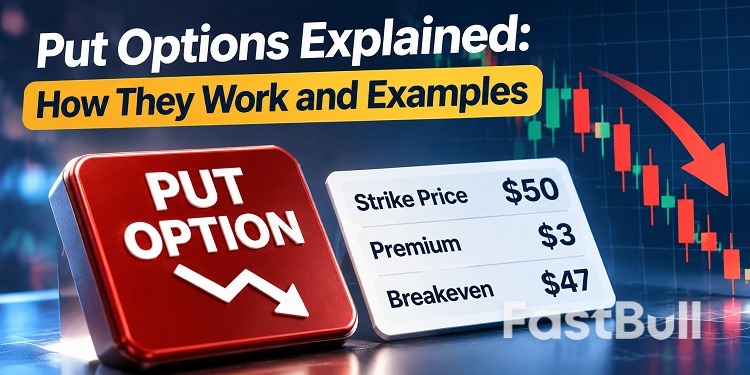
Что такое опцион пут?
Опцион пут — это финансовый контракт, который дает покупателю право продать базовый актив, такой как акции или ETF, по определенной цене, называемой ценой исполнения. Контракт также имеет дату истечения срока действия, которая определяет, когда прекращается право покупателя на исполнение опциона.
Опционы пут обычно ассоциируются с медвежьими рыночными ожиданиями, поскольку их стоимость, как правило, увеличивается при падении цены базового актива при прочих равных условиях. Однако инвесторы также могут использовать их для хеджирования потенциальных убытков в существующем портфеле.
У каждого опциона пут есть две стороны:
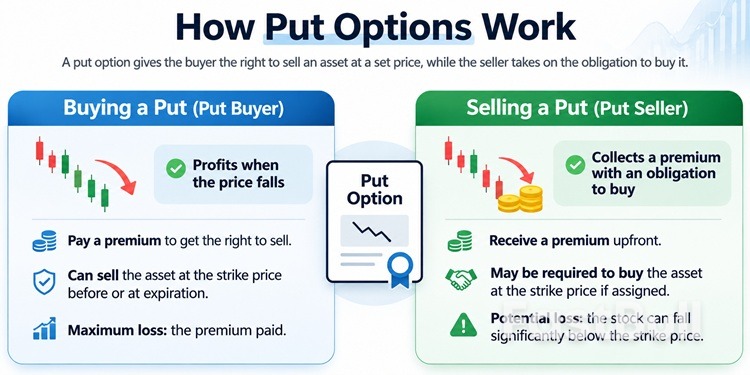
- Покупатель опциона «пут»: платит премию и получает право продать базовый актив по цене исполнения. Покупатель может воспользоваться опционом, но не обязан это делать.
- Продавец пут-опциона: получает премию и принимает на себя обязательство купить базовый актив по цене исполнения в случае его исполнения.
В случае стандартных опционов на акции в США один контракт обычно представляет 100 акций базового актива. Однако такие корпоративные действия, как дробление акций и слияния, могут привести к изменению контрактов с различными объемами поставок. Спецификации опционов на акции, разработанные Options Clearing Corporation, содержат более подробную информацию о стандартных условиях контрактов.
Как опцион пут дает вам право продать
Главная особенность опциона пут заключается в праве продать актив по заранее определенной цене, даже если его рыночная цена упадет ниже этого уровня.
Например, предположим, что акции в данный момент торгуются по цене 50 долларов, и инвестор покупает опцион пут с ценой исполнения 50 долларов. Если цена акций упадет до 40 долларов до истечения срока действия опциона, инвестор все равно сможет продать акции за 50 долларов, исполнив опцион. Разница между ценой исполнения и рыночной ценой составляет 10 долларов за акцию.
Это право становится ценным, когда рыночная цена падает ниже цены исполнения. Если же цена акций поднимается выше 50 долларов, у покупателя, как правило, нет причин исполнять опцион пут, поскольку продажа акций по 50 долларов будет менее привлекательной, чем продажа их по более высокой рыночной цене.
Важно отметить, что покупка опциона пут не означает автоматического владения инвестором базовыми акциями. Инвесторы могут приобретать опционы пут для спекуляции на снижении цены, не владея акциями, хотя исполнение контракта предполагает продажу базовых акций и может создать короткую позицию по акциям, если инвестор ими не владеет.
Ключевые термины, которые вам необходимо понимать.
Перед началом торговли опционами пут полезно понять пять основных терминов:
- Цена исполнения: Заранее определенная цена, по которой покупатель опциона пут может продать базовый актив.
- Premium: The price paid by the buyer and received by the seller for the option contract. For standard stock options, quoted premiums are generally multiplied by 100 to calculate the cost of one contract.
- Expiration Date: The date when the option contract expires and its exercise rights end.
- Underlying Asset: The stock, ETF, index, or other financial instrument on which the option is based.
- Exercise and Assignment: Exercise occurs when the buyer uses the option's rights. Assignment occurs when the seller is selected to fulfill the corresponding obligation.
How Do Put Options Work?
Put options work differently depending on whether an investor buys or sells the contract. Buyers generally seek to benefit from falling prices or protect their holdings, while sellers collect premiums in exchange for accepting the obligation to purchase the underlying asset if assigned.
Buying a Put Option
Buying a put option is a common strategy for investors who expect a stock's price to decline. The buyer pays a premium upfront and gains the right to sell the stock at the strike price during the contract's exercise period.
For example, an investor buys a put option on a stock trading at $60, with a strike price of $55 and a premium of $2 per share. Assuming one standard contract, the initial cost is $200.
If the stock falls to $45 at expiration, the put has $10 per share of intrinsic value. Its total expiration value is $1,000, giving the buyer a net profit of $800 before fees and commissions.
If the stock remains above $55 at expiration, the option expires without intrinsic value, and the buyer loses the $200 premium. This is why the buyer's maximum loss on a standalone long put is generally limited to the premium paid. The investor may also sell the option before expiration to close the position rather than exercise it.
Buying puts can also serve as portfolio insurance. For example, an investor holding 100 shares of a company may buy a put with a strike price below the current stock price. If the stock declines sharply, the put can help offset some of the losses in the shares.
Selling a Put Option
Selling a put option, also called writing a put, involves receiving a premium upfront in exchange for agreeing to buy the underlying asset at the strike price if assigned.
This strategy is generally used by investors who are neutral to moderately bullish on a stock and are willing to own it at a predetermined price.
For example, suppose a stock trades at $50, and an investor sells a put with a $45 strike price for a premium of $2 per share. The seller receives $200 for one standard contract.
- If the stock stays above $45 at expiration: The option may expire worthless, allowing the seller to keep the $200 premium.
- If the stock falls below $45: The buyer may exercise the put, and the seller may be assigned to purchase 100 shares at $45 each.
In a cash-secured put strategy, the seller keeps enough cash available to cover the potential stock purchase. This approach allows investors to collect premiums while potentially buying shares at a lower effective cost. However, the stock can fall well below the strike price, resulting in substantial losses.
Unlike buyers, put sellers do not have the right to decide whether to fulfill the contract after assignment. They must meet their contractual obligations. American-style options can be exercised before expiration, so assignment may happen earlier than expected. The Options Industry Council's explanation of options assignment provides further details.
What Happens When a Put Option Expires?
When a put option reaches expiration, its value depends on the underlying asset's market price relative to the strike price. Options are generally classified into three categories:
| Option Status | Stock Price vs. Strike Price | Meaning for the Put Buyer |
|---|---|---|
| In the Money (ITM) | Stock price below strike price | Has intrinsic value and may be exercised. |
| At the Money (ATM) | Stock price approximately equal to strike price | Has little or no intrinsic value. |
| Out of the Money (OTM) | Stock price above strike price | Has no intrinsic value and generally expires worthless. |
For example, if a put has a $50 strike price, it is in the money when the stock trades at $45, at the money when the stock is around $50, and out of the money when the stock trades at $55.
However, being in the money does not necessarily mean the buyer has made a profit. The option's intrinsic value must exceed the premium paid for the trade to be profitable at expiration, excluding transaction costs.
At expiration, an in-the-money put may be exercised according to the contract and brokerage procedures. The seller may then be assigned and required to purchase the underlying shares. An out-of-the-money put generally expires without value, leaving the buyer with the premium paid as a loss and allowing the seller to retain the premium.
Put Option Examples: Buying vs. Selling
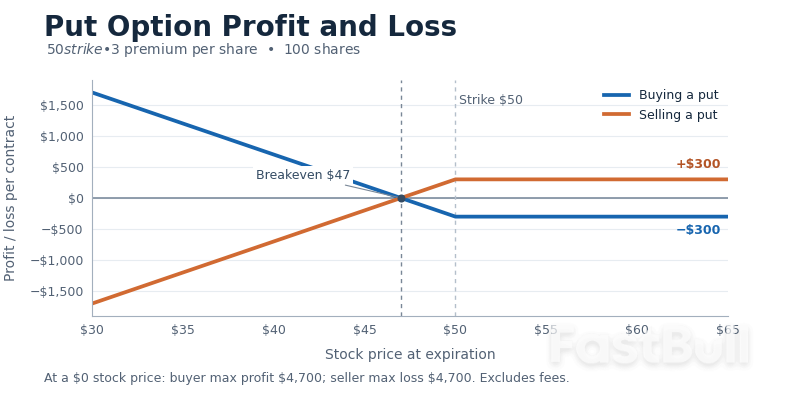
To understand how put options work in practice, consider a stock trading at $50. An investor buys or sells a put option with a $50 strike price and a premium of $3 per share. Since one standard stock option contract typically represents 100 shares, the total premium is $300.
The same contract creates different outcomes for the buyer and seller depending on the stock price at expiration.
| Stock Price at Expiration | Put Buyer's Profit/Loss | Put Seller's Profit/Loss |
|---|---|---|
| $40 | +$700 | -$700 |
| $47 | $0 | $0 |
| $50 | -$300 | +$300 |
| $55 | -$300 | +$300 |
These results assume the positions are held until expiration, one standard 100-share contract is used, and transaction costs are excluded.
When the stock falls to $40: The put buyer can sell the shares for $50 even though their market value is only $40. The option has $10 per share of intrinsic value, or $1,000 for the contract. After subtracting the $300 premium, the buyer earns $700. The seller experiences the opposite result, losing $700.
When the stock falls to $47: The put has $3 per share of intrinsic value, exactly matching the $3 premium. The buyer breaks even, and the seller also breaks even before transaction costs.
When the stock stays at $50 or rises to $55: The put expires without intrinsic value. The buyer loses the $300 premium, while the seller keeps the entire amount.
This comparison shows why buying a put is generally attractive when an investor expects a significant price decline, while selling a put can be suitable for someone willing to purchase the stock at a lower effective price.
Put Option Profit, Loss, and Breakeven
Calculating the potential profit or loss of a put option requires comparing its strike price, premium, and the underlying stock price at expiration. The calculation differs depending on whether the investor buys or sells the contract.
Put Option Breakeven and Profit Formulas
For a standard stock put option, the buyer's profit or loss at expiration can be calculated as:
Put Buyer Profit/Loss = [Max(Strike Price - Stock Price at Expiration, 0) - Premium] × 100
The seller's result is the opposite:
Put Seller Profit/Loss = [Premium - Max(Strike Price - Stock Price at Expiration, 0)] × 100
These formulas assume one standard contract representing 100 shares. For adjusted contracts, the actual contract deliverable must be used instead.
The key figures for each position are:
- Breakeven Price: Strike Price - Premium. For the $50 strike put with a $3 premium, the breakeven price is $47.
- Buyer's Maximum Loss: Premium × 100. In this example, the buyer can lose up to $300 if the option expires worthless.
- Buyer's Maximum Profit: (Strike Price - Premium) × 100, assuming the stock price falls to zero. Here, the maximum profit is $4,700.
- Seller's Maximum Profit: Premium × 100. The seller can earn up to $300 if the option expires worthless.
- Seller's Maximum Loss: (Strike Price - Premium) × 100, assuming the stock price falls to zero. Here, the maximum loss is $4,700.
The buyer's potential profit is limited because a stock price cannot fall below zero. The seller's potential loss is also technically limited for a standard equity put, but it can still be substantial if the underlying stock declines sharply.
These breakeven and maximum profit or loss figures describe the position at expiration. Before expiration, an option's market value can also change with time remaining, implied volatility, and other pricing factors.
Put vs. Call Options: Key Differences
Put and call options are two basic types of options contracts. Both give buyers the right, but not the obligation, to trade an underlying asset at a predetermined strike price. The main difference is the direction of the transaction: a put gives the buyer the right to sell, while a call gives the buyer the right to buy.
| Feature | Put Option | Call Option |
|---|---|---|
| Buyer's Right | Right to sell | Right to buy |
| Seller's Obligation | Buy the asset if assigned | Sell the asset if assigned |
| Typical Buyer Outlook | Bearish | Bullish |
| Buyer Benefits When | Asset price falls | Asset price rises |
| Buyer's Maximum Loss | Premium paid | Premium paid |
| Seller's Main Risk | Having to buy the asset at the strike price | Having to sell the asset at the strike price |
For example, if an investor expects a stock to fall from $50 to $40, buying a put may provide an opportunity to profit from the decline. If the investor instead expects the stock to rise from $50 to $60, buying a call may be more appropriate.
Investors can also sell puts or calls to collect premiums, but doing so creates different obligations and risks. The choice depends on the investor's market outlook, willingness to hold the underlying asset, and ability to manage potential losses.
Risks of Buying and Selling Put Options
Put options can help investors manage market exposure or pursue specific trading opportunities, but they also involve risks. The potential outcomes depend on the underlying asset's price movement, time remaining until expiration, implied volatility, and the investor's position.
Risks of Buying Put Options
Although the maximum loss for a standalone long put position is generally limited to the premium paid, several factors can cause the option to lose value:
- The stock does not fall as expected: If the stock stays above the strike price until expiration, the put may expire worthless, and the buyer loses the entire premium.
- Time decay: Options lose time value as expiration approaches, all else being equal. Even if the stock price remains relatively stable, the put can become less valuable over time.
- Implied volatility declines: A drop in expected market volatility can reduce an option's premium, potentially causing a loss even when the stock moves in the expected direction.
- Insufficient price movement: A stock may fall but not enough to offset the premium paid. In this case, the buyer can still lose money.
Buyers should consider the strike price, expiration date, premium, and potential price movement before entering a trade. A correct bearish outlook alone does not guarantee a profitable put position.
Risks of Selling Put Options
Продажа опциона пут приносит премиальный доход авансом, но продавец принимает на себя обязательство выкупить базовый актив в случае его исполнения. Основные риски включают:
- Значительный риск снижения стоимости: если цена акций резко упадет, продавцу, возможно, придется выкупить акции по цене исполнения, значительно превышающей их текущую рыночную стоимость.
- Досрочное исполнение: опционы американского типа могут быть исполнены до истечения срока действия. Таким образом, продавец пут-опциона может быть исполнен раньше, чем ожидалось.
- Требования к капиталу: Продавцам опционов пут, обеспеченных денежными средствами, необходимо иметь достаточно свободных денежных средств для покупки акций в случае их исполнения. Другие стратегии продажи опционов пут могут включать требования к марже и дополнительные риски.
- Ограниченный потенциал роста: максимальная прибыль, как правило, ограничена полученной премией, даже если цена акций существенно вырастет.
- Рыночные разрывы: Неожиданные объявления о доходах компаний, экономические новости или другие события могут привести к резкому падению стоимости акций, увеличивая потенциальные убытки продавца.
Перед продажей опционов пут инвесторам следует оценить, насколько комфортно им владеть базовой акцией по эффективной цене покупки, рассчитанной как цена исполнения за вычетом полученной премии. Им также следует убедиться в своей способности выполнить потенциальные финансовые обязательства.
Опционы пут могут служить различным целям в зависимости от способа их использования. Покупка опционов пут может обеспечить защиту от снижения стоимости актива или защиту портфеля, в то время как продажа опционов пут может принести инвесторам, желающим приобрести базовый актив, премию в виде дохода. Перед началом торговли крайне важно понимать потенциальную прибыль, цену безубыточности и риски каждой позиции.