


- EURUSD
- XAUUSD
- XAGUSD
- WTI
- USDX



















Продукты с фиксированным доходом — это инвестиции, приносящие доход в виде процентов, купонных выплат или других договорных денежных потоков. К распространенным примерам относятся государственные и корпоративные облигации, муниципальные облигации, депозитные сертификаты (CD) и облигационные фонды. Сроки погашения, структура выплат, риски и налоговый режим различаются.
Что такое инструменты с фиксированным доходом и как они работают?
Продукты с фиксированным доходом — это финансовые инструменты, обеспечивающие доход на оговоренных условиях. Многие из них работают, позволяя инвесторам предоставлять деньги в долг государству, компании или финансовому учреждению в обмен на проценты и, в большинстве случаев, возврат основной суммы долга по истечении срока действия.
Например, компания может выпустить облигацию для привлечения капитала и согласиться выплачивать инвесторам проценты в установленные сроки. По истечении срока действия облигации ожидается ее возврат по номинальной стоимости. Другие продукты работают иначе: казначейские векселя, как правило, покупаются со скидкой, в то время как по некоторым кредитам и облигациям проценты меняются в зависимости от базовой ставки.
Термин «фиксированный доход» не означает, что каждый платеж или стоимость инвестиций гарантированы. Процентные ставки могут меняться, эмитенты могут объявить дефолт, а ценная бумага, проданная до наступления срока погашения, может стоить меньше, чем ее цена покупки.
Каким образом продукты с фиксированным доходом приносят доход?
Возврат товара зависит от его конструкции. Обычно возврат осуществляется через следующие источники:
- Купонные выплаты: По облигациям проценты выплачиваются регулярно, обычно два раза в год. Облигация номиналом 1000 долларов с годовым купоном в 5% выплачивает 50 долларов в год.
- Выплата процентов: по депозитным сертификатам и многим кредитам проценты начисляются в соответствии с их условиями. Ставка может быть фиксированной или переменной.
- Доходность по дисконту к номинальной стоимости: Казначейские векселя, как правило, продаются со скидкой или по номинальной стоимости. При наступлении срока погашения инвесторы получают номинальную стоимость; любая скидка представляет собой доходность.
- Платежи с плавающей процентной ставкой: Процентные ставки по некоторым облигациям и кредитам пересматриваются относительно базового показателя, поэтому платежи могут как увеличиваться, так и уменьшаться.
- Распределение средств фондом: Облигационные фонды получают доход от своих активов и могут распределять его между акционерами. Размеры распределений могут меняться.
Что происходит по истечении срока действия продукта с фиксированным доходом?
В случае индивидуальной облигации или депозита со сроком погашения эмитент или банк обязаны вернуть основную сумму по истечении срока действия, при условии выполнения своих обязательств и соблюдения условий продукта. Выплата процентов, как правило, прекращается по истечении срока действия.
Паевой инвестиционный фонд облигаций или ETF отличается от них. Он владеет портфелем ценных бумаг и, как правило, не имеет установленной даты погашения. Инвесторы продают паи фонда по текущей рыночной цене, а не получают обещанную выплату основной суммы в конкретную дату.
Какие основные типы продуктов с фиксированным доходом существуют?
Продукты с фиксированным доходом варьируются от краткосрочных государственных ценных бумаг до корпоративных облигаций и инвестиционных фондов. Основные различия заключаются в том, кто их выпускает, как они приносят доход, когда они погашаются и какие риски принимают на себя инвесторы.
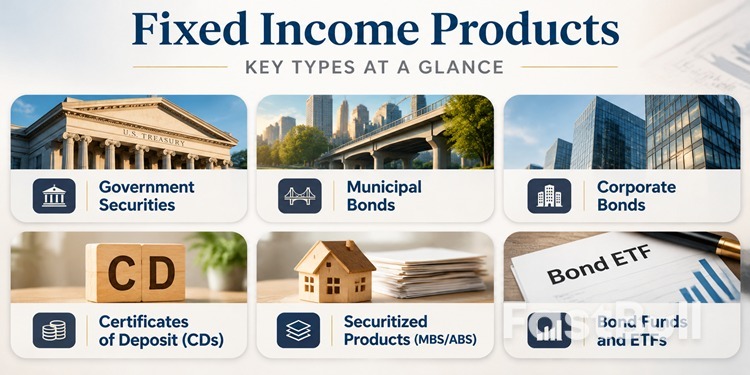
Ценные бумаги Казначейства США
U.S. Treasury securities are debt instruments issued by the federal government. Common types include:
- Treasury Bills (T-Bills): Short-term securities with maturities of 4 to 52 weeks. They are generally sold at a discount and pay face value at maturity.
- Treasury Notes (T-Notes): Securities with maturities of 2, 3, 5, 7, or 10 years that pay interest every six months.
- Treasury Bonds (T-Bonds): Long-term securities with 20- or 30-year maturities that generally pay interest twice a year.
- Treasury Inflation-Protected Securities (TIPS): Securities whose principal adjusts with changes in the Consumer Price Index for All Urban Consumers (CPI-U). Interest is calculated on the adjusted principal, so payment amounts can change.
Treasury securities are backed by the full faith and credit of the U.S. government. Their interest is generally subject to federal income tax but exempt from state and local income taxes. See TreasuryDirect's overview of marketable securities for product details.
Municipal Bonds
Municipal bonds are issued by states, cities, counties, and public authorities to finance projects such as schools, roads, hospitals, and utilities. Two common types are:
- General Obligation Bonds: Supported by the issuer's taxing power or general revenues.
- Revenue Bonds: Repaid primarily from revenue generated by a specific project or service, such as a toll road or water system.
Interest on many municipal bonds is exempt from federal income tax, and it may also be exempt from state and local taxes for residents of the issuing state. Tax treatment varies: some municipal bond interest is taxable or may affect the alternative minimum tax (AMT). Check the bond's official documents and your tax situation. The IRS guidance on investment income explains the general rules.
Corporate Bonds
Companies issue corporate bonds to finance expansion, acquisitions, refinancing, and operations. Investors receive interest under the bond terms, and the company is expected to repay principal at maturity.
- Investment-Grade Bonds: Have higher credit ratings and generally lower perceived default risk, so they often offer lower yields.
- High-Yield Bonds: Have lower credit ratings and greater default risk. They generally offer higher yields to compensate investors for taking that risk.
A higher yield is not automatically a better deal. It may reflect a greater chance that the issuer will miss interest payments or fail to repay principal.
Certificates of Deposit (CDs)
Certificates of deposit are bank deposits that pay interest in exchange for keeping money deposited for an agreed term. Early withdrawal from a traditional CD may trigger a penalty.
- Traditional CDs: Purchased directly from a bank, usually with a stated interest rate and maturity date.
- Brokered CDs: Issued by banks but purchased through brokerage firms. They may be sold in a secondary market before maturity, and the sale price can be above or below the amount invested.
CDs at FDIC-insured banks are generally covered up to $250,000 per depositor, per insured bank, per ownership category, subject to FDIC rules. Coverage is aggregated with other deposits in the same category at that bank. Brokered CD investors should check the issuing bank and available coverage. The FDIC deposit insurance overview explains the limits and eligible deposits.
Agency Bonds and Securitized Products
Agency bonds are issued by federal agencies or government-sponsored enterprises (GSEs). Their backing varies by issuer, and not all carry the full faith and credit guarantee of the U.S. government.
Securitized products are created by pooling loans or other financial assets and issuing securities backed by the cash flows from those assets. Examples include:
- Mortgage-Backed Securities (MBS): Backed by pools of residential or commercial mortgages. Investor payments come from mortgage principal and interest.
- Asset-Backed Securities (ABS): Backed by assets such as auto loans, credit card receivables, or student loans.
Cash flows can be affected by borrower defaults, early repayments, and changes in interest rates.
Bond Mutual Funds and ETFs
Bond mutual funds and exchange-traded funds pool investors' money to buy portfolios of government, corporate, municipal, or other debt securities. They can provide diversification and access to bonds without requiring investors to select each security themselves.
Bond ETFs trade on exchanges during market hours. Mutual funds generally transact once each business day at their net asset value (NAV). Both can fluctuate in value, charge fees, and make distributions that vary. Unlike an individual bond held to maturity, a typical bond fund does not promise to return a fixed principal amount on a specific date.
Other Fixed Income Instruments
Institutional fixed income markets also include instruments such as:
- Commercial Paper: Short-term, generally unsecured corporate debt used to fund operating expenses and other near-term needs.
- Bank Loans: Loans to businesses. Many institutional loan investments have floating rates, so interest payments can change as benchmark rates move.
Fixed Income Products: Examples and Key Differences
The table below compares common products by how they generate income and what distinguishes them.
| Product | Income Source | Key Characteristic |
|---|---|---|
| Treasury Bills | Discount to face value | Short-term U.S. government debt |
| Treasury Bonds | Coupon payments | Long-term U.S. government debt |
| Municipal Bonds | Interest payments | Potential tax advantages |
| Corporate Bonds | Coupon payments | Credit risk varies by issuer |
| CDs | Interest payments | Bank deposit with a stated term |
| Bond ETFs | Portfolio income and distributions | Diversified bond exposure |
Consider a corporate bond with a $1,000 face value and a 5% annual coupon. It pays $50 in interest each year, often in two $25 installments. If the investor buys it for $950, the current yield is about 5.26% ($50 ÷ $950).
The coupon rate, current yield, and yield to maturity (YTM) measure different things:
- Coupon Rate: Annual coupon interest divided by the bond's face value.
- Current Yield: Annual coupon interest divided by the bond's current market price.
- Yield to Maturity: The estimated annualized return if the bond is held until maturity, taking into account coupon payments and the difference between its purchase price and the amount repaid at maturity, assuming the issuer makes the required payments.
What Risks Should Investors Understand?
Fixed income products can offer more predictable cash flows than some investments, but they are not risk-free. The main risks depend on the issuer, maturity, structure, and market conditions.
Interest Rate Risk
Market interest rates and the prices of existing fixed-rate bonds generally move in opposite directions. When rates rise, older bonds with lower coupons become less attractive and their market prices tend to fall. Longer-maturity bonds are usually more sensitive to rate changes.
Credit and Default Risk
Credit risk is the possibility that an issuer will fail to make interest payments or repay principal. Lower-rated corporate bonds generally carry greater default risk than investment-grade bonds. Credit ratings help assess risk, but they are opinions, not guarantees.
Inflation, Liquidity and Reinvestment Risks
Inflation reduces the purchasing power of fixed payments. Liquidity risk arises when a security is difficult to sell without accepting a lower price. Reinvestment risk occurs when coupon or principal payments must be reinvested at lower rates. Callable bonds and mortgage-backed securities can also expose investors to early repayment, which may force them to reinvest sooner than expected.
How Do You Choose the Right Fixed Income Product?
The right product depends on when you need the money, how much risk you can accept, and whether you prioritize income, liquidity, or tax treatment.
Match the Product to Your Investment Timeline
Investors who need their money soon may compare Treasury bills or short-term CDs. Those seeking longer-term income may consider Treasury notes, corporate bonds, or municipal bonds. Bond funds can provide ongoing exposure without requiring investors to choose individual maturity dates.
Compare Yields, Credit Quality and Tax Treatment
Не следует сравнивать продукты, основываясь только на заявленной доходности. Необходимо учитывать кредитное качество, срок погашения, комиссии, ликвидность и доход после уплаты налогов. В случае муниципальных облигаций эквивалентная налоговая доходность может помочь сравнить доход, освобожденный от налогов, с облагаемыми налогом альтернативами, но результат зависит от налоговой категории инвестора и правил налогообложения штата.
Отдельные облигации против фондов с фиксированным доходом
Отдельные облигации имеют установленные условия погашения и даты выплаты. Если эмитент выполняет свои обязательства, и инвестор держит облигацию до погашения, основная сумма, как правило, возвращается по номинальной стоимости. Фонды облигаций предлагают диверсификацию и более легкий доступ к портфелю, но цены их акций колеблются, и они, как правило, не имеют даты погашения или обещания возврата первоначальных инвестиций.
Часто задаваемые вопросы о продуктах с фиксированным доходом
Считаются ли облигации продуктами с фиксированным доходом?
Да. Государственные, муниципальные и корпоративные облигации — распространенные инструменты с фиксированным доходом. Как правило, они выплачивают проценты в соответствии с установленными условиями и предназначены для погашения основной суммы долга при наступлении срока погашения, при условии платежеспособности эмитента.
Являются ли кредиты кредитами с фиксированным доходом?
Кредиты могут быть частью рынка облигаций, когда инвесторы владеют долговыми обязательствами, которые генерируют договорные процентные и основные платежи. Некоторые кредиты имеют плавающие процентные ставки, поэтому их платежи меняются в зависимости от базовой процентной ставки.
Что представляют собой продукты с фиксированным доходом в инвестиционно-банковской сфере?
В инвестиционно-банковской сфере продукты с фиксированным доходом обычно включают долговые ценные бумаги и связанные с ними инструменты, которые учреждения выпускают, структурируют, торгуют или распространяют. Примерами являются государственные и корпоративные облигации, муниципальные облигации, ипотечные ценные бумаги и другие структурированные кредитные продукты.
Что такое фонд с фиксированным доходом?
Фонд с фиксированным доходом — это паевой инвестиционный фонд или ETF, который инвестирует преимущественно в долговые ценные бумаги, такие как государственные облигации, корпоративные облигации или муниципальные облигации. Он обеспечивает доступ к портфелю инвестиций с фиксированным доходом, но его рыночная стоимость и дивидендные выплаты могут меняться.