Markets
News
Analysis
User
24/7
Economic Calendar
Education
Data
- Names
- Latest
- Prev


Signal Accounts for Members
All Signal Accounts
All Contests


Canada Unemployment Rate (SA) (Nov)A:--
F: --
P: --
Canada Labor Force Participation Rate (SA) (Nov)A:--
F: --
P: --
Canada Employment (SA) (Nov)A:--
F: --
P: --
Canada Part-Time Employment (SA) (Nov)A:--
F: --
P: --
Canada Full-time Employment (SA) (Nov)A:--
F: --
P: --
U.S. Personal Income MoM (Sept)A:--
F: --
P: --
U.S. PCE Price Index YoY (SA) (Sept)A:--
F: --
P: --
U.S. PCE Price Index MoM (Sept)A:--
F: --
P: --
U.S. Personal Outlays MoM (SA) (Sept)A:--
F: --
P: --
U.S. Core PCE Price Index MoM (Sept)A:--
F: --
P: --
U.S. Core PCE Price Index YoY (Sept)A:--
F: --
P: --
U.S. UMich 5-Year-Ahead Inflation Expectations Prelim YoY (Dec)A:--
F: --
P: --
U.S. Real Personal Consumption Expenditures MoM (Sept)A:--
F: --
P: --
U.S. 5-10 Year-Ahead Inflation Expectations (Dec)A:--
F: --
P: --
U.S. UMich Current Economic Conditions Index Prelim (Dec)A:--
F: --
P: --
U.S. UMich Consumer Sentiment Index Prelim (Dec)A:--
F: --
P: --
U.S. UMich 1-Year-Ahead Inflation Expectations Prelim (Dec)A:--
F: --
P: --
U.S. UMich Consumer Expectations Index Prelim (Dec)A:--
F: --
P: --
U.S. Weekly Total Rig CountA:--
F: --
P: --
U.S. Weekly Total Oil Rig CountA:--
F: --
P: --
U.S. Unit Labor Cost Prelim (SA) (Q3)--
F: --
P: --
U.S. Consumer Credit (SA) (Oct)A:--
F: --
P: --
China, Mainland Foreign Exchange Reserves (Nov)A:--
F: --
P: --
China, Mainland Exports YoY (USD) (Nov)--
F: --
P: --
China, Mainland Imports YoY (CNH) (Nov)--
F: --
P: --
China, Mainland Imports YoY (USD) (Nov)--
F: --
P: --
China, Mainland Imports (CNH) (Nov)--
F: --
P: --
China, Mainland Trade Balance (CNH) (Nov)--
F: --
P: --
China, Mainland Exports (Nov)--
F: --
P: --
Japan Wages MoM (Oct)A:--
F: --
P: --
Japan Trade Balance (Oct)--
F: --
P: --
Japan Nominal GDP Revised QoQ (Q3)--
F: --
P: --
Japan Trade Balance (Customs Data) (SA) (Oct)--
F: --
P: --
Japan GDP Annualized QoQ Revised (Q3)--
F: --
China, Mainland Exports YoY (CNH) (Nov)--
F: --
P: --
China, Mainland Trade Balance (USD) (Nov)--
F: --
P: --
Germany Industrial Output MoM (SA) (Oct)--
F: --
P: --
Euro Zone Sentix Investor Confidence Index (Dec)--
F: --
P: --
Canada Leading Index MoM (Nov)--
F: --
P: --
Canada National Economic Confidence Index--
F: --
P: --
U.S. Dallas Fed PCE Price Index YoY (Sept)--
F: --
P: --
China, Mainland Trade Balance (USD) (Nov)--
F: --
P: --
U.S. 3-Year Note Auction Yield--
F: --
P: --
U.K. BRC Overall Retail Sales YoY (Nov)--
F: --
P: --
U.K. BRC Like-For-Like Retail Sales YoY (Nov)--
F: --
P: --
Australia Overnight (Borrowing) Key Rate--
F: --
P: --
RBA Rate Statement
RBA Press Conference
Germany Exports MoM (SA) (Oct)--
F: --
P: --
U.S. NFIB Small Business Optimism Index (SA) (Nov)--
F: --
P: --
Mexico Core CPI YoY (Nov)--
F: --
P: --
Mexico 12-Month Inflation (CPI) (Nov)--
F: --
P: --
Mexico PPI YoY (Nov)--
F: --
P: --
Mexico CPI YoY (Nov)--
F: --
P: --
U.S. Weekly Redbook Index YoY--
F: --
P: --
U.S. JOLTS Job Openings (SA) (Oct)--
F: --
P: --
China, Mainland M2 Money Supply YoY (Nov)--
F: --
P: --
China, Mainland M0 Money Supply YoY (Nov)--
F: --
P: --
China, Mainland M1 Money Supply YoY (Nov)--
F: --
P: --
U.S. EIA Short-Term Crude Production Forecast For The Next Year (Dec)--
F: --
P: --
U.S. EIA Short-Term Crude Production Forecast For The Year (Dec)--
F: --
P: --


No matching data
Latest Views
Latest Views
Trending Topics
Top Columnists
Latest Update
White Label
Data API
Web Plug-ins
Affiliate Program
View All

No data
Six-week U.S. government shutdown ends, with over $10 billion in permanent economic losses; UK government drops plan to increase income tax rates......

Oil prices moved higher yesterday, settling just shy of 0.5% higher, despite a bearish weekly Energy Information Administration (EIA) inventory report. Also, a monthly International Energy Agency (IEA) release again highlighted expectations for a sizable oil surplus in 2026.
The EIA's report showed that US crude oil inventories increased by 6.4m barrels over the last week, larger than expected and more than the 1.3m barrel increase the API reported the previous day. This leaves crude stocks at their highest level since June. Seasonally, they are at their lowest level since 2014. The increase was largely driven by weaker exports, which declined by 1.55m b/d week on week. For refined products, gasoline and distillate stocks fell by 945k barrels and 637k barrels, respectively. These inventory declines come despite refiners increasing utilisation rates by 3.4 percentage points, week on week, to 89.4%. Run rates are expected to increase as refinery maintenance concludes, while healthy refinery margins are likely to also support higher refinery run rates.
The IEA's monthly report continues to indicate a well-supplied market. The agency estimates that global oil supply will grow by 3.1m b/d and 2.5m b/d in 2025 and 2026, respectively. Meanwhile, demand growth is forecast to be more modest, with the IEA expecting it to increase by just 790k per day (b/d) in 2025 and a further 770k b/d in 2026. In terms of oil inventories, the IEA estimates that global observed stocks surged by 77.7m barrels in September, with a large increase in floating storage. Meanwhile, preliminary data shows that global stocks increased further in October, driven once again by floating storage.
While the ICE gasoil crack has fallen from its recent highs over the past couple of days, it remains at elevated levels, above $30/bbl. As we head deeper into the Northern hemisphere winter, refinery maintenance season, a number of unplanned refinery outages, Russian sanction uncertainty and low stocks have kept the middle distillate market well-supported. The latest inventory data from Enterprise Singapore shows that onshore middle distillate stocks in the nation fell by 119k barrels over the last week. In the Amsterdam-Rotterdam-Antwerp (ARA) region, gasoil stocks increased by 87kt WoW to 2.29mt, according to Insights Global.
Key points:
The Asian rice export markets were subdued this week, with rates in Thailand at their lowest level in 18 years due to subdued demand and ample supply from the new season's crop, with fears emerging that the persistent low prices might lead farmers to grow less rice.
Thailand's 5% broken rice (RI-THBKN5-P1) was quoted at $335 per tonnes on Thursday, slightly down from $338 quoted last week, to its lowest since October 2007.
"Buyers have been purchasing only little amount due to news that India will be releasing more rice that is cheaper than Thai variety," a Bangkok-based trader said, adding that farmers are now going to grow less rice due to the persisting low prices.
The supply situation also offers little relief in Thailand with more rice entering the market as the rainy season winds down.
India's 5% broken parboiled variety (RI-INBKN5-P1) was quoted this week at $344-$350 per ton, unchanged from the last week, while its 5% broken white rice was priced at $350 to $360 per ton.
"Supplies from the new season's crop are starting to push local prices down, though the government's been buying up stocks pretty aggressively," said a New Delhi-based dealer with a trade house.
Vietnam's 5% broken rice (RI-VNBKN5-P1) was offered at $415-$430 per ton, unchanged from a week ago, according to the Vietnam Food Association.
Sales are very slow due to weak demand, despite offering lower prices, said a trader based in Ho Chi Minh City.
Vietnam's rice exports are forecast to be 8.8 million tons this year, state media on Thursday cited the association chairman Do Ha Nam as saying.
Meanwhile, Bangladesh has approved a proposal to import 50,000 metric tons of parboiled rice at $355.59 per tonne through a tender. The move aims to strengthen food security and ensure sufficient stock as the government struggles to control rising prices of rice.
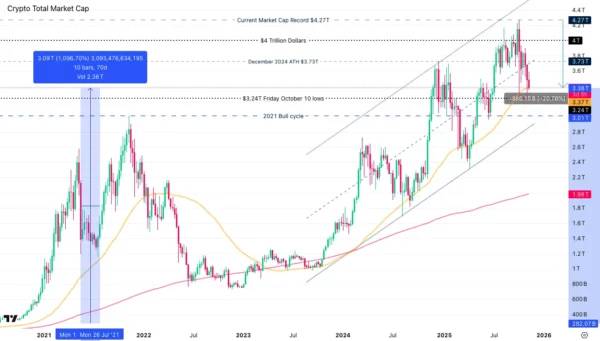
Risk assets have been yo-yoing since mid-October, with fundamentals turning increasingly obscure amid the absence of US data, leaving investors hesitant to take on new risk.
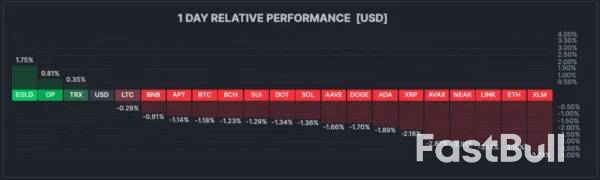
Cryptocurrencies have also been flashing mixed signals following the early-October rallies in Bitcoin, Solana, and Ethereum.
Despite ongoing market cap outflows, the crypto space has made solid progress this year.Screenshot 2025-11-13 at 11.15.59 AM

Still, with prices now down roughly 32% from the $4,950 August peak, the hype in ETH has cooled substantially.
Yet, it's often when fewer people are watching that true opportunities emerge—though the question remains: is this a dip to buy or a reason to panic?
Overstretched tech valuations continue to weigh on markets, as reflected in today's weakness across stock indices, and crypto is facing similar pressure.
From an investment standpoint, the long term will reveal its truth—but for those without a crystal ball, a prudent approach is Dollar-Cost Averaging (DCA), which involves gradually building positions over time.
For traders, the focus should stay on support and resistance levels—spotting trends between them and reacting when those levels break.
Let's now look these levels through a multi-timeframe Ethereum analysis.


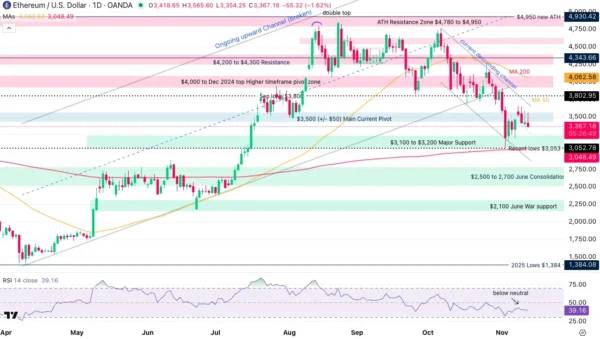
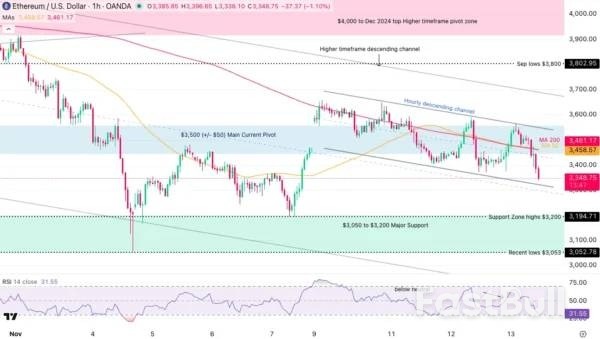
Having broken its April 2025 explosive upward channel, the picture for ETH is tilting more bearish, as strong flows have brought the second-Crypto below its $3,500 momentum pivot.
Multiple attempts to break resistances have been met with consequent selloffs, leading to the formation of lower-highs.
A balancing rebound last Tuesday (Nov 4) marked a temporary bottom at $3,053 – the rest will be to see if the bottom holds in an eventual double bottom or if its breaks, but for now these prices are still 8% from here (But never underestimate Crypto volatility!).

Levels of interest for ETH trading:
Support Levels:
Resistance Levels:

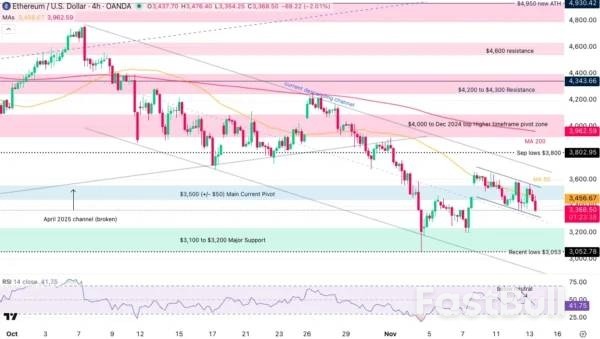
ETH is oscillating in a shorter timeframe descending channel which serves as immediate momentum indicator:
Bouncing at the lows of the channel points to a short-term revisit of the $3,500 Pivot Zone.
Further upwards, a break above $3,700 (with preferably a session/weekly close), points to a more stable rebound that may serve for future rallies.
In Australia, the week's dataflow kicked off with a bang as Westpac-MI Consumer Sentiment surged 12.8% in November to 103.8, the first reading above the optimist / pessimist divide since the economy reopened after the 'delta' outbreak. A calmer geopolitical backdrop following the de-escalation of US-China trade tensions and a more assured domestic recovery look to be behind the result.
While respondents showed some renewed concerns over inflation and the interest rate outlook, these negatives were offset. It is interesting to note that responses received after the RBA's November decision were positive, suggesting the Board's decision and communications were construed as measured rather than outright hawkish.
On balance, these factors led to a significant improvement in views on the economic outlook for one year (+16.6%) and five years (+15.3%). The 'time to buy a major household item' sub-index also jumped (+14.9%); together with less-restrained intentions for Christmas spending, this outcome suggests the foundation for the consumer recovery is firming. Positive wealth effects associated with the housing upswing are arguably also at play, as evinced by strong investor-led growth in home lending and Westpac-MI house price expectations moving to a new cycle high.
While consumers have grown more anxious on the jobs outlook, this week's labour force data confirmed that the labour market is only softening at a very gradual pace. Employment was firmer-than-expected in the month, rising +42.2k, keeping annual growth steady at 1.5% on a three-month average basis. The unemployment rate also fell from a 'thin' 4.5% in September to a 'fat' 4.3% in October (–0.1ppt from 4.45% to 4.34%). Looking through the noise, the steady-but-modest uptrend in the unemployment rate in place throughout 2025 remains intact. At its current level, the unemployment rate is broadly consistent with full employment – indicative of a labour market in good health but which poses little-to-no risk to inflation via wages.
The rebalancing of employment growth from the 'jobs-rich', public-funded care economy to the less 'jobs-intensive' market sector is a key driver of the softening employment trend. The latest NAB business survey suggests this transition remains in good stead, the business conditions index rising to its highest level since March 2024. Confidence is re-emerging but remains fragile. Given the weak starting point for investment, businesses might hold off on capacity expansion.
The main development offshore this week was US Congressional approval to end the government shutdown in place since the beginning of October. While a welcome development, another partial shutdown from the end of January is a distinct possibility, with only the Departments of Agriculture and Veteran's Affairs, the Food and Drug Administration, military construction projects and Congress funded through to end-September. There is no guarantee a vote on extending the Obamacare subsidies will pass over year end, and so debate is likely to remain highly politicised over funding the remainder of the Government from February.
In coming weeks, US statistical agencies will attempt to bring the dataflow back up to date, though the market has already been told some upcoming releases will be incomplete. FOMC members, by and large, continue to focus attention on inflation risks, viewing these as more significant and immediate than the labour market's ongoing deceleration. Arguably then, it will take a material deterioration in conditions for the Committee to ease again at the December meeting.
White Label
Data API
Web Plug-ins
Poster Maker
Affiliate Program
The risk of loss in trading financial instruments such as stocks, FX, commodities, futures, bonds, ETFs and crypto can be substantial. You may sustain a total loss of the funds that you deposit with your broker. Therefore, you should carefully consider whether such trading is suitable for you in light of your circumstances and financial resources.
No decision to invest should be made without thoroughly conducting due diligence by yourself or consulting with your financial advisors. Our web content might not suit you since we don't know your financial conditions and investment needs. Our financial information might have latency or contain inaccuracy, so you should be fully responsible for any of your trading and investment decisions. The company will not be responsible for your capital loss.
Without getting permission from the website, you are not allowed to copy the website's graphics, texts, or trademarks. Intellectual property rights in the content or data incorporated into this website belong to its providers and exchange merchants.
Not Logged In
Log in to access more features

FastBull Membership
Not yet
Purchase
Log In
Sign Up