• Trade
  • Markets
  • Copy
  • Contests
  • 24/7
  • Calendar
  • Q&A
  • Chats
Screeners
SYMBOL
LAST
BID
ASK
HIGH
LOW
NET CHG.
%CHG.
SPREAD
SOURCE
SPX
S&P 500 Index
7473.48
7473.48
7473.48
7506.32
7463.29
+27.75
+ 0.37%
--
--
DJI
Dow Jones Industrial Average
50579.69
50579.69
50579.69
50830.24
50434.65
+294.04
+ 0.58%
--
--
IXIC
NASDAQ Composite Index
26343.96
26343.96
26343.96
26504.55
26309.80
+50.87
+ 0.19%
--
--
USDX
US Dollar Index
99.190
99.190
99.270
99.340
99.080
+0.050
+ 0.05%
--
--
EURUSD
Euro / US Dollar
1.16014
1.16014
1.16051
1.16210
1.15880
-0.00153
-0.13%
--
--
GBPUSD
Pound Sterling / US Dollar
1.34278
1.34278
1.34323
1.34625
1.34129
-0.00007
-0.01%
--
--
XAUUSD
Gold / US Dollar
4509.66
4509.66
4509.66
4545.94
4491.55
-33.22
-0.73%
--
--
WTI
Light Sweet Crude Oil
96.068
96.068
96.163
98.439
93.817
-1.115
-1.15%
--
--

Community Accounts

Signal Accounts
--
Profit Accounts
--
Loss Accounts
--
View More

Become a signal provider

Sell trading signals to earn additional income

View More

Guide to Copy Trading

Get started with ease and confidence

View More

Signal Accounts for Members

All Signal Accounts

Best Return
  • Best Return
  • Best P/L
  • Best MDD
Past 1W
  • Past 1W
  • Past 1M
  • Past 1Y

All Contests

  • All
  • Recommend
  • Stocks
  • Cryptocurrencies
  • Central Banks
  • Trump Updates
  • Featured News
Top News Only
Share

According To The Egyptian Ministry Of Foreign Affairs: The Egyptian Foreign Minister Spoke By Phone With EU High Representative For Foreign Affairs And Security Policy Karas To Discuss Regional Developments

Share

Ukraine Says It Struck A Russian Oil Pumping Station

Share

According To Fox News, Citing U.S. Government Officials, The U.S. Government Will Consider Easing Sanctions If Tehran Makes Concessions On Uranium Enrichment

Share

According To Fox News, Citing A Senior U.S. Official: "We Have Observed That Iran Has Made Serious And Unprecedented Concessions On The Issue Of Uranium Enrichment."

Share

Israeli Prime Minister Netanyahu: US President Trump Reiterated Israel's Right To Defend Its Security In All Aspects, Including In Lebanon

Share

Bond Strategists Warn That Yields Will Remain Elevated Even If The Iran Conflict Ends

Share

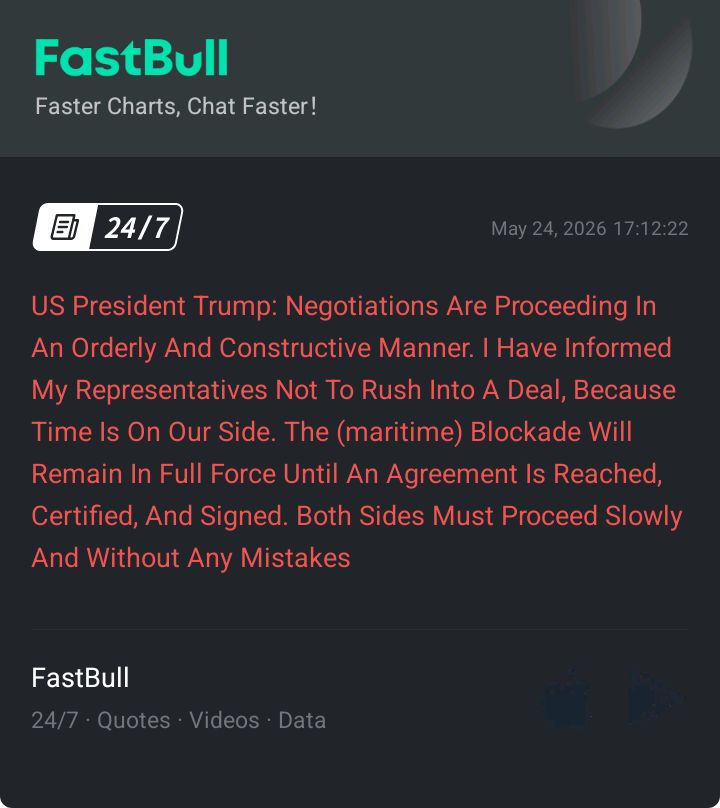
US President Trump: Negotiations Are Proceeding In An Orderly And Constructive Manner. I Have Informed My Representatives Not To Rush Into A Deal, Because Time Is On Our Side. The (maritime) Blockade Will Remain In Full Force Until An Agreement Is Reached, Certified, And Signed. Both Sides Must Proceed Slowly And Without Any Mistakes

Share

[A Certain Whale Longed 25x The Value Of $12.6 Million In Gold] May 24th, According To Onchain Lens Monitoring, A Whale Went Long 25x On 2700 Ounces Of Gold, Worth $12.6 Million.The Whale Also Holds A 20x Leveraged Short Position On Crude Oil, Currently With Unrealized Gains Of Over $324,000

Share

[Railgun Token RAIL Briefly Surged Above $4.7 Before Retracing, Posting A More Than 73% Gain In The Last 24 Hours] May 24th, According To HTX Market Data, The Privacy Protocol Railgun's Token RAIL Briefly Surged Above $4.7 Before Falling Back, Now Trading At $4.01, Up Over 73% In The Past 24 Hours

Share

Indian Foreign Minister: Discussed Key Minerals, Artificial Intelligence And Nuclear Energy With US Secretary Of State Rubio

Share

Navigation Warning: Live-Fire Exercises In The Southern Yellow Sea

Share

Three Government Departments Have Dispatched 10,000 Pieces Of Central Disaster Relief Supplies To Chongqing To Support Local Disaster Relief And Assistance Efforts

Share

Market News: Turkish Riot Police Fired Tear Gas And Stormed The Headquarters Of The Main Opposition Party, Expelling The Ousted Leadership

Share

Russia Stated That Its Strikes On Ukraine That Day Targeted Only Military Objectives And Did Not Involve Civilian Infrastructure

Share

The Azerbaijani Consul General In Tabriz, Iran, Died In A Car Accident

Share

According To The Bahrain News Agency, A Bahraini Court Sentenced Nine Defendants To Life Imprisonment For "collaborating With The Iranian Revolutionary Guard."

Share

German Chancellor Merkel: Russia Has Once Again Used The S-300 Missile System To Strike Ukraine. The German Government Strongly Condemns This Reckless Escalation

Share

German Chancellor Merz: Russia Has Once Again Used The Hazel Missile System To Attack Ukraine. The German Government Strongly Condemns This Reckless Escalation

Share

China Will Release, In Due Course, Foreign Trade Data For The Guangdong-Hong Kong-Macao Greater Bay Area As A Whole

Share

German Foreign Minister: Russia's Missile Attacks On Ukraine Are Shocking; The Use Of Iskander Missiles Marks Yet Another Escalation

TIME
ACT
FCST
PREV
IMPACT
U.S. Weekly Treasuries Held by Foreign Central Banks

A:--

F: --

P: --

USDX
  • USDX
  • XAUUSD
  • XAGUSD
  • WTI
U.K. GfK Consumer Confidence Index (May)

A:--

F: --

P: --

GBPUSD
  • GBPUSD
  • XAUUSD
  • XAGUSD
  • WTI
Japan CPI MoM (Apr)

A:--

F: --

P: --

USDJPY
  • USDJPY
  • XAUUSD
  • XAGUSD
  • WTI
  • USDX
Japan National CPI MoM (Apr)

A:--

F: --

P: --

USDJPY
  • USDJPY
  • XAUUSD
  • XAGUSD
  • WTI
Japan National CPI YoY (Apr)

A:--

F: --

P: --

USDJPY
  • USDJPY
  • XAUUSD
  • XAGUSD
  • WTI
Japan National Core CPI YoY (Apr)

A:--

F: --

P: --

USDJPY
  • USDJPY
  • XAUUSD
  • XAGUSD
  • WTI
Japan National CPI MoM (Not SA) (Apr)

A:--

F: --

P: --

USDJPY
  • USDJPY
  • XAUUSD
  • XAGUSD
  • WTI
ECB Chief Economist Lane Speaks
U.K. Retail Sales MoM (SA) (Apr)

A:--

F: --

P: --

GBPUSD
  • GBPUSD
  • XAUUSD
  • XAGUSD
  • WTI
  • USDX
U.K. Retail Sales YoY (SA) (Apr)

A:--

F: --

P: --
GBPUSD
  • GBPUSD
  • XAUUSD
  • XAGUSD
  • WTI
  • USDX
Germany GfK Consumer Confidence Index (SA) (Jun)

A:--

F: --

P: --
EURUSD
  • EURUSD
  • XAUUSD
  • XAGUSD
  • WTI
  • USDX
U.K. Core Retail Sales YoY (SA) (Apr)

A:--

F: --

P: --
GBPUSD
  • GBPUSD
  • XAUUSD
  • XAGUSD
  • WTI
  • USDX
ECB Chief Economist Lane Speaks
Turkey Capacity Utilization (May)

A:--

F: --

P: --

XAUUSD
  • XAUUSD
  • XAGUSD
  • WTI
  • USDX
Turkey Trade Balance (Apr)

A:--

F: --

P: --

XAUUSD
  • XAUUSD
  • XAGUSD
  • WTI
  • USDX
Germany Ifo Current Business Situation Index (SA) (May)

A:--

F: --

P: --

EURUSD
  • EURUSD
  • XAUUSD
  • XAGUSD
  • WTI
  • USDX
Germany Ifo Business Expectations Index (SA) (May)

A:--

F: --

P: --
EURUSD
  • EURUSD
  • XAUUSD
  • XAGUSD
  • WTI
  • USDX
Germany IFO Business Climate Index (SA) (May)

A:--

F: --

P: --
EURUSD
  • EURUSD
  • XAUUSD
  • XAGUSD
  • WTI
  • USDX
Mexico Economic Activity Index YoY (Mar)

A:--

F: --

P: --

XAUUSD
  • XAUUSD
  • XAGUSD
  • WTI
  • USDX
Canada Industrial Product Price Index YoY (Apr)

A:--

F: --

P: --
USDCAD
  • USDCAD
  • XAUUSD
  • XAGUSD
  • WTI
  • USDX
Canada Retail Sales MoM (SA) (Mar)

A:--

F: --

P: --

USDCAD
  • USDCAD
  • XAUUSD
  • XAGUSD
  • WTI
  • USDX
Canada Industrial Product Price Index MoM (Apr)

A:--

F: --

P: --
USDCAD
  • USDCAD
  • XAUUSD
  • XAGUSD
  • WTI
  • USDX
Canada Core Retail Sales MoM (SA) (Mar)

A:--

F: --

P: --
USDCAD
  • USDCAD
  • XAUUSD
  • XAGUSD
  • WTI
  • USDX
U.S. Conference Board Leading Economic Index MoM (Apr)

A:--

F: --

P: --

USDX
  • USDX
  • XAUUSD
  • XAGUSD
  • WTI
U.S. Conference Board Leading Economic Index (Apr)

A:--

F: --

P: --

USDX
  • USDX
  • XAUUSD
  • XAGUSD
  • WTI
U.S. Conference Board Coincident Economic Index MoM (Apr)

A:--

F: --

P: --

USDX
  • USDX
  • XAUUSD
  • XAGUSD
  • WTI
U.S. Conference Board Lagging Economic Index MoM (Apr)

A:--

F: --

P: --

USDX
  • USDX
  • XAUUSD
  • XAGUSD
  • WTI
U.S. Weekly Total Rig Count

A:--

F: --

P: --

WTI
  • WTI
  • XAUUSD
  • XAGUSD
  • USDX
U.S. Weekly Total Oil Rig Count

A:--

F: --

P: --

WTI
  • WTI
  • XAUUSD
  • XAGUSD
  • USDX
Argentina Retail Sales YoY (Mar)

A:--

F: --

P: --

XAUUSD
  • XAUUSD
  • XAGUSD
  • WTI
  • USDX
Turkey Economic Sentiment Indicator (May)

--

F: --

P: --

Canada National Economic Confidence Index

--

F: --

P: --

Mexico Trade Balance (Apr)

--

F: --

P: --

U.K. BRC Shop Price Index YoY (May)

--

F: --

P: --

U.K. CBI Retail Sales Expectations Index (May)

--

F: --

P: --

U.K. CBI Distributive Trades (May)

--

F: --

P: --

Brazil Current Account (Apr)

--

F: --

P: --

U.S. Chicago Fed National Activity Index (Apr)

--

F: --

P: --

U.S. S&P/CS 20-City Home Price Index YoY (Not SA) (Mar)

--

F: --

P: --

U.S. S&P/CS 20-City Home Price Index MoM (SA) (Mar)

--

F: --

P: --

U.S. FHFA House Price Index MoM (Mar)

--

F: --

P: --

U.S. FHFA House Price Index (Mar)

--

F: --

P: --

U.S. FHFA House Price Index YoY (Mar)

--

F: --

P: --

U.S. S&P/CS 10-City Home Price Index MoM (Not SA) (Mar)

--

F: --

P: --

U.S. S&P/CS 10-City Home Price Index YoY (Mar)

--

F: --

P: --

U.S. S&P/CS 20-City Home Price Index (Not SA) (Mar)

--

F: --

P: --

U.S. S&P/CS 20-City Home Price Index MoM (Not SA) (Mar)

--

F: --

P: --

U.S. Conference Board Consumer Expectations Index (May)

--

F: --

P: --

U.S. Conference Board Consumer Confidence Index (May)

--

F: --

P: --

U.S. Conference Board Present Situation Index (May)

--

F: --

P: --

U.S. Dallas Fed General Business Activity Index (May)

--

F: --

P: --

U.S. Dallas Fed New Orders Index (May)

--

F: --

P: --

U.S. 2-Year Note Auction Avg. Yield

--

F: --

P: --

Australia Westpac Leading Index MoM (Apr)

--

F: --

P: --
China, Mainland Industrial Profit YoY (YTD) (Apr)

--

F: --

P: --

Australia Construction Work Done YoY (Q1)

--

F: --

P: --

Australia RBA Trimmed Mean CPI YoY (Q2)

--

F: --

P: --

Australia Construction Work Done QoQ (SA) (Q1)

--

F: --

P: --

France Unemployment Class-A (Apr)

--

F: --

P: --

U.S. MBA Mortgage Application Activity Index WoW

--

F: --

P: --

Q&A with Experts
    • All
    • Chatrooms
    • Groups
    • Friends
    EuroTrader flag
    JABO GOLD TRADER
    hello guys
    @JABO GOLD TRADER Hello mate, welcome back, how are you doing today?
    JABO GOLD TRADER flag
    EuroTrader
    @JABO GOLD TRADER Hello mate, welcome back, how are you doing today?
    @EuroTraderfine brother and you
    EuroTrader flag
    JABO GOLD TRADER
    @EuroTraderfine brother and you
    @JABO GOLD TRADER I'm doing okay, thanks for asking, hope you are preparing for the week?
    JABO GOLD TRADER flag
    EuroTrader
    @JABO GOLD TRADER I'm doing okay, thanks for asking, hope you are preparing for the week?
    @EuroTraderyes brother I am ready to kill gold
    EuroTrader flag
    JABO GOLD TRADER
    @EuroTraderyes brother I am ready to kill gold
    @JABO GOLD TRADER wow that's really good, it's gonna be an interesting week trust me .
    EuroTrader flag
    JABO GOLD TRADER
    @EuroTraderyes brother I am ready to kill gold
    @JABO GOLD TRADER So tell me friend, which side are you pushing gold when the market opens?
    JABO GOLD TRADER flag
    EuroTrader
    @JABO GOLD TRADER So tell me friend, which side are you pushing gold when the market opens?
    @EuroTraderfirst gold can touch 4528 Then gold will big fall my target 4465
    JABO GOLD TRADER flag
    EuroTrader
    @JABO GOLD TRADER So tell me friend, which side are you pushing gold when the market opens?
    @EuroTradertomorrow only sell brother
    EuroTrader flag
    JABO GOLD TRADER
    @EuroTraderfirst gold can touch 4528 Then gold will big fall my target 4465
    @JABO GOLD TRADER wow that's really good, I've seen a lot of people projecting gold to buy tomorrow
    EuroTrader flag
    JABO GOLD TRADER
    @EuroTradertomorrow only sell brother
    @JABO GOLD TRADER Yeah I'm seeing that too, even on the EURUSD, the structure is looking bearish
    JABO GOLD TRADER flag
    EuroTrader
    @JABO GOLD TRADER wow that's really good, I've seen a lot of people projecting gold to buy tomorrow
    @EuroTraderaccording to my experience gold will big fall brother
    EuroTrader flag
    JABO GOLD TRADER
    @EuroTraderaccording to my experience gold will big fall brother
    @JABO GOLD TRADER That's good, do you have any fundamentals backing this up?
    EuroTrader flag
    JABO GOLD TRADER
    @EuroTraderaccording to my experience gold will big fall brother
    @JABO GOLD TRADER I believe people take a look at the fundamentals too and not just technicals, what do you think?
    JABO GOLD TRADER flag
    gold vip signal group available guys
    JABO GOLD TRADER flag
    gold vip signal room available guys
    john flag
    this might give the market the reason to buy tomorrow
    john flag
    john flag
    JABO GOLD TRADER
    gold vip signal room available guys
    @JABO GOLD TRADER you better drop the signal here because nobody is coming to your private chats
    JABO GOLD TRADER flag
    big loss recovery Quick process available
    john flag
    JABO GOLD TRADER
    big loss recovery Quick process available
    @JABO GOLD TRADER you know there is nothing like this,,,,why don't use your capital and make money from those signals of yours ?
    Type here...
    Add Symbol or Code

      No matching data

      All
      Recommend
      Stocks
      Cryptocurrencies
      Central Banks
      Trump Updates
      Featured News
      • All
      • Russia-Ukraine Conflict
      • Middle East Flashpoint
      • All
      • Russia-Ukraine Conflict
      • Middle East Flashpoint
      Search
      Products

      Charts Free Forever

      Chats Q&A with Experts
      Screeners Economic Calendar Data Tools
      Membership Features
      Data Warehouse Market Trends Institutional Data Policy Rates Macro

      Market Trends

      Market Sentiment Order Book Forex Correlations

      Top Indicators

      Charts Free Forever
      Markets

      News

      24/7 Analysis Education

      Latest Views

      Latest Update

      Signals

      Copy Rankings Latest Signals Become a signal provider AI Rating
      Contests
      Brokers

      Overview Brokers Assessment Rankings Regulators News Claims
      Broker listing Forex Brokers Comparison Tool Live Spread Comparison Scam
      Q&A Complaint Scam Alert Videos Tips to Detect Scam
      More

      Business
      Events
      Careers About Us Advertising Help Center

      White Label

      Broker API

      Data API

      Web Plug-ins

      Affiliate Program

      Awards Institution Evaluation IB Seminar Salon Event Exhibition
      Vietnam Thailand Singapore Dubai
      Fans Party Investment Sharing Session
      FastBull Summit BrokersView Expo
      Recent Searches
        Top Searches
          Markets
          Analysis
          User
          24/7
          Economic Calendar
          Education
          Data
          • Names
          • Latest
          • Prev

          View All

          No data

          Scan to Download

          Faster Charts, Chat Faster!

          Download App
          English
          • English
          • Español
          • العربية
          • Bahasa Indonesia
          • Bahasa Melayu
          • Tiếng Việt
          • ภาษาไทย
          • Français
          • Italiano
          • Türkçe
          • Русский язык
          • 简中
          • 繁中
          Open Account
          Search
          Products
          Charts Free Forever
          Markets
          News
          Signals

          Copy Rankings Latest Signals Become a signal provider AI Rating
          Contests
          Brokers

          Overview Brokers Assessment Rankings Regulators News Claims
          Broker listing Forex Brokers Comparison Tool Live Spread Comparison Scam
          Q&A Complaint Scam Alert Videos Tips to Detect Scam
          More

          Business
          Events
          Careers About Us Advertising Help Center

          White Label

          Broker API

          Data API

          Web Plug-ins

          Affiliate Program

          Awards Institution Evaluation IB Seminar Salon Event Exhibition
          Vietnam Thailand Singapore Dubai
          Fans Party Investment Sharing Session
          FastBull Summit BrokersView Expo

          Indian Stock Market Trend Analysis: Current State & 2026 Outlook

          zhan chen
          Summary:

          Macro headwinds meet domestic resilience. Our Indian stock market trend analysis dissects the 2026 landscape to help you navigate this volatile growth cycle.

          The Indian equity landscape in mid-2026 presents a complex environment for investors as severe macroeconomic headwinds collide with robust domestic resilience. Evaluating this shifting terrain requires looking beyond surface-level index movements to understand the underlying capital flows, corporate earnings metrics, and geopolitical pressures dictating valuations. This Indian stock market trend analysis unpacks the critical mechanisms driving current market behavior and projects how sectoral leadership will evolve through 2027. By examining institutional allocations and specific market segment fundamentals, investors can identify actionable strategies to protect their portfolios and position themselves for the next growth cycle.

          Indian Stock Market Trend Analysis: Current State & 2026 Outlook

          Where Does the Indian Stock Market Stand Right Now?

          The Indian equity market in mid-2026 is undergoing a severe structural correction driven by unprecedented foreign capital flight, leaving benchmark indices materially underperforming their global peers. Valuations are compressing as external macro pressures outweigh domestic corporate earnings growth.

          How Have Sensex and Nifty 50 Performed in 2025–2026?

          Both the Sensex and Nifty 50 have trailed emerging and developed market benchmarks, effectively erasing dollar-denominated returns for foreign investors over the last 18 months. While global indices like South Korea’s KOSPI surged over 75% in 2025 on the back of the AI hardware boom, the Nifty 50 posted a modest 10.5% gain.

          The divergence accelerated into 2026. By mid-May 2026, the Nifty 50 dropped to the 23,600 range, and the BSE Sensex corrected to roughly 75,200. The mechanism driving this underperformance is a combination of elevated starting valuations and currency depreciation. The Indian Rupee’s slide past 94 against the US dollar has generated a nearly 12% currency-translation loss for unhedged foreign portfolios. Consequently, an Indian stock market trend analysis for this period shows a market that is flat in local currency but deep in the red for global allocators, fundamentally breaking the investment thesis for offshore funds.

          Which Sectors Are Leading and Which Are Lagging?

          Defensive and commodity-linked sectors are currently buffering the index, while high-beta and globally exposed sectors are absorbing the heaviest valuation downgrades. The market lacks clear sectoral leadership for growth, forcing a rotation into safety.

          Sector CategoryKey Constituents2026 Trend & Valuation MechanismGlobal Catalyst
          Leading (Defensive)Pharma, HealthcareDemonstrating relative resilience and positive inflows. Acting as a classic hedge during broader market liquidations.Insulated from domestic inflation spikes and surging crude oil costs.
          Leading (Commodities)MetalsMaintaining upward momentum driven by global supply constraints and sustained industrial demand.Correlated with elevated global commodity pricing.
          Lagging (Growth)Information TechnologyUndergoing a prolonged derating phase. Indian IT firms largely lack pure-play AI infrastructure exposure.Shifting foreign allocations to Taiwanese and Korean semiconductor markets.
          Lagging (Cyclical)Realty, AutoExperiencing steep profit-booking (Realty indices down over 8% weekly in May) as higher funding costs materialize.Vulnerable to persistent domestic inflation and import bills.

          How Are Foreign and Domestic Institutional Flows Shaping the Market?

          The defining feature of the 2026 market is a historic liquidity tug-of-war: record Foreign Portfolio Investor (FPI) liquidations are being absorbed almost entirely by aggressive Domestic Institutional Investor (DII) accumulation.

          In the first four months of 2026 alone, foreign institutions withdrew ₹1.92 lakh crore ($20.6 billion) from Indian equities. This rapid exodus completely eclipses the ₹1.66 lakh crore outflow recorded across all of 2025. For investors analyzing why the stock market is falling today in India, the trigger is mechanical rather than fundamental: US 10-year Treasury yields climbing above 4.6% and crude oil surging past $109 per barrel have forced offshore capital back into dollar-denominated safe havens.

          Conversely, domestic systematic investment plans (SIPs) and insurance allocations have provided a structural floor. DII ownership in the Nifty 500 reached a record 20.9% by Q1 2026. The trade-off of this dynamic is market stagnation. While aggressive domestic buying prevents a catastrophic crash, the sheer volume of foreign selling absorbs all available liquidity, capping any upward momentum and keeping indices trapped in a tight, volatile range.

          What's Driving the Current Trends in the Indian Stock Market?

          Beyond the structural liquidity tug-of-war outlined above, market momentum has decoupled from pure corporate earnings and is currently dictated by macroeconomic firefighting. As the Nifty 50 hovers near the 23,640 level, Domestic Institutional Investors (DIIs) continue to absorb the sell-off, pushing Foreign Institutional Investor (FII) ownership to a 14-year low of 14.7%.

          How Are RBI Policy Decisions Affecting Market Direction?

          The Reserve Bank of India’s decision to freeze the repo rate at 5.25% under a ‘neutral’ stance establishes a valuation floor for rate-sensitive equities without providing immediate liquidity-driven upside. After aggressively cutting rates by 125 basis points throughout 2025 to stimulate private investment, the central bank has hit a wall of imported inflation in 2026.

          This monetary pause creates distinct sector-level mechanics:

          • Banking and Financial Services (BFSI): Weighted average lending rates declined by 93 basis points during the 2025 easing cycle, compressing Net Interest Margins (NIMs). The current 5.25% hold prevents further margin erosion for lenders but stifles credit growth acceleration.
          • Real Estate and Auto: Borrowing costs have stabilized, keeping EMI structures predictable. However, incomplete transmission of past rate cuts means consumer demand is not receiving the full benefit of the 5.25% benchmark.
          • Corporate Debt Refinancing: Highly leveraged mid-cap firms face a higher-for-longer domestic scenario as the RBI signals zero tolerance for premature easing while global energy prices remain volatile.

          Is India's GDP Growth Still Supporting Equity Valuations?

          India’s projected 6.9% GDP expansion for FY26 continues to justify long-term equity allocations, but the margin of safety for broader market valuations has largely evaporated. The Nifty 50 entered the year trading at a stretched 25x FY26E earnings and has since corrected to a more historical norm of roughly 20x trailing twelve-month earnings.

          This macroeconomic support relies entirely on domestic consumption buffering external shocks. The RBI models an accelerating quarterly trajectory—from 6.8% in Q1 to 7.2% by Q4—anchored by strong capital goods order books and sustained infrastructure spending. The explicit trade-off is that to maintain this 6.9% growth floor, the government is absorbing higher subsidy burdens to shield domestic consumers from global energy inflation. Consequently, sectors dependent on domestic capital expenditure and defense command premium multiples, while export-oriented sectors like IT and chemicals face severe valuation downgrades amid weak global demand.

          How Are Global Factors Like the US-Iran Conflict and Surging Crude Oil Prices Playing In?

          The escalating US-Iran conflict and the effective blockade of the Strait of Hormuz are currently the heaviest drags on Indian equities, triggering systematic foreign capital flight. India imports over 80% of its crude oil requirements. With Brent crude breaching $107 per barrel in May 2026, the macroeconomic arithmetic turns hostile, mechanically inflating the national import bill and importing inflation.

          This energy shock operates through a direct transmission channel to the stock market: rising crude prices widen the current account deficit, triggering rapid depreciation of the Indian Rupee, which crashed past the 95/$ mark in May. Compounded by US 10-year Treasury yields climbing back to 4.60%, foreign investors find Indian risk assets mathematically unviable. Between January and March 2026, FIIs offloaded ₹1.75 lakh crore ($22 billion) in Indian equities, systematically rotating out of domestic consumption and rate-sensitive financials.

          MetricPre-Conflict Baseline (Late 2025)Conflict Impact (May 2026)Market Implication
          Brent Crude Oil~$75 - $80 / bbl$107+ / bblMargin compression for FMCG, paints, and aviation.
          USD/INR Exchange Rate~83.5095.60+Reduces unhedged FII portfolio returns, accelerating outflows.
          US 10-Year Treasury Yield~3.80%4.60%Narrows the yield spread, stripping the premium from emerging market equities.
          FII Net PositioningNet Buyers$22B Net OutflowForces structural shift as DIIs absorb the float, increasing domestic market concentration.

          This dynamic creates a hard ceiling on the Nifty 50. Until the Strait of Hormuz reopens and Brent crude normalizes below $85, any domestic market rallies will likely be capped by aggressive institutional profit-booking at higher resistance levels.

          Are Indian Stock Valuations Reasonable at Current Levels?

          Applying an Indian Stock Market Trend Analysis to this macroeconomic environment reveals a stark bifurcation: large-cap benchmarks remain tethered to historical averages, while broader market metrics signal severe overextension. The Buffett Indicator—measuring total market capitalization against gross domestic product—breached 240% in May 2026, technically classifying the broader Indian equity market as significantly overvalued.

          However, this macro-level froth masks vast improvements in underlying corporate fundamentals. Listed companies have engineered a structural doubling of Return on Equity (ROE), rising from roughly 7% in FY20 to 15% by FY26. This profitability expansion, driven by decade-low corporate leverage and sustained domestic SIP inflows that routinely absorb massive foreign institutional (FII) selling—such as the ₹60,000 crore FII exodus in March 2026—provides a durable floor for institutional valuations. The market is not cheap, but its premium is increasingly backed by clean balance sheets rather than heavy corporate borrowing.

          How Do Current P/E Ratios Compare to Historical Averages?

          The Nifty 50 currently trades at a trailing price-to-earnings (P/E) ratio of 20.6x, sitting slightly below its long-term historical average of 21.5x. This indicates that large-cap Indian equities are fairly priced; when reviewing indian stock market returns last 10 years, these heavyweights have consolidated their earnings growth without requiring permanent multiple expansion. The structural risk lies entirely down the market capitalization curve.

          Market SegmentBenchmark IndexCurrent P/E (May 2026)Historical / Peer ContextValuation Stance
          Large CapNifty 5020.6x21.5x (Long-term Avg)Fairly Valued
          Mid CapNifty Midcap 15027.2xHigh relative to earnings growthOvervalued
          Small CapNifty Smallcap 25038.3x19.5x (MSCI World Small Cap)Severely Overvalued

          Data as of May 2026.

          The 17-point P/E premium of the Nifty Smallcap 250 over the Nifty 50 highlights a liquidity-driven distortion. While domestic retail flows have compressed the risk premium for smaller companies, Indian small caps are trading at nearly double the multiple of the MSCI World Small Cap Index (19.5x). This implies investors are currently paying peak multiples for businesses burdened with inherently higher operational fragility and debt loads.

          Which Market Segments Look Overvalued or Undervalued Right Now?

          Sectoral valuations in 2026 reflect a necessary transition from momentum-chasing to balance-sheet scrutiny. Institutional capital is actively rotating out of speculative narratives and retreating toward sectors with visible free cash flow and dividend support.

          • Undervalued: Financials and Banking. Despite driving the bulk of corporate earnings growth, heavy-weight private and public sector banks remain priced below their five-year average price-to-book (P/B) ratios. Years of balance sheet cleanup have yielded pristine asset quality and high Net Interest Margins (NIMs), yet the sector has noticeably lagged the broader market rally.
          • Fairly Valued with Margin of Safety: Energy and PSUs. Public Sector Undertakings (PSUs) and energy stocks absorbed recent geopolitical shocks with minimal drawdowns, correcting only 5-6% during the mid-2026 volatility spikes. They offer reliable dividend yields exceeding 3%, providing a structural hedge against crude oil price surges.
          • Tactically Attractive: Auto and Realty. After leading the 2024–2025 bull run, both sectors underwent a swift 15% price correction in early 2026. This multiple contraction has brought valuations back in line with forward earnings estimates, creating targeted entry points for cyclical growth.
          • Severely Overvalued: Defense, Power, and Micro-Caps. Propelled by sustained retail speculation and domestic order-book narratives, defense and power mid-caps exhibit dangerous information asymmetry. These segments currently price in aggressive, uninterrupted revenue growth for the next decade, leaving zero margin of error for execution delays or state capital expenditure cuts.

          What Does the Outlook for the Rest of 2026 and 2027 Look Like for Indian Stocks?

          Looking beyond immediate valuation risks, the Indian equity market is transitioning from a momentum-driven rally into a fundamentally grounded earnings cycle. Supported by a projected GDP growth of 7.4% and an anticipated 10% to 13% EPS expansion for the Nifty 50 in FY27, the baseline trajectory remains bullish despite severe short-term volatility tied to global energy markets. While the indian stock market returns last 10 years have delivered roughly 14.2% compound annual growth, achieving similar alpha in 2026 and 2027 demands rotating out of overvalued mid-caps and into sectors demonstrating concrete earnings visibility.

          Which Sectors Have the Strongest Growth Potential in the Rest of 2026 and 2027?

          Specific sectors command the strongest capital allocation due to robust balance sheets, domestic consumption metrics, and explicit government policy support.

          • Banking and Financial Services (BFSI): Systemic asset quality sits at a multi-year high, with gross non-performing assets (NPAs) below 2.5% and capital adequacy near 17%. This structural health allows private sector lenders to finance an estimated ₹94 lakh crore in incremental credit demand without requiring fresh equity dilution.
          • Power and Energy Infrastructure: Escalating electricity consumption—accelerated by electric vehicle adoption and localized data center scaling—has triggered a ₹65–70 lakh crore capex cycle. Companies managing grid transmission and solar manufacturing capture direct earnings, though execution delays represent a consistent friction point.
          • Defense and Capital Goods: Government indigenization mandates provide multi-year order book visibility, shielding these firms from consumer slowdowns. However, forward valuations for top-tier defense equities currently price in flawless execution, meaning any quarterly margin miss forces an immediate market correction.
          • FMCG and Rural Consumption: Fast-moving consumer goods face immediate margin compression in the first half of FY27 due to supply-side food inflation. A subsequent volume recovery is projected for late 2026 and 2027, as rural consumption historically rebounds once post-election fiscal spending enters the broader economy.

          What Are the Biggest Risks That Could Derail the Rally?

          The primary threat to an extended bull cycle stems from the intersection of imported inflation and aggressive foreign capital flight. Brent crude spiking above the $100-to-$114 per barrel threshold directly attacks macroeconomic stability by widening the current account deficit and compressing corporate margins. Cement and auto manufacturers immediately absorb higher pet-coke and input costs that cannot be seamlessly passed on to price-sensitive consumers without destroying demand volume.

          Retail investors tracking stock market news today and wondering why stock market is falling today in india must trace the pricing mechanism back to institutional outflows. Foreign Institutional Investors (FIIs) liquidated over ₹1.51 lakh crore in Indian equities in the first four months of 2026 alone. The dynamic is explicit: elevated US Treasury yields paired with Middle Eastern geopolitical tension force global capital into dollar-denominated safe havens. As the Indian Rupee depreciates against the US Dollar, FIIs realize currency losses on unhedged equity holdings, triggering accelerated sell-offs that domestic inflows cannot fully absorb at premium valuations.

          What Are Analysts and Major Institutions Forecasting for Nifty in the Rest of 2026 and 2027?

          Institutional consensus signals double-digit upside for benchmark indices by early 2027, though exact targets diverge sharply based on baseline energy price assumptions. Proper Indian Stock Market Trend Analysis requires mapping these differing institutional rationales against actual market data.

          InstitutionNifty 50 TargetTarget HorizonPrimary Rationale & Catalyst
          Goldman Sachs & Morgan Stanley28,500 – 29,000December 2026Driven by 14% projected earnings growth, sustained domestic capital inflows, and robust baseline GDP expansion capping global shocks.
          OmniScience Capital28,000 – 31,000March 2027Anchored to FY27 EPS projections of ₹1,280–₹1,320; anticipates a broad re-rating from stable RBI interest rates.
          Citi~28,000December 2026Estimates a 17% upside from early 2026 levels but mandates a portfolio shift away from automobiles into defensive large-cap allocations.
          Nomura24,900December 2026Issued a 15% bearish downgrade directly citing sustained $100+ oil prices and geopolitical threats to domestic corporate margins.

          What Should Investors Actually Do Based on This Trend Analysis?

          To successfully navigate these projected outlooks and current macro risks, investors must pivot from broad-market accumulation to tactical sector rotation and explicit downside protection. With the Nifty 50 hovering around the 23,600 mark in mid-2026 and trading at a steep 20x forward earnings multiple, the easy gains of the post-pandemic bull run are exhausted. While indian stock market returns last 10 years were largely driven by multiple expansion and cheap global capital, the current regime demands earnings-backed growth. A rigorous Indian Stock Market Trend Analysis dictates shifting capital away from overvalued segments into domestic structural themes.

          Where Should Capital Be Rotated in the Current Macro Regime?

          Shift portfolio weightings out of traditional IT services and consumer cyclicals, reallocating toward domestic infrastructure, defense, and pharmaceuticals. Reacting to noisy stock market news today destroys capital; following institutional sector flow data preserves it.

          • Underweight IT Services: The "OpenAI disruption" narrative has fundamentally altered the growth trajectory of Indian tech heavyweights. Retaining passive index weights here exposes portfolios to sustained structural multiple compression as AI automation eats into traditional billing models.
          • Overweight Capex and Defense: Morgan Stanley's 2026 outlook projects Asia entering its most powerful industrial super-cycle since the mid-2000s. Indian government spending remains heavily skewed toward infrastructure and defense, making these sectors highly resilient to global monetary shocks.
          • Overweight Pharma and Metals: These sectors offer the most reliable hedge against domestic economic friction. Pharma specifically captures currency depreciation benefits without the structural AI headwinds facing the tech sector.

          How Can Portfolios Be Hedged Against the Rupee-Crude Squeeze?

          Neutralize the dual impact of Brent crude holding above $105 per barrel and the Indian Rupee sliding past the historic Rs 96/USD threshold by eliminating raw-material-dependent consumer stocks. When crude spikes, India’s current account deficit widens, triggering foreign capital outflows. When retail participants search for why stock market is falling today in india, the catalyst is frequently this exact macroeconomic squeeze.

          Reduce exposure to domestic consumer discretionary companies—like paints, aviation, and FMCG—where margins collapse under raw material inflation and consumers reject aggressive price hikes. Conversely, hold targeted positions in domestic upstream oil producers that realize immediate margin expansion from higher global crude benchmarks.

          Should Investors Prefer Active or Passive Strategies Right Now?

          Suspend aggressive passive Nifty 50 accumulation in favor of active stock picking until index valuations normalize from their 25% premium over Japanese equities. Broad index funds mechanically absorb the drag of underperforming heavyweights, particularly in banking and IT. Obsessing over whether the tomorrow share market up or down forecast is accurate adds no alpha; managing the specific vulnerabilities of an index-heavy portfolio does. Anticipating indian stock market news tomorrow is a trader's game, but strategic allocators must execute based on the following framework:

          Market Trend IndicatorPortfolio RiskRequired Investor Action
          Nifty 50 Range-Bound (23,100 - 23,900)Sideways returns on passive index vehiclesShift fresh SIP allocations from Nifty 50 ETFs to actively managed flexi-cap funds prioritizing capex.
          Forward P/E > 20xSevere multiple contraction if corporate earnings miss 16% growth targetsTrim allocations to mid-cap and small-cap segments; rotate into defensive, fairly-valued large-caps.
          Rupee at Historic Lows (Rs 96/USD)Margin compression for import-heavy manufacturingIncrease weightings in Pharma and select export-driven specialty chemicals.
          Brent Crude > $105/bblProfitability drop for raw-material-dependent consumptionExit high-beta consumer discretionary stocks; hold domestic energy and metal producers.

          FAQs about Indian Stock Market Trend Analysis

          What key factors are driving the current Indian stock market trends?

          The Indian stock market in mid-2026 is primarily driven by global geopolitical tensions, particularly conflicts in West Asia, and a significant surge in Brent crude oil prices. Heavy outflows from Foreign Institutional Investors (FIIs) and the Indian Rupee depreciating to record lows against the US dollar are also major influences. Additionally, domestic inflation concerns and recent government austerity appeals have heavily impacted investor sentiment in consumer-driven sectors.

          How to use technical indicators for Indian stock market trend analysis?

          Traders track technical indicators to identify market momentum, support levels, and resistance zones on key indices like the Nifty 50 and Sensex. Moving averages, such as the 50-day and 200-day Exponential Moving Averages (EMA), help determine the primary trend direction and signal bearish shifts when prices fall below them. Additionally, momentum oscillators like the Relative Strength Index (RSI) are heavily used to measure the strength of price movements and spot potential trend reversals.

          Why is the Indian stock market falling?

          In May 2026, the Indian stock market experienced significant selloffs driven by surging crude oil prices above $107 per barrel and rising geopolitical instability. The Indian Rupee hitting a historic low past 95 against the US dollar sparked fears of further foreign investor capital flights and aggressive monetary tightening. Furthermore, a public austerity call from the Prime Minister urging citizens to limit discretionary spending triggered sharp drops in retail, jewelry, and travel stocks.

          What is the current state of the Indian stock market?

          As of mid-May 2026, the Indian stock market is experiencing high volatility and intense selling pressure. The Nifty 50 has recently fluctuated between the 23,300 and 23,600 levels, while the BSE Sensex has hovered between 74,500 and 75,200. Both indices have slipped below key short-term moving averages, leading market analysts to advise a cautious approach as bearish sentiment continues to dominate.

          Conclusion

          Navigating the mid-2026 Indian equity market demands a shift away from passive accumulation and toward active, fundamentally grounded sector rotation. With foreign capital flight and global energy shocks placing a hard ceiling on broader indices, investors must prioritize segments with clean balance sheets and visible domestic earnings growth. Reallocating capital into infrastructure, defense, and select defensive large-caps provides a necessary buffer against persistent currency depreciation and commodity inflation. By aligning portfolios with concrete institutional flows rather than speculative momentum, market participants can successfully bridge this transitional period and capture long-term structural value.

          Risk Warnings and Disclaimers
          You understand and acknowledge that there is a high degree of risk involved in trading. Following any strategies or investment methods may lead to potential losses. The content on the site is provided by our contributors and analysts for information purposes only. You are solely responsible for determining whether any trading assets, securities, strategy, or any other product is suitable for investing based on your own investment objectives and financial situation.
          Add to Favorites
          Share
          FastBull
          Copyright © 2026 FastBull Ltd

          728 RM B 7/F GEE LOK IND BLDG NO 34 HUNG TO RD KWUN TONG KLN HONG KONG

          TelegramInstagramTwitterfacebooklinkedin
          App Store Google Play Google Play
          Products
          Charts

          Chats

          Q&A with Experts
          Screeners
          Economic Calendar
          Data
          Tools
          Membership
          Features
          Function
          Markets
          Copy Trading
          Latest Signals
          Contests
          24/7
          Analysis
          Education
          Company
          Careers
          About Us
          Contact Us
          Advertising
          Help Center
          Feedback
          User Agreement
          Privacy Policy
          Personal Information Protection Statement
          Business

          White Label

          Broker API

          Data API

          Web Plug-ins

          Poster Maker

          Affiliate Program

          Risk Disclosure

          The risk of loss in trading financial instruments such as stocks, FX, commodities, futures, bonds, ETFs and crypto can be substantial. You may sustain a total loss of the funds that you deposit with your broker. Therefore, you should carefully consider whether such trading is suitable for you in light of your circumstances and financial resources.

          No decision to invest should be made without thoroughly conducting due diligence by yourself or consulting with your financial advisors. Our web content might not suit you since we don't know your financial conditions and investment needs. Our financial information might have latency or contain inaccuracy, so you should be fully responsible for any of your trading and investment decisions. The company will not be responsible for your capital loss.

          Without getting permission from the website, you are not allowed to copy the website's graphics, texts, or trademarks. Intellectual property rights in the content or data incorporated into this website belong to its providers and exchange merchants.

          Not Logged In

          Log in to access more features

          Connect Broker
          Become a signal provider
          Help Center
          Customer Service
          Dark Mode
          Price Up/Down Colors

          Log In

          Sign Up

          Position
          Layout
          Fullscreen
          Default to Chart
          The chart page opens by default when you visit fastbull.com