• Trade
  • Markets
  • Copy
  • Contests
  • News
  • 24/7
  • Calendar
  • Q&A
  • Chats
Trending
Screeners
SYMBOL
LAST
BID
ASK
HIGH
LOW
NET CHG.
%CHG.
SPREAD
SPX
S&P 500 Index
6870.39
6870.39
6870.39
6895.79
6858.28
+13.27
+ 0.19%
--
DJI
Dow Jones Industrial Average
47954.98
47954.98
47954.98
48133.54
47871.51
+104.05
+ 0.22%
--
IXIC
NASDAQ Composite Index
23578.12
23578.12
23578.12
23680.03
23506.00
+72.99
+ 0.31%
--
USDX
US Dollar Index
98.950
99.030
98.950
99.060
98.740
-0.030
-0.03%
--
EURUSD
Euro / US Dollar
1.16426
1.16443
1.16426
1.16715
1.16277
-0.00019
-0.02%
--
GBPUSD
Pound Sterling / US Dollar
1.33312
1.33342
1.33312
1.33622
1.33159
+0.00041
+ 0.03%
--
XAUUSD
Gold / US Dollar
4197.91
4197.91
4197.91
4259.16
4191.87
-9.26
-0.22%
--
WTI
Light Sweet Crude Oil
59.809
60.061
59.809
60.236
59.187
+0.426
+ 0.72%
--

Community Accounts

Signal Accounts
--
Profit Accounts
--
Loss Accounts
--
View More

Become a signal provider

Sell trading signals to earn additional income

View More

Guide to Copy Trading

Get started with ease and confidence

View More

Signal Accounts for Members

All Signal Accounts

Best Return
  • Best Return
  • Best P/L
  • Best MDD
Past 1W
  • Past 1W
  • Past 1M
  • Past 1Y

All Contests

  • All
  • Trump Updates
  • Recommend
  • Stocks
  • Cryptocurrencies
  • Central Banks
  • Featured News
Top News Only
Share

Government Spokesperson: Fourteen Arrested Over Benin Coup Attempt

Share

French President Macron: Nigeria Seeks French Help To Combat Insecurity

Share

Industry Source: EU Commission May Announce Package To Support Auto Industry On December 16

Share

Israel Foreign Currency Reserves $231.425 Billion In November Versus$231.954 Billion In October -Bank Of Israel

Share

[Moodeng Surges Over 43% In The Last 24 Hours, With A Current Market Cap Of $104 Million.] December 7Th, According To Gmgn Market Data, The Solana-Based Meme Coin Moodeng Surged Over 43% In The Past 24 Hours, With A Market Capitalization Currently Standing At 104 Million USD

Share

Jerusalem-German Chancellor Merz: We Have Not Discussed A Visit To Germany By Israeli Prime Minister Benjamin Netanyahu, Not An Issue At The Moment

Share

Israeli Prime Minister Netanyahu: We're Close To The Second Phase Of Trump's Gaza Plan

Share

West Africa's ECOWAS Bloc: 'Strongly Condemns' Attempted Military Coup In Benin

Share

Israeli Prime Minister Netanyahu: Political Annexation Of The West Bank Remains A Subject Of Discussion

Share

Israeli Prime Minister Netanyahu: Sovereign Power Of Security From The Jordan River To The Mediterranean Will Always Remain In Israel's Hands

Share

Israeli Prime Minister Netanyahu: We Believe There Is A Path To A Workable Peace With Our Palestinian Neighbors

Share

Israeli Prime Minister Netanyahu: I Will Meet Trump This Month

Share

Egypt's Net Foreign Reserves Rise To $50.216 Billion In November From $50.071 Billion In October

Share

Uganda Opposition Candidate Says He Was Beaten By Security Forces

Share

Benin's Foreign Minister Bakari:Large Part Of The Army And National Guard Still Loyalist And Are Controlling The Situation

Share

Russian Defence Ministry: Russian Troops Complete Capture Of Rivne In Ukraine's Donetsk Region

Share

Russian Defence Ministry: Russian Troops Carried Out Group Strike Overnight On Ukraine's Transport Infrastructure Facilities, Fuel And Energy Complexes, And Long-Range Drone Complexes

Share

Russian Defence Ministry: Russian Forces Capture Kucherivka In Ukraine's Kharkiv Region

Share

US Envoy Kellogg Says Ukraine Peace Deal Is Really Close

Share

US Embassy In India- US Under Secretary Of State For Political Affairs Allison Hooker Will Visit New Delhi And Bengaluru, India, From December 7 To 11

TIME
ACT
FCST
PREV
Euro Zone Employment YoY (SA) (Q3)

A:--

F: --

P: --

Euro Zone GDP Final YoY (Q3)

A:--

F: --

P: --

Euro Zone GDP Final QoQ (Q3)

A:--

F: --

P: --

Euro Zone Employment Final QoQ (SA) (Q3)

A:--

F: --

P: --

Euro Zone Employment Final (SA) (Q3)

A:--

F: --

P: --
Brazil PPI MoM (Oct)

A:--

F: --

P: --

Mexico Consumer Confidence Index (Nov)

A:--

F: --

P: --

Canada Unemployment Rate (SA) (Nov)

A:--

F: --

P: --

Canada Labor Force Participation Rate (SA) (Nov)

A:--

F: --

P: --

Canada Employment (SA) (Nov)

A:--

F: --

P: --

Canada Part-Time Employment (SA) (Nov)

A:--

F: --

P: --

Canada Full-time Employment (SA) (Nov)

A:--

F: --

P: --

U.S. Personal Income MoM (Sept)

A:--

F: --

P: --

U.S. PCE Price Index YoY (SA) (Sept)

A:--

F: --

P: --

U.S. PCE Price Index MoM (Sept)

A:--

F: --

P: --

U.S. Personal Outlays MoM (SA) (Sept)

A:--

F: --

P: --

U.S. Core PCE Price Index MoM (Sept)

A:--

F: --

P: --

U.S. Core PCE Price Index YoY (Sept)

A:--

F: --

P: --

U.S. UMich 5-Year-Ahead Inflation Expectations Prelim YoY (Dec)

A:--

F: --

P: --

U.S. Real Personal Consumption Expenditures MoM (Sept)

A:--

F: --

P: --

U.S. 5-10 Year-Ahead Inflation Expectations (Dec)

A:--

F: --

P: --

U.S. UMich Current Economic Conditions Index Prelim (Dec)

A:--

F: --

P: --

U.S. UMich Consumer Sentiment Index Prelim (Dec)

A:--

F: --

P: --

U.S. UMich 1-Year-Ahead Inflation Expectations Prelim (Dec)

A:--

F: --

P: --

U.S. UMich Consumer Expectations Index Prelim (Dec)

A:--

F: --

P: --

U.S. Weekly Total Rig Count

A:--

F: --

P: --

U.S. Weekly Total Oil Rig Count

A:--

F: --

P: --

U.S. Unit Labor Cost Prelim (SA) (Q3)

--

F: --

P: --

U.S. Consumer Credit (SA) (Oct)

A:--

F: --

P: --

China, Mainland Foreign Exchange Reserves (Nov)

A:--

F: --

P: --

China, Mainland Exports YoY (USD) (Nov)

--

F: --

P: --

China, Mainland Imports YoY (CNH) (Nov)

--

F: --

P: --

China, Mainland Imports YoY (USD) (Nov)

--

F: --

P: --

China, Mainland Imports (CNH) (Nov)

--

F: --

P: --

China, Mainland Trade Balance (CNH) (Nov)

--

F: --

P: --

China, Mainland Exports (Nov)

--

F: --

P: --

Japan Wages MoM (Oct)

--

F: --

P: --

Japan Trade Balance (Oct)

--

F: --

P: --

Japan Nominal GDP Revised QoQ (Q3)

--

F: --

P: --

Japan Trade Balance (Customs Data) (SA) (Oct)

--

F: --

P: --

Japan GDP Annualized QoQ Revised (Q3)

--

F: --

P: --
China, Mainland Exports YoY (CNH) (Nov)

--

F: --

P: --

China, Mainland Trade Balance (USD) (Nov)

--

F: --

P: --

Germany Industrial Output MoM (SA) (Oct)

--

F: --

P: --

Euro Zone Sentix Investor Confidence Index (Dec)

--

F: --

P: --

Canada Leading Index MoM (Nov)

--

F: --

P: --

Canada National Economic Confidence Index

--

F: --

P: --

U.S. Dallas Fed PCE Price Index YoY (Sept)

--

F: --

P: --

U.S. 3-Year Note Auction Yield

--

F: --

P: --

U.K. BRC Overall Retail Sales YoY (Nov)

--

F: --

P: --

U.K. BRC Like-For-Like Retail Sales YoY (Nov)

--

F: --

P: --

Australia Overnight (Borrowing) Key Rate

--

F: --

P: --

RBA Rate Statement
RBA Press Conference
Germany Exports MoM (SA) (Oct)

--

F: --

P: --

U.S. NFIB Small Business Optimism Index (SA) (Nov)

--

F: --

P: --

Mexico Core CPI YoY (Nov)

--

F: --

P: --

Mexico 12-Month Inflation (CPI) (Nov)

--

F: --

P: --

Mexico PPI YoY (Nov)

--

F: --

P: --

Mexico CPI YoY (Nov)

--

F: --

P: --

U.S. Weekly Redbook Index YoY

--

F: --

P: --

Q&A with Experts
    • All
    • Chatrooms
    • Groups
    • Friends
    Connecting
    .
    .
    .
    Type here...
    Add Symbol or Code

      No matching data

      All
      Trump Updates
      Recommend
      Stocks
      Cryptocurrencies
      Central Banks
      Featured News
      • All
      • Russia-Ukraine Conflict
      • Middle East Flashpoint
      • All
      • Russia-Ukraine Conflict
      • Middle East Flashpoint
      Search
      Products

      Charts Free Forever

      Chats Q&A with Experts
      Screeners Economic Calendar Data Tools
      Membership Features
      Data Warehouse Market Trends Institutional Data Policy Rates Macro

      Market Trends

      Market Sentiment Order Book Forex Correlations

      Top Indicators

      Charts Free Forever
      Markets

      News

      News Analysis 24/7 Columns Education
      From Institutions From Analysts
      Topics Columnists

      Latest Views

      Latest Views

      Trending Topics

      Top Columnists

      Latest Update

      Signals

      Copy Rankings Latest Signals Become a signal provider AI Rating
      Contests
      Brokers

      Overview Brokers Assessment Rankings Regulators News Claims
      Broker listing Forex Brokers Comparison Tool Live Spread Comparison Scam
      Q&A Complaint Scam Alert Videos Tips to Detect Scam
      More

      Business
      Events
      Careers About Us Advertising Help Center

      White Label

      Data API

      Web Plug-ins

      Affiliate Program

      Awards Institution Evaluation IB Seminar Salon Event Exhibition
      Vietnam Thailand Singapore Dubai
      Fans Party Investment Sharing Session
      FastBull Summit BrokersView Expo
      Recent Searches
        Top Searches
          Markets
          News
          Analysis
          User
          24/7
          Economic Calendar
          Education
          Data
          • Names
          • Latest
          • Prev

          View All

          No data

          Scan to Download

          Faster Charts, Chat Faster!

          Download App
          English
          • English
          • Español
          • العربية
          • Bahasa Indonesia
          • Bahasa Melayu
          • Tiếng Việt
          • ภาษาไทย
          • Français
          • Italiano
          • Türkçe
          • Русский язык
          • 简中
          • 繁中
          Open Account
          Search
          Products
          Charts Free Forever
          Markets
          News
          Signals

          Copy Rankings Latest Signals Become a signal provider AI Rating
          Contests
          Brokers

          Overview Brokers Assessment Rankings Regulators News Claims
          Broker listing Forex Brokers Comparison Tool Live Spread Comparison Scam
          Q&A Complaint Scam Alert Videos Tips to Detect Scam
          More

          Business
          Events
          Careers About Us Advertising Help Center

          White Label

          Data API

          Web Plug-ins

          Affiliate Program

          Awards Institution Evaluation IB Seminar Salon Event Exhibition
          Vietnam Thailand Singapore Dubai
          Fans Party Investment Sharing Session
          FastBull Summit BrokersView Expo

          Ukraine Sends Special Forces To Bolster Nearly 'Surrounded' Troops In Pokrovsk

          Devin

          Russia-Ukraine Conflict

          Summary:

          Defense chief admits troops facing the "hardest" time there...

          Ukraine has sent special forces to the embattled eastern city of Pokrovsk, the country's top military commander announced over the weekend, after the Kremlin has said that thousands of Ukrainian troops are surrounded in Pokrovsk.

          The strategic city is considered to be "the gateway to Donetsk" - and its loss would be a huge blow to Ukraine's logistical abilities across the eastern front lines. Kiev has rejected Putin's claim to have the whole city surrounded and blockaded. "We are holding Pokrovsk," Ukraine's army chief Oleksandr Syrskii wrote on Facebook Saturday. "A comprehensive operation to destroy and dislodge enemy forces from Pokrovsk is ongoing."

          Kiev's response involves the special forces units being sent to bolster potentially trapped Ukrainian forces - though this could soon prove too little, too-late. "Kyiv announced Saturday it had deployed special forces to the eastern city of Pokrovsk, where it is under pressure from an intense Russian assault involving thousands of troops," The Moscow Times wrote.

          Recent days have seen Moscow and Kiev issue conflicting back-and-forth statements about the fighting in the city, with Russia's Ministry of Defense claiming that its troops had already defeated the Ukrainian special forces deployed there. It even later released videos purportedly showing two captured Ukrainian soldiers.

          Gen. Syrskii has admitted that Ukrainian forces are facing their "hardest" time there currently. But he's still rejected Moscow's narrative of total battlefield encirclement of the city.

          "The main burden lies on the shoulders of the units of the Armed Forces of Ukraine, particularly UAV [unmanned aerial vehicle] operators and assault units," Syrskii has said.

          Russian officials over much of the past year of fighting there have consistently articulated that seizing Pokrovsk and the nearby city of Kostiantynivka would allow Moscow to advance north toward the last major Ukrainian strongholds in Donetsk - Kramatorsk and Sloviansk.

          For the majority of the war Pokrovsk has acted as the logistical hub and rear operations base for Ukraine's eastern defensive lines. It sits astride both a key railroad juncture and the highway to Ukraine's fourth-largest metro, Dnipro.

          The loss of the primary rail lines and highway routes in and out of Pokrovsk would cut resources to Ukrainian units across the Donbas and possibly force them to retreat before running out of supplies. This would mean an immediate and sweeping Russian advance all along the eastern lines.

          The city's defensive positions are a final obstacle to Russia's access to most of the region. If Pokrovsk falls Russian forces will indeed be able to more easily flank entrenched troops in the north and south of the country.

          Russia's military has said that Ukrainian forces have been suffering steady and immense losses seeking to defend Pokrovsk.

          "At least 200 Russian infantry armed with automatic rifles, machine guns, and hand-held rockets were moving freely in the southern districts of city, at times ambushing Ukrainian defense forces still generally in control of central and northern districts, according to public statements by army officers to Ukrainian media," according to Kyiv Post reporting on the situation last week.

          Source: Zero Hedge

          Risk Warnings and Disclaimers
          You understand and acknowledge that there is a high degree of risk involved in trading. Following any strategies or investment methods may lead to potential losses. The content on the site is provided by our contributors and analysts for information purposes only. You are solely responsible for determining whether any trading assets, securities, strategy, or any other product is suitable for investing based on your own investment objectives and financial situation.
          Add to Favorites
          Share

          Spot gold trades near $4,030/oz after October ISM Manufacturing PMI falls to 48.7

          Adam

          Commodity

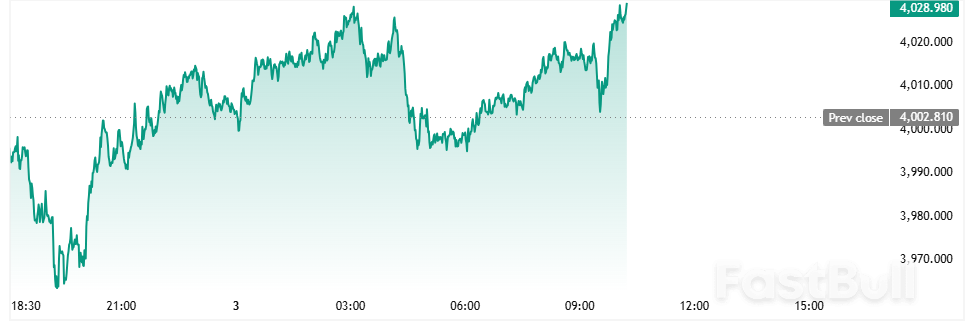
          Gold is trading near the $4,030 per ounce session high after the latest data showed the U.S. manufacturing sector weakening last month.
          The Institute for Supply Management (ISM) announced on Monday that its Manufacturing Purchasing Managers Index fell to 48.7 in October after posting a 49.1 reading in September. The headline number was worse than expected, as consensus forecasts looked for a reading of 49.5.
          “In October, U.S. manufacturing activity contracted at a faster rate, with contractions in production and inventories leading to the 0.4-percentage point decrease of the Manufacturing PMI,” said Susan Spence, Chair of the ISM Manufacturing Business Survey Committee. “A chain reaction of one-month index improvements started with New Orders in August and flowed to Production in September. In October, it manifested in a 1.7-percentage point increase in the Backlog of Orders Index. These short gains have not appeared to translate into sustained growth for the sector, a reflection of continuing economic uncertainty.”
          Spot gold continued to trade near the upper edge of its range on the session in the minutes after the 10 am EDT release. Spot gold last traded at $4,028.64 per ounce for a gain of 0.65% on the day.
          Spot gold trades near $4,030/oz after October ISM Manufacturing PMI falls to 48.7_1
          The report’s components were mixed. The ISM noted cooling in inflation pressures, with the Price Index falling to 58, down from 61.3 in September. At the same time, the Production Index fell to 48.2, down from the 51 posted the previous month.
          The New Orders Index rose to 49.4, down from the 48.9 reported in September. The ISM also noted improvement in the labor market, with the Employment Index rising to 46 from 45.3 the previous month.
          ““The Supplier Deliveries Index indicated slower delivery performance for the third consecutive month after one month in ‘faster’ territory, which was preceded by seven consecutive months in ‘slower’ territory,” Spence said. “The reading of 54.2 percent is up 1.6 percentage points from the 52.6 percent recorded in September. The Inventories Index registered 45.8 percent, down 1.9 percentage points compared to September’s reading of 47.7 percent.”
          “All of the four demand indicators (New Orders, New Export Orders, Backlog of Orders, and Customers’ Inventories indexes) improved, although they are still in contraction territory,” she added. “The Customers’ Inventories Index contracted at a slower rate. A ‘too low’ status for the Customers’ Inventories Index is usually considered positive for future production.”
          “Regarding output, production deteriorated and employment contracted at a slower pace, as 67 percent of panelists indicated that managing head count is still the norm at their companies, as opposed to hiring,” Spence said. “Finally, inputs (defined as supplier deliveries, inventories, prices and imports), are mixed, with the Supplier Deliveries Index indicating slower deliveries, the Inventories Index contracting at a faster rate, and the Prices Index continuing to indicate pricing increases, but at a slower rate. The Imports Index contracted at a slower pace.”

          Source: kitco

          Risk Warnings and Disclaimers
          You understand and acknowledge that there is a high degree of risk involved in trading. Following any strategies or investment methods may lead to potential losses. The content on the site is provided by our contributors and analysts for information purposes only. You are solely responsible for determining whether any trading assets, securities, strategy, or any other product is suitable for investing based on your own investment objectives and financial situation.
          Add to Favorites
          Share

          Oil Swings as OPEC+ Braces for Surplus With First Quarter Pause

          Adam

          Commodity

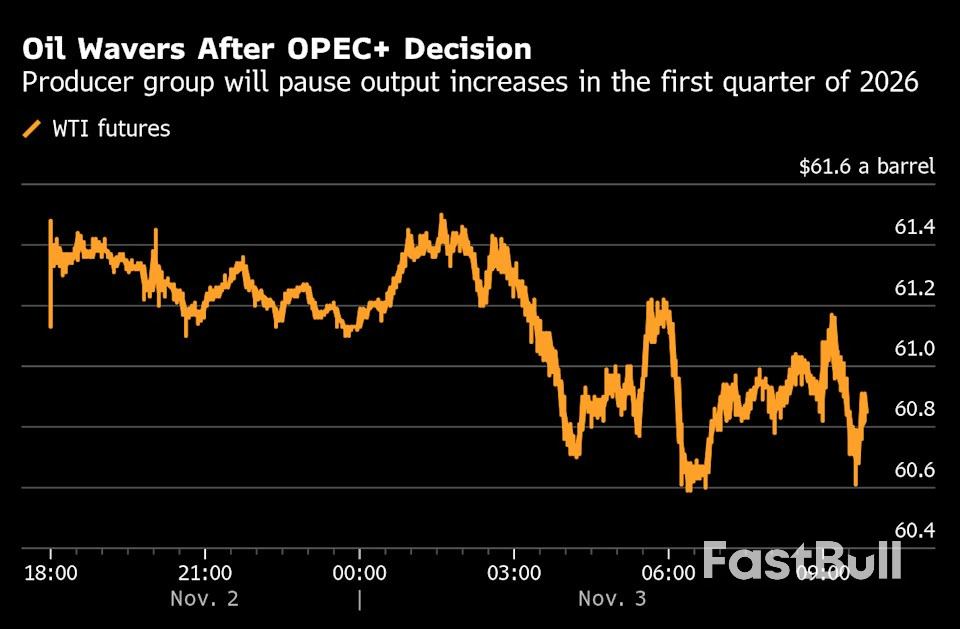
          Oil fluctuated between small gains and losses as traders weighed the OPEC+ alliance’s plan to pause its output revival next quarter on anticipation demand will slow, while the market is seen headed for oversupply.
          West Texas Intermediate traded below $61 a barrel, pressured by a stronger dollar. The Organization of the Petroleum Exporting Countries and its partners said the decision on Sunday to halt production hikes from January reflects an expectation for a seasonal slowdown. The move comes against a backdrop of widespread forecasts for excess supplies next year.
          Oil Swings as OPEC+ Braces for Surplus With First Quarter Pause_1
          The US benchmark has slumped about 12% over the past three months as OPEC+ ramped up output in an apparent effort to regain market share, while producers outside the group also increased production. Prices recently bounced from a five-month low after tighter US sanctions on two major Russian oil producers over the war in Ukraine raised some questions about supply from Moscow.
          “The decision to halt quota hikes during 1Q does not materially change our production forecasts but still sends an important signal,” Morgan Stanley analysts including Martijn Rats and Charlotte Firkins wrote. “The group is still adjusting supply in response to market conditions.”
          The eight key members of OPEC+ are left with roughly 1.2 million barrels a day of their current supply tranche still to restore. Actual output increases have fallen short of advertised volumes, as some members offset earlier overproduction and others struggle to pump more.
          Following the OPEC+ move, Morgan Stanley raised its near-term price forecast for Brent, while also maintaining a warning for a “substantial surplus.” The United Arab Emirates, meanwhile, on Monday added to the chorus of producers who have come out to downplay glut concerns.
          Traders will also be monitoring disruptions to flows after a Ukrainian drone attack in the Black Sea left a tanker ablaze and damaged loading facilities in the port city of Tuapse. Oil intake at the refinery at Tuapse halted after the attack, according to a person familiar with the matter.
          At the same time, top energy producers warned at the Adipec conference in Abu Dhabi that supply will be hit by the latest set of sanctions on Russia. The restrictions are serious and dampening supply, said BP Plc boss Murray Auchincloss.

          Source: Bloomberg

          Risk Warnings and Disclaimers
          You understand and acknowledge that there is a high degree of risk involved in trading. Following any strategies or investment methods may lead to potential losses. The content on the site is provided by our contributors and analysts for information purposes only. You are solely responsible for determining whether any trading assets, securities, strategy, or any other product is suitable for investing based on your own investment objectives and financial situation.
          Add to Favorites
          Share

          Markets May Be Underpricing The Most Consequential Court Ruling Of The Year

          Justin

          Economic

          We will soon find out if tariffs are unconstitutional.

          Nov 5th will be a key date for markets: the Supreme Court will start hearing arguments on Trump's IEEPA tariffs.

          And while markets don't seem particularly focused on this event, I believe it's crucial to be prepared for it.

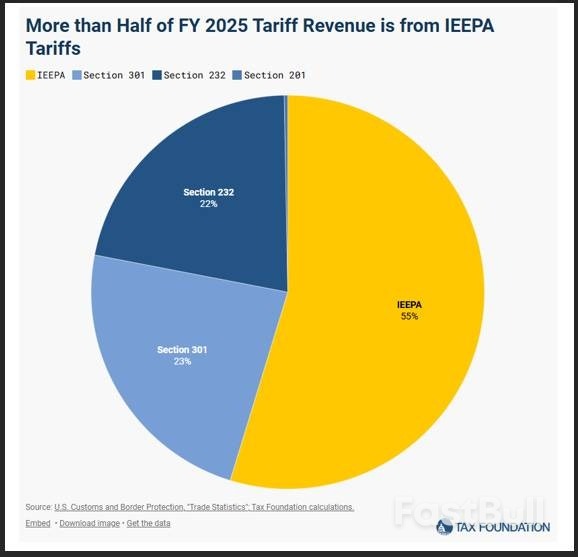
          The pie chart above shows why the Supreme Court ruling will be crucial.

          If the Supreme Court strikes down IEEPA tariffs as unconstitutional, around 55% of the US tariff income would be wiped out from the 2026 budget and US companies would be eligible for a refund for the 2025 tariffs paid under the IEEPA regime.

          In numbers, we are talking about a $150-200bn annualized tariff income loss for the US.

          Now, you all know that from a strict monetary perspective, the US tariffs act like a tax.

          Data is uncontroversial there: tariffs are being paid by US consumers and corporates (mostly corporates), which is akin to an increase in corporate tax rate that reduces companies' margins.

          If the Supreme Court undoes IEEPA tariffs, this would be the equivalent of a ~200bn fiscal stimulus:

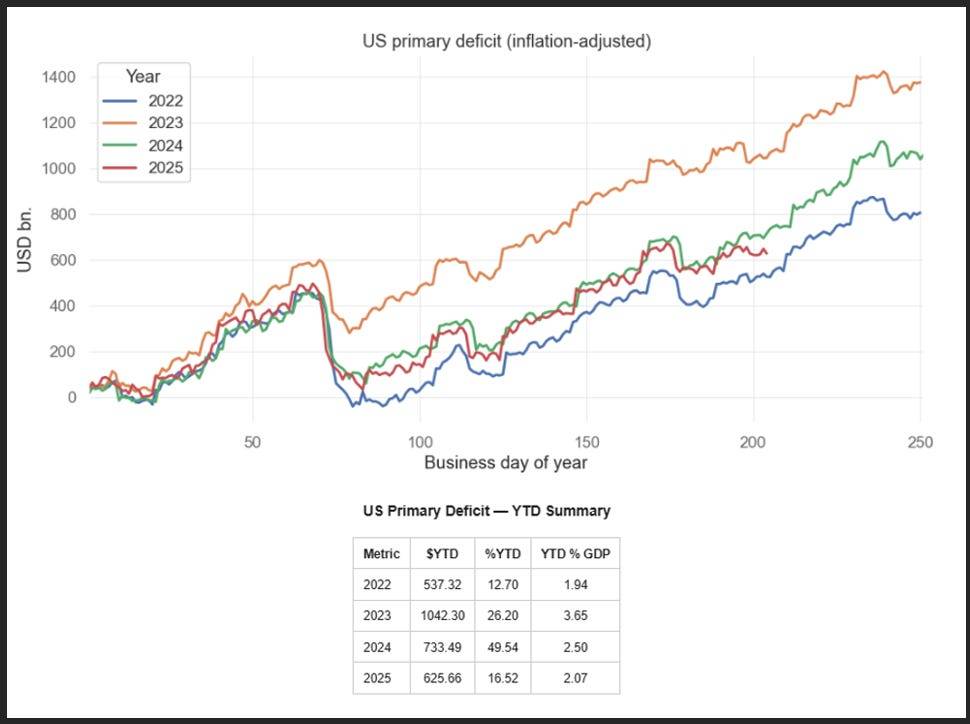
          The chart above shows the inflation-adjusted primary deficit spending in the US (read: money printing).

          In 2025, the US government has injected $626 billion in the US economy – this is a much lower pace than 2023-2024. The slowdown in US primary deficit spending is mostly due to tariffs.

          Revert the IEEPA tariffs, and the US will be going back to the glorious money-printing days of 2024 at least.

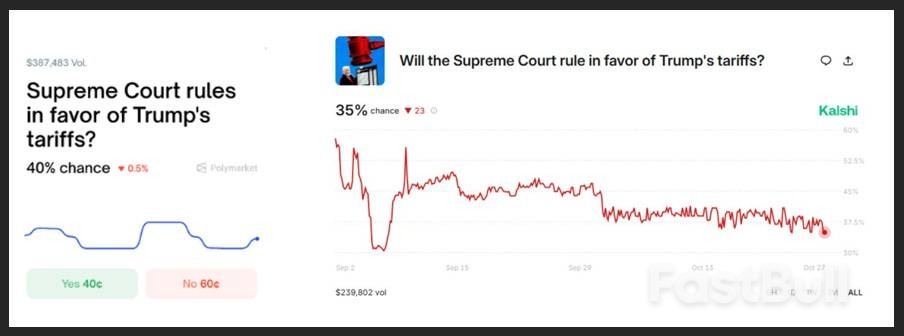
          So, what are the odds that the Supreme Court will strike down Trump's IEEPA tariffs?

          Prediction platforms suggest 60-65% odds, although volumes are quite small:

          We can actually get an idea of the real market-implied odds by looking at another market: the newly set-up ''Tariff Refund Trade'' that certain banks are allowing hedge funds to invest in.

          According to Bloomberg:

          "Wall Street banks are arranging bets on President Donald Trump's tariffs being struck down by the Supreme Court — long-shot trades that could pay off handsomely for hedge funds betting against the legality of the administration's flagship policy.

          Jefferies Financial Group Inc. and Oppenheimer & Co. are among firms brokering the deals, matching investors with companies that have paid tariffs to import goods into the US, according to people with knowledge of the matter and correspondence seen by Bloomberg News."

          In the trades, the importing companies essentially sell to investors any future rights to claim refunds on their tariff bills, which could come if the nation's top court sides with an ongoing legal challenge to Trump's tariffs. The companies sell at a discount to their expected refunds, meaning investors would reap the upside in the event of a favorable ruling. The banks arranging the deals take a cut.

          For example, a hedge fund might pay somewhere between 20 to 40 cents for each dollar of claims they could get back in refunds, giving them an upside of several times their bet, according to the correspondence and some of the people, who asked not to be identified discussing potential terms. Most of the trades range in size from $2 million to $20 million, with few over $100 million, one of the people said.''

          It would seem that hedge funds are paying ~30% on average upfront for the trade, which implies roughly the same probability that tariffs are deemed unconstitutional.

          But companies are cashing in months in advance the US government refund that would come if IEEPA tariffs are shut down, so we need to make an adjustment for that.

          This cross-check says the real market-implied odds of tariffs deemed unconstitutional are closer to the 40-45% area, while prediction platform sit around 60-65%.

          Call it 50-50: a coin toss.

          Now, let's assume the Supreme Court strikes IEEPA tariffs down.

          Can we say with 100% certainty that this will be akin to a ~200bn fiscal stimulus?

          Not so fast.

          Trump can also set tariffs under Section 232, 301 and 122.

          Section 232 covers the sectorial tariffs under commerce authority, and Section 301 the ''fentanyl-like'' tariffs under USTR authority – both fall under the executive (President) powers, not the Congress.

          Section 122 also falls under Presidential powers, and it would allow Trump to go for global 15% tariffs for 150 days before Congress would have to approve.

          I am saying this because while the Supreme Court might strike down IEEPA tariffs, the Trump administration has seven Section 232 sectoral investigations ending by January 2026 and could come up with more Section 301 or blanket Section 122 tariffs to offset the Supreme Court decision.

          Nevertheless, we are going into a coin-flip decision and markets might find reasons to celebrate a Supreme Court decision to strike down IEEPA tariffs – but Trump has weapons to counter such decisions.

          In general, bear in mind the following:

          • - The US will add $400bn in primary spending through the OBBB next year;
          • - Germany will kickstart a large fiscal spending program;
          • - The new Japanese PM Takaichi is working on an additional budget to increase fiscal spending;
          • - Korea, Canada, Sweden and Australia are expanding primary fiscal spending by 1% of GDP;
          • - Debt-funded AI capex might total $300bn next year

          Regardless of the Supreme Court decision, the global money printing machine will accelerate.

          Source: Investing

          To stay updated on all economic events of today, please check out our Economic calendar
          Risk Warnings and Disclaimers
          You understand and acknowledge that there is a high degree of risk involved in trading. Following any strategies or investment methods may lead to potential losses. The content on the site is provided by our contributors and analysts for information purposes only. You are solely responsible for determining whether any trading assets, securities, strategy, or any other product is suitable for investing based on your own investment objectives and financial situation.
          Add to Favorites
          Share

          Big Oil gets big boost from escalating economic war on Russia

          Adam

          Commodity

          Top Western oil companies are enjoying a windfall from the expanding attacks on Russia's oil industry – both literal and economic – that have boosted global refining profit margins and mitigated concerns over a looming supply glut.
          Waves of Ukrainian drone strikes on Russia's vast network of refineries and export terminals since July have hammered the country's exports of refined fuel, such as diesel and fuel oil. Russia's seaborne refined product exports in September dropped by 500,000 barrels per day from their 2025 highs to around 2 million bpd, the lowest level in over five years, according to Kpler data.
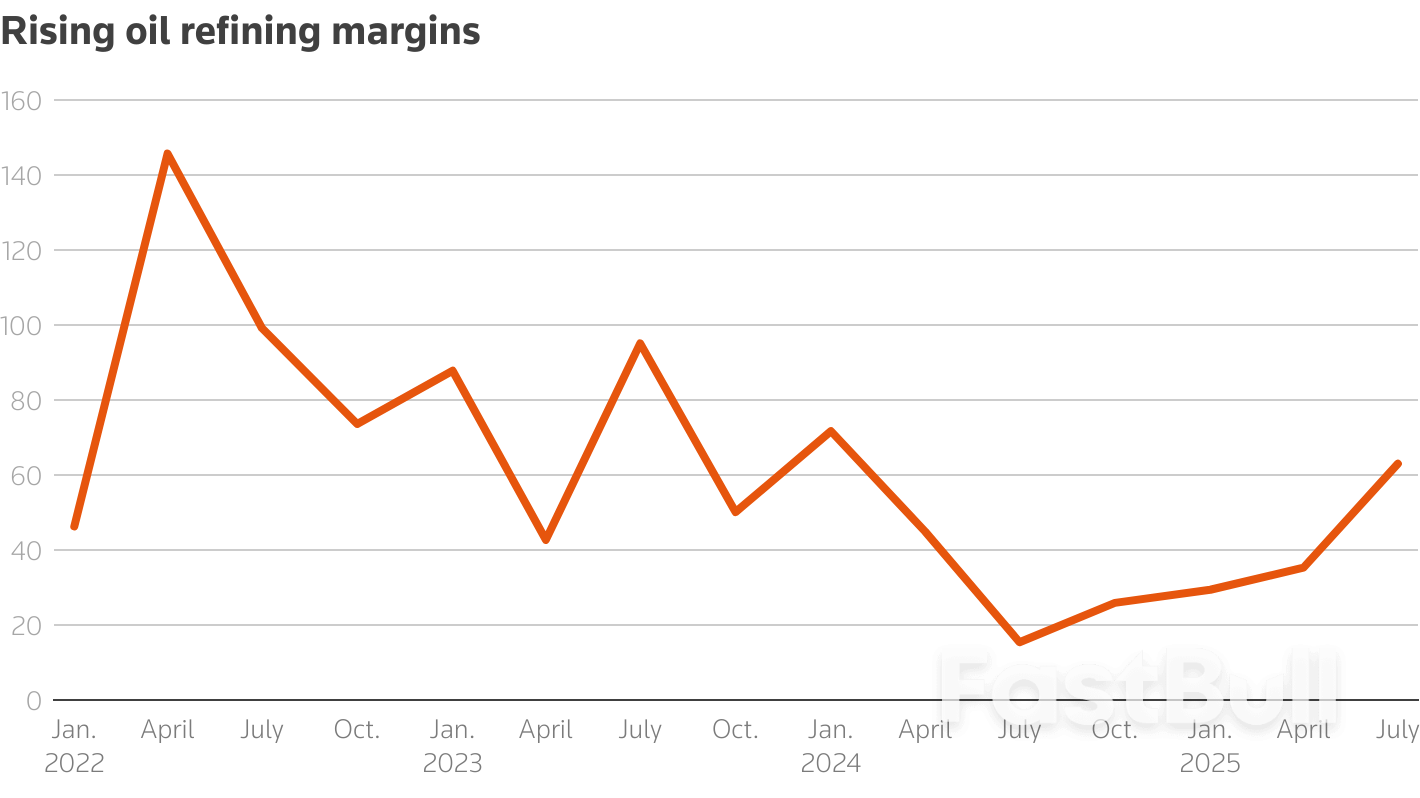
          Curtailed Russian exports have boosted global refining margins, benefiting energy giants like Shell (SHEL.L), Exxon Mobil (XOM.N), Chevron (CVX.N), and France's TotalEnergies (TTEF.PA), which jointly operate nearly 11 million bpd, over 10% of global refining capacity.
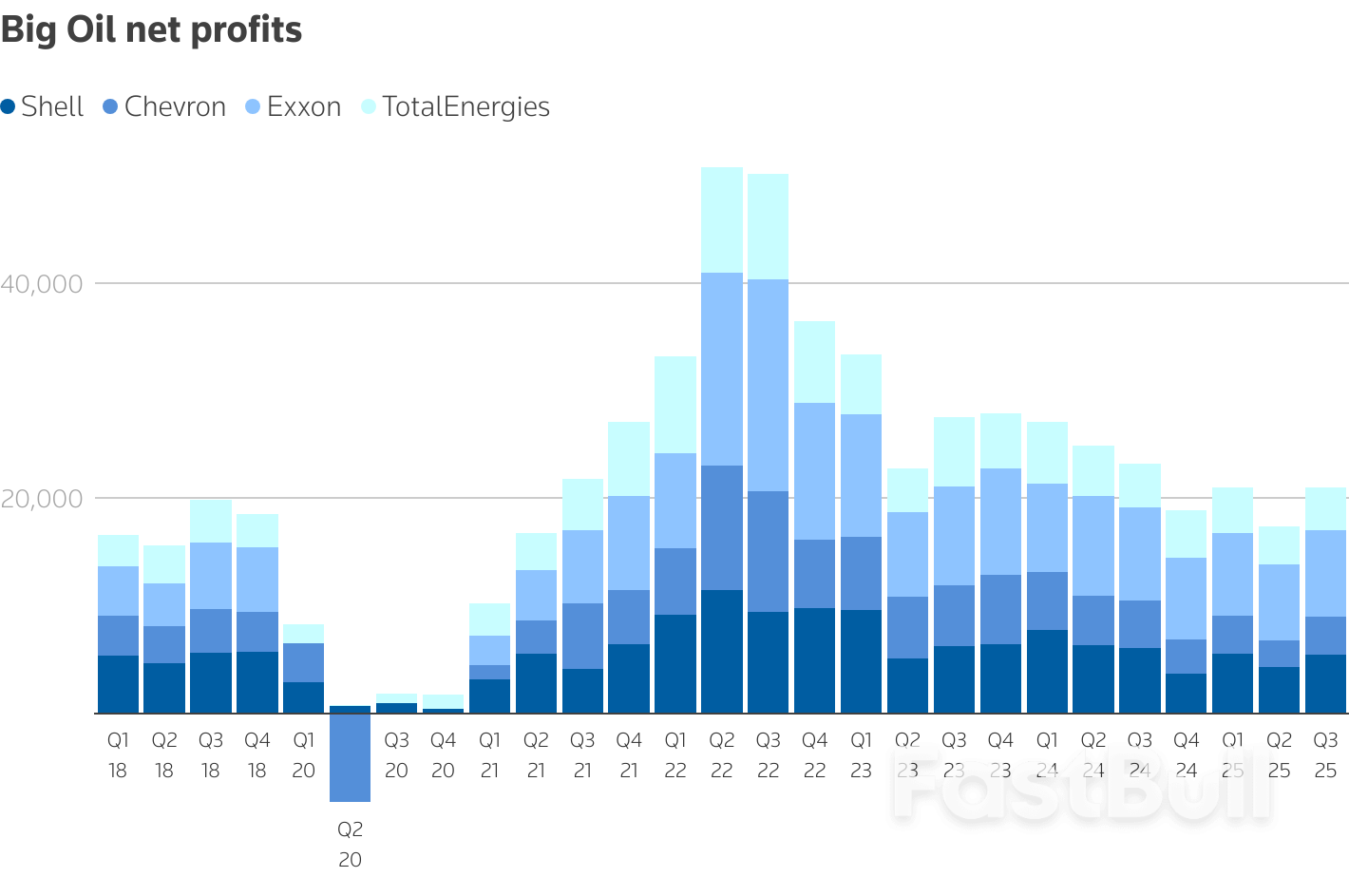
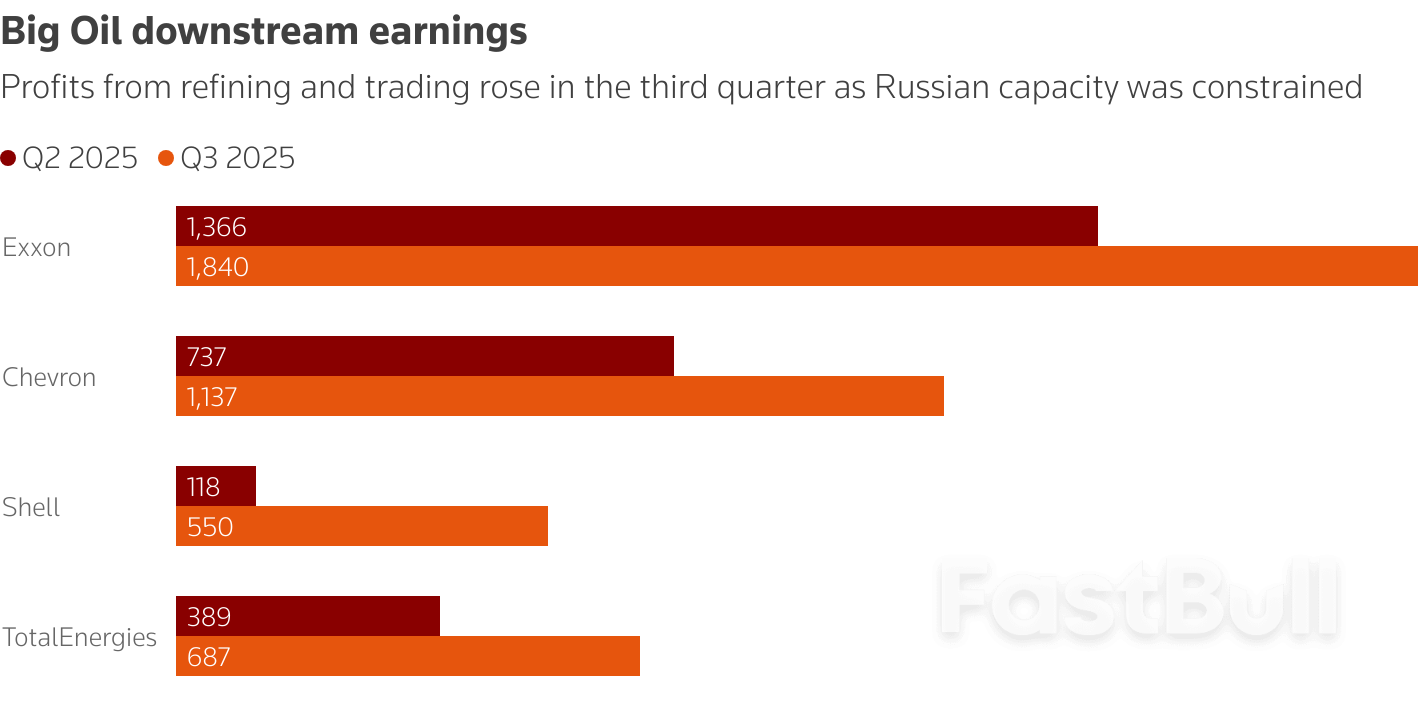
          The four companies posted a combined 61% rise in profits from refining operations in the third quarter compared with the previous quarter, which contributed in large part to their 20% rise in overall profits.
          Exxon, the largest U.S. oil company, saw earnings in its energy product division rise more than 30% on a quarterly basis to $1.84 billion, driven by strong refining margins "due to supply disruptions," the company said on Friday.
          BP (BP.L)will report results on Tuesday, and it also looks set to benefit from these positive global refining trends. The British firm’s refining indicator margin, a gauge for its global operations, rose to $15.8 per barrel in the three months through September, a 33% quarter-on-quarter increase, and this figure is running at $15.1 per barrel in the fourth quarter thus far.
          Stronger refining earnings will help offset declines in oil prices as the market appears to enter a period of significant oversupply.
          The volatility in energy markets created by Western sanctions and other geopolitical conflicts has also benefitted the trading divisions of the oil majors, in particular Shell, BP and TotalEnergies. These trading desks can generate huge profits by rapidly responding to small changes in supply and demand dynamics.
          Shell, the world's largest oil trader, does not disclose the division’s profits. However, it reported that stronger trading and refining margins boosted adjusted earnings in its chemicals and products division by $706 million in the third quarter compared with the previous three months.
          Big Oil gets big boost from escalating economic war on Russia_1

          Big Oil downstream earnings

          Big Oil gets big boost from escalating economic war on Russia_2

          Big Oil net profits

          BENEFICIAL BANS
          Refining margins are apt to stay elevated in the near term in response to the recent escalation in Western governments’ efforts to pressure Moscow to end the war in Ukraine.
          The European Union stepped up its economic warfare against Russia in July when it announced plans to ban imports of fuels produced from Russian crude oil as of January 2026. The EU is seeking to close a loophole in previous sanctions packages that allowed refiners in India, Turkey and elsewhere to use discounted Russian feedstock to produce diesel and jet fuel that was then often sold to Europe.
          The ban, which the EU formally approved earlier this month, again puts the Western oil majors in an advantageous position as non-Russian crude – including refined products made with non-sanctioned crude – will now be in higher demand.
          Western energy giants then got another positive surprise last month when U.S. President Donald Trump on October 22 sanctioned Russia's two top oil companies, Rosneft and Lukoil, which together account for 5% of global crude supply and 3.3 million bpd of crude and refined product exports, roughly half of Russia's total.
          The sanctions boosted oil prices and refining margins as buyers of Russian crude and products, particularly in India and Turkey, scrambled to find alternative supplies.
          Does the combination of escalating Western sanctions and Ukrainian drone strikes mean the oil market should expect to see a repeat of the huge price rally that shook the market in the immediate aftermath of Russia's invasion in 2022, leading to record profits for the oil majors?
          Probably not. The oil market today is well supplied and far better equipped to adapt to the impact of sanctions, especially given the expansion of the so-called “shadow fleet” of tankers that has been able to circumvent Western sanctions to sell Russian oil.
          But the targeting of Russia’s oil and gas industry should, nevertheless, continue to be a boon to Western oil majors, which benefit from large upstream oil production as well as sprawling refining and trading operations.
          Big Oil gets big boost from escalating economic war on Russia_3

          Rising oil refining margins

          Enjoying this column? Check out Reuters Open Interest (ROI),your essential new source for global financial commentary. ROI delivers thought-provoking, data-driven analysis. Markets are moving faster than ever. ROI can help you keep up. Follow ROI on LinkedIn and X.

          Source: reuters

          Risk Warnings and Disclaimers
          You understand and acknowledge that there is a high degree of risk involved in trading. Following any strategies or investment methods may lead to potential losses. The content on the site is provided by our contributors and analysts for information purposes only. You are solely responsible for determining whether any trading assets, securities, strategy, or any other product is suitable for investing based on your own investment objectives and financial situation.
          Add to Favorites
          Share

          Why the Goldman Sachs CEO isn’t buying the AI jobs freakout

          Adam

          Economic

          The fingerprints of artificial intelligence are all over mass layoffs and downsizing at Meta (META), Amazon (AMZN), Salesforce (CRM), YouTube and other major companies, raising fears of an AI-fueled jobs wipeout for white-collar workers.
          AI may hurt demand for office workers, but there’s reason for hope, Goldman Sachs CEO David Solomon believes. The dynamic American workforce will evolve, as it has in the past, Solomon told CNN during a sit-down interview.
          Solomon, speaking from the sidelines of the Goldman Sachs (GS) 10,000 Small Businesses Summit in Washington, cited the disruption caused by the invention in the late 1700s of the steam engine, which helped fuel the first industrial revolution.
          “There will be disruption. But I’m a big believer that our economy is very nimble, very flexible. And when you look at the technology that has flooded over hundreds of years into our society, we adapt,” Solomon said. “We find new businesses. We find new jobs. I don’t believe it will be different this time.”
          Of course, that adjustment process can be difficult – especially for the workers whose careers have been sidelined by new technology.
          AI is advancing rapidly
          A key difference this time is the explosive speed at which AI is being embraced by businesses – and how rapidly AI itself is advancing. A Goldman Sachs survey of bankers found that 37% of clients are using AI for regular production, with adoption expected to hit 50% next year and 74% in the next three years.
          ChatGPT launched in November 2022 and now boasts 800 million weekly active users. Its parent company OpenAI is reportedly laying the groundwork for an IPO that could value it at up to $1 trillion.
          Today’s AI chatbots can do deep research, generate stunningly realistic films, compose music and instantly flag financial fraud before it can even get completed.
          That speed could make the transition bumpier this time around.
          “The pace of adoption of this technology is going a little bit faster. As businesses wrestle with deploying the technology and the automation, the short-term disruption might be a little bit higher,” the Goldman Sachs CEO said. “But our economy is incredibly broad and nimble.”
          White-collar jobs exposed to AI
          Office workers may be especially exposed to that disruption.
          Although Amazon CEO Andy Jassy told analysts the company’s recent 14,000 layoffs were “not even really AI driven,” he said in June that adopting generative AI and AI agents will shrink the company’s corporate workforce.
          Meta recently cut 600 roles within its AI team, which reports have indicated is part of an effort to move more nimbly. YouTube this week began offering voluntary buyouts to US employees as part of an AI-focused restructuring.
          Workers at Chegg, an online education company, are being hurt by AI on two fronts. First, the rise of ChatGPT is lowering demand for Chegg’s education services. Secondly, Chegg itself is investing in AI, promising to run its business leaner with fewer workers to compete. This week Chegg said it will slash nearly half its workforce as it grapples with the “new realities of AI” and lower search traffic.
          AI was cited as a reason for 17,375 layoff announcements this year tracked by outplacement and coaching firm Challenger, Gray & Christmas through the end of September. That represents less than 2% of the total layoffs announced this year.
          However, Challenger noted that this tally likely undershoots AI-linked layoffs. Another 20,219 job cuts announced during that period were tied to companies citing unspecified technological updates – some of which could be related to AI.
          “The need for some white-collar office jobs will be diminished, but they’ll be picked up in other parts of the economy,” said Solomon.
          By contrast, Anthropic CEO Dario Amodei has warned that AI could eliminate half of entry-level jobs in white-collar professions, lifting the unemployment rate to up to 20% in the near future.
          “It’s eerie the extent to which the broader public and politicians, legislators, I don’t think, are fully aware of what’s going on,” Amodei told CNN’s Anderson Cooper in May. “We have to act now. We can’t just sleepwalk into it.”
          ‘Transformative impact’
          Federal Reserve Chairman Jerome Powell acknowledged during a press conference that a “significant number of companies” are either doing layoffs or saying they won’t hire much in part because of AI.
          “We’re watching that very carefully…It could absolutely have implications for job creation,” Powell said.
          A survey of over 100 Goldman Sachs investment bankers finds that just 11% of US companies are “actively reducing headcount due to AI,” a report published last week said. However, that figure rises to 31% for tech, media and telecom companies.
          Goldman Sachs bankers expect AI will lead to “modest headcount reductions” of 4% over the next year. But that number could rise to 11% over the next three years – especially in customer service jobs.
          Jan Hatzius, Goldman’s chief economist, wrote that the findings support the bank’s view that AI will have a “transformative impact on the labor market and economy,” and that rapid adoption signals that “AI impacts on the US labor market could arrive sooner than expected.”
          ‘Bumps along the way’
          The AI boom has also raised worries about a bubble forming in this red-hot part of the market.
          Solomon said that while many “great companies” will be formed during the AI boom, at some point the exuberance could get overdone and it won’t be a “straight line up” in value.
          One scenario he laid out is that demand for AI services may at some point fail to reach lofty expectations, driving valuations down.
          But that process could take time to play out because, as Solomon noted, most public tech companies are well-established and the newer AI companies are largely still in private markets, where valuation markdowns only change slowly.
          “The technology is exciting – there should be a lot of enthusiasm for it,” Solomon said. “But there will be bumps along the way, too.”

          Source: finance.yahoo

          To stay updated on all economic events of today, please check out our Economic calendar
          Risk Warnings and Disclaimers
          You understand and acknowledge that there is a high degree of risk involved in trading. Following any strategies or investment methods may lead to potential losses. The content on the site is provided by our contributors and analysts for information purposes only. You are solely responsible for determining whether any trading assets, securities, strategy, or any other product is suitable for investing based on your own investment objectives and financial situation.
          Add to Favorites
          Share

          ECB Urges Caution On Synthetic SRTs In Securitization Overhaul

          Daniel Carter

          Central Bank

          Economic

          The European Central Bank, wary of lenders' over-reliance on synthetic risk transfers, is urging issuers to use other ways of securitizing assets, according to people familiar with the matter.
          In a forthcoming opinion, the ECB will argue that shifting credit risks off the balance sheet through so-called synthetic significant risk transfers could expose banks to refinancing risks during market stress, according to people familiar with the matter. Instead, the ECB wants banks to carry out more deals known as cash SRTs that get rid of the actual loans and not just the attached credit risk, the people said.
          The move by the EU's top banking regulator is the latest sign that regulatory scrutiny of synthetic SRTs is growing as the deals enjoy an unprecedented boom that has made them one of the most popular instruments for banks to manage their balance sheets and free up capital. Large European banks increased the volume of synthetic securitizations by 85% in the first half, with the resulting capital relief helping them to return money to investors or fund growth.
          The ECB will weigh in on forthcoming securitization rules for the 27-country bloc touted as a way to stimulate the economy, said the people, who asked to remain anonymous as the formal view has yet to be made public. While the ECB broadly supports the European Commission initiative, it's wary of instruments that could make banks vulnerable in a credit crunch.
          A spokeswoman for the ECB declined to comment.
          European banks are boosting issuance of synthetic SRTs because they're cheap and currently easy to sell given rampant demand for yields which at times run in the double digits. The transactions allow banks to free up capital for more profitable lending, and ultimately more generous payouts to shareholders.
          Synthetic SRTs rely on credit derivatives to insure loan risk without actually removing the loan from a bank's books. Other types of asset-backed securities, including some SRTs, remove both the loans and their associated risk. The maturities of these securities tend to be longer than the underlying loans, ensuring there's no gap during which the bank remains exposed to the risk of the securitized assets.
          On-balance sheet instruments can leave banks exposed to losses on securitized assets. SRTs usually have shorter maturities than the loans they insure. That creates refinancing risk because banks have keep going back to investors to cover those gaps.
          The ECB is worried about a scenario in which demand for synthetic SRTs seizes up and banks lose the relief they'd been counting on from the market, the people said. To bring their capital ratios back into line, banks could be forced to issue new equity, cut dividends or in extreme cases abruptly pull back lending.
          "A freeze in the synthetic securitization market would expose banks to higher capital requirements than they had anticipated when originating the loans," according to a May report from the European Systemic Risk Board.
          These synthetic transfers now dwarf cash SRTs, ECB data shows, accounting for more than 90% of all SRT transactions among the banks overseen by the ECB in 2023. Such deals are "faster and easier to execute but, unlike cash transactions, have no secondary market," the ECB noted last year.
          Others are concerned about rampant and indiscriminate growth. A majority of respondents in a Bloomberg Intelligence survey released in June favored limits on the issuance of SRTs. Around 72% of the 50 firms taking part in the study, including issuers and investors, favored a regulatory ceiling on SRT issues for banks. Among them, more than half said that banks' guardrails should be in the form of a maximum percentage of their loan books.

          Source: Bloomberg Europe

          To stay updated on all economic events of today, please check out our Economic calendar
          Risk Warnings and Disclaimers
          You understand and acknowledge that there is a high degree of risk involved in trading. Following any strategies or investment methods may lead to potential losses. The content on the site is provided by our contributors and analysts for information purposes only. You are solely responsible for determining whether any trading assets, securities, strategy, or any other product is suitable for investing based on your own investment objectives and financial situation.
          Add to Favorites
          Share
          FastBull
          Copyright © 2025 FastBull Ltd

          728 RM B 7/F GEE LOK IND BLDG NO 34 HUNG TO RD KWUN TONG KLN HONG KONG

          TelegramInstagramTwitterfacebooklinkedin
          App Store Google Play Google Play
          Products
          Charts

          Chats

          Q&A with Experts
          Screeners
          Economic Calendar
          Data
          Tools
          Membership
          Features
          Function
          Markets
          Copy Trading
          Latest Signals
          Contests
          News
          Analysis
          24/7
          Columns
          Education
          Company
          Careers
          About Us
          Contact Us
          Advertising
          Help Center
          Feedback
          User Agreement
          Privacy Policy
          Business

          White Label

          Data API

          Web Plug-ins

          Poster Maker

          Affiliate Program

          Risk Disclosure

          The risk of loss in trading financial instruments such as stocks, FX, commodities, futures, bonds, ETFs and crypto can be substantial. You may sustain a total loss of the funds that you deposit with your broker. Therefore, you should carefully consider whether such trading is suitable for you in light of your circumstances and financial resources.

          No decision to invest should be made without thoroughly conducting due diligence by yourself or consulting with your financial advisors. Our web content might not suit you since we don't know your financial conditions and investment needs. Our financial information might have latency or contain inaccuracy, so you should be fully responsible for any of your trading and investment decisions. The company will not be responsible for your capital loss.

          Without getting permission from the website, you are not allowed to copy the website's graphics, texts, or trademarks. Intellectual property rights in the content or data incorporated into this website belong to its providers and exchange merchants.

          Not Logged In

          Log in to access more features

          FastBull Membership

          Not yet

          Purchase

          Become a signal provider
          Help Center
          Customer Service
          Dark Mode
          Price Up/Down Colors

          Log In

          Sign Up
          Position
          Layout
          Fullscreen
          Default to Chart
          The chart page opens by default when you visit fastbull.com