• Trade
  • Markets
  • Copy
  • Contests
  • News
  • 24/7
  • Calendar
  • Q&A
  • Chats
Trending
Screeners
SYMBOL
LAST
BID
ASK
HIGH
LOW
NET CHG.
%CHG.
SPREAD
SPX
S&P 500 Index
6870.39
6870.39
6870.39
6895.79
6858.28
+13.27
+ 0.19%
--
DJI
Dow Jones Industrial Average
47954.98
47954.98
47954.98
48133.54
47871.51
+104.05
+ 0.22%
--
IXIC
NASDAQ Composite Index
23578.12
23578.12
23578.12
23680.03
23506.00
+72.99
+ 0.31%
--
USDX
US Dollar Index
98.950
99.030
98.950
99.060
98.740
-0.030
-0.03%
--
EURUSD
Euro / US Dollar
1.16374
1.16453
1.16374
1.16374
1.16341
-0.00052
-0.04%
--
GBPUSD
Pound Sterling / US Dollar
1.33155
1.33358
1.33155
1.33155
1.33151
-0.00157
-0.12%
--
XAUUSD
Gold / US Dollar
4197.91
4197.91
4197.91
4259.16
4191.87
-9.26
-0.22%
--
WTI
Light Sweet Crude Oil
59.809
60.061
59.809
60.236
59.187
+0.426
+ 0.72%
--

Community Accounts

Signal Accounts
--
Profit Accounts
--
Loss Accounts
--
View More

Become a signal provider

Sell trading signals to earn additional income

View More

Guide to Copy Trading

Get started with ease and confidence

View More

Signal Accounts for Members

All Signal Accounts

Best Return
  • Best Return
  • Best P/L
  • Best MDD
Past 1W
  • Past 1W
  • Past 1M
  • Past 1Y

All Contests

  • All
  • Trump Updates
  • Recommend
  • Stocks
  • Cryptocurrencies
  • Central Banks
  • Featured News
Top News Only
Share

Zelenskiy, Ahead Of Consultations With European Leaders, Says Talks With USA Representatives On Peace Plan For Ukraine Constructive But Not Easy

Share

[Venezuelan Vice President Calls For Oil Industry Vigilance] Venezuelan Vice President Rodríguez, Speaking To Oil Industry Workers At A Heavy Crude Oil Processing Facility In Anzoátegui State On The 7th, Called On The Entire Industry To Remain "highly Vigilant," Noting That "the Enemy Never Stops." Rodríguez Reiterated That, Given The Current Tense Situation Between Venezuela And The United States, The Government Will Firmly Safeguard National Sovereignty And Independence

Share

Treasury Secretary Bessent Says He Has Divested His Soybean Farm

Share

[Syrian Transitional Government Foreign Minister: Israel Is The Most Dangerous Factor Threatening Syria's Stability] On December 7, Syrian Transitional Government Foreign Minister Shibani Said During The Doha Forum In Doha, The Capital Of Qatar, That Since December 2024, Israel Has Been The Most Dangerous Factor Threatening Syria's Stability, Both Politically And Through Military Operations

Share

Bolsonaro's Son Says He May Not Run For Brazil President

Share

[Hamas Says It's Willing To Discuss Disarmament In The Framework Of Palestinian Statehood] On The 7th Local Time, Basem Naeem, A Senior Official Of The Palestinian Islamic Resistance Movement (Hamas), Stated That Hamas Is Willing To Negotiate On Its Weapons Issue, Including "freezing Or Stockpiling Weapons," In Order To Advance The Second Phase Of Negotiations On The Gaza Ceasefire Agreement. Naeem Condemned Israel For Failing To Fulfill Its Promises, Refusing To Deliver Large Quantities Of Humanitarian Aid To Gaza, And Failing To Open The Rafah Crossing In Both Directions As Promised. Naeem Acknowledged That Palestinians Paid A Heavy Price For The October 7, 2023 Attack, But Insisted That The Action Was An "act Of Self-defense."

Share

West Africa's ECOWAS Bloc: Has Ordered Deployment Of Elements Of ECOWAS Standby Force To Benin With Immediate Effect

Share

Benin's President Patrice Talon: Says This Treachery Will Not Go Unpunished

Share

Italy Prime Minister Meloni Pledges Emergency Aid To Ukraine In Call With Zelenskiy

Share

Benin's President Patrice Talon:Appears On State TV To Make A Statement After Foiled Coup

Share

[Chinese Business Delegation Visits The US To Promote Deeper Economic And Trade Cooperation] At The Invitation Of The U.S. Chamber Of Commerce, The China Council For The Promotion Of International Trade (CCPIT) Organized A Delegation Of Chinese Business Leaders To Visit Washington, San Francisco, And Oakland From February 2nd To 6th To Promote Deeper Economic And Trade Exchanges And Cooperation Between The Two Countries. During The Visit, The CCPIT, In Cooperation With The Oakland City Government, The U.S. Chamber Of Commerce, The U.S.-China Business Council, The Semiconductor Industry Association, U.S. Asia Group, Meridian International Center, And The U.S. Soybean Export Council, Held Several Sino-U.S. Business Matchmaking Events And Held Discussions With More Than 170 U.S. Companies And Institutions

Share

French President Emmanuel Macron Has Called On The European Central Bank (ECB) To Change Its Monetary Policy Approach In Order To Boost The Single Market And Protect It From The Risks Of A Financial Crisis. Macron Stated That The ECB Needs To Think Differently, Reaffirming The Value Of The European Internal Market, Which Means It Cannot Solely Target Inflation But Should Also Focus On Growth And Employment. Macron Argued That The Increasing Deregulation Of Crypto Assets And Stablecoins In The United States Could Create Financial Instability, And That Europe Must Maintain A Stable Monetary Zone

Share

U.S. Treasury Secretary Bessenter: Inflation Is Expected To Decline "strongly" In 2026

Share

USTR Says China's Trade Commitments 'Going In The Right Direction'

Share

India Aviation Regulator: Continues To Monitor The Situation Closely

Share

USA, Israel, And Qatar Are Holding A Trilateral Meeting In New York On Sunday To Rebuild Relations

Share

Kremlin Says New US Security Strategy Accords Largely With Russia's View

Share

United Arab Emirates's Abu Dhabi National Oil Company Sets January Murban Crude Osp At $65.53/Bbl

Share

Bessent: USA Will Finish The Year With 3% GDP Growth

Share

Israeli Prime Minister Netanyahu: He Will Not Quit Politics If He Receives A Pardon

TIME
ACT
FCST
PREV
Mexico Consumer Confidence Index (Nov)

A:--

F: --

P: --

Canada Unemployment Rate (SA) (Nov)

A:--

F: --

P: --

Canada Labor Force Participation Rate (SA) (Nov)

A:--

F: --

P: --

Canada Employment (SA) (Nov)

A:--

F: --

P: --

Canada Part-Time Employment (SA) (Nov)

A:--

F: --

P: --

Canada Full-time Employment (SA) (Nov)

A:--

F: --

P: --

U.S. Personal Income MoM (Sept)

A:--

F: --

P: --

U.S. PCE Price Index YoY (SA) (Sept)

A:--

F: --

P: --

U.S. PCE Price Index MoM (Sept)

A:--

F: --

P: --

U.S. Personal Outlays MoM (SA) (Sept)

A:--

F: --

P: --

U.S. Core PCE Price Index MoM (Sept)

A:--

F: --

P: --

U.S. Core PCE Price Index YoY (Sept)

A:--

F: --

P: --

U.S. UMich 5-Year-Ahead Inflation Expectations Prelim YoY (Dec)

A:--

F: --

P: --

U.S. Real Personal Consumption Expenditures MoM (Sept)

A:--

F: --

P: --

U.S. 5-10 Year-Ahead Inflation Expectations (Dec)

A:--

F: --

P: --

U.S. UMich Current Economic Conditions Index Prelim (Dec)

A:--

F: --

P: --

U.S. UMich Consumer Sentiment Index Prelim (Dec)

A:--

F: --

P: --

U.S. UMich 1-Year-Ahead Inflation Expectations Prelim (Dec)

A:--

F: --

P: --

U.S. UMich Consumer Expectations Index Prelim (Dec)

A:--

F: --

P: --

U.S. Weekly Total Rig Count

A:--

F: --

P: --

U.S. Weekly Total Oil Rig Count

A:--

F: --

P: --

U.S. Unit Labor Cost Prelim (SA) (Q3)

--

F: --

P: --

U.S. Consumer Credit (SA) (Oct)

A:--

F: --

P: --

China, Mainland Foreign Exchange Reserves (Nov)

A:--

F: --

P: --

China, Mainland Exports YoY (USD) (Nov)

--

F: --

P: --

China, Mainland Imports YoY (CNH) (Nov)

--

F: --

P: --

China, Mainland Imports YoY (USD) (Nov)

--

F: --

P: --

China, Mainland Imports (CNH) (Nov)

--

F: --

P: --

China, Mainland Trade Balance (CNH) (Nov)

--

F: --

P: --

China, Mainland Exports (Nov)

--

F: --

P: --

Japan Wages MoM (Oct)

--

F: --

P: --

Japan Trade Balance (Oct)

--

F: --

P: --

Japan Nominal GDP Revised QoQ (Q3)

--

F: --

P: --

Japan Trade Balance (Customs Data) (SA) (Oct)

--

F: --

P: --

Japan GDP Annualized QoQ Revised (Q3)

--

F: --

P: --
China, Mainland Exports YoY (CNH) (Nov)

--

F: --

P: --

China, Mainland Trade Balance (USD) (Nov)

--

F: --

P: --

Germany Industrial Output MoM (SA) (Oct)

--

F: --

P: --

Euro Zone Sentix Investor Confidence Index (Dec)

--

F: --

P: --

Canada Leading Index MoM (Nov)

--

F: --

P: --

Canada National Economic Confidence Index

--

F: --

P: --

U.S. Dallas Fed PCE Price Index YoY (Sept)

--

F: --

P: --

China, Mainland Trade Balance (USD) (Nov)

--

F: --

P: --

U.S. 3-Year Note Auction Yield

--

F: --

P: --

U.K. BRC Overall Retail Sales YoY (Nov)

--

F: --

P: --

U.K. BRC Like-For-Like Retail Sales YoY (Nov)

--

F: --

P: --

Australia Overnight (Borrowing) Key Rate

--

F: --

P: --

RBA Rate Statement
RBA Press Conference
Germany Exports MoM (SA) (Oct)

--

F: --

P: --

U.S. NFIB Small Business Optimism Index (SA) (Nov)

--

F: --

P: --

Mexico Core CPI YoY (Nov)

--

F: --

P: --

Mexico 12-Month Inflation (CPI) (Nov)

--

F: --

P: --

Mexico PPI YoY (Nov)

--

F: --

P: --

Mexico CPI YoY (Nov)

--

F: --

P: --

U.S. Weekly Redbook Index YoY

--

F: --

P: --

U.S. JOLTS Job Openings (SA) (Oct)

--

F: --

P: --

China, Mainland M2 Money Supply YoY (Nov)

--

F: --

P: --

China, Mainland M0 Money Supply YoY (Nov)

--

F: --

P: --

China, Mainland M1 Money Supply YoY (Nov)

--

F: --

P: --

U.S. EIA Short-Term Crude Production Forecast For The Next Year (Dec)

--

F: --

P: --

Q&A with Experts
    • All
    • Chatrooms
    • Groups
    • Friends
    Connecting
    .
    .
    .
    Type here...
    Add Symbol or Code

      No matching data

      All
      Trump Updates
      Recommend
      Stocks
      Cryptocurrencies
      Central Banks
      Featured News
      • All
      • Russia-Ukraine Conflict
      • Middle East Flashpoint
      • All
      • Russia-Ukraine Conflict
      • Middle East Flashpoint
      Search
      Products

      Charts Free Forever

      Chats Q&A with Experts
      Screeners Economic Calendar Data Tools
      Membership Features
      Data Warehouse Market Trends Institutional Data Policy Rates Macro

      Market Trends

      Market Sentiment Order Book Forex Correlations

      Top Indicators

      Charts Free Forever
      Markets

      News

      News Analysis 24/7 Columns Education
      From Institutions From Analysts
      Topics Columnists

      Latest Views

      Latest Views

      Trending Topics

      Top Columnists

      Latest Update

      Signals

      Copy Rankings Latest Signals Become a signal provider AI Rating
      Contests
      Brokers

      Overview Brokers Assessment Rankings Regulators News Claims
      Broker listing Forex Brokers Comparison Tool Live Spread Comparison Scam
      Q&A Complaint Scam Alert Videos Tips to Detect Scam
      More

      Business
      Events
      Careers About Us Advertising Help Center

      White Label

      Data API

      Web Plug-ins

      Affiliate Program

      Awards Institution Evaluation IB Seminar Salon Event Exhibition
      Vietnam Thailand Singapore Dubai
      Fans Party Investment Sharing Session
      FastBull Summit BrokersView Expo
      Recent Searches
        Top Searches
          Markets
          News
          Analysis
          User
          24/7
          Economic Calendar
          Education
          Data
          • Names
          • Latest
          • Prev

          View All

          No data

          Scan to Download

          Faster Charts, Chat Faster!

          Download App
          English
          • English
          • Español
          • العربية
          • Bahasa Indonesia
          • Bahasa Melayu
          • Tiếng Việt
          • ภาษาไทย
          • Français
          • Italiano
          • Türkçe
          • Русский язык
          • 简中
          • 繁中
          Open Account
          Search
          Products
          Charts Free Forever
          Markets
          News
          Signals

          Copy Rankings Latest Signals Become a signal provider AI Rating
          Contests
          Brokers

          Overview Brokers Assessment Rankings Regulators News Claims
          Broker listing Forex Brokers Comparison Tool Live Spread Comparison Scam
          Q&A Complaint Scam Alert Videos Tips to Detect Scam
          More

          Business
          Events
          Careers About Us Advertising Help Center

          White Label

          Data API

          Web Plug-ins

          Affiliate Program

          Awards Institution Evaluation IB Seminar Salon Event Exhibition
          Vietnam Thailand Singapore Dubai
          Fans Party Investment Sharing Session
          FastBull Summit BrokersView Expo

          Trump Tariffs Fate Rides on Supreme Court Justices He Picked

          Manuel

          Political

          China–U.S. Trade War

          Summary:

          The case will decide the fate of most of the import taxes Trump has imposed since taking office, including his April 2 “Liberation Day” tariffs.

          President Donald Trump’s three US Supreme Court appointees will play pivotal roles as the court considers the fate of his signature global tariffs Wednesday.
          Each of the three — Neil Gorsuch, Brett Kavanaugh and Amy Coney Barrett — has generally backed the president in a blizzard of emergency orders this year letting Trump implement his policies temporarily.
          But the tariff case will be the first time the court and its 6-3 Republican-appointed majority have directly considered Trump’s underlying assertions of sweeping presidential power. And to varying degrees, the Trump appointees have hinted that they aren’t sure bets to back him as he seeks unprecedented authority to levy tariffs in the name of addressing national emergencies.
          “I don’t think it’s inevitable that this is going to be a sort of partisan alignment, or the sort of standard 6-3 alignment that we’ve seen in some other cases,” said Roman Martinez, an appellate lawyer at Latham & Watkins who helped file a brief for the US Chamber of Commerce opposing the tariffs.
          The case will decide the fate of most of the import taxes Trump has imposed since taking office, including his April 2 “Liberation Day” tariffs.
          Trump says the tariffs are authorized by the 1977 International Emergency Economic Powers Act, which gives the president a panoply of tools to address national security, foreign policy and economic emergencies – but doesn’t explicitly authorize tariffs. Administration lawyers say the national trade deficit and fentanyl crisis constitute emergencies that let the president invoke the law and impose tariffs on trillions of dollars of trade.
          Here’s a look at how each Trump appointee might approach the case, along with another key figure, Chief Justice John Roberts. The companies and states challenging the levies will probably need the votes of two of the four to win the case.
          The court’s three liberals Sonia Sotomayor, Elena Kagan and Ketanji Brown Jackson — are likely to vote against Trump. Conservatives Clarence Thomas and Samuel Alito usually side with Trump.
          The arguments begin at 10 a.m. and will likely last at least two hours.

          Brett Kavanaugh

          Some court watchers say Kavanaugh is the most likely of the Trump appointees to back his tariffs. It’s a bit of an unusual spot for Kavanaugh, who in other contexts joins Barrett or Roberts to put restraints on their more conservative colleagues, including Gorsuch.
          But Kavanaugh is a staunch advocate of presidential power, particularly when interpreting statutes affecting foreign affairs or national security. “The usual understanding is that Congress intends to give the president substantial authority and flexibility to protect America and the American people,” he wrote in June in a case involving the Federal Communications Commission.
          Kavanaugh made those comments while discussing the so-called major questions doctrine, an issue that could be central in the tariff case. Under that doctrine, which the court used repeatedly to thwart Democrat Joe Biden during his presidency, federal agencies need explicit congressional authorization to take actions that have sweeping economic or political significance.
          The doctrine “has not been applied by this court in the national security or foreign policy contexts, because the canon does not reflect ordinary congressional intent in those areas,” Kavanaugh wrote.
          The best hope for the challengers may be that Kavanaugh will see the case as more about the tariff and taxing powers that the Constitution allocates to Congress than about the president’s foreign-affairs and national-security authority.
          Even so, the opponents may be hard-pressed to win over Kavanaugh. He “may be less in play for the plaintiffs who are challenging the tariffs,” said Elizabeth Prelogar, an appellate lawyer at Cooley who was Biden’s solicitor general.

          Neil Gorsuch

          In contrast, Gorsuch might be less sympathetic to Trump than the conservative justice is in other contexts.
          A stickler for statutory language, Gorsuch is likely to have questions about Trump’s use of a law that doesn’t explicitly mention either tariffs or taxes. The closest the law comes is by saying the president may “regulate” the “importation” of products in emergency situations.
          Gorsuch is a staunch advocate of both the major questions doctrine and a related legal argument known as the nondelegation doctrine, which limits Congress’ leeway to hand off its constitutional legislative and taxing powers. In the FCC case, he said the nondelegation doctrine was especially important as a check on Congress’s ability to give away its domestic taxing power, though Gorsuch said tariffs might be a different matter.
          Though he normally aligns with Thomas and Alito, Gorsuch may be more likely to vote against Trump’s tariffs than Kavanaugh is, according to Prelogar. “It might actually be the chief, Barrett and Gorsuch who are in play,” she said.

          Amy Coney Barrett

          Like Gorsuch, Barrett is a textualist who focuses heavily on the words of a statute. She has embraced a softer version of the major questions doctrine than some of her colleagues, describing it as a “common sense” tool to help ascertain how much power Congress was handing off.
          Because the Constitution vests all legislative powers with Congress, “a reasonable interpreter would expect it to make the big-time policy calls itself, rather than pawning them off to another branch,” she wrote in 2023, when she joined the court in striking down Biden’s bid to slash the student debt of 40 million people.
          One can imagine Barrett voting to block Trump’s tariffs as a similarly “big-time policy call” that Congress didn’t authorize. But her opinion didn’t mention taxes or tariffs, and she didn’t say whether foreign-policy or national-security implications would affect her analysis.

          John Roberts

          Roberts tends to care less about legal doctrine than the Trump appointees and more about the court’s institutional role and practical ramifications.
          The chief justice famously cast the deciding vote in 2012 to uphold Barack Obama’s Affordable Care Act, declining to invalidate that president’s signature domestic accomplishment even while disagreeing with him on major legal questions. Roberts now will have to decide whether to vote against Trump’s top economic initiative.
          Doing so may entail a cost, given Trump’s penchant for lashing out at the court and individual justices when they don’t agree with him.
          “The justices who are going to determine the outcome of this case are going to feel like they need a really pretty strong case on the legal merits before they’re going to decide that they’re going to cross swords with the president,” said Donald Verrilli, an appellate lawyer at Munger, Tolles & Olson and former solicitor general under Barack Obama.
          “You can’t help but think that that’s going to be hovering over the decision-making process in this case,” Verrilli added.

          Source: Bloomberg

          Risk Warnings and Disclaimers
          You understand and acknowledge that there is a high degree of risk involved in trading. Following any strategies or investment methods may lead to potential losses. The content on the site is provided by our contributors and analysts for information purposes only. You are solely responsible for determining whether any trading assets, securities, strategy, or any other product is suitable for investing based on your own investment objectives and financial situation.
          Add to Favorites
          Share

          OPEC Oil Output Rises By 30,000 Bpd In October, Survey Finds

          John Adams

          Commodity

          OPEC's oil output rose further in October after an OPEC+ agreement to raise production, a Reuters survey found on Tuesday, though the scale of the increase slowed sharply from September and the summer months.

          The Organization of the Petroleum Exporting Countries pumped 28.43 million barrels per day (bpd) last month, up 30,000 bpd from September's total, the survey showed, with Saudi Arabia and Iraq making the largest increases.

          OPEC+, comprising OPEC and allies including Russia, slowed the pace of its output increases for October on growing concern over a possible supply glut. Simultaneously, some members are tasked with extra cuts to compensate for earlier overproduction, limiting the impact of increases.

          Under an agreement by eight OPEC+ members covering October output, the five of them that are OPEC members - Algeria, Iraq, Kuwait, Saudi Arabia and the UAE - were to raise output by 86,000 bpd before the effect of compensation cuts totalling 140,000 bpd for Iraq and the UAE.

          The survey shows that the actual increase by the five was 114,000 bpd, but declines in Nigeria, Libya and Venezuela offset those gains.

          Estimates of output in Iraq and the UAE vary widely, with many outside sources putting the countries' output higher than the countries themselves.

          While the Reuters survey and data provided by OPEC's secondary sources show they are pumping close to the quotas, other estimates, such as those of the International Energy Agency, say they are pumping significantly higher volumes.

          The Reuters survey aims to track supply to the market and is based on flow data from financial group LSEG, information from other companies that track flows, such as Kpler, and information provided by sources at oil companies, OPEC and consultants.

          Source: Kitco

          Risk Warnings and Disclaimers
          You understand and acknowledge that there is a high degree of risk involved in trading. Following any strategies or investment methods may lead to potential losses. The content on the site is provided by our contributors and analysts for information purposes only. You are solely responsible for determining whether any trading assets, securities, strategy, or any other product is suitable for investing based on your own investment objectives and financial situation.
          Add to Favorites
          Share

          European Union Welcomes Suspension Of China's Rare Earth Controls

          Justin

          Commodity

          The European Union has agreed with China on stabilizing the flow of rare earth materials and products from China that are critical elements for many high-tech and military products, an official said Tuesday. EU trade commissioner Maroš Šefčovič met with Chinese Commerce Minister Wang Wentao in Brussels on Friday to discuss Beijing's export controls on rare earths issued in April and October, and European regulations on semiconductor sales, said Olof Gill, a spokesperson for the European Commission, the 27-nation bloc's executive arm. Like the U.S., Europe runs a huge trade deficit with China — around 300 billion euros ($345 billion) last year. It relies heavily on China for rare earth material and products, which are also used to make magnets used in cars and appliances.

          Gill said that the EU welcomed China's recent 12-month suspension of rare earths export controls, and called for a new and stable system of trade in the critical materials. The EU is working with China on an export licensing system to ensure a more stable flow of rare earth minerals to the bloc, he said.

          "This is an appropriate and responsible step in the context of ensuring stable global trade flows in a critically important area," Gill said.

          Šefčovič said that that Brussels and Beijing were continuing to speak about further trade measures.

          "Both sides reaffirmed commitment to continue engagement on improving the implementation of export control policies," he said in an X post.

          China is the EU's second-largest trading partner in goods, after the United States. Bilateral trade is estimated at 2.3 billion euros ($2.7 billion) per day.

          Both China and the EU believe it's in their interest to keep their trade ties stable for the sake of the global economy, and they share certain climate goals.

          Source: Yahoo Finance

          Risk Warnings and Disclaimers
          You understand and acknowledge that there is a high degree of risk involved in trading. Following any strategies or investment methods may lead to potential losses. The content on the site is provided by our contributors and analysts for information purposes only. You are solely responsible for determining whether any trading assets, securities, strategy, or any other product is suitable for investing based on your own investment objectives and financial situation.
          Add to Favorites
          Share

          AI Investment Surge Shows No Signs of Slowing

          Adam

          Economic

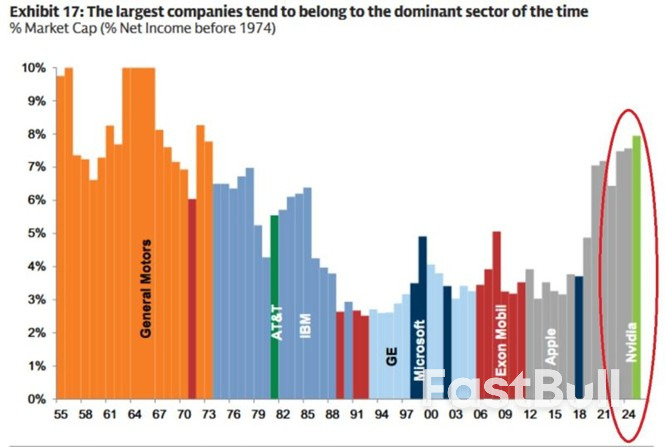
          The Fed flinches, the bull runs, and the AI boom isn’t slowing, with NVIDIA (NASDAQ:NVDA) claiming 8% of the S&P 500. Each week, the Syz investment team takes you through the last seven days in seven charts.

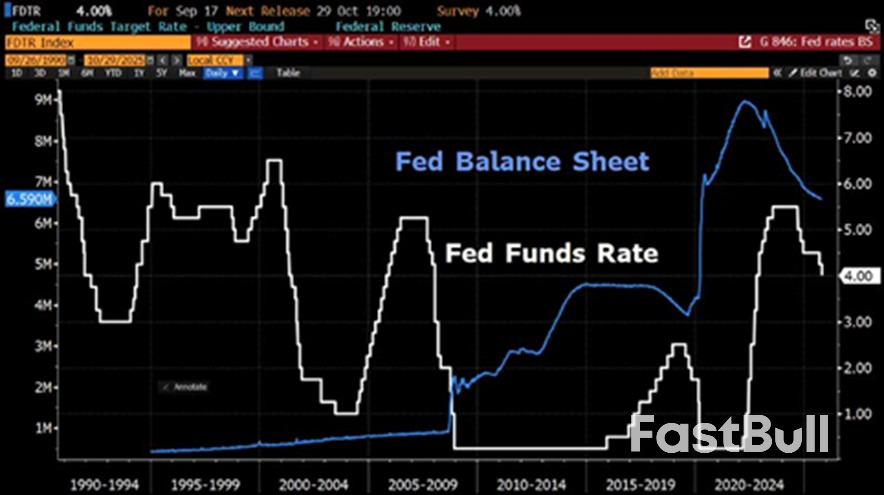
          A Fed Cut, the End of Quantitative Tightening, Yet a Hawkish Shift in Tone

          The Federal Reserve delivered a rate cut and announced the conclusion of its quantitative tightening programme. However, Chair Powell’s unexpectedly hawkish remarks prompted markets to sharply scale back expectations for a December rate cut. As a result, US Treasury yields surged, equities lost ground, and the dollar strengthened.
          The decision to end QT may help alleviate near-term liquidity pressures and ease tensions in money markets. In the coming weeks, investors will closely assess how the Fed’s move, Powell’s cautious messaging, and upcoming liquidity indicators influence inflation expectations.
          Given the current data gaps caused by the government shutdown, both policymakers and markets remain in a wait-and-see mode. As Powell underlined, another rate cut in December is “not a foregone conclusion – far from it."
          AI Investment Surge Shows No Signs of Slowing_1

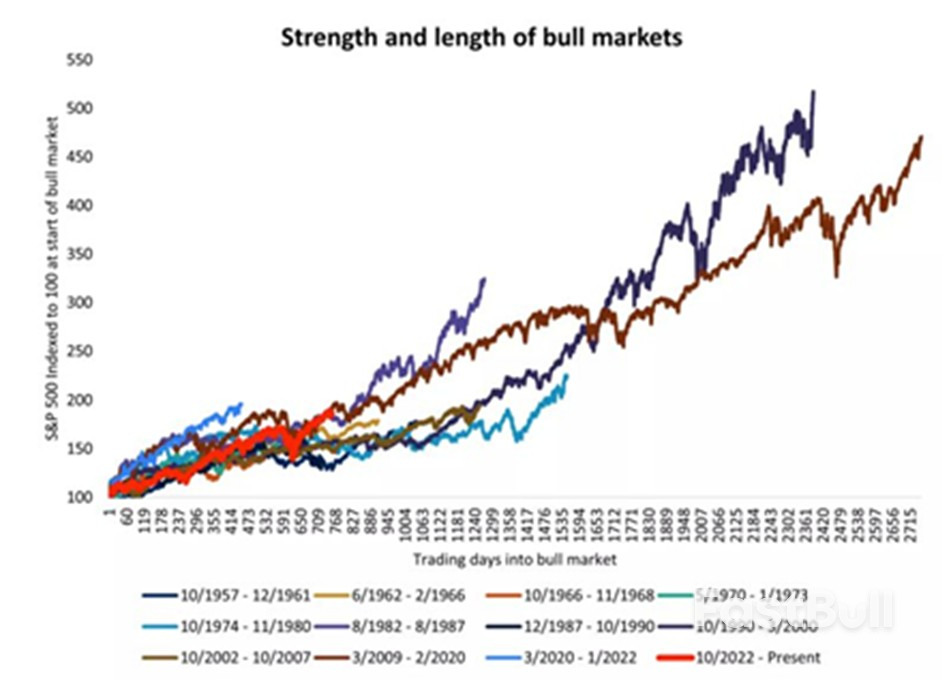
          This Bull Market Isn’t Young… but It’s Far From Done

          It’s not a newborn rally learning to walk, nor an aging one losing steam. We’re firmly in the middle of the cycle, where things usually get intriguing.
          As the saying goes, “Bull markets don’t die of old age. They die from recessions or Fed tightening.”
          For now, neither seems to be looming on the 2026 horizon.
          Bottom line: The market’s rally isn’t over, it’s simply moving at a more measured, confident pace.
          AI Investment Surge Shows No Signs of Slowing_2

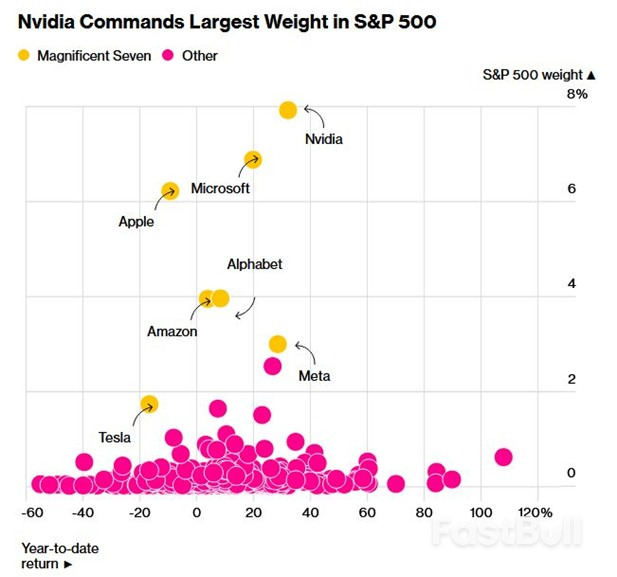
          NVIDIA’s Market Cap Now Makes Up a RECORD 8% of the S&P 500’s Total Value

          Nvidia continues to break records. Last week, its market capitalisation surpassed $5 trillion, representing roughly 16% of US GDP. The company now makes up 8% of the S&P 500, a concentration not seen since the 1970s.
          To put things in perspective, Nvidia’s valuation exceeds the entire economies of Japan and India, and it’s closing in on Germany’s GDP.
          AI Investment Surge Shows No Signs of Slowing_3

          Such US Equity Market Concentration Has Almost NEVER Happened

          Nvidia now dominates the S&P 500, accounting for 8% of its total market value, the highest share ever held by a single company since the 1970s. Microsoft (NASDAQ:MSFT) and Apple (NASDAQ:AAPL) follow at 6.5% and 6.0%, respectively. Together, the top ten stocks now command a record 40% of the entire index.
          AI Investment Surge Shows No Signs of Slowing_4

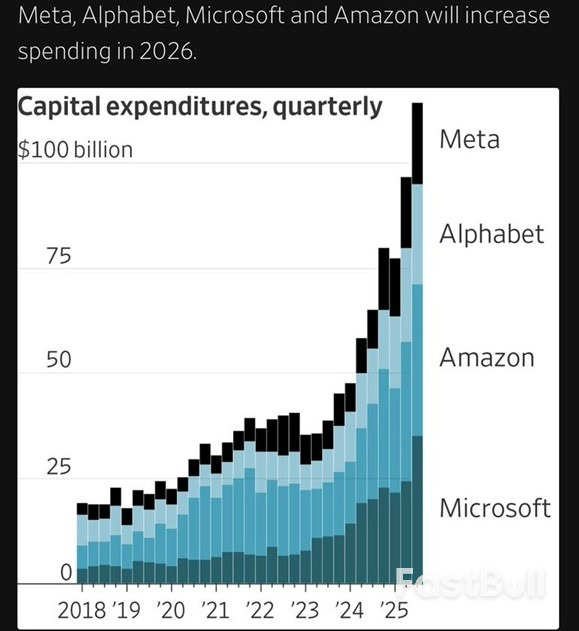
          Big Tech Just Confirmed It: The AI Spending Boom Is Still on Fire

          This week’s results from the Magnificent 7 confirm that AI-related CapEx is set to accelerate well into 2026, fuelled by structural, long-term demand that shows no sign of cooling.
          Far from being a subplot, this spending surge is the main driver of the current bull market.
          The key question now: will the rumored OpenAI IPO signal the top of the AI cycle or ignite its next powerful leg higher?
          AI Investment Surge Shows No Signs of Slowing_5

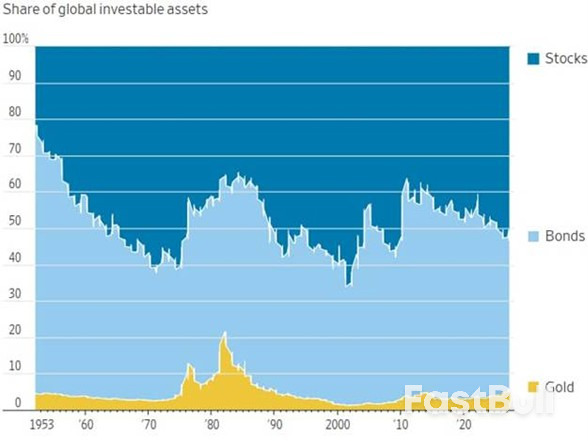
          Gold Share of Global Investable Assets Is Way Off the Peak of the 1980s

          Over the past two years, gold’s share of global investable assets has risen from 4% to 6%, its highest level since 1986.
          For context, during the 1980 gold bubble, that share peaked at 22%, before collapsing to just 1% two decades later, in 2000.
          AI Investment Surge Shows No Signs of Slowing_6

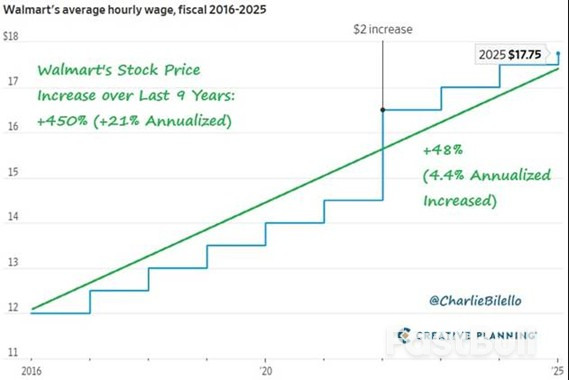
          Walmart’s Winning Formula

          This fall, Walmart’s (NYSE:WMT) transformation will be studied at Harvard Business School as a case study on corporate reinvention.
          In 2015, the company made a bold but necessary move, raising wages for nearly half of its one million hourly employees. High turnover, weak morale, and slipping customer satisfaction were eroding performance.
          Investors initially reacted negatively, sending the stock down 10%. Yet since then, wages have risen 48%, fuelling a more engaged workforce, stronger customer experience, and an impressive 450% increase in Walmart’s share price.
          AI Investment Surge Shows No Signs of Slowing_7

          Source: investing

          To stay updated on all economic events of today, please check out our Economic calendar
          Risk Warnings and Disclaimers
          You understand and acknowledge that there is a high degree of risk involved in trading. Following any strategies or investment methods may lead to potential losses. The content on the site is provided by our contributors and analysts for information purposes only. You are solely responsible for determining whether any trading assets, securities, strategy, or any other product is suitable for investing based on your own investment objectives and financial situation.
          Add to Favorites
          Share

          US Steel Says Japanese Ownership To Unlock $3 Billion In Value

          Daniel Carter

          Economic

          United States Steel Corp. sees the potential to unlock $3 billion in value thanks to its new Japanese ownership, with added earnings from Nippon Steel Corp.'s investments in new projects along with operational efficiencies.
          US Steel said Tuesday it's anticipating $2.5 billion in incremental run-rate earnings before interest, taxes, depreciation and amortization from capital investments Nippon Steel committed to as part of its takeover of the American steelmaker. The companies also identified more than 200 initiatives to boost efficiencies by adding Nippon Steel's technological expertise to US Steel operations.
          Nippon Steel acquired US Steel for $14.1 billion in June, bringing an end to a bruising takeover battle that was embroiled in American politics for months until gaining support from President Donald Trump. As part of the deal, the Japanese company agreed to invest $11 billion in the Pittsburgh-based company by 2028.
          "Even just a few months into our partnership with Nippon Steel, we're making great progress," US Steel CEO Dave Burritt said in Tuesday's statement. "We have a robust pipeline of growth projects, ranging from the modernization of our Gary Works Hot Strip Mill to the new slag recycler at Mon Valley Works and the development of new product capabilities."

          Source: Bloomberg Europe

          To stay updated on all economic events of today, please check out our Economic calendar
          Risk Warnings and Disclaimers
          You understand and acknowledge that there is a high degree of risk involved in trading. Following any strategies or investment methods may lead to potential losses. The content on the site is provided by our contributors and analysts for information purposes only. You are solely responsible for determining whether any trading assets, securities, strategy, or any other product is suitable for investing based on your own investment objectives and financial situation.
          Add to Favorites
          Share

          Wall Street CEOs Flag High Market Valuations, Pullback Risk

          Adam

          Economic

          Wall Street chief executives said investors should brace for an equity market drop of more than 10% in the next 12 to 24 months, and that such a correction may be a positive development.
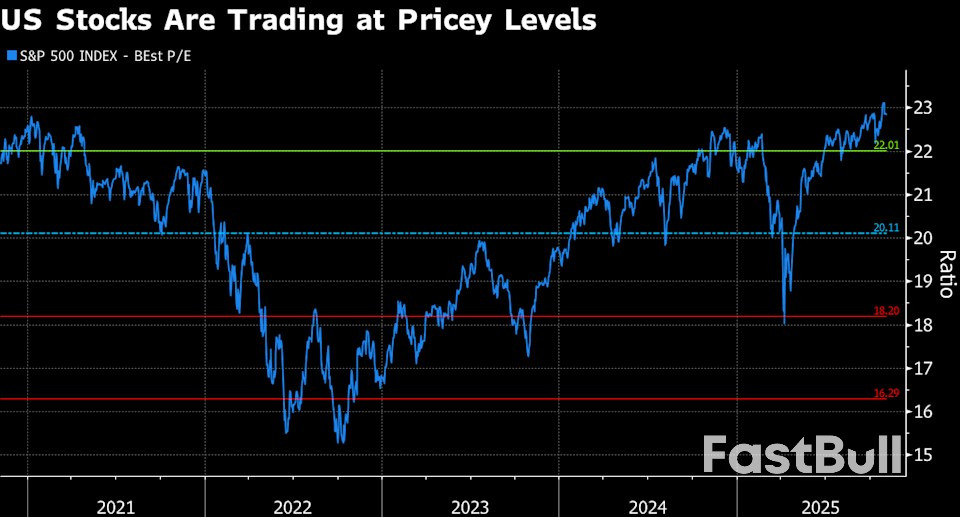
          Corporate earnings are strong but “what’s challenging are valuations,” said Mike Gitlin, who helps oversee about $3 trillion as president and chief executive officer of investment manager Capital Group, during a financial summit organized by the Hong Kong Monetary Authority on Tuesday.
          On whether stocks are cheap, fair or fully valued, Gitlin said most people “would say we’re somewhere between fair and full, but I don’t think a lot of people would say we’re between cheap and fair,” he said. The same goes for credit spreads, Gitlin added.
          His views were echoed by Morgan Stanley CEO Ted Pick and Goldman Sachs Group Inc.’s David Solomon, who also see the possibility of a significant selloff in the coming period and said pullbacks are a normal feature of market cycles.
          Wall Street CEOs Flag High Market Valuations, Pullback Risk_1
          ick said markets have come a long way, but there’s still “policy error risk” in the US and geopolitical uncertainty.
          “Yes markets seem expensive...but the reality is that systematic risk has probably narrowed,” he said. There will be more focus on company earnings in 2026 and there will be greater dispersion, where stronger firms will outperform while weaker ones will lag, he said. In addition, the new issue market is active around the world “and investors want to take risks.”
          “We should also welcome the possibility that there would be 10 to 15% drawdowns that are not driven by some sort of macro-cliff effect,” Pick said, calling that “a healthy development.”
          The S&P 500 index is trading at 23 times forward earnings estimates, above its five-year average of 20 times. Similarly, the Nasdaq 100 Index fetches a multiple of 28 times, compared with nearly 19 times in 2022. Futures on the tech-heavy gauge dropped as much as 1.8% on Tuesday, with AI bellwether Palantir Technologies Inc. declining more than 7% in pre-market trading on worries about the company’s lofty valuation after a record run-up.
          Concerns about rich valuations have intensified after global equities repeatedly hit new highs this year despite a slowing US economy and a government shutdown.
          Markets are most irrational at the heights of a bull market and the depths of a bear market, said Citadel Chief Executive Officer Ken Griffin, who added that now “we are very deep into a bull market.”
          Solomon said “technology multiples are full,” but that’s not the case for the whole market. He said Goldman’s advice to clients has been to stay invested, to look at their portfolio allocations, and avoid trying to time the market.
          He added that equity drawdowns of 10% to 15% also often occur through positive cycles without altering the general direction of capital flows or long-term allocations.
          “It just means things run and then they pull back so people can reassess,” Solomon said.

          Source: Bloomberg

          To stay updated on all economic events of today, please check out our Economic calendar
          Risk Warnings and Disclaimers
          You understand and acknowledge that there is a high degree of risk involved in trading. Following any strategies or investment methods may lead to potential losses. The content on the site is provided by our contributors and analysts for information purposes only. You are solely responsible for determining whether any trading assets, securities, strategy, or any other product is suitable for investing based on your own investment objectives and financial situation.
          Add to Favorites
          Share

          World Will Overshoot 1.5C Climate Goal, UN Says

          Devin

          Economic

          The world has failed to meet its main climate change target of limiting the rise in global temperatures to 1.5 degrees Celsius, and will likely breach this threshold in the next decade, the United Nations' Environment Programme said on Tuesday.

          The annual Emissions Gap report said because of countries' slow action to reduce planet-heating greenhouse gas emissions, it was now clear that the world would exceed the core target of the 2015 Paris Agreement - at least temporarily.

          "This will be difficult to reverse – requiring faster and bigger additional reductions in greenhouse gas emissions to minimize overshoot," UNEP said.

          'WE CAN NO LONGER TOTALLY AVOID IT'

          Lead report author Anne Olhoff said deep emissions cuts now could delay when the overshoot happens, "but we can no longer totally avoid it".

          The 2015 Paris Agreement commits countries to limit the global average temperature rise to 2°C above pre-industrial levels, and to aim for 1.5°C.

          Yet governments' latest pledges to cut emissions in future, if met, would see the world face 2.3-2.5°C of warming, UNEP said.

          That's around 0.3°C less warming than the U.N.'s projection a year ago - indicating that new emissions-cutting plans announced this year by countries including top CO2 emitter China have failed to substantially close the gap.

          China pledged in September to cut emissions by 7-10% from their peak by 2035. Analysts note the country tends to set modest targets and exceed them.

          FINDINGS ADD PRESSURE TO COP30 CLIMATE SUMMIT

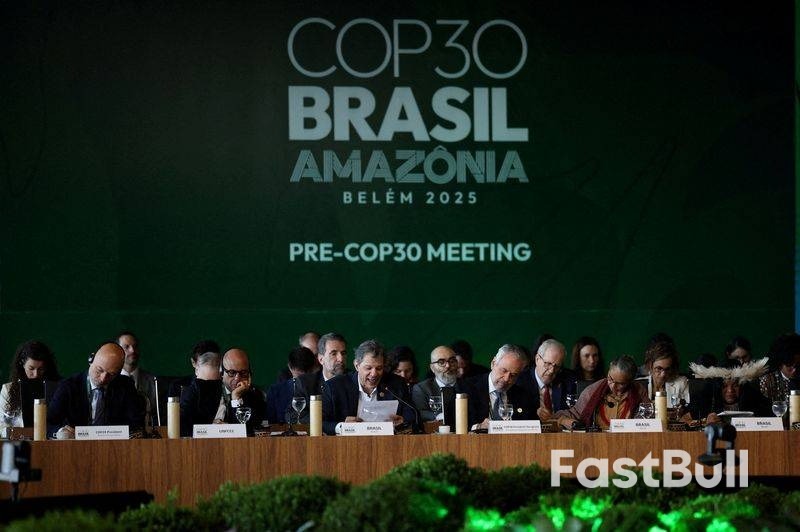
          The findings add pressure to the U.N.'s COP30 climate summit this month, where countries will debate how to kick-start and finance faster action to rein in global warming.

          The Paris Agreement temperature goals were based on scientific assessments of how each increment of global warming fuels worse heatwaves, droughts and wildfires. For example, 2°C of warming would more than double the share of the population exposed to extreme heat, compared with 1.5°C . Warming of 1.5°C would destroy at least 70% of coral reefs, versus 99% at 2°C.

          Current policies - the ones countries already have in place - would lead to even more warming, of around 2.8°C, UNEP said.

          The world has made some progress. A decade ago, when the Paris Agreement was signed, the planet was on course for around a 4°C temperature rise.

          But heat-trapping CO2 emissions continue to rise, as countries burn coal, oil and gas to power their economies.

          Global greenhouse gas emissions increased by 2.3% in 2024, to 57.7 gigatonnes of CO2 equivalent, UNEP said.

          Source: Investing

          To stay updated on all economic events of today, please check out our Economic calendar
          Risk Warnings and Disclaimers
          You understand and acknowledge that there is a high degree of risk involved in trading. Following any strategies or investment methods may lead to potential losses. The content on the site is provided by our contributors and analysts for information purposes only. You are solely responsible for determining whether any trading assets, securities, strategy, or any other product is suitable for investing based on your own investment objectives and financial situation.
          Add to Favorites
          Share
          FastBull
          Copyright © 2025 FastBull Ltd

          728 RM B 7/F GEE LOK IND BLDG NO 34 HUNG TO RD KWUN TONG KLN HONG KONG

          TelegramInstagramTwitterfacebooklinkedin
          App Store Google Play Google Play
          Products
          Charts

          Chats

          Q&A with Experts
          Screeners
          Economic Calendar
          Data
          Tools
          Membership
          Features
          Function
          Markets
          Copy Trading
          Latest Signals
          Contests
          News
          Analysis
          24/7
          Columns
          Education
          Company
          Careers
          About Us
          Contact Us
          Advertising
          Help Center
          Feedback
          User Agreement
          Privacy Policy
          Business

          White Label

          Data API

          Web Plug-ins

          Poster Maker

          Affiliate Program

          Risk Disclosure

          The risk of loss in trading financial instruments such as stocks, FX, commodities, futures, bonds, ETFs and crypto can be substantial. You may sustain a total loss of the funds that you deposit with your broker. Therefore, you should carefully consider whether such trading is suitable for you in light of your circumstances and financial resources.

          No decision to invest should be made without thoroughly conducting due diligence by yourself or consulting with your financial advisors. Our web content might not suit you since we don't know your financial conditions and investment needs. Our financial information might have latency or contain inaccuracy, so you should be fully responsible for any of your trading and investment decisions. The company will not be responsible for your capital loss.

          Without getting permission from the website, you are not allowed to copy the website's graphics, texts, or trademarks. Intellectual property rights in the content or data incorporated into this website belong to its providers and exchange merchants.

          Not Logged In

          Log in to access more features

          FastBull Membership

          Not yet

          Purchase

          Become a signal provider
          Help Center
          Customer Service
          Dark Mode
          Price Up/Down Colors

          Log In

          Sign Up
          Position
          Layout
          Fullscreen
          Default to Chart
          The chart page opens by default when you visit fastbull.com