
• Trade
  • Markets
  • Copy
  • Contests
  • News
  • 24/7
  • Calendar
  • Q&A
  • Chats
Trending
Screeners
SYMBOL
LAST
BID
ASK
HIGH
LOW
NET CHG.
%CHG.
SPREAD
SPX
S&P 500 Index
6870.39
6870.39
6870.39
6895.79
6858.28
+13.27
+ 0.19%
--
DJI
Dow Jones Industrial Average
47954.98
47954.98
47954.98
48133.54
47871.51
+104.05
+ 0.22%
--
IXIC
NASDAQ Composite Index
23578.12
23578.12
23578.12
23680.03
23506.00
+72.99
+ 0.31%
--
USDX
US Dollar Index
98.950
99.030
98.950
99.060
98.740
-0.030
-0.03%
--
EURUSD
Euro / US Dollar
1.16426
1.16443
1.16426
1.16715
1.16277
-0.00019
-0.02%
--
GBPUSD
Pound Sterling / US Dollar
1.33312
1.33342
1.33312
1.33622
1.33159
+0.00041
+ 0.03%
--
XAUUSD
Gold / US Dollar
4197.91
4197.91
4197.91
4259.16
4191.87
-9.26
-0.22%
--
WTI
Light Sweet Crude Oil
59.809
60.061
59.809
60.236
59.187
+0.426
+ 0.72%
--

Community Accounts

Signal Accounts
--
Profit Accounts
--
Loss Accounts
--
View More

Become a signal provider

Sell trading signals to earn additional income

View More

Guide to Copy Trading

Get started with ease and confidence

View More

Signal Accounts for Members

All Signal Accounts

Best Return
  • Best Return
  • Best P/L
  • Best MDD
Past 1W
  • Past 1W
  • Past 1M
  • Past 1Y

All Contests

  • All
  • Trump Updates
  • Recommend
  • Stocks
  • Cryptocurrencies
  • Central Banks
  • Featured News
Top News Only
Share

[Chinese Business Delegation Visits The US To Promote Deeper Economic And Trade Cooperation] At The Invitation Of The U.S. Chamber Of Commerce, The China Council For The Promotion Of International Trade (CCPIT) Organized A Delegation Of Chinese Business Leaders To Visit Washington, San Francisco, And Oakland From February 2nd To 6th To Promote Deeper Economic And Trade Exchanges And Cooperation Between The Two Countries. During The Visit, The CCPIT, In Cooperation With The Oakland City Government, The U.S. Chamber Of Commerce, The U.S.-China Business Council, The Semiconductor Industry Association, U.S. Asia Group, Meridian International Center, And The U.S. Soybean Export Council, Held Several Sino-U.S. Business Matchmaking Events And Held Discussions With More Than 170 U.S. Companies And Institutions

Share

French President Emmanuel Macron Has Called On The European Central Bank (ECB) To Change Its Monetary Policy Approach In Order To Boost The Single Market And Protect It From The Risks Of A Financial Crisis. Macron Stated That The ECB Needs To Think Differently, Reaffirming The Value Of The European Internal Market, Which Means It Cannot Solely Target Inflation But Should Also Focus On Growth And Employment. Macron Argued That The Increasing Deregulation Of Crypto Assets And Stablecoins In The United States Could Create Financial Instability, And That Europe Must Maintain A Stable Monetary Zone

Share

U.S. Treasury Secretary Bessenter: Inflation Is Expected To Decline "strongly" In 2026

Share

USTR Says China's Trade Commitments 'Going In The Right Direction'

Share

India Aviation Regulator: Continues To Monitor The Situation Closely

Share

USA, Israel, And Qatar Are Holding A Trilateral Meeting In New York On Sunday To Rebuild Relations

Share

Kremlin Says New US Security Strategy Accords Largely With Russia's View

Share

United Arab Emirates's Abu Dhabi National Oil Company Sets January Murban Crude Osp At $65.53/Bbl

Share

Bessent: USA Will Finish The Year With 3% GDP Growth

Share

Israeli Prime Minister Netanyahu: He Will Not Quit Politics If He Receives A Pardon

Share

Government Spokesperson: Fourteen Arrested Over Benin Coup Attempt

Share

French President Macron: Nigeria Seeks French Help To Combat Insecurity

Share

Industry Source: EU Commission May Announce Package To Support Auto Industry On December 16

Share

Israel Foreign Currency Reserves $231.425 Billion In November Versus$231.954 Billion In October -Bank Of Israel

Share

[Moodeng Surges Over 43% In The Last 24 Hours, With A Current Market Cap Of $104 Million.] December 7Th, According To Gmgn Market Data, The Solana-Based Meme Coin Moodeng Surged Over 43% In The Past 24 Hours, With A Market Capitalization Currently Standing At 104 Million USD

Share

Jerusalem-German Chancellor Merz: We Have Not Discussed A Visit To Germany By Israeli Prime Minister Benjamin Netanyahu, Not An Issue At The Moment

Share

Israeli Prime Minister Netanyahu: We're Close To The Second Phase Of Trump's Gaza Plan

Share

West Africa's ECOWAS Bloc: 'Strongly Condemns' Attempted Military Coup In Benin

Share

Israeli Prime Minister Netanyahu: Political Annexation Of The West Bank Remains A Subject Of Discussion

Share

Israeli Prime Minister Netanyahu: Sovereign Power Of Security From The Jordan River To The Mediterranean Will Always Remain In Israel's Hands

TIME
ACT
FCST
PREV
Mexico Consumer Confidence Index (Nov)

A:--

F: --

P: --

Canada Unemployment Rate (SA) (Nov)

A:--

F: --

P: --

Canada Labor Force Participation Rate (SA) (Nov)

A:--

F: --

P: --

Canada Employment (SA) (Nov)

A:--

F: --

P: --

Canada Part-Time Employment (SA) (Nov)

A:--

F: --

P: --

Canada Full-time Employment (SA) (Nov)

A:--

F: --

P: --

U.S. Personal Income MoM (Sept)

A:--

F: --

P: --

U.S. PCE Price Index YoY (SA) (Sept)

A:--

F: --

P: --

U.S. PCE Price Index MoM (Sept)

A:--

F: --

P: --

U.S. Personal Outlays MoM (SA) (Sept)

A:--

F: --

P: --

U.S. Core PCE Price Index MoM (Sept)

A:--

F: --

P: --

U.S. Core PCE Price Index YoY (Sept)

A:--

F: --

P: --

U.S. UMich 5-Year-Ahead Inflation Expectations Prelim YoY (Dec)

A:--

F: --

P: --

U.S. Real Personal Consumption Expenditures MoM (Sept)

A:--

F: --

P: --

U.S. 5-10 Year-Ahead Inflation Expectations (Dec)

A:--

F: --

P: --

U.S. UMich Current Economic Conditions Index Prelim (Dec)

A:--

F: --

P: --

U.S. UMich Consumer Sentiment Index Prelim (Dec)

A:--

F: --

P: --

U.S. UMich 1-Year-Ahead Inflation Expectations Prelim (Dec)

A:--

F: --

P: --

U.S. UMich Consumer Expectations Index Prelim (Dec)

A:--

F: --

P: --

U.S. Weekly Total Rig Count

A:--

F: --

P: --

U.S. Weekly Total Oil Rig Count

A:--

F: --

P: --

U.S. Unit Labor Cost Prelim (SA) (Q3)

--

F: --

P: --

U.S. Consumer Credit (SA) (Oct)

A:--

F: --

P: --

China, Mainland Foreign Exchange Reserves (Nov)

A:--

F: --

P: --

China, Mainland Exports YoY (USD) (Nov)

--

F: --

P: --

China, Mainland Imports YoY (CNH) (Nov)

--

F: --

P: --

China, Mainland Imports YoY (USD) (Nov)

--

F: --

P: --

China, Mainland Imports (CNH) (Nov)

--

F: --

P: --

China, Mainland Trade Balance (CNH) (Nov)

--

F: --

P: --

China, Mainland Exports (Nov)

--

F: --

P: --

Japan Wages MoM (Oct)

--

F: --

P: --

Japan Trade Balance (Oct)

--

F: --

P: --

Japan Nominal GDP Revised QoQ (Q3)

--

F: --

P: --

Japan Trade Balance (Customs Data) (SA) (Oct)

--

F: --

P: --

Japan GDP Annualized QoQ Revised (Q3)

--

F: --

P: --
China, Mainland Exports YoY (CNH) (Nov)

--

F: --

P: --

Germany Industrial Output MoM (SA) (Oct)

--

F: --

P: --

Euro Zone Sentix Investor Confidence Index (Dec)

--

F: --

P: --

Canada Leading Index MoM (Nov)

--

F: --

P: --

Canada National Economic Confidence Index

--

F: --

P: --

U.S. Dallas Fed PCE Price Index YoY (Sept)

--

F: --

P: --

China, Mainland Trade Balance (USD) (Nov)

--

F: --

P: --

U.S. 3-Year Note Auction Yield

--

F: --

P: --

U.K. BRC Overall Retail Sales YoY (Nov)

--

F: --

P: --

U.K. BRC Like-For-Like Retail Sales YoY (Nov)

--

F: --

P: --

Australia Overnight (Borrowing) Key Rate

--

F: --

P: --

RBA Rate Statement
RBA Press Conference
Germany Exports MoM (SA) (Oct)

--

F: --

P: --

U.S. NFIB Small Business Optimism Index (SA) (Nov)

--

F: --

P: --

Mexico Core CPI YoY (Nov)

--

F: --

P: --

Mexico 12-Month Inflation (CPI) (Nov)

--

F: --

P: --

Mexico PPI YoY (Nov)

--

F: --

P: --

Mexico CPI YoY (Nov)

--

F: --

P: --

U.S. Weekly Redbook Index YoY

--

F: --

P: --

Q&A with Experts
    • All
    • Chatrooms
    • Groups
    • Friends
    Connecting
    .
    .
    .
    Type here...
    Add Symbol or Code

      No matching data

      All
      Trump Updates
      Recommend
      Stocks
      Cryptocurrencies
      Central Banks
      Featured News
      • All
      • Russia-Ukraine Conflict
      • Middle East Flashpoint
      • All
      • Russia-Ukraine Conflict
      • Middle East Flashpoint
      Search
      Products

      Charts Free Forever

      Chats Q&A with Experts
      Screeners Economic Calendar Data Tools
      Membership Features
      Data Warehouse Market Trends Institutional Data Policy Rates Macro

      Market Trends

      Market Sentiment Order Book Forex Correlations

      Top Indicators

      Charts Free Forever
      Markets

      News

      News Analysis 24/7 Columns Education
      From Institutions From Analysts
      Topics Columnists

      Latest Views

      Latest Views

      Trending Topics

      Top Columnists

      Latest Update

      Signals

      Copy Rankings Latest Signals Become a signal provider AI Rating
      Contests
      Brokers

      Overview Brokers Assessment Rankings Regulators News Claims
      Broker listing Forex Brokers Comparison Tool Live Spread Comparison Scam
      Q&A Complaint Scam Alert Videos Tips to Detect Scam
      More

      Business
      Events
      Careers About Us Advertising Help Center

      White Label

      Data API

      Web Plug-ins

      Affiliate Program

      Awards Institution Evaluation IB Seminar Salon Event Exhibition
      Vietnam Thailand Singapore Dubai
      Fans Party Investment Sharing Session
      FastBull Summit BrokersView Expo
      Recent Searches
        Top Searches
          Markets
          News
          Analysis
          User
          24/7
          Economic Calendar
          Education
          Data
          • Names
          • Latest
          • Prev

          View All

          No data

          Scan to Download

          Faster Charts, Chat Faster!

          Download App
          English
          • English
          • Español
          • العربية
          • Bahasa Indonesia
          • Bahasa Melayu
          • Tiếng Việt
          • ภาษาไทย
          • Français
          • Italiano
          • Türkçe
          • Русский язык
          • 简中
          • 繁中
          Open Account
          Search
          Products
          Charts Free Forever
          Markets
          News
          Signals

          Copy Rankings Latest Signals Become a signal provider AI Rating
          Contests
          Brokers

          Overview Brokers Assessment Rankings Regulators News Claims
          Broker listing Forex Brokers Comparison Tool Live Spread Comparison Scam
          Q&A Complaint Scam Alert Videos Tips to Detect Scam
          More

          Business
          Events
          Careers About Us Advertising Help Center

          White Label

          Data API

          Web Plug-ins

          Affiliate Program

          Awards Institution Evaluation IB Seminar Salon Event Exhibition
          Vietnam Thailand Singapore Dubai
          Fans Party Investment Sharing Session
          FastBull Summit BrokersView Expo

          TACO Hopes Outweigh Regional Bank Jitters

          Pepperstone

          Forex

          Political

          Economic

          Summary:

          A rather famous old market adage is ‘there's nothing like price to change sentiment'. I might change that a bid, to ‘there's nothing like a TACO to change sentiment'.

          WHERE WE STAND – A rather famous old market adage is ‘there's nothing like price to change sentiment'. I might change that a bid, to ‘there's nothing like a TACO to change sentiment'.Yes, that's right, after participants spent the back end of Thursday brushing up on funding markets and fretting (unnecessarily) about the state of US regional banks, a couple of positive trade-related snippets from ‘The Donald', and signs of easing money market stress stateside, were good to spark a bout of optimism as we moved into the weekend.

          Fine, conditions were still incredibly choppy, and yes it wasn't as if the risk-on vibe that took hold was the most convincing of things that you're ever going to see, but at least participants appear to no longer be pointlessly worrying about insignificant financial institutions that nobody has ever heard of, and re-focusing on what remains a constructive setup for risk assets as we move towards year-end.I'll get to that in a second, but first just want to touch on the banking sector. Last week's jitters appeared to stem from a couple of relatively small banks writing off bad loans – one of these was Zions Bancorp, who took a $50mln write-down on a fraudulent loan, but have a $90bln (with a ‘B'!) balance sheet, which at best makes that seem ‘small beer'.

          In many ways, those jitters last week were a bit of a ‘perfect storm', with idiosyncratic loan write-downs coinciding with sizeable funding pressures stemming from the California tax filing deadline, as well as Treasury auction settlements, thus creating notable tightness in funding markets. Said tightness subsided on Friday, with no institutions tapping the Fed's SRF, while in any case the Fed are alert to the lack of ‘wriggle room' that they now have, with RRP usage basically zero, and Chair Powell having already flagged that balance sheet run-off will probably wrap up sooner rather than later. December is the base case on that front, though risks skew towards it happening sooner.

          Anyway, markets already appeared on surer footing as those fears subsided, before we got a ‘TACO' for lunch to help steady things up even more. That, of course, came by virtue of comments from President Trump, who continued to dial down the rhetoric in terms of US-China trade tensions, confirming that he will be meeting President Xi in a fortnight, that high tariffs on Chinese goods are ‘not sustainable', and again noting that things will be ‘fine' with China in due course. Treasury Sec Bessent confirming he'll meet his Chinese counterpart this week provided a bit of a helping hand as well.

          Given the above, equities on Wall St ended the week in the green, with this rally resulting in the major benchmarks notching a weekly gain, despite what was quite the rollercoaster ride over the last five days. Though conditions have clearly been turbulent, I remain an equity bull, with earnings growth solid, underlying economic growth resilient, the monetary backdrop becoming looser, the present round of trade tensions likely to soon be de-escalated, corporate buybacks being on the verge of resuming, as well as the typical FOMO/FOMU buying into year-end. All that feels like a very powerful force that I'd not want to fight.

          Speaking of powerful forces, relentless selling pressure was felt across the precious metals complex as the week wrapped up, with spot gold falling back towards $4,200/oz, and spot silver notching its biggest one-day drop in half a year. It must be said that there wasn't anything especially obvious to drive these moves, besides perhaps a combination of fading haven demand coupled with an unwind of relatively fresh momentum-based longs, in a market that had undoubtedly come a very long way, in a very short space of time.

          I'm not going to sit here and call a ‘top' in the complex, not least considering that the bull case which has underpinned a 60% YTD gain in gold, and near-80% YTD gain in silver, continues to hold water, amid the risk of inflation expectations un-anchoring, continued runaway DM fiscal spending and, most importantly, incredibly high levels of physical demand. That said, if Friday's moves were to prove the start of a pullback in this uptrend, you'd initially be looking for support at $4,000/oz in gold, and $50/oz in silver, where I'd be keen to buy into any dips – one to keep on the radar for the week ahead.

          Speaking of buying dips, I was reassured by the way in which the dollar not only snapped a 3-day losing run as the week wrapped up, but how the DXY held above both the 50- and 100-day moving averages as well. Although conditions in the G10 FX space have become akin to watching paint dry in recent weeks, the Fed's ‘run it hot' approach skews risks towards us returning to the RHS of the ‘dollar smile' as risks to the US economic outlook increasingly tilt to the upside.

          That same approach, though, should tilt risks to Treasuries, especially at the long-end, to the downside as well, however that's not a call I'd have especially much conviction in for the time being, not least until we can be confident that sentiment is on much steadier footing.

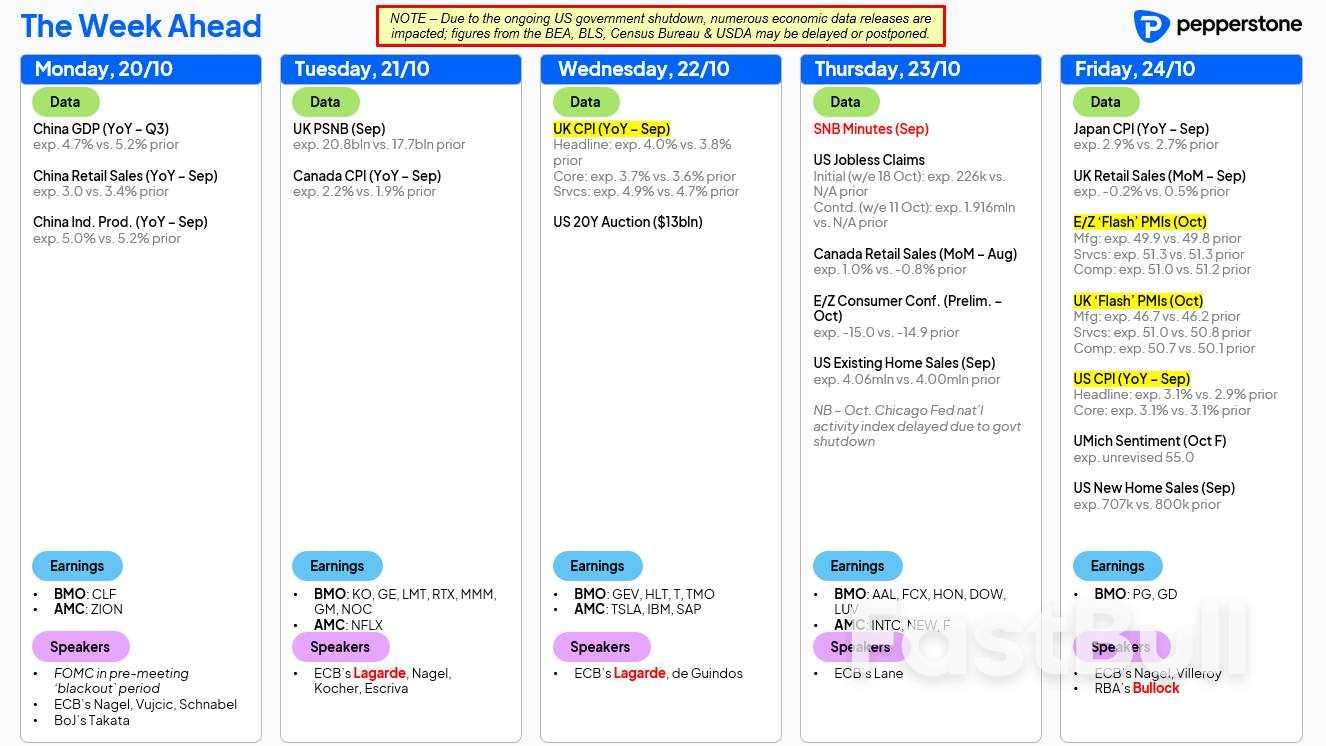
          LOOK AHEAD – As the US government shutdown rolls on, the economic calendar remains something of a mess, with market participants continuing, by and large, to operate in a data vacuum.

          That said, we will at least get the September US CPI figures this week, with that print on Friday highlighting the data docket. Both headline and core CPI are seen having risen by 3.1% YoY last month, as tariff-induced price pressures continue to make themselves known, though it's very tough indeed to imagine the data materially altering the Fed policy outlook, with 25bp cuts this month, and in December, effectively locked in amid mounting downside labour market risks.For those curious, the CPI data is being released due to it being required in calculating the annual Social Security cost of living adjustment, no other BLS-calculated figures will be released until the shutdown comes to an end.

          Elsewhere, we also get inflation figures from here in the UK this week, with headline CPI seen having risen to 4.0% YoY in September, and services CPI pushing 5.0% YoY once more. The BoE expect that this will be the peak in price pressures this cycle, though are unlikely to take any more steps to remove policy restriction until they are sure of that fact, meaning my base case is now that the ‘Old Lady' stands pat until delivering a 25bp cut next February. Meanwhile, ‘flash' PMIs from pretty much every major economy, as well as Canadian inflation, and US consumer sentiment are also due.

          From a policy perspective, the FOMC are now (mercifully!!) in the pre-meeting ‘blackout' period, though plenty of ECB speakers will fill that particular void. We also receive the first ever set of minutes from an SNB decision this week, where comments on the valuation of the CHF are likely to be of particular interest.Earnings season also steps up a gear this week, with 90 S&P 500 set to report this week, including notable releases from the likes of Netflix (NFLX), Tesla (TSLA), and Intel (INTC).Finally, focus will of course also remain on incoming trade and tariff news flow, especially with Treasury Secretary Bessent meeting his Chinese opposite number in Malaysia at some point this week.

          As always, the full week ahead calendar is below.
          Source: Pepperstone

          To stay updated on all economic events of today, please check out our Economic calendar
          Risk Warnings and Disclaimers
          You understand and acknowledge that there is a high degree of risk involved in trading. Following any strategies or investment methods may lead to potential losses. The content on the site is provided by our contributors and analysts for information purposes only. You are solely responsible for determining whether any trading assets, securities, strategy, or any other product is suitable for investing based on your own investment objectives and financial situation.
          Add to Favorites
          Share

          Global Capital Flows Into Indian Banks as Foreign Investors Seek Stability Amid Global Credit Turmoil

          Gerik

          Economic

          India Emerges as Safe Haven for Global Financial Investment

          A new wave of foreign capital is targeting India’s banking sector, with recent billion-dollar deals highlighting the country’s rising appeal as a financial growth hub. Emirates NBD’s $3 billion investment in RBL Bank Ltd. marks the largest foreign infusion into India’s banking space to date. It follows earlier moves such as Abu Dhabi’s International Holding Co.’s $1 billion investment in Sammaan Capital Ltd. and Sumitomo Mitsui’s $1.6 billion acquisition of a 20% stake in Yes Bank Ltd.
          Altogether, foreign-led deals in India’s financial services industry have reached $15 billion this year, signaling sustained investor interest even as the global backdrop grows increasingly unstable. These flows stand in stark contrast to rising fears in the U.S. credit market, where recent collapses at Tricolor Holdings and First Brands Group have rattled confidence.

          India’s Financial Reforms Attract Capital Amid Global Uncertainty

          India’s appeal is underpinned by more than just growth momentum. Regulatory reforms, improved credit discipline, and structural overhauls have strengthened the country’s financial sector since the shadow bank crisis that shook markets seven years ago. The Reserve Bank of India (RBI) has tightened oversight, discouraged excessive risk-taking, and pushed for better capital adequacy across lenders. These changes appear to have had a causal impact on investor confidence, reinforcing India’s credibility as a long-term investment destination.
          Foreign investors, particularly those from Japan, the Middle East, and Europe, are increasingly drawn to India’s under-banked population, digital banking adoption, and consumption-led economy. As global capital searches for yield in a high-risk environment, India’s relative insulation from external volatility enhances its attractiveness. According to Vivek Ramji Iyer of Grant Thornton Bharat, India’s domestic focus and low correlation with global financial cycles make it an ideal entry point for long-horizon capital.

          Skepticism Remains Over Execution Risks and Competition

          Despite the influx of capital, historical performance raises questions about the profitability of foreign ownership in Indian banks. Independent analyst Hemindra Hazari notes that past acquisitions have rarely translated into outsized profit or revenue growth, largely due to entrenched competition and regulatory complexities. The intense retail competition and dominance of domestic players mean that capital alone may not guarantee market share or operational success.
          Nonetheless, the scale of current deals shows renewed confidence in India’s long-term trajectory. CEO of RBL Bank, R. Subramaniakumar, emphasized India’s stable financial system and regulatory robustness as key selling points to global investors.

          Policy and Market Signals Point to Further Deal Activity

          With record-high performance from key banks like HDFC and ICICI, and the Nifty Bank Index surging over 13% year-to-date, investor sentiment continues to build. Policymakers are reportedly evaluating proposals to simplify foreign ownership norms in public sector banks and possibly extend banking licenses to large corporations both of which could unleash further waves of foreign deal activity.
          Meanwhile, Mitsubishi UFJ Financial Group is actively scouting targets and is in advanced discussions to acquire a stake in Shriram Finance Ltd., while a forthcoming government stake sale in IDBI Bank Ltd. is expected to attract multi-billion dollar bids.
          These developments suggest that foreign investors are not simply responding to short-term dislocations but are placing strategic bets on India’s evolving financial architecture.
          In an era marked by geopolitical tensions, credit fragility, and uncertain monetary policy across developed economies, India’s financial sector has become a beacon for global capital. Recent billion-dollar investments are not only a testament to India’s growth story but also a reflection of investor demand for structural safety, regulatory clarity, and long-term opportunity. While execution risks remain high in a fiercely competitive banking environment, the scale and pace of foreign inflows indicate a broader recalibration of global investment priorities with India now firmly at the center.

          Source: Bloomberg

          To stay updated on all economic events of today, please check out our Economic calendar
          Risk Warnings and Disclaimers
          You understand and acknowledge that there is a high degree of risk involved in trading. Following any strategies or investment methods may lead to potential losses. The content on the site is provided by our contributors and analysts for information purposes only. You are solely responsible for determining whether any trading assets, securities, strategy, or any other product is suitable for investing based on your own investment objectives and financial situation.
          Add to Favorites
          Share

          FairWind To Scale APAC Wind Expertise With Acquisition Of Cosmic Group

          Samantha Luan

          Stocks

          Forex

          Economic

          Renewables specialist FairWind is set to boost its Asia-Pacific (APAC) presence and accelerate global growth by reaching agreement to acquire Cosmic Group, a leading Australian wind installation and maintenance provider.This strategic acquisition reinforces the company's existing presence in Australia and expands its footprint into New Zealand and Japan. The transaction is expected to close in Q4 subject customary regulatory approval, and will see the Brisbane-based business and its team of 100 technicians become part of FairWind.

          Together with Cosmic, FairWind will be able to leverage local expertise while aligning the team with its global systems, standards, and strategic direction. The business will become the regional hub for FairWind's APAC operations with one of its founders, Matt Crossan, appointed as Regional Director. Cosmic, will continue to operate under the Cosmic name - ensuring continuity for its existing projects and clients.Stewart Mitchell CEO FairWind said: "This collaboration with Cosmic is a significant step in our growth strategy. There are great synergies between the two organisations, with shared values and unwavering commitment to safety. By joining forces with a team known for delivering to the highest standards, we're extending our geographic reach while strengthening our capability to support customers wherever they operate.

          "Together, our deep technical expertise and track record in onshore and offshore wind create a powerful platform in our mission to help advance the global energy transition. We look forward to working closely together and unlocking new opportunities across the region's renewables landscape."Matt Crossan commented: "With the installed turbine base set to continue to increase and the next generation of wind turbines being introduced to the region by our customers, there is significant potential for growth across Asia Pacific.

          "We are proud of what we have built at Cosmic to become one of the leading wind services providers, by joining FairWind we have a partner who enhances our existing capability and we are excited for the next phase of the business."FairWind has a workforce of more than 2,000 people in more than 40 countries across Europe, North America, South America, Asia, and Oceania. The business provides complete lifecycle solutions for the installation and maintenance of onshore and offshore wind turbines around the world.

          Source: TradingView

          To stay updated on all economic events of today, please check out our Economic calendar
          Risk Warnings and Disclaimers
          You understand and acknowledge that there is a high degree of risk involved in trading. Following any strategies or investment methods may lead to potential losses. The content on the site is provided by our contributors and analysts for information purposes only. You are solely responsible for determining whether any trading assets, securities, strategy, or any other product is suitable for investing based on your own investment objectives and financial situation.
          Add to Favorites
          Share

          China’s Quarterly Growth Slows to 4.8% Amid Trade Tensions and Weak Domestic Demand

          Gerik

          Economic

          Growth Slows to Lowest Pace Since Q3 2024

          China’s GDP growth decelerated to 4.8% year-on-year in the third quarter of 2025, marking the weakest expansion since the same period in 2024, according to official data released Monday. This follows a 5.2% annual growth rate in the second quarter and signals mounting challenges for the world’s second-largest economy as it grapples with both external and internal pressures.
          The slowdown is driven by a combination of intensifying trade friction with the United States particularly after President Donald Trump’s imposition of new tariffs and persistent weakness in domestic demand. Despite these headwinds, cumulative growth for the first nine months of 2025 remained at a relatively stable 5.2% pace, bolstered by earlier quarters.

          Trade Holds Up, But Demand Falters

          While U.S.-China relations have become increasingly strained in recent months, China’s export sector has shown notable resilience. Exporters have managed to partially offset U.S. market losses by redirecting goods to alternative destinations, helping to stabilize the country’s external performance. This development reflects a shift in trade dynamics rather than a full substitution of lost U.S. demand, highlighting the adaptability of Chinese supply chains.
          However, on the domestic front, consumption and investment have remained lackluster. Retail sales and fixed-asset investment figures have shown only marginal improvement, if any, indicating that household confidence and private-sector investment are still under pressure. The causal relationship between consumer weakness and slowing GDP growth is particularly evident this quarter, as lackluster domestic demand directly weighs on output and services activity.
          The 4.8% GDP growth in Q3 confirms that China’s post-pandemic recovery is losing momentum under the strain of geopolitical risk and insufficient internal demand. While export resilience offers some relief, the underlying fragility in household consumption and business investment suggests deeper structural issues. As Beijing continues to navigate its economic challenges amid a contentious global environment, the focus now shifts to whether more aggressive fiscal or monetary support will be deployed to bolster growth in the final quarter of 2025.

          Source: AP

          To stay updated on all economic events of today, please check out our Economic calendar
          Risk Warnings and Disclaimers
          You understand and acknowledge that there is a high degree of risk involved in trading. Following any strategies or investment methods may lead to potential losses. The content on the site is provided by our contributors and analysts for information purposes only. You are solely responsible for determining whether any trading assets, securities, strategy, or any other product is suitable for investing based on your own investment objectives and financial situation.
          Add to Favorites
          Share

          French Bond Futures Slide After Surprise S&P Downgrade Deepens Fiscal Confidence Crisis

          Gerik

          Economic

          Sharp Drop in Futures Reflects Renewed Investor Caution

          French 10-year bond futures fell by 35 ticks to 122.80 during early Asia trading, reacting to S&P Global Ratings’ unexpected downgrade of France’s credit rating from AA- to A+. This unscheduled decision followed a prior downgrade by Fitch in September and now places France below the double-A threshold used by many conservative funds to guide investment. Although the euro remained stable, the bond market's pronounced move contrasted with a more restrained reaction in German securities, highlighting country-specific investor anxiety.
          The downgrade comes at a time when France is already under financial market scrutiny. By losing its AA status at two of the three major agencies in under two months, France risks triggering rebalancing activity in portfolios bound by minimum average credit quality requirements.

          Political Gridlock and Budget Fragility Erode Fiscal Credibility

          S&P’s downgrade underscores growing doubts over France’s fiscal management capacity as Prime Minister Sébastien Lecornu attempts to advance the 2026 budget through a fractured National Assembly. His political survival last week came at the cost of suspending President Emmanuel Macron’s flagship pension reform — a reform viewed as essential to strengthening long-term public finances.
          This compromise provided temporary political stability but introduced a clear fiscal cost. The rating agency explicitly cited the pension reform’s suspension as a contributing factor to the downgrade, reflecting a causal link between political concessions and weakened consolidation efforts. This political backdrop has become a central risk driver for French debt markets.
          According to S&P, France is now experiencing its deepest political instability since the birth of the Fifth Republic in 1958. The lack of clarity on long-term fiscal policy, especially ahead of the 2027 presidential elections, is creating uncertainty that could further pressure borrowing costs and deter investment.

          Widening Risk Premium and Yield Spread Pressures

          The downgrade has also intensified structural pressures on French yields. The spread between 10-year French and German bonds — a key risk barometer in the eurozone has widened from under 50 basis points before the 2024 snap elections to nearly 90 basis points earlier this month. Although the spread narrowed slightly to 78 basis points last Friday, it remains elevated and reflects lingering concerns over France’s creditworthiness relative to peers.
          French bonds now yield more than those of some lower-rated eurozone nations, such as Greece and Portugal — a sign that investors are pricing in political and fiscal risks over pure credit metrics. Former PIMCO CEO Mohamed El-Erian warned that the downgrade could place upward pressure on these spreads and undermine regional confidence at a time when the euro area needs deeper reform and cohesion.

          Implications for Institutional Investors and Market Liquidity

          The downgrade presents a risk of partial disinvestment by highly conservative funds, including central banks, reserve managers, and pension funds that manage products benchmarked to double-A ratings. Institutions such as BlackRock, Vanguard, and Legal & General operate products with mandates to maintain specific credit quality averages, and France’s fall below AA at two major agencies may force asset reallocation, even though French bonds remain investment-grade.
          This potential for forced selling is more than symbolic. While the majority of institutional holders are likely to retain exposure, rebalancing flows could still dent liquidity and exacerbate price volatility. The broader reputational effect of a second major downgrade could also weigh on foreign demand.

          Budget Process and Moody’s Verdict Now in Focus

          Looking ahead, market attention will shift to the upcoming budget negotiations. Prime Minister Lecornu has for now abandoned the use of Article 49.3 — a constitutional mechanism that allows budgets to pass without parliamentary votes. This decision, while intended to respect democratic norms, raises the risk that the 2026 budget may fail to pass, particularly amid a divided legislature.
          The other critical juncture will be Moody’s credit review on Friday. Moody’s currently rates France at Aa3 — the lowest tier of the double-A category. If it joins S&P and Fitch in downgrading France, the move would cement a broader consensus of deteriorating credit quality, increasing the likelihood of substantial reallocation by rating-sensitive funds.
          France’s latest credit downgrade by S&P marks a pivotal moment in the nation’s fiscal narrative, shifting focus from market-friendly reforms to short-term political survival. As the suspension of pension reform derails fiscal consolidation, bond markets are responding with spread widening and elevated risk premiums. Although France’s debt remains investment-grade, its appeal to the most risk-averse investors is diminishing. With a volatile budget season ahead and Moody’s review on the horizon, the coming weeks may determine whether France can regain control of its fiscal path or face deeper market dislocation.

          Source: Bloomberg

          To stay updated on all economic events of today, please check out our Economic calendar
          Risk Warnings and Disclaimers
          You understand and acknowledge that there is a high degree of risk involved in trading. Following any strategies or investment methods may lead to potential losses. The content on the site is provided by our contributors and analysts for information purposes only. You are solely responsible for determining whether any trading assets, securities, strategy, or any other product is suitable for investing based on your own investment objectives and financial situation.
          Add to Favorites
          Share

          China Imports No US Soybeans In September For First Time In Seven Years

          Samantha Luan

          Forex

          Political

          China–U.S. Trade War

          Economic

          China imported no soybeans from the U.S. in September, the first time since November 2018 that shipments fell to zero, while South American shipments surged from a year earlier, as buyers shunned American cargoes during the ongoing trade dispute between the world's two largest economies.Imports last month from the U.S. fell to zero from 1.7 million metric tons a year earlier, data from China's General Administration of Customs showed on Monday.Shipments fell because of the high tariffs China has imposed on U.S. imports and as previously harvested U.S. supplies, known as old-crop beans, have already been traded. China is the world's biggest soybean importer.

          "This is mainly due to tariffs. In a typical year, some old-crop beans would still enter the market," said Wan Chengzhi, an analyst at Capital Jingdu Futures.Brazil arrivals last month jumped 29.9% year-on-year to 10.96 million tons, accounting for 85.2% of China's total imports of the oilseed, customs data showed, while shipments from Argentina rose 91.5% to 1.17 million tons, or 9% of the total.China's soybean imports reached 12.87 million metric tons in September, the second-highest level on record.

          China has not purchased any U.S. soybean cargoes from this autumn's harvest. The window for U.S. soybean purchases is rapidly closing as buyers secure shipments through November, largely from Brazil and Argentina, helped by Argentina's brief tax holiday.Without a breakthrough in trade talks, U.S. farmers could face billions in losses as Chinese crushers continue sourcing from South America. Beijing, however, may also face a potential supply crunch early next year before Brazil's new crops hit the market."A soybean supply gap may emerge in China between February and April next year if there's no trade deal in place. Brazil has already shipped a huge volume, and no one knows how much old-crop stock remains," said Johnny Xiang, founder of Beijing-based AgRadar Consulting.

          Trade negotiations between Beijing and Washington appear to be regaining momentum after weeks of fresh tariff threats and export controls. U.S. President Donald Trump said on Sunday he believed a soybean deal would be reached.For the January-September period, China imported 63.7 million tons from Brazil, up 2.4% year-on-year, and 2.9 million tons from Argentina, up 31.8% year-on-year.Even as Chinese buyers are shunning this year's U.S. harvest, purchases earlier in 2025 mean that year-to-date imports of American beans have totalled 16.8 million tons, up 15.5%, data showed.

          Source: Yahoo Finance

          To stay updated on all economic events of today, please check out our Economic calendar
          Risk Warnings and Disclaimers
          You understand and acknowledge that there is a high degree of risk involved in trading. Following any strategies or investment methods may lead to potential losses. The content on the site is provided by our contributors and analysts for information purposes only. You are solely responsible for determining whether any trading assets, securities, strategy, or any other product is suitable for investing based on your own investment objectives and financial situation.
          Add to Favorites
          Share

          Vietnam’s Masan In Talks With Costco To Sell Its Noodles In US

          Samantha Luan

          Forex

          Economic

          Stocks

          Masan Group is in talks with Costco Wholesale Corp. to sell its branded noodles, fish sauce and coffee in the retailer’s US stores as the Vietnamese conglomerate accelerates its global expansion.“Our leading products such as fish sauce, chili sauce, and noodles have already entered Costco’s hypermarket system in South Korea, and will soon be available in Costco in the US,” said Le Thi Nga, deputy chief executive officer of Masan Consumer, the group’s unit.

          Some of its products are now being offered in a limited number of Costco stores on a trial basis, according to Masan Consumer.Representatives for Costco didn’t immediately respond to requests for comment.The Ho Chi Minh City-based company is also in discussions with Walmart Inc. to put some of its branded products on the retail giant’s shelves, Nga said.Representatives for Walmart didn’t immediately respond to requests for comment outside regular business hours.

          Masan Consumer produces a range of food and beverages, including sauces, noodles, cereals, instant coffee and beer. It aims for 15% of its revenue to come from abroad “in the next few years,” up from about 5% now, Nga said.In particular, it seeks to ramp up global sales of its Chin-su seasoning products, Omachi noodles and Vinacafe instant coffee.The company says it sells goods in regions including North America, Europe, New Zealand, the UK, South Korea, Japan, and China.

          Masan Consumer is making a major push to form more US partnerships, said Nga, who oversees the unit’s research and development.“Masan is pursuing a strategy to bring Vietnamese cuisine and products to the world, and we are taking our first firm steps in that direction,” she said.Masan Group is planning an initial public offering of the unit, which could raise as much as $1.5 billion.

          The conglomerate reported second-quarter net income of 1.03 trillion dong ($39.1 million), up from 503 billion dong in the same year-ago period. Revenue was at 18.32 trillion dong.

          Source: Bloomberg Europe

          To stay updated on all economic events of today, please check out our Economic calendar
          Risk Warnings and Disclaimers
          You understand and acknowledge that there is a high degree of risk involved in trading. Following any strategies or investment methods may lead to potential losses. The content on the site is provided by our contributors and analysts for information purposes only. You are solely responsible for determining whether any trading assets, securities, strategy, or any other product is suitable for investing based on your own investment objectives and financial situation.
          Add to Favorites
          Share
          FastBull
          Copyright © 2025 FastBull Ltd

          728 RM B 7/F GEE LOK IND BLDG NO 34 HUNG TO RD KWUN TONG KLN HONG KONG

          TelegramInstagramTwitterfacebooklinkedin
          App Store Google Play Google Play
          Products
          Charts

          Chats

          Q&A with Experts
          Screeners
          Economic Calendar
          Data
          Tools
          Membership
          Features
          Function
          Markets
          Copy Trading
          Latest Signals
          Contests
          News
          Analysis
          24/7
          Columns
          Education
          Company
          Careers
          About Us
          Contact Us
          Advertising
          Help Center
          Feedback
          User Agreement
          Privacy Policy
          Business

          White Label

          Data API

          Web Plug-ins

          Poster Maker

          Affiliate Program

          Risk Disclosure

          The risk of loss in trading financial instruments such as stocks, FX, commodities, futures, bonds, ETFs and crypto can be substantial. You may sustain a total loss of the funds that you deposit with your broker. Therefore, you should carefully consider whether such trading is suitable for you in light of your circumstances and financial resources.

          No decision to invest should be made without thoroughly conducting due diligence by yourself or consulting with your financial advisors. Our web content might not suit you since we don't know your financial conditions and investment needs. Our financial information might have latency or contain inaccuracy, so you should be fully responsible for any of your trading and investment decisions. The company will not be responsible for your capital loss.

          Without getting permission from the website, you are not allowed to copy the website's graphics, texts, or trademarks. Intellectual property rights in the content or data incorporated into this website belong to its providers and exchange merchants.

          Not Logged In

          Log in to access more features

          FastBull Membership

          Not yet

          Purchase

          Become a signal provider
          Help Center
          Customer Service
          Dark Mode
          Price Up/Down Colors

          Log In

          Sign Up

          Position
          Layout
          Fullscreen
          Default to Chart
          The chart page opens by default when you visit fastbull.com