Markets
News
Analysis
User
24/7
Economic Calendar
Education
Data
- Names
- Latest
- Prev


Signal Accounts for Members
All Signal Accounts
All Contests


Canada Part-Time Employment (SA) (Nov)A:--
F: --
P: --
Canada Unemployment Rate (SA) (Nov)A:--
F: --
P: --
Canada Full-time Employment (SA) (Nov)A:--
F: --
P: --
Canada Labor Force Participation Rate (SA) (Nov)A:--
F: --
P: --
Canada Employment (SA) (Nov)A:--
F: --
P: --
U.S. PCE Price Index MoM (Sept)A:--
F: --
P: --
U.S. Personal Income MoM (Sept)A:--
F: --
P: --
U.S. Core PCE Price Index MoM (Sept)A:--
F: --
P: --
U.S. PCE Price Index YoY (SA) (Sept)A:--
F: --
P: --
U.S. Core PCE Price Index YoY (Sept)A:--
F: --
P: --
U.S. Personal Outlays MoM (SA) (Sept)A:--
F: --
U.S. 5-10 Year-Ahead Inflation Expectations (Dec)A:--
F: --
P: --
U.S. Real Personal Consumption Expenditures MoM (Sept)A:--
F: --
U.S. Weekly Total Rig CountA:--
F: --
P: --
U.S. Weekly Total Oil Rig CountA:--
F: --
P: --
U.S. Consumer Credit (SA) (Oct)A:--
F: --
China, Mainland Foreign Exchange Reserves (Nov)A:--
F: --
P: --
Japan Trade Balance (Oct)A:--
F: --
P: --
Japan Nominal GDP Revised QoQ (Q3)A:--
F: --
P: --
China, Mainland Imports YoY (CNH) (Nov)A:--
F: --
P: --
China, Mainland Exports (Nov)A:--
F: --
P: --
China, Mainland Imports (CNH) (Nov)A:--
F: --
P: --
China, Mainland Trade Balance (CNH) (Nov)A:--
F: --
P: --
China, Mainland Exports YoY (USD) (Nov)A:--
F: --
P: --
China, Mainland Imports YoY (USD) (Nov)A:--
F: --
P: --
Germany Industrial Output MoM (SA) (Oct)A:--
F: --
Euro Zone Sentix Investor Confidence Index (Dec)A:--
F: --
P: --
Canada National Economic Confidence IndexA:--
F: --
P: --
U.K. BRC Like-For-Like Retail Sales YoY (Nov)A:--
F: --
P: --
U.K. BRC Overall Retail Sales YoY (Nov)A:--
F: --
P: --
Australia Overnight (Borrowing) Key Rate--
F: --
P: --
RBA Rate Statement
RBA Press Conference
Germany Exports MoM (SA) (Oct)--
F: --
P: --
U.S. NFIB Small Business Optimism Index (SA) (Nov)--
F: --
P: --
Mexico 12-Month Inflation (CPI) (Nov)--
F: --
P: --
Mexico Core CPI YoY (Nov)--
F: --
P: --
Mexico PPI YoY (Nov)--
F: --
P: --
U.S. Weekly Redbook Index YoY--
F: --
P: --
U.S. JOLTS Job Openings (SA) (Oct)--
F: --
P: --
China, Mainland M1 Money Supply YoY (Nov)--
F: --
P: --
China, Mainland M0 Money Supply YoY (Nov)--
F: --
P: --
China, Mainland M2 Money Supply YoY (Nov)--
F: --
P: --
U.S. EIA Short-Term Crude Production Forecast For The Year (Dec)--
F: --
P: --
U.S. EIA Natural Gas Production Forecast For The Next Year (Dec)--
F: --
P: --
U.S. EIA Short-Term Crude Production Forecast For The Next Year (Dec)--
F: --
P: --
EIA Monthly Short-Term Energy Outlook
U.S. API Weekly Gasoline Stocks--
F: --
P: --
U.S. API Weekly Cushing Crude Oil Stocks--
F: --
P: --
U.S. API Weekly Crude Oil Stocks--
F: --
P: --
U.S. API Weekly Refined Oil Stocks--
F: --
P: --
South Korea Unemployment Rate (SA) (Nov)--
F: --
P: --
Japan Reuters Tankan Non-Manufacturers Index (Dec)--
F: --
P: --
Japan Reuters Tankan Manufacturers Index (Dec)--
F: --
P: --
Japan Domestic Enterprise Commodity Price Index MoM (Nov)--
F: --
P: --
Japan Domestic Enterprise Commodity Price Index YoY (Nov)--
F: --
P: --
China, Mainland PPI YoY (Nov)--
F: --
P: --
China, Mainland CPI MoM (Nov)--
F: --
P: --
Italy Industrial Output YoY (SA) (Oct)--
F: --
P: --


No matching data
Latest Views
Latest Views
Trending Topics
Top Columnists
Latest Update
White Label
Data API
Web Plug-ins
Affiliate Program
View All

No data
Macquarie strategists, including Walt Chancellor, revealed that they are forecasting that U.S. crude inventories will be up for the week ending October 10.
In an oil and gas report sent to Rigzone late Monday by the Macquarie team, Macquarie strategists, including Walt Chancellor, revealed that they are forecasting that U.S. crude inventories will be up by 5.2 million barrels for the week ending October 10.
“This follows a 3.7 million barrel build in the prior week, with the crude balance realizing relatively close to our expectations,” the strategists said in the report.
“For this week’s balance, from refineries, we model a large reduction in crude runs (-0.6 million barrels per day) following a surprisingly strong print last week,” they added.
“Among net imports, we model a large reduction, with exports higher (+0.2 million barrels per day) and imports lower (-0.6 million barrels per day) on a nominal basis,” they continued.
The strategists warned in the report that timing of cargoes remains a source of potential volatility in this week’s crude balance.
“From implied domestic supply (prod.+adj.+transfers), we look for a moderate increase (+0.5 MBD) on a nominal basis this week,” the strategists went on to state in the report.
“Rounding out the picture, we model a larger increase (+0.5 million barrels) in SPR [Strategic Petroleum Reserve] stocks this week,” they added.
Also in the report, the Macquarie strategists noted that, “among products”, they “look for draws in gasoline (-1.4 million barrels) and distillate (-0.6 million barrels), with a build in jet (+1.1 million barrels)”.
“We model implied demand for these three products at ~14.2 million barrels per day for the week ending October 10,” the strategists stated in the report.
In its latest weekly petroleum status report at the time of writing, which was released on October 8 and includes data for the week ending October 3, the U.S. Energy Information Administration (EIA) highlighted that U.S. commercial crude oil inventories, excluding those in the SPR, increased by 3.7 million barrels from the week ending September 26 to the week ending October 3.
That EIA report showed that crude oil stocks, not including the SPR, stood at 420.3 million barrels on October 3, 416.5 million barrels on September 26, and 422.7 million barrels on October 4, 2024. The report highlighted that data may not add up to totals due to independent rounding.
Crude oil in the SPR stood at 407.0 million barrels on October 3, 406.7 million barrels on September 26, and 382.9 million barrels on October 4, 2024, according to that EIA report. Total petroleum stocks - including crude oil, total motor gasoline, fuel ethanol, kerosene type jet fuel, distillate fuel oil, residual fuel oil, propane/propylene, and other oils - stood at 1.694 billion barrels on October 3, the report highlighted. Total petroleum stocks were down 0.9 million barrels week on week and up 52.2 million barrels year on year, the report showed.
In a market analysis sent to Rigzone on Friday, Van Ha Trinh, Financial Markets Strategist at Exness, warned that “underlying inventory figures … point to potentially lower prices”.
“The latest official U.S. report showed that commercial crude oil stockpiles grew by 3.7 million barrels, which was larger than expected. However, the decline in gasoline and distillate stocks could limit the impact,” Trinh added in that analysis.
In an oil and gas report sent to Rigzone on October 6 by the Macquarie team, Macquarie strategists, including Walt Chancellor, revealed that they were forecasting that U.S. crude inventories would be up by 4.3 million barrels for the week ending October 3.
The EIA’s next weekly petroleum status report is scheduled to be released on October 16. It will include data for the week ending October 10.
In its weekly petroleum status report, the EIA describes itself as the independent statistical and analytical agency within the Department of Energy. Although the White House website highlights that the U.S. government is currently shut down, a banner visible on the EIA website on Wednesday states that the EIA “is continuing normal publication schedules and data collection until further notice”.

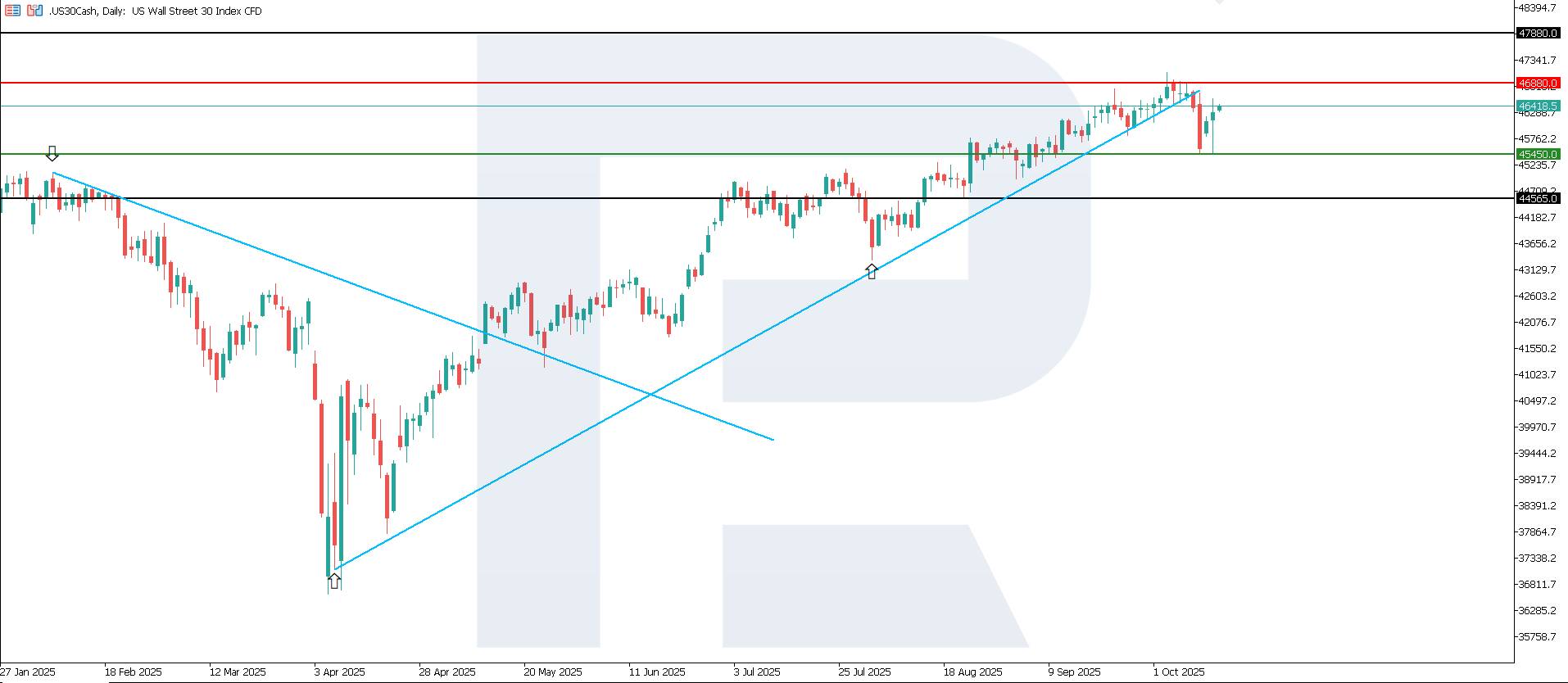
Within the global trend, the US 30 index has declined, leading to a shift towards a downward trajectory. The US 30 forecast for today is negative.
US 30 forecast: key trading points
Speaking at the National Association for Business Economics conference in Philadelphia, Federal Reserve Chairman Jerome Powell discussed in detail the current stage of quantitative tightening. Although he did not specify when the program might end, Powell noted that there are signs the Fed is nearing its target level of adequate reserves available to banks. While balance sheet management may appear to be a technical issue, it plays an important role for financial markets.
When financial conditions tighten, the Fed aims to maintain ample reserves so that banks can access liquidity and support the economy. As conditions evolve, the central bank targets a sufficient – rather than excessive – level of reserves to prevent surplus capital in the system. During the COVID-19 pandemic, the Federal Reserve significantly expanded its balance sheet through large-scale purchases of US Treasury and mortgage-backed securities, pushing it close to 9 trillion USD.
The US 30 index continues to fall within a downtrend. The resistance level has formed at 46,880.0, while support lies at 45,450.0. At this stage, it is difficult to assess how long the current trend might last. A breakout above the current resistance level would signal a potential resumption of upward movement.
The US 30 price forecast considers the following scenarios:


Jerome Powell noted signs of gradually tightening liquidity conditions, suggesting that further reserve reductions could hinder growth. The US 30 stock index has been in a downtrend since late last week. Only developments related to the US-China trade conflict are likely to reverse this trend, while economic data remains unavailable due to the government shutdown. The next downside target for the index could be 46,880.0.
When an incursion of Russian drones forced Warsaw airport to shut down last month, Poland immediately shot them down. When unidentified drones forced Munich airport to suspend operations this month, German authorities provided snacks for stranded passengers while police helicopters monitored the air space. As strange as it may sound, Germany’s military isn’t allowed to defend German airspace against anything short of a full-scale invasion. It’s just one roadblock of many in the way of making Germany fighting fit.
On paper, Berlin has a free pass to strengthen national defense. With military spending above 1% gross domestic product exempted from borrowing restrictions, there is effectively no limit on funding of the military, known as the Bundeswehr. But as the drone dilemma indicates, Germany faces more daunting obstacles to defending itself as the neighborhood gets increasingly dangerous.
For one, the constitution, written after World War II, strictly limits the military’s role inside the country, even banning it from shooting down flying objects such as drones anywhere in domestic airspace that isn’t above a military base. This rule was meant to prevent the kind of military overreach seen during authoritarian times, especially under the Nazi regime. Today, these restrictions make it hard to respond to modern threats.
Germany could of course change the legislation, but this is where its deeply fragmented political landscape comes into play. For the first time in post-war history, Germany’s moderate parties don’t command a two-thirds majority in parliament, which is necessary to change constitutionally enshrined rules like the one in question. The far-right AfD and the far-left Die Linke together take up over a third of the seats. The ruling conservatives have a party resolution in place not to negotiate with either.
Even if Chancellor Friedrich Merz talked to all political parties freely to find a two-thirds majority to change the rules, it’s unlikely that he’d find one. His coalition partners, the center-left Social Democrats (SPD), have a vocal pacifist wing and the Green Party has its roots in the peace movements of the 1970s and 1980s. When Merz’s Interior Minister Alexander Dobrindt recently suggested finding a way to use the Bundeswehr against drone attacks, representatives of both parties rejected the idea outright.
With the head of the foreign intelligence service, Martin Jaeger, warning this week that “a frosty peace” in Europe “could turn into hot confrontation here and there at any moment,” it seems impossible for Merz to find a political consensus to defend German airspace.But his problems run deeper than that. Many Germans themselves harbor a profound mistrust of state power and public institutions. The Bundeswehr itself has remained popular, with around three-quarters of people saying in polls that they trust it as an institution. But belief in the politicians that would direct its actions has reached a nadir, with one recent survey suggesting that only 17% trust their democratically elected government.
The far-right AfD, now neck-and-neck with the ruling conservatives in the polls, embodies this dilemma. On the one hand, the party program demands more funding for the Bundeswehr and a reintroduction of a compulsory military service to “secure Germany’s defense capability.” On the other, many of its politicians, especially in the former East Germany, openly question if a boosted Bundeswehr would be used “in the German interest,” as the AfD leader in the state of Brandenburg, Christoph Berndt, told the media recently.
Surprisingly for a party that claims to have the national interest at heart, some AfD representatives wouldn’t even be willing to fight for their country in case of an outright attack. A young regional MP, Felix Teichner, told a German journalist last year: “One thing is clear: if this country is attacked, no matter by whom, I will grab my children and go as far away as possible.”He is not alone with this view. A recent survey found that only 16% of Germans would “definitely” defend the country with arms. That’s despite the fact that over a quarter of people thought it likely that Germany would be attacked militarily within the next five years. It’s hardly surprising that the political class can’t find a consensus when society shares their deeply entrenched reluctance to build German defense readiness.
Germany’s grappling with the question of how to defend its airspace from drone incursions is the tip of a giant iceberg of problems when it comes to rearmament and defense readiness. A deeply divided country with increasingly messy politics, it is far from mounting the kind of collective resolve necessary to build an effective military ethos. It’s a conundrum that afflicts much of the West to varying degrees. But Germany’s exceptional fiscal power, combined with its particular past and present, creates a unique paradox: Germany is an economic giant that is astonishingly hard to defend.
White Label
Data API
Web Plug-ins
Poster Maker
Affiliate Program
The risk of loss in trading financial instruments such as stocks, FX, commodities, futures, bonds, ETFs and crypto can be substantial. You may sustain a total loss of the funds that you deposit with your broker. Therefore, you should carefully consider whether such trading is suitable for you in light of your circumstances and financial resources.
No decision to invest should be made without thoroughly conducting due diligence by yourself or consulting with your financial advisors. Our web content might not suit you since we don't know your financial conditions and investment needs. Our financial information might have latency or contain inaccuracy, so you should be fully responsible for any of your trading and investment decisions. The company will not be responsible for your capital loss.
Without getting permission from the website, you are not allowed to copy the website's graphics, texts, or trademarks. Intellectual property rights in the content or data incorporated into this website belong to its providers and exchange merchants.
Not Logged In
Log in to access more features

FastBull Membership
Not yet
Purchase
Log In
Sign Up