Markets
News
Analysis
User
24/7
Economic Calendar
Education
Data
- Names
- Latest
- Prev


Signal Accounts for Members
All Signal Accounts
All Contests


Euro Zone Employment YoY (SA) (Q3)A:--
F: --
P: --
Euro Zone GDP Final YoY (Q3)A:--
F: --
P: --
Euro Zone GDP Final QoQ (Q3)A:--
F: --
P: --
Euro Zone Employment Final QoQ (SA) (Q3)A:--
F: --
P: --
Euro Zone Employment Final (SA) (Q3)A:--
F: --
Brazil PPI MoM (Oct)A:--
F: --
P: --
Mexico Consumer Confidence Index (Nov)A:--
F: --
P: --
Canada Unemployment Rate (SA) (Nov)A:--
F: --
P: --
Canada Labor Force Participation Rate (SA) (Nov)A:--
F: --
P: --
Canada Employment (SA) (Nov)A:--
F: --
P: --
Canada Part-Time Employment (SA) (Nov)A:--
F: --
P: --
Canada Full-time Employment (SA) (Nov)A:--
F: --
P: --
U.S. Personal Income MoM (Sept)A:--
F: --
P: --
U.S. PCE Price Index YoY (SA) (Sept)A:--
F: --
P: --
U.S. PCE Price Index MoM (Sept)A:--
F: --
P: --
U.S. Personal Outlays MoM (SA) (Sept)A:--
F: --
P: --
U.S. Core PCE Price Index MoM (Sept)A:--
F: --
P: --
U.S. Core PCE Price Index YoY (Sept)A:--
F: --
P: --
U.S. UMich 5-Year-Ahead Inflation Expectations Prelim YoY (Dec)A:--
F: --
P: --
U.S. Real Personal Consumption Expenditures MoM (Sept)A:--
F: --
P: --
U.S. 5-10 Year-Ahead Inflation Expectations (Dec)A:--
F: --
P: --
U.S. UMich Current Economic Conditions Index Prelim (Dec)A:--
F: --
P: --
U.S. UMich Consumer Sentiment Index Prelim (Dec)A:--
F: --
P: --
U.S. UMich 1-Year-Ahead Inflation Expectations Prelim (Dec)A:--
F: --
P: --
U.S. UMich Consumer Expectations Index Prelim (Dec)A:--
F: --
P: --
U.S. Weekly Total Rig CountA:--
F: --
P: --
U.S. Weekly Total Oil Rig CountA:--
F: --
P: --
U.S. Unit Labor Cost Prelim (SA) (Q3)--
F: --
P: --
U.S. Consumer Credit (SA) (Oct)A:--
F: --
P: --
China, Mainland Foreign Exchange Reserves (Nov)A:--
F: --
P: --
China, Mainland Exports YoY (USD) (Nov)--
F: --
P: --
China, Mainland Imports YoY (CNH) (Nov)--
F: --
P: --
China, Mainland Imports YoY (USD) (Nov)--
F: --
P: --
China, Mainland Imports (CNH) (Nov)--
F: --
P: --
China, Mainland Trade Balance (CNH) (Nov)--
F: --
P: --
China, Mainland Exports (Nov)--
F: --
P: --
Japan Wages MoM (Oct)--
F: --
P: --
Japan Trade Balance (Oct)--
F: --
P: --
Japan Nominal GDP Revised QoQ (Q3)--
F: --
P: --
Japan Trade Balance (Customs Data) (SA) (Oct)--
F: --
P: --
Japan GDP Annualized QoQ Revised (Q3)--
F: --
China, Mainland Exports YoY (CNH) (Nov)--
F: --
P: --
China, Mainland Trade Balance (USD) (Nov)--
F: --
P: --
Germany Industrial Output MoM (SA) (Oct)--
F: --
P: --
Euro Zone Sentix Investor Confidence Index (Dec)--
F: --
P: --
Canada Leading Index MoM (Nov)--
F: --
P: --
Canada National Economic Confidence Index--
F: --
P: --
U.S. Dallas Fed PCE Price Index YoY (Sept)--
F: --
P: --
U.S. 3-Year Note Auction Yield--
F: --
P: --
U.K. BRC Overall Retail Sales YoY (Nov)--
F: --
P: --
U.K. BRC Like-For-Like Retail Sales YoY (Nov)--
F: --
P: --
Australia Overnight (Borrowing) Key Rate--
F: --
P: --
RBA Rate Statement
RBA Press Conference
Germany Exports MoM (SA) (Oct)--
F: --
P: --
U.S. NFIB Small Business Optimism Index (SA) (Nov)--
F: --
P: --
Mexico Core CPI YoY (Nov)--
F: --
P: --
Mexico 12-Month Inflation (CPI) (Nov)--
F: --
P: --
Mexico PPI YoY (Nov)--
F: --
P: --
Mexico CPI YoY (Nov)--
F: --
P: --
U.S. Weekly Redbook Index YoY--
F: --
P: --


No matching data
Latest Views
Latest Views
Trending Topics
Top Columnists
Latest Update
White Label
Data API
Web Plug-ins
Affiliate Program
View All

No data
A Ukrainian drone attack on the Russian Black Sea port of Novorossiysk, one of the country’s most significant oil export hubs, triggered renewed fears of supply disruptions...
Oil prices jumped in early Asian trade on Friday morning as markets responded to renewed Ukrainian attacks on Russia's energy infrastructure. A Ukrainian drone attack on the Russian Black Sea port of Novorossiysk, one of the country's most significant oil export hubs, triggered renewed fears of supply disruptions.
At the time of writing, WTI had risen 2.71% to $60.30...
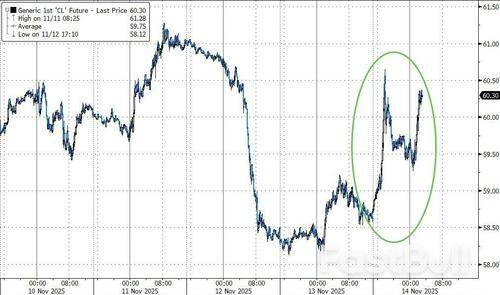
The attacks damaged a ship, nearby apartment buildings, and an oil depot, injuring three crew members aboard the vessel, Russian regional authorities confirmed.
Ukrainian forces have increasingly targeted Russian oil-refining, storage, and export infrastructure using drones and missiles.
The campaign has gained intensity in recent months, with the Center for European Policy Analysis noting a shift in strategy "from smaller-scale strikes on storage tanks to targeting hard-to-replace refinery equipment, like cracking units, much of it western-made and subject to sanctions."
"The intensity of these attacks has increased, it's much more often. Eventually they could hit something that causes lasting disruption," said Giovanni Staunovo, commodity analyst at UBS.
If Ukraine continues to press its deep-strike campaign and Russia faces rolling or compounding infrastructure losses, the supply risk to global oil markets could rise meaningfully.
Russian oil supply is being further suppressed by renewed U.S. sanctions, most notably new restrictions on Russian oil majors Rosneft and Lukoil, effective Nov. 21, prohibiting transactions with the companies as Washington increases pressure on Moscow.
The broader oil market outlook, however, remains bearish, with U.S. crude inventories rising and multiple warnings of a severe glut in 2026.
Malaysia said it's entered mediation talks with Julius Baer Group Ltd. in a bid to settle a $112 million lawsuit filed against the Swiss bank by a unit of the failed 1MDB development fund.
SRC International (Malaysia) Ltd. sued the Zurich-based firm in 2021, claiming a breach of fiduciary duty for its role in the scandal, according to a filing with a Hong Kong court.
"Mediation is ongoing,"' Johari Abdul Ghani, chairman of the 1MDB asset recovery task force, told Bloomberg News Thursday in response to questions.
Baer declined to comment when asked whether it's participating in mediation talks. The firm stands by a statement in its first-half earnings report that it's contesting the claim, "while taking appropriate measures to defend its interests," a spokesperson said.
The Malaysian fund collapsed in 2016, spawning multiple lawsuits against banks across Asia, Europe and the US. 1MDB was originally intended as a development fund to finance big infrastructure projects and spur economic growth in the Southeast Asian country. Instead, alleged mastermind Jho Low and his co-conspirators were suspected of using 1MDB as a scheme to pay bribes and enrich themselves.
In August, JPMorgan settled a case filed in Malaysia, agreeing to pay 1.4 billion ringgit ($339 million) "without admission of liability." The Singapore High Court two months later blocked attempts by 1MDB liquidators to sue Standard Chartered Plc and BSI Bank Ltd. over transactions allegedly linked to the collapsed fund, citing technical grounds.
SRC obtained two loans from Malaysia's state-controlled pension funds for investing in energy resources for the benefit of Malaysians, according to the suit. The firm, under its management, instructed Baer to make "fraudulent payments" totaling about $112.5 million to third parties.
Julius Baer carried out the payments from 2013 to 2016, even though the 1MDB scandal had been publicized internationally by then, and there were "'red flag' grounds for suspicion" about SRC's management, the suit alleged.
Separately in Malaysia, a suit against Deutsche Bank AG for $1.1 billion in damages is currently set for trial in January. The German bank is going to fight the case, said people with knowledge of the matter who asked not to be named because the case is still before the court. A Deutsche Bank spokesperson declined to comment.
As of the end of July, about 42.2 billion ringgit has been channeled to finance debt repayments and other commitments of 1MDB, according to the finance ministry. The Malaysian government has recovered 29.7 billion ringgit of funds relating to 1MDB and its former unit SRC International Sdn. since the establishment of the assets recovery account, the ministry said.


Over-indebtedness among German adults is climbing again after years of decline, as economic weakness and rising costs squeeze household finances, data from credit agency Creditreform showed on Friday.
About 5.67 million people aged over 18 are over-indebted - defined as total expenditure exceeding income - in 2025, up 111,000 or 2% from last year, pushing the rate to 8.16% from 8.09%.
"The trend reversal is here – and it was predictable," said Patrik-Ludwig Hantzsch, head of economic research at Creditreform, citing depleted savings buffers after years of crisis-driven spending caution.
The surge spans nearly all social groups, including middle-income households seeking to maintain living standards through deferred consumption.
Young adults under 30 and seniors over 60 are particularly vulnerable – the former due to credit-fuelled spending and online purchases, the latter to rising living costs and limited pensions.

Creditreform warned the situation could worsen in 2026 as high interest rates, a softer labour market and persistent inflation weigh on consumers.
"Over-indebtedness risks becoming a major social issue again," Hantzsch said.
According to a16zcrypto, the demand for privacy-focused solutions is surging, driven by growing awareness among users and businesses.
On-chain data and search trends reveal a global shift. Interest in topics like blockchain privacy and private payments reached record highs in 2025. This shows that investors and developers alike are taking privacy seriously, seeing it as essential to the next phase of crypto adoption.
Privacy technology is maturing fast. Take Zcash, for example. Its shielded pool, which allows transactions to be hidden from public view, has grown from zero in 2018 to four million ZEC in 2025. Railgun, a privacy-focused application, is expected to exceed $250 million in transaction volume this year, signaling that private transactions are entering mainstream use. Ethereum's privacy teams and private swap initiatives like Zcash & NEAR demonstrate that major networks are experimenting with and integrating privacy at a deeper level. Investors are noticing too. In 2025, firms like a16z and Pantera made targeted investments in privacy projects, signaling confidence in long-term growth.
Search trends, developer activity, and market signals provide additional proof. GitHub data shows active development on zero-knowledge proofs and multi-party computation projects. Meanwhile, trading volumes in privacy-focused applications highlight real user adoption. Regulatory clarity is also improving. Policies such as the lifted Tornado Cash sanctions and compliance-friendly protocols from Dusk Foundation are helping privacy solutions move from experimental tools to viable, mainstream financial products.
The outlook for 2026 points to privacy becoming a core demand rather than an optional feature. Technology standards and compliance frameworks are expected to clarify, enabling applications to scale globally. Emerging tech stacks combine AI, zero-knowledge proofs, and hardware acceleration to create seamless privacy solutions. Projects like Monero continue to refine mature privacy technology, while DashPay and SeismicSys explore private, instant, and enterprise-friendly options.
Andreessen Horowitz's a16z crypto warns: "As crypto reaches more mainstream users, the need for privacy is more urgent than ever."
Supporting data shows Google searches for privacy terms surging since 2021, Zcash shielded supply jumping from under 1M to over 3M by 2024, and Railgun privacy app flows projected to top $250M in 2025. Key 2025 moves include Ethereum's new privacy SDK, a16z backing Zcash wallet Zashi, Near enabling Zcash swaps, and Tornado Cash remaining blacklisted.
A wave of voluntary and early retirement programmes in Japan is on track to hit a four-year high, as companies from Panasonic Holdings Corp to Japan Display Inc try to balance an ageing workforce with the need to boost competitiveness.
In all, 11,045 employees were targeted for early retirement at publicly listed companies this year as of Nov 10 — the highest since 2021, according to data from Tokyo Shoko Research Ltd. More than 90% of those employees work for companies listed on the Tokyo Stock Exchange's Prime Market, particularly in the electric equipment, food, metal products and machinery sectors.
These programmes overwhelmingly target employees aged 50 and above, marking a shift away from Japan's traditional lifetime employment model. The redundancies are unfolding against the backdrop of demographic pressures — shrinking birthrates, an ageing population, and longer life expectancy.
While many employers are extending retirement age to at least 65, it's far from universal. Others are actively encouraging early exits as part of broader restructuring efforts.
Companies such as Mitsubishi Electric Corp, Mitsubishi Chemical Group Corp, and Meiji Holdings Co are offering retirement packages to older staff. These moves are aimed at strengthening competitiveness in a tight labour market that's increasingly favouring mid-career mobility, Tokyo Shoko said.
"It's no longer feasible to operate on a business-as-usual basis," said Shintaro Iwai, an economist at Dai-ichi Life Research Institute. "The focus is on eliminating redundant tasks to boost productivity and efficiency."
Activist investors and the Tokyo Stock Exchange are demanding stronger returns, prompting companies to cut costs and unlock value. Even profitable firms are not immune — 28 of the 41 companies implementing retirement programmes this year reported profits, and 77% of the job cuts came from those firms, the data showed.
Meiji and Olympus Corp are among those cutting jobs despite healthy earnings.
Sweden's jobless rate unexpectedly hit a nine-month high in a disappointment for the Nordic nation's authorities who have recently suggested the economic outlook is brightening.
Seasonally adjusted unemployment rose to 9.3% in October from 8.7% the previous month, mainly due to an increase in the labor supply, especially among young people, Sweden's statistics agency said in a release on Friday.
The outcome was the highest since January, and exceeded all forecasts in a survey of economists by Bloomberg that had a median estimate of 8.6%.
The October reading suggests Sweden's recovery from three years of stagnation remains fragile despite the efforts of the central bank and the finance ministry to reduce economic restraint. Unemployment in the 10.7-million nation remains among the highest in Europe, only trailing Spain and neighboring Finland, according to Eurostat.
The Riksbank has cut interest rates by 225 basis points since May last year and the finance ministry plans the biggest budget deficit since 2020, aiming to support household spending in particular.
Svenska Handelsbanken AB analyst Anders Bergvall said the latest data show the labor market remains weak with high unemployment and labor shortages well below the historical average, but he added that there are "tentative" signs of a turnaround ahead.
"New vacancies have increased somewhat from low levels and hiring plans are close to normal levels, indicating a weak upturn in employment in the coming months," Bergvall said in a note to clients.
The finance ministry's most recent forecasts project a fall in the jobless rate to 8.3% next year from 8.7% in 2025 while the Riksbank expects 8.4%.
White Label
Data API
Web Plug-ins
Poster Maker
Affiliate Program
The risk of loss in trading financial instruments such as stocks, FX, commodities, futures, bonds, ETFs and crypto can be substantial. You may sustain a total loss of the funds that you deposit with your broker. Therefore, you should carefully consider whether such trading is suitable for you in light of your circumstances and financial resources.
No decision to invest should be made without thoroughly conducting due diligence by yourself or consulting with your financial advisors. Our web content might not suit you since we don't know your financial conditions and investment needs. Our financial information might have latency or contain inaccuracy, so you should be fully responsible for any of your trading and investment decisions. The company will not be responsible for your capital loss.
Without getting permission from the website, you are not allowed to copy the website's graphics, texts, or trademarks. Intellectual property rights in the content or data incorporated into this website belong to its providers and exchange merchants.
Not Logged In
Log in to access more features

FastBull Membership
Not yet
Purchase
Log In
Sign Up