• Trade
  • Markets
  • Copy
  • Contests
  • News
  • 24/7
  • Calendar
  • Q&A
  • Chats
Trending
Screeners
SYMBOL
LAST
BID
ASK
HIGH
LOW
NET CHG.
%CHG.
SPREAD
SPX
S&P 500 Index
6846.50
6846.50
6846.50
6878.28
6827.18
-23.90
-0.35%
--
DJI
Dow Jones Industrial Average
47739.31
47739.31
47739.31
47971.51
47611.93
-215.67
-0.45%
--
IXIC
NASDAQ Composite Index
23545.89
23545.89
23545.89
23698.93
23455.05
-32.22
-0.14%
--
USDX
US Dollar Index
99.000
99.080
99.000
99.000
99.000
+0.050
+ 0.05%
--
EURUSD
Euro / US Dollar
1.16416
1.16424
1.16416
1.16428
1.16322
+0.00052
+ 0.04%
--
GBPUSD
Pound Sterling / US Dollar
1.33265
1.33273
1.33265
1.33277
1.33140
+0.00060
+ 0.05%
--
XAUUSD
Gold / US Dollar
4192.47
4192.92
4192.47
4195.53
4189.64
+2.77
+ 0.07%
--
WTI
Light Sweet Crude Oil
58.692
58.729
58.692
58.704
58.543
+0.137
+ 0.23%
--

Community Accounts

Signal Accounts
--
Profit Accounts
--
Loss Accounts
--
View More

Become a signal provider

Sell trading signals to earn additional income

View More

Guide to Copy Trading

Get started with ease and confidence

View More

Signal Accounts for Members

All Signal Accounts

Best Return
  • Best Return
  • Best P/L
  • Best MDD
Past 1W
  • Past 1W
  • Past 1M
  • Past 1Y

All Contests

  • All
  • Trump Updates
  • Recommend
  • Stocks
  • Cryptocurrencies
  • Central Banks
  • Featured News
Top News Only
Share

Ukraine President Zelenskiy: Ukraine To Share Revised Peace Plan With US On Tuesday

Share

Japan's Nikkei Average Futures Down 0.3 In Early Trade

Share

Brazil Finance Minister Haddad: Loan For Correios Is Possible This Year, But It Is Not The Only Option Under Works

Share

KCNA: North Korea's Supreme Leader Kim Jong UN Sends Condolences To Russian Embassy For Ambassador's Death

Share

Japan Prime Minister Takaichi: 30 Injuries Reported So Far From Monday Earthquake

Share

USA Senate Committee Votes To Advance Nomination Of Jared Isaacman To Head Nasa

Share

Australia's S&P/ASX 200 Index Down 0.27% At 8601.10 Points In Early Trade

Share

Trump: The USA Needs Mexico To Release 200000 Acre-Feet Of Water Before December 31St, And The Rest Must Come Soon After

Share

Trump: I Have Authorized Documentation To Impose A 5% Tariff On Mexico If This Water Isn't Released

Share

Brazil's Sao Paulo State Governor Tarcisio De Freitas Says Flavio Bolsonaro Will Have His Support - Cnn Brasil

Share

Ukraine's Security Must Be Guaranteed, In The Long Term, As A First Line Of Defence For Our Union, Says European Commission President

Share

Ukraine's Sovereignty Must Be Respected, Says European Commission President

Share

The Goal Is A Strong Ukraine, On The Battlefield And At The Negotiating Table, Says European Commission President

Share

As Peace Talks Are Ongoing, The EU Remains Ironclad In Its Support For Ukraine, Says European Commission President

Share

A U.S. Judge Ruled That President Trump’s Ban On Several Wind Power Projects Was Illegal

Share

Senior USA Administration Official: We Continue To Monitor Drc-Rwanda Situation Closely, Continue To Work With All Sides To Ensure Commitments Are Honored

Share

Israeli Military Says It Has Struck Infrastructure Belonging To Hezbollah In Several Areas In Southern Lebanon

Share

SPDR Gold Holdings Down 0.11%, Or 1.14 Tonnes

Share

On Monday (December 8), In Late New York Trading, S&P 500 Futures Fell 0.21%, Dow Jones Futures Fell 0.43%, NASDAQ 100 Futures Fell 0.08%, And Russell 2000 Futures Fell 0.04%

Share

Morgan Stanley: Data Center ABS Spreads Are Expected To Widen In 2026

TIME
ACT
FCST
PREV
Canada Part-Time Employment (SA) (Nov)

A:--

F: --

P: --

Canada Unemployment Rate (SA) (Nov)

A:--

F: --

P: --

Canada Full-time Employment (SA) (Nov)

A:--

F: --

P: --

Canada Labor Force Participation Rate (SA) (Nov)

A:--

F: --

P: --

Canada Employment (SA) (Nov)

A:--

F: --

P: --

U.S. PCE Price Index MoM (Sept)

A:--

F: --

P: --

U.S. Personal Income MoM (Sept)

A:--

F: --

P: --

U.S. Core PCE Price Index MoM (Sept)

A:--

F: --

P: --

U.S. PCE Price Index YoY (SA) (Sept)

A:--

F: --

P: --

U.S. Core PCE Price Index YoY (Sept)

A:--

F: --

P: --

U.S. Personal Outlays MoM (SA) (Sept)

A:--

F: --

P: --
U.S. 5-10 Year-Ahead Inflation Expectations (Dec)

A:--

F: --

P: --

U.S. Real Personal Consumption Expenditures MoM (Sept)

A:--

F: --

P: --
U.S. Weekly Total Rig Count

A:--

F: --

P: --

U.S. Weekly Total Oil Rig Count

A:--

F: --

P: --

U.S. Consumer Credit (SA) (Oct)

A:--

F: --

P: --
China, Mainland Foreign Exchange Reserves (Nov)

A:--

F: --

P: --

Japan Trade Balance (Oct)

A:--

F: --

P: --

Japan Nominal GDP Revised QoQ (Q3)

A:--

F: --

P: --

China, Mainland Imports YoY (CNH) (Nov)

A:--

F: --

P: --

China, Mainland Exports (Nov)

A:--

F: --

P: --

China, Mainland Imports (CNH) (Nov)

A:--

F: --

P: --

China, Mainland Trade Balance (CNH) (Nov)

A:--

F: --

P: --

China, Mainland Exports YoY (USD) (Nov)

A:--

F: --

P: --

China, Mainland Imports YoY (USD) (Nov)

A:--

F: --

P: --

Germany Industrial Output MoM (SA) (Oct)

A:--

F: --

P: --
Euro Zone Sentix Investor Confidence Index (Dec)

A:--

F: --

P: --

Canada National Economic Confidence Index

A:--

F: --

P: --

U.K. BRC Like-For-Like Retail Sales YoY (Nov)

A:--

F: --

P: --

U.K. BRC Overall Retail Sales YoY (Nov)

A:--

F: --

P: --

Australia Overnight (Borrowing) Key Rate

--

F: --

P: --

RBA Rate Statement
RBA Press Conference
Germany Exports MoM (SA) (Oct)

--

F: --

P: --

U.S. NFIB Small Business Optimism Index (SA) (Nov)

--

F: --

P: --

Mexico 12-Month Inflation (CPI) (Nov)

--

F: --

P: --

Mexico Core CPI YoY (Nov)

--

F: --

P: --

Mexico PPI YoY (Nov)

--

F: --

P: --

U.S. Weekly Redbook Index YoY

--

F: --

P: --

U.S. JOLTS Job Openings (SA) (Oct)

--

F: --

P: --

China, Mainland M1 Money Supply YoY (Nov)

--

F: --

P: --

China, Mainland M0 Money Supply YoY (Nov)

--

F: --

P: --

China, Mainland M2 Money Supply YoY (Nov)

--

F: --

P: --

U.S. EIA Short-Term Crude Production Forecast For The Year (Dec)

--

F: --

P: --

U.S. EIA Natural Gas Production Forecast For The Next Year (Dec)

--

F: --

P: --

U.S. EIA Short-Term Crude Production Forecast For The Next Year (Dec)

--

F: --

P: --

EIA Monthly Short-Term Energy Outlook
U.S. API Weekly Gasoline Stocks

--

F: --

P: --

U.S. API Weekly Cushing Crude Oil Stocks

--

F: --

P: --

U.S. API Weekly Crude Oil Stocks

--

F: --

P: --

U.S. API Weekly Refined Oil Stocks

--

F: --

P: --

South Korea Unemployment Rate (SA) (Nov)

--

F: --

P: --

Japan Reuters Tankan Non-Manufacturers Index (Dec)

--

F: --

P: --

Japan Reuters Tankan Manufacturers Index (Dec)

--

F: --

P: --

Japan Domestic Enterprise Commodity Price Index MoM (Nov)

--

F: --

P: --

Japan Domestic Enterprise Commodity Price Index YoY (Nov)

--

F: --

P: --

China, Mainland PPI YoY (Nov)

--

F: --

P: --

China, Mainland CPI MoM (Nov)

--

F: --

P: --

Italy Industrial Output YoY (SA) (Oct)

--

F: --

P: --

Q&A with Experts
    • All
    • Chatrooms
    • Groups
    • Friends
    Connecting
    .
    .
    .
    Type here...
    Add Symbol or Code

      No matching data

      All
      Trump Updates
      Recommend
      Stocks
      Cryptocurrencies
      Central Banks
      Featured News
      • All
      • Russia-Ukraine Conflict
      • Middle East Flashpoint
      • All
      • Russia-Ukraine Conflict
      • Middle East Flashpoint
      Search
      Products

      Charts Free Forever

      Chats Q&A with Experts
      Screeners Economic Calendar Data Tools
      Membership Features
      Data Warehouse Market Trends Institutional Data Policy Rates Macro

      Market Trends

      Market Sentiment Order Book Forex Correlations

      Top Indicators

      Charts Free Forever
      Markets

      News

      News Analysis 24/7 Columns Education
      From Institutions From Analysts
      Topics Columnists

      Latest Views

      Latest Views

      Trending Topics

      Top Columnists

      Latest Update

      Signals

      Copy Rankings Latest Signals Become a signal provider AI Rating
      Contests
      Brokers

      Overview Brokers Assessment Rankings Regulators News Claims
      Broker listing Forex Brokers Comparison Tool Live Spread Comparison Scam
      Q&A Complaint Scam Alert Videos Tips to Detect Scam
      More

      Business
      Events
      Careers About Us Advertising Help Center

      White Label

      Data API

      Web Plug-ins

      Affiliate Program

      Awards Institution Evaluation IB Seminar Salon Event Exhibition
      Vietnam Thailand Singapore Dubai
      Fans Party Investment Sharing Session
      FastBull Summit BrokersView Expo
      Recent Searches
        Top Searches
          Markets
          News
          Analysis
          User
          24/7
          Economic Calendar
          Education
          Data
          • Names
          • Latest
          • Prev

          View All

          No data

          Scan to Download

          Faster Charts, Chat Faster!

          Download App
          English
          • English
          • Español
          • العربية
          • Bahasa Indonesia
          • Bahasa Melayu
          • Tiếng Việt
          • ภาษาไทย
          • Français
          • Italiano
          • Türkçe
          • Русский язык
          • 简中
          • 繁中
          Open Account
          Search
          Products
          Charts Free Forever
          Markets
          News
          Signals

          Copy Rankings Latest Signals Become a signal provider AI Rating
          Contests
          Brokers

          Overview Brokers Assessment Rankings Regulators News Claims
          Broker listing Forex Brokers Comparison Tool Live Spread Comparison Scam
          Q&A Complaint Scam Alert Videos Tips to Detect Scam
          More

          Business
          Events
          Careers About Us Advertising Help Center

          White Label

          Data API

          Web Plug-ins

          Affiliate Program

          Awards Institution Evaluation IB Seminar Salon Event Exhibition
          Vietnam Thailand Singapore Dubai
          Fans Party Investment Sharing Session
          FastBull Summit BrokersView Expo

          Oil Prices Rebound as Supply Constraints Overshadow Demand Concerns

          Warren Takunda

          Commodity

          Summary:

          In a surprising turn of events, oil prices experienced a significant surge on Monday, with WTI crude futures trading over 1% higher, reaching approximately $72.5 per barrel.

          In a surprising turn of events, oil prices experienced a significant surge on Monday, with WTI crude futures trading over 1% higher, reaching approximately $72.5 per barrel. Despite apprehensions regarding slowing demand, the market was buoyed by expectations of reduced supply. The rally was prompted by Saudi Arabia's announcement during the high-stakes OPEC+ meeting that it would curtail production by an additional 1 million barrels per day, bringing it to a historic low of around 9 million barrels per day in July. This commitment by the world's largest oil exporter aimed to stabilize the market. However, while some OPEC+ members supported the decision to maintain existing production cuts until the end of 2024, others, such as Russia, did not commit to further reductions. Additionally, the United Arab Emirates was permitted to raise its output targets for the upcoming year. Notably, oil prices had experienced a sharp decline of 11% in May and are currently down by nearly 10% for the year.
          Supply Constraints Outweighing Demand Concerns
          The recent price rebound in the oil market can be primarily attributed to the anticipation of lower oil supply. Saudi Arabia's commitment to deepening production cuts signifies its determination to ensure market stability. By reducing output, the country aims to counterbalance any potential oversupply and prevent a downward spiral in oil prices. Such a move demonstrates Saudi Arabia's willingness to take necessary measures to sustain a favorable price environment. Although Russia did not pledge additional reductions, the impact of Saudi Arabia's decision to curtail production should still have a notable effect on rebalancing supply and demand dynamics.
          While concerns regarding slowing global oil demand persist, they were overshadowed by the positive market sentiment generated by the supply-side developments. The ongoing global economic recovery and the resumption of travel and industrial activities in many parts of the world provide a glimmer of hope for oil demand growth. Moreover, the Organization for Economic Cooperation and Development (OECD) recently revised its global economic growth forecast upward, further underpinning expectations of improved oil consumption.
          Challenges Ahead
          Despite the recent uptick in oil prices, challenges remain on the horizon. Geopolitical tensions, such as the uncertain future of the Iran nuclear deal and potential disruptions in oil-producing regions, could impact global supply dynamics. Any setbacks in the recovery or the emergence of new variants could dampen the positive outlook for oil consumption.
          Furthermore, the divergence within the OPEC+ alliance regarding production levels could introduce volatility to the market. Disagreements among member countries may hinder the organization's ability to swiftly respond to changing market conditions and effectively manage supply levels. The resolution of such disagreements will be crucial in maintaining stability and avoiding price fluctuations.
          The recent surge in oil prices, driven by expectations of reduced supply, presents a welcome relief for the market. Saudi Arabia's commitment to further production cuts, albeit unilaterally, has instilled confidence among investors and stakeholders. Nevertheless, challenges persist, including uncertainties surrounding global oil demand and potential geopolitical disruptions. Market participants should closely monitor developments within the OPEC+ alliance, as any changes in production levels or disagreements among member nations could introduce volatility. As the world continues its recovery from the COVID-19 pandemic, the path to a sustained and balanced oil market remains contingent upon careful supply management and a gradual resurgence in global demand.
          Risk Warnings and Disclaimers
          You understand and acknowledge that there is a high degree of risk involved in trading. Following any strategies or investment methods may lead to potential losses. The content on the site is provided by our contributors and analysts for information purposes only. You are solely responsible for determining whether any trading assets, securities, strategy, or any other product is suitable for investing based on your own investment objectives and financial situation.
          Comments
          Add to Favorites
          Share

          June 6th Financial News

          FastBull Featured

          Daily News

          [Quick Facts]

          1. The U.S. service sector nearly stagnated.
          2. Russia's revenue from oil and gas fell by more than a third in May.
          3. Demand-side drag on commodity performance, a rebound is still expected in 2H 2023.
          4. European natural gas prices soar as LNG supply is expected to tighten.
          5. Canada's strong economy puts the central bank's next move in doubt.

          [News Details]

          The U.S. service sector nearly stagnated
          The U.S. service sector nearly stagnated in May as business activity and orders downshifted and a measure of prices paid slipped to a three-year low. Data released on Monday showed that the Institute for Supply Management's (ISM) overall gauge of services fell to 50.3, the weakest level this year, from 51.9 in April. The May reading was barely above 50, which separates growth and contraction, weaker than expected. U.S. Treasury yields and the U.S. dollar fell after the data were released, and traders scaled back bets on a Fed rate hike next week. The ISM measure of prices paid for materials and services dropped more than 3 points to 56.2 in May, closer to pre-pandemic levels.
          Russia's revenue from oil and gas fell by more than a third in May
          Russia's revenues from oil and gas slumped by more than a third in May as crude oil prices dropped under Western sanctions and gas exports to Europe declined. Budgeted revenues from oil and gas taxes fell 36 percent year-on-year to 570.7 billion rubles ($7 billion), according to data released on Monday by Russia's Finance Ministry. Gas revenues fell nearly 46 percent y/y to 145 billion rubles in May. Higher revenues from mineral extraction taxes failed to compensate for the loss of export duties. Revenues from tariffs on gas export plummeted 81% to 38.3 billion rubles after Gazprom reduced pipeline gas supplies to Europe, its largest market of all time.
          Demand-side drag on commodity performance, a rebound is still expected in 2H 2023
          Since February this year, global commodity prices have continued to adjust sharply. Important commodity indices have fallen by more than 20% compared with the high point in May last year. Insiders believe that the economic downturn and recession expectations in Europe and the United States are important factors driving the continued adjustment of commodity prices since this year. In general, global monetary policies, economic fundamentals, and commodity supply and demand are three important aspects to judge the trajectory of commodity prices. This year, due to the lack of effective demand, commodity prices are expected to remain weak, but some inventory replenishment activities and the already weak enough real estate industry and other factors may promote a rebound in the commodity market.
          European natural gas prices soar as LNG supply is expected to tighten
          European natural gas futures rose 12% intraday to €26.53/MWh, after falling to their lowest level in two years last week. There are signs of tightening supply in the LNG market and Asian demand is likely to be stronger. The U.S. can profit more by exporting gas to Asia in July, August, and September. The rise in European gas prices may also be related to the oil market. Last weekend, Saudi Arabia decided to further restrict crude oil supplies in July to boost the falling oil prices. Long-term LNG contracts are usually tied to oil, which means buyers may prefer spot shipments for now.
          European gas prices have trended back up after the oil price crash, and prices could move higher. So far, weak demand has kept gas prices low, possibly masking a dwindling supply buffer in Europe through next winter and a possible recovery in Asian LNG demand in the second half of the year.
          Canada's strong economy puts the central bank's next move in doubt
          In January, the Bank of Canada became the first major global central bank to pause on rate hikes. Canada's economy has been surprisingly strong since then. It will test Governor Tiff Macklem's resolve to keep a wait-and-see attitude this week. A return to rate hike mode would raise questions about how high the central bank can crank up borrowing costs without causing the economy to fall into chaos. Between March 2022 and January this year, the Bank of Canada has raised interest rates eight times in total, bringing them to a 15-year high of 4.50%. But still, the rapid rise in currency prices has failed to cool an overheated economy. This resilience has boosted the possibility of another rate hike by the central bank after a rapid improvement in the housing market and an unexpected uptick in CPI in April. They now consider it more likely than not that the Bank will raise interest rates.

          [Focus of the Day]

          UTC+8 12:30 The Reserve Bank of Australia announces its interest rate decision
          UTC+8 17:00 Eurozone Retail Sales MoM (Apr)
          UTC+8 00:00 EIA publishes its monthly short-term energy outlook report
          UTC+8 04:30 U.S. API Weekly Crude Oil Stocks
          Risk Warnings and Disclaimers
          You understand and acknowledge that there is a high degree of risk involved in trading. Following any strategies or investment methods may lead to potential losses. The content on the site is provided by our contributors and analysts for information purposes only. You are solely responsible for determining whether any trading assets, securities, strategy, or any other product is suitable for investing based on your own investment objectives and financial situation.
          Comments
          Add to Favorites
          Share

          Saudi Puts Refiners Over a Barrel with July Output Cut, Price Hike

          Devin

          Commodity

          Having been surprised by Saudi Arabia announcing a unilateral 1 million barrels per day cut in oil output for July, oil refiners got more bad news when Saudi Aramco informed Asian customers that prices for July-loading cargoes were going up.
          Prior to the decision to increase the official selling prices (OSPs) for crude to be shipped in July, refiners in the top-importing region had been expecting prices to be lowered.
          Saudi Arabia's unexpected, solo cut in output came after the rest of the OPEC+ group decided at a meeting not to immediately add to their surprise 1.16 million bpd reduction in output announced after their April 2 meeting.
          Justifying the Saudi decision, Energy Minister Prince Abdulaziz bin Salman stuck a somewhat contradictory theme, saying: "We don't want people to try to predict what we do ... This market needs stabilisation."
          After which, Aramco promptly increased OSPs.
          The Saudis have in the past maintained that output decisions are taken by the energy ministry and are entirely separate from pricing decisions, which are made by state-owned Aramco based on market factors.
          For this reason the political decision to cut output should have had no impact on the OSP decision. The fact that Aramco raised the OSPs when the market anticipated a cut was a major surprise and at odds with the market view of the current state of refining margins and fuel demand
          The OSP for the benchmark Arab Light grade for July cargoes to Asia was increased by 45 cents a barrel from June's level to $3.00 a barrel over the regional Oman/Dubai price marker.
          Refiners surveyed by Reuters ahead of Monday's announcement had expected the OSP for Arab Light to be cut by about $1.00 a barrel for July.
          With the decision to increase the OSP, Saudi Arabia's Asian customers are facing the prospect of margins shrinking even further, as well as uncertainty over the state of demand given rising fears of a global recession.
          How they respond will be key to the path of crude oil prices in coming months.
          The obvious path for Asian refiners to go down is to buy less Saudi oil, or crudes from other Middle East producers who tend to follow the Saudi lead on pricing.
          Aramco sells the bulk of its crude under term contracts, but it is believed that these include provisions for either party to vary volumes up to a certain level.
          This allows Aramco to reduce the volume supplied when the Saudis decide to cut output, as they just did.
          But it also allows refiners to lower the amount of crude they buy from the kingdom if they are concerned about fuel demand, or indeed if they take the view Saudi crude is uncompetitive against competing grades.
          Limited Choices
          The problem for refiners in Asia is that there are limited alternatives to the crude supplied by the Saudis and other Middle East producers such as the United Arab Emirates, Iraq and Kuwait.
          Russian, Iranian and Venezuelan crudes are all under some form of Western sanctions, meaning they can really only be bought by the big players in China and India.
          U.S. crude and other grades from exporters in the Americas such as Brazil and Mexico can go some way to replacing barrels from the Middle East, but these have to be significantly cheaper in order to make the economics work, given the higher freight and insurance costs involved.
          Ultimately, some refiners in Asia will face the choice of shrinking their profit margins even further, or reducing throughput in the hope of boosting retail fuel prices by creating scarcity.
          There isn't too much scope for margins to drop, with the profit per barrel of crude at a typical Singapore refinery ending at $4.45 on Monday.
          This is a simple calculation of estimating profit by adding up the price of the various fuels produced and subtracting the cost of a barrel of regional benchmark Dubai crude.
          As such it doesn't include other items such as sustaining capital, taxes and operating costs, meaning that the low margin likely means many refiners are already operating at an overall loss.
          This means refiners are likely to cut operating rates if they can't secure crude cheaper than what is being offered by the Saudis.
          The potential exception is refiners in China, the world's biggest oil importer.
          China has in the past trimmed imports and used up some of its ample stockpiles if refiners there take the view that oil prices are too high, or have risen too quickly.
          It's possible that Chinese refiners will continue to operate at high run rates in coming months, but keep imports largely steady.

          Source: U.S. News

          Risk Warnings and Disclaimers
          You understand and acknowledge that there is a high degree of risk involved in trading. Following any strategies or investment methods may lead to potential losses. The content on the site is provided by our contributors and analysts for information purposes only. You are solely responsible for determining whether any trading assets, securities, strategy, or any other product is suitable for investing based on your own investment objectives and financial situation.
          Comments
          Add to Favorites
          Share

          Apple Takes a Leap into Augmented Reality with $3,499 Vision Pro AR Headset

          Warren Takunda

          Traders' Opinions

          Apple, the technology giant known for its groundbreaking innovations, has unveiled its highly anticipated Vision Pro AR headset. Priced at $3,499, this cutting-edge device promises to redefine the augmented reality (AR) experience and propel Apple further into the realm of immersive technology.
          The Vision Pro AR headset marks Apple's official entry into the augmented reality hardware market. With its sleek design and advanced features, it is poised to capture the attention of tech enthusiasts and consumers alike. Compatible with various Apple devices and services, such as AirPods, Apple Music, and iCloud, the headset seamlessly integrates with the existing Apple ecosystem, providing users with a holistic and immersive AR experience¹²³.
          One of the key selling points of the Vision Pro AR headset is its ability to deliver high-quality graphics and sound. Users can expect stunning visuals and realistic audio, creating a truly immersive environment for gaming, entertainment, and productivity applications. This technological leap showcases Apple's dedication to pushing the boundaries of what is possible in AR and cementing its position as a leader in innovation.
          According to sources familiar with the matter, pre-orders for the Vision Pro AR headset have already begun, and early demand seems strong. This positive response reflects the anticipation surrounding Apple's foray into the AR hardware market. With its loyal customer base and reputation for delivering exceptional products, Apple is well-positioned to make a significant impact in this emerging industry.
          Industry analysts believe that Apple's entry into the AR headset market could have far-reaching implications. As augmented reality continues to gain traction across various sectors, including gaming, education, and healthcare, Apple's expertise and resources could help drive widespread adoption. The Vision Pro AR headset may pave the way for future developments in AR technology and potentially redefine how people interact with digital content.
          While the Vision Pro AR headset's price point may initially seem steep, it aligns with Apple's reputation for offering premium products. The company has a track record of attracting consumers willing to pay a premium for its innovative devices, and the Vision Pro AR headset is no exception. As the market matures and competition intensifies, it will be interesting to observe how Apple's pricing strategy and product offerings evolve.
          Apple's commitment to privacy and data security remains paramount, even with the introduction of the Vision Pro AR headset. The company has emphasized its dedication to protecting user privacy and ensuring the responsible use of AR technology. By implementing robust security measures and transparent data practices, Apple aims to build trust with its customers and alleviate any concerns related to privacy.
          As the Vision Pro AR headset hits the market, all eyes are on Apple to see if it can successfully deliver on its promises. With its reputation for innovation and its ability to create seamless user experiences, Apple has the potential to shape the future of augmented reality. The Vision Pro AR headset represents an exciting step forward, providing a glimpse into the possibilities of a more immersive and interconnected digital world.
          Risk Warnings and Disclaimers
          You understand and acknowledge that there is a high degree of risk involved in trading. Following any strategies or investment methods may lead to potential losses. The content on the site is provided by our contributors and analysts for information purposes only. You are solely responsible for determining whether any trading assets, securities, strategy, or any other product is suitable for investing based on your own investment objectives and financial situation.
          Comments
          Add to Favorites
          Share

          Ukraine Launches Counteroffensive Against Russian Forces, Escalating Tensions

          Warren Takunda

          Traders' Opinions

          Russia-Ukraine Conflict

          In a dramatic turn of events, Ukraine has initiated a comprehensive counteroffensive against Russian forces, intensifying the ongoing conflict in the eastern front. Reports suggest that the offensive is primarily focused on the southeastern region of Donetsk province, with the ultimate objective of severing the critical land bridge that connects Russia with its occupied territory of Crimea. This bold move by Ukraine signifies a significant escalation in the hostilities and threatens to further destabilize the region.
          The counteroffensive, aimed at breaching Russian defensive lines, has been met with heavy resistance and is expected to result in prolonged and intense fighting. Ukrainian forces are determined to regain control of strategically important territories and disrupt the supply routes between Russia and Crimea. This latest development follows months of stalemate and a growing sense of frustration among Ukrainian officials, who have sought to break the impasse and assert their authority over the disputed regions.
          Additionally, Ukraine has reportedly supported rebel groups within Russia's Belgorod region, resulting in attacks on military targets. This move signifies a potential expansion of the conflict beyond Ukrainian borders and raises concerns about the possibility of further destabilization in the region. Russia has swiftly responded, accusing Ukraine of exacerbating the situation and issuing threats of retaliation. As tensions rise, the situation remains unpredictable, and the potential for a wider and more destructive conflict looms.
          The impact of the counteroffensive on financial markets is being closely monitored by analysts, given the potential consequences for global stability. Concerns about the disruption of energy supplies from Russia, as well as the wider geopolitical implications of a protracted conflict, have led to increased market volatility. Investors are advised to closely watch the developments in the region as they could have significant ramifications for commodity prices and international relations.
          International observers, including the United States, have urged both parties to seek a peaceful resolution and have called for an immediate ceasefire. The conflict in Ukraine has already taken a heavy toll on civilian populations and resulted in immense human suffering. A swift de-escalation of hostilities is crucial to prevent further loss of life and protect regional stability.
          As the situation unfolds, it is essential for the international community to prioritize diplomatic efforts aimed at finding a peaceful resolution to the conflict. Escalating tensions in the region have far-reaching implications, and a failure to resolve the dispute could have profound economic and geopolitical consequences. The eyes of the world are now fixed on Ukraine as it navigates this critical phase of the conflict, with hopes that a path towards stability and peace can be forged amid the chaos.
          Risk Warnings and Disclaimers
          You understand and acknowledge that there is a high degree of risk involved in trading. Following any strategies or investment methods may lead to potential losses. The content on the site is provided by our contributors and analysts for information purposes only. You are solely responsible for determining whether any trading assets, securities, strategy, or any other product is suitable for investing based on your own investment objectives and financial situation.
          Comments
          Add to Favorites
          Share

          CBDCs Can Help Protect against Surveillance Capitalism

          Justin

          Central Bank

          Economic

          Among digital privacy advocates, the launch of central bank digital currencies is often greeted with suspicion and alarm. On both sides of the Atlantic, there are concerns that CBDCs represent an opportunity for the state to obtain greater oversight over payments systems. In Europe, protesters demonstrated against a digital euro as an invasion of privacy in February, while in the US, Republican Congressman Tom Emmer has sponsored a bill called the CBDC Anti-Surveillance State Act.
          In early 2022, a convoy of truckers in Toronto had their assets frozen after objecting to vaccine mandates and gridlocking US-Canada trade. This led some people to suggest that a CBDC would consolidate state control over payments and provide an easier tool to suppress dissidents or discourage certain behaviours.
          It is true that certain ways of designing a CBDC might provide new, more efficient means for the state to implement control. Payments are best provided as a public good, and for the state to use access to them as a tool of social engineering is much closer to authoritarianism than most of us are comfortable with.
          But as the example of the Toronto truckers indicates, Canadians are already living in a world where the state has the willingness and capacity to restrict access to payments services, despite not having a CBDC.
          A CBDC might – if designed in a certain way – concentrate data, leading to new risks and the capacity to make the exercise of state authority over payments more complete. But this kind of development does not require a CBDC. Aggregating data from multiple services is a technical challenge, but one that law enforcement agencies are already eminently capable of solving.

          Threatening our privacy? What privacy?

          CBDCs are not a serious threat to the privacy of digital payments because we have so little to begin with. The European Data Protection Supervisor points out that, ‘tracking payments of a person can describe the consumers’ life in great detail… The amount of personal information that actors involved in transactions’ management learn about each individual when a payment system operates is significant. This generates a systemic risk of profiling and surveillance by the parties operating the payment system.’
          Whether a CBDC is implemented or not, there should be more robust protection of privacy. At present, the main defence is simply that most people use a variety of services, but the sophistication of the tools used to aggregate and process payments data is growing. Regardless of whether this is driven by private actors seeking profit or state actors seeking greater control, the prospect is not appetising, as the EDPS also mentions that ‘payment data is often used for purposes other than those strictly related to the payment execution… payment providers may collaborate with private credit scoring companies that inform landlords, creditors and service providers about the individual trust score of their future clients.’

          Can we hope for better?

          Central banks have made it clear that they will not launch a fully anonymous CBDC due to the risk that it would facilitate financial crime. There is a notion that privacy and oversight are a trade-off and the best that regulators and privacy advocates can hope for is some kind of mutually unsatisfying compromise.
          But innovation in privacy-enhancing technology offers a way to improve privacy without degrading law enforcement agencies’ ability to fight crime. In most countries, payments data is generally only available for use by law enforcement agencies under circumstances set out in a comprehensive legal framework. If a CBDC erodes that framework’s ability to protect individuals’ right to privacy, that is a design choice and not a necessity.If (and this is far from certain) a CBDC is designed with the correct principles, it can form a new benchmark for privacy in digital payments.
          A central bank should not become a repository of individuals’ data. Whether the core ledger is distributed or centralised, there is no reason for the central bank to have access to the know-your-customer information of those transacting in CBDCs. That should be sufficient to ensure that a CBDC does not worsen the privacy of digital payments systems. Privacy-enhancing technologies can also be used to make improvements. There are a broad range of such techniques, many of which are discussed in the Bank of England’s digital pound technology working paper. These include: zero-knowledge proofs, which allow a party to verify a statement without revealing additional data; homomorphic encryption, which allows parties to process encrypted data; and distributed data analysis, which allows multiple entities to jointly process datasets without sharing data.
          Central banks and law enforcement agencies will still need the capacity to obtain personal data in their crime-fighting activities, but these data should only be visible to them if rigorous criteria are met. The concept of reciprocal negotiated accountability offers a framework that keeps payment data encrypted and keys held in escrow – released only if certain rules are satisfied. It is a cryptographically secured enforcement of the existing framework.

          Winning public trust

          Much of the challenge in this area is cultural, not technical. The encryption standards and systems architectures already exist but revelations from Edward Snowden, the National Security Agency whistleblower, and others have shaken the public’s trust in the state’s willingness to respect individual privacy. Can the state be trusted to implement these privacy-enhancing technologies without leaving additional backdoors? Convincing the general public will be a tremendous challenge.
          That is not a reason not to try. We are not starting from a point of sufficient privacy so do not risk losing it. Privacy in digital payments is already poor – the chance is that we improve it.
          The digitalisation of the global economy has caused a rapid loss in control over data. The technology exists to regain it but, as the commercial value of such data increases, the likelihood of the private sector willingly deploying that technology shrinks. If, however, the state establishes a benchmark – a free, high-quality payments system that protects privacy without facilitating crime – then the private sector will be forced to raise its standards.

          Source:Lewis McLellan

          To stay updated on all economic events of today, please check out our Economic calendar
          Risk Warnings and Disclaimers
          You understand and acknowledge that there is a high degree of risk involved in trading. Following any strategies or investment methods may lead to potential losses. The content on the site is provided by our contributors and analysts for information purposes only. You are solely responsible for determining whether any trading assets, securities, strategy, or any other product is suitable for investing based on your own investment objectives and financial situation.
          Comments
          Add to Favorites
          Share

          ISM Reports Add to US Recession Fears

          Justin

          Central Bank

          Economic

          ISM reports indicate a rapid softening in business activity

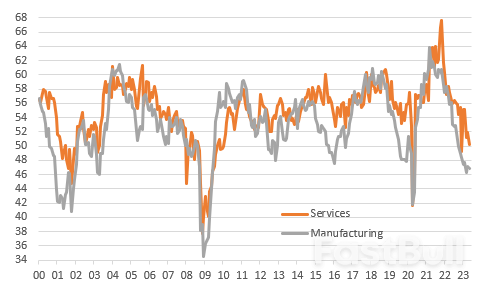
          Last week’s ISM manufacturing index dropped to 46.9, the seventh consecutive sub-50 reading with order books, aside from two months of pandemic stress, looking in their worst shape since the 2009. Today’s ISM services report for May, while not quite as grim, only adds to worries about the outlook for the economy.
          The headline balance fell to 50.3 from 51.9 (consensus 52.4). As with many of the manufacturing ISM components, the only time the service sector report has been weaker in the past 14 years was in April and May 2020 at the peak of Covid containment and the December 2022 blip caused by the huge winter storm that was so disruptive for the travel, entertainment and service sectors. The details are poor throughout with business activity having similar metrics to the headline. New orders fell 3.2 points to 52.9, but the backlog of orders plummeted to 40.9 from 49.7. The backlog of orders are not seasonally-adjusted so comparisons are tricky, but for what it is worth, this is the worst reading since 2009. This is something that we also saw in the manufacturing report, dropping from 43.1 to 37.5.

          ISM reports are heading in the wrong directions

          ISM Reports Add to US Recession Fears_1

          Order books need to turn around quickly to avert recession

          Now at least in the manufacturing report we saw the employment component rise to 51.4 from 50.5, yet the payrolls report said manufacturing employment fell 2000. We saw private sector employment rise 257,000 in that same report, yet the ISM has service sector employment in contraction territory at 49.2! The data contradictions underscore the challenge for the Federal Reserve and only support the argument that they leave policy on hold in June to try and get a better gauge of what is happening in the economy. The decline in price pressure is a welcome development though with the manufacturing prices paid below the break-even 50 level at 44.2 and service sector prices falling to 56.2 from 59.6. This leaves the service sector price index at its lowest level since March 2020 and slap bang in the middle of its long run range.
          It looks likely that the manufacturing sector is already in recession (seven consecutive sub-50 readings for ISM manufacturing). The service sectors order books are weak and will need to turn around rapidly to prevent the service sector joining it. Given this situation it is difficult to imagine that employment will continue to make such large gains. Then with price measures rapidly weakening it is understandable that markets doubt that if we do get a pause at the June Federal Open Market Committee meeting that the Fed will be able justifying a restart on rate hikes later in the year.

          Source: ING

          To stay updated on all economic events of today, please check out our Economic calendar
          Risk Warnings and Disclaimers
          You understand and acknowledge that there is a high degree of risk involved in trading. Following any strategies or investment methods may lead to potential losses. The content on the site is provided by our contributors and analysts for information purposes only. You are solely responsible for determining whether any trading assets, securities, strategy, or any other product is suitable for investing based on your own investment objectives and financial situation.
          Comments
          Add to Favorites
          Share
          FastBull
          Copyright © 2025 FastBull Ltd

          728 RM B 7/F GEE LOK IND BLDG NO 34 HUNG TO RD KWUN TONG KLN HONG KONG

          TelegramInstagramTwitterfacebooklinkedin
          App Store Google Play Google Play
          Products
          Charts

          Chats

          Q&A with Experts
          Screeners
          Economic Calendar
          Data
          Tools
          Membership
          Features
          Function
          Markets
          Copy Trading
          Latest Signals
          Contests
          News
          Analysis
          24/7
          Columns
          Education
          Company
          Careers
          About Us
          Contact Us
          Advertising
          Help Center
          Feedback
          User Agreement
          Privacy Policy
          Business

          White Label

          Data API

          Web Plug-ins

          Poster Maker

          Affiliate Program

          Risk Disclosure

          The risk of loss in trading financial instruments such as stocks, FX, commodities, futures, bonds, ETFs and crypto can be substantial. You may sustain a total loss of the funds that you deposit with your broker. Therefore, you should carefully consider whether such trading is suitable for you in light of your circumstances and financial resources.

          No decision to invest should be made without thoroughly conducting due diligence by yourself or consulting with your financial advisors. Our web content might not suit you since we don't know your financial conditions and investment needs. Our financial information might have latency or contain inaccuracy, so you should be fully responsible for any of your trading and investment decisions. The company will not be responsible for your capital loss.

          Without getting permission from the website, you are not allowed to copy the website's graphics, texts, or trademarks. Intellectual property rights in the content or data incorporated into this website belong to its providers and exchange merchants.

          Not Logged In

          Log in to access more features

          FastBull Membership

          Not yet

          Purchase

          Become a signal provider
          Help Center
          Customer Service
          Dark Mode
          Price Up/Down Colors

          Log In

          Sign Up

          Position
          Layout
          Fullscreen
          Default to Chart
          The chart page opens by default when you visit fastbull.com