• Trade
  • Markets
  • Copy
  • Contests
  • News
  • 24/7
  • Calendar
  • Q&A
  • Chats
Trending
Screeners
SYMBOL
LAST
BID
ASK
HIGH
LOW
NET CHG.
%CHG.
SPREAD
SPX
S&P 500 Index
6870.39
6870.39
6870.39
6895.79
6858.28
+13.27
+ 0.19%
--
DJI
Dow Jones Industrial Average
47954.98
47954.98
47954.98
48133.54
47871.51
+104.05
+ 0.22%
--
IXIC
NASDAQ Composite Index
23578.12
23578.12
23578.12
23680.03
23506.00
+72.99
+ 0.31%
--
USDX
US Dollar Index
98.950
99.030
98.950
99.060
98.740
-0.030
-0.03%
--
EURUSD
Euro / US Dollar
1.16426
1.16443
1.16426
1.16715
1.16277
-0.00019
-0.02%
--
GBPUSD
Pound Sterling / US Dollar
1.33312
1.33342
1.33312
1.33622
1.33159
+0.00041
+ 0.03%
--
XAUUSD
Gold / US Dollar
4197.91
4197.91
4197.91
4259.16
4191.87
-9.26
-0.22%
--
WTI
Light Sweet Crude Oil
59.809
60.061
59.809
60.236
59.187
+0.426
+ 0.72%
--

Community Accounts

Signal Accounts
--
Profit Accounts
--
Loss Accounts
--
View More

Become a signal provider

Sell trading signals to earn additional income

View More

Guide to Copy Trading

Get started with ease and confidence

View More

Signal Accounts for Members

All Signal Accounts

Best Return
  • Best Return
  • Best P/L
  • Best MDD
Past 1W
  • Past 1W
  • Past 1M
  • Past 1Y

All Contests

  • All
  • Trump Updates
  • Recommend
  • Stocks
  • Cryptocurrencies
  • Central Banks
  • Featured News
Top News Only
Share

Zelenskiy, Ahead Of Consultations With European Leaders, Says Talks With USA Representatives On Peace Plan For Ukraine Constructive But Not Easy

Share

[Venezuelan Vice President Calls For Oil Industry Vigilance] Venezuelan Vice President Rodríguez, Speaking To Oil Industry Workers At A Heavy Crude Oil Processing Facility In Anzoátegui State On The 7th, Called On The Entire Industry To Remain "highly Vigilant," Noting That "the Enemy Never Stops." Rodríguez Reiterated That, Given The Current Tense Situation Between Venezuela And The United States, The Government Will Firmly Safeguard National Sovereignty And Independence

Share

Treasury Secretary Bessent Says He Has Divested His Soybean Farm

Share

[Syrian Transitional Government Foreign Minister: Israel Is The Most Dangerous Factor Threatening Syria's Stability] On December 7, Syrian Transitional Government Foreign Minister Shibani Said During The Doha Forum In Doha, The Capital Of Qatar, That Since December 2024, Israel Has Been The Most Dangerous Factor Threatening Syria's Stability, Both Politically And Through Military Operations

Share

Bolsonaro's Son Says He May Not Run For Brazil President

Share

[Hamas Says It's Willing To Discuss Disarmament In The Framework Of Palestinian Statehood] On The 7th Local Time, Basem Naeem, A Senior Official Of The Palestinian Islamic Resistance Movement (Hamas), Stated That Hamas Is Willing To Negotiate On Its Weapons Issue, Including "freezing Or Stockpiling Weapons," In Order To Advance The Second Phase Of Negotiations On The Gaza Ceasefire Agreement. Naeem Condemned Israel For Failing To Fulfill Its Promises, Refusing To Deliver Large Quantities Of Humanitarian Aid To Gaza, And Failing To Open The Rafah Crossing In Both Directions As Promised. Naeem Acknowledged That Palestinians Paid A Heavy Price For The October 7, 2023 Attack, But Insisted That The Action Was An "act Of Self-defense."

Share

West Africa's ECOWAS Bloc: Has Ordered Deployment Of Elements Of ECOWAS Standby Force To Benin With Immediate Effect

Share

Benin's President Patrice Talon: Says This Treachery Will Not Go Unpunished

Share

Italy Prime Minister Meloni Pledges Emergency Aid To Ukraine In Call With Zelenskiy

Share

Benin's President Patrice Talon:Appears On State TV To Make A Statement After Foiled Coup

Share

[Chinese Business Delegation Visits The US To Promote Deeper Economic And Trade Cooperation] At The Invitation Of The U.S. Chamber Of Commerce, The China Council For The Promotion Of International Trade (CCPIT) Organized A Delegation Of Chinese Business Leaders To Visit Washington, San Francisco, And Oakland From February 2nd To 6th To Promote Deeper Economic And Trade Exchanges And Cooperation Between The Two Countries. During The Visit, The CCPIT, In Cooperation With The Oakland City Government, The U.S. Chamber Of Commerce, The U.S.-China Business Council, The Semiconductor Industry Association, U.S. Asia Group, Meridian International Center, And The U.S. Soybean Export Council, Held Several Sino-U.S. Business Matchmaking Events And Held Discussions With More Than 170 U.S. Companies And Institutions

Share

French President Emmanuel Macron Has Called On The European Central Bank (ECB) To Change Its Monetary Policy Approach In Order To Boost The Single Market And Protect It From The Risks Of A Financial Crisis. Macron Stated That The ECB Needs To Think Differently, Reaffirming The Value Of The European Internal Market, Which Means It Cannot Solely Target Inflation But Should Also Focus On Growth And Employment. Macron Argued That The Increasing Deregulation Of Crypto Assets And Stablecoins In The United States Could Create Financial Instability, And That Europe Must Maintain A Stable Monetary Zone

Share

U.S. Treasury Secretary Bessenter: Inflation Is Expected To Decline "strongly" In 2026

Share

USTR Says China's Trade Commitments 'Going In The Right Direction'

Share

India Aviation Regulator: Continues To Monitor The Situation Closely

Share

USA, Israel, And Qatar Are Holding A Trilateral Meeting In New York On Sunday To Rebuild Relations

Share

Kremlin Says New US Security Strategy Accords Largely With Russia's View

Share

United Arab Emirates's Abu Dhabi National Oil Company Sets January Murban Crude Osp At $65.53/Bbl

Share

Bessent: USA Will Finish The Year With 3% GDP Growth

Share

Israeli Prime Minister Netanyahu: He Will Not Quit Politics If He Receives A Pardon

TIME
ACT
FCST
PREV
Mexico Consumer Confidence Index (Nov)

A:--

F: --

P: --

Canada Unemployment Rate (SA) (Nov)

A:--

F: --

P: --

Canada Labor Force Participation Rate (SA) (Nov)

A:--

F: --

P: --

Canada Employment (SA) (Nov)

A:--

F: --

P: --

Canada Part-Time Employment (SA) (Nov)

A:--

F: --

P: --

Canada Full-time Employment (SA) (Nov)

A:--

F: --

P: --

U.S. Personal Income MoM (Sept)

A:--

F: --

P: --

U.S. PCE Price Index YoY (SA) (Sept)

A:--

F: --

P: --

U.S. PCE Price Index MoM (Sept)

A:--

F: --

P: --

U.S. Personal Outlays MoM (SA) (Sept)

A:--

F: --

P: --

U.S. Core PCE Price Index MoM (Sept)

A:--

F: --

P: --

U.S. Core PCE Price Index YoY (Sept)

A:--

F: --

P: --

U.S. UMich 5-Year-Ahead Inflation Expectations Prelim YoY (Dec)

A:--

F: --

P: --

U.S. Real Personal Consumption Expenditures MoM (Sept)

A:--

F: --

P: --

U.S. 5-10 Year-Ahead Inflation Expectations (Dec)

A:--

F: --

P: --

U.S. UMich Current Economic Conditions Index Prelim (Dec)

A:--

F: --

P: --

U.S. UMich Consumer Sentiment Index Prelim (Dec)

A:--

F: --

P: --

U.S. UMich 1-Year-Ahead Inflation Expectations Prelim (Dec)

A:--

F: --

P: --

U.S. UMich Consumer Expectations Index Prelim (Dec)

A:--

F: --

P: --

U.S. Weekly Total Rig Count

A:--

F: --

P: --

U.S. Weekly Total Oil Rig Count

A:--

F: --

P: --

U.S. Unit Labor Cost Prelim (SA) (Q3)

--

F: --

P: --

U.S. Consumer Credit (SA) (Oct)

A:--

F: --

P: --

China, Mainland Foreign Exchange Reserves (Nov)

A:--

F: --

P: --

China, Mainland Exports YoY (USD) (Nov)

--

F: --

P: --

China, Mainland Imports YoY (CNH) (Nov)

--

F: --

P: --

China, Mainland Imports YoY (USD) (Nov)

--

F: --

P: --

China, Mainland Imports (CNH) (Nov)

--

F: --

P: --

China, Mainland Trade Balance (CNH) (Nov)

--

F: --

P: --

China, Mainland Exports (Nov)

--

F: --

P: --

Japan Wages MoM (Oct)

--

F: --

P: --

Japan Trade Balance (Oct)

--

F: --

P: --

Japan Nominal GDP Revised QoQ (Q3)

--

F: --

P: --

Japan Trade Balance (Customs Data) (SA) (Oct)

--

F: --

P: --

Japan GDP Annualized QoQ Revised (Q3)

--

F: --

P: --
China, Mainland Exports YoY (CNH) (Nov)

--

F: --

P: --

China, Mainland Trade Balance (USD) (Nov)

--

F: --

P: --

Germany Industrial Output MoM (SA) (Oct)

--

F: --

P: --

Euro Zone Sentix Investor Confidence Index (Dec)

--

F: --

P: --

Canada Leading Index MoM (Nov)

--

F: --

P: --

Canada National Economic Confidence Index

--

F: --

P: --

U.S. Dallas Fed PCE Price Index YoY (Sept)

--

F: --

P: --

China, Mainland Trade Balance (USD) (Nov)

--

F: --

P: --

U.S. 3-Year Note Auction Yield

--

F: --

P: --

U.K. BRC Overall Retail Sales YoY (Nov)

--

F: --

P: --

U.K. BRC Like-For-Like Retail Sales YoY (Nov)

--

F: --

P: --

Australia Overnight (Borrowing) Key Rate

--

F: --

P: --

RBA Rate Statement
RBA Press Conference
Germany Exports MoM (SA) (Oct)

--

F: --

P: --

U.S. NFIB Small Business Optimism Index (SA) (Nov)

--

F: --

P: --

Mexico Core CPI YoY (Nov)

--

F: --

P: --

Mexico 12-Month Inflation (CPI) (Nov)

--

F: --

P: --

Mexico PPI YoY (Nov)

--

F: --

P: --

Mexico CPI YoY (Nov)

--

F: --

P: --

U.S. Weekly Redbook Index YoY

--

F: --

P: --

U.S. JOLTS Job Openings (SA) (Oct)

--

F: --

P: --

China, Mainland M2 Money Supply YoY (Nov)

--

F: --

P: --

China, Mainland M0 Money Supply YoY (Nov)

--

F: --

P: --

China, Mainland M1 Money Supply YoY (Nov)

--

F: --

P: --

U.S. EIA Short-Term Crude Production Forecast For The Next Year (Dec)

--

F: --

P: --

Q&A with Experts
    • All
    • Chatrooms
    • Groups
    • Friends
    Connecting
    .
    .
    .
    Type here...
    Add Symbol or Code

      No matching data

      All
      Trump Updates
      Recommend
      Stocks
      Cryptocurrencies
      Central Banks
      Featured News
      • All
      • Russia-Ukraine Conflict
      • Middle East Flashpoint
      • All
      • Russia-Ukraine Conflict
      • Middle East Flashpoint
      Search
      Products

      Charts Free Forever

      Chats Q&A with Experts
      Screeners Economic Calendar Data Tools
      Membership Features
      Data Warehouse Market Trends Institutional Data Policy Rates Macro

      Market Trends

      Market Sentiment Order Book Forex Correlations

      Top Indicators

      Charts Free Forever
      Markets

      News

      News Analysis 24/7 Columns Education
      From Institutions From Analysts
      Topics Columnists

      Latest Views

      Latest Views

      Trending Topics

      Top Columnists

      Latest Update

      Signals

      Copy Rankings Latest Signals Become a signal provider AI Rating
      Contests
      Brokers

      Overview Brokers Assessment Rankings Regulators News Claims
      Broker listing Forex Brokers Comparison Tool Live Spread Comparison Scam
      Q&A Complaint Scam Alert Videos Tips to Detect Scam
      More

      Business
      Events
      Careers About Us Advertising Help Center

      White Label

      Data API

      Web Plug-ins

      Affiliate Program

      Awards Institution Evaluation IB Seminar Salon Event Exhibition
      Vietnam Thailand Singapore Dubai
      Fans Party Investment Sharing Session
      FastBull Summit BrokersView Expo
      Recent Searches
        Top Searches
          Markets
          News
          Analysis
          User
          24/7
          Economic Calendar
          Education
          Data
          • Names
          • Latest
          • Prev

          View All

          No data

          Scan to Download

          Faster Charts, Chat Faster!

          Download App
          English
          • English
          • Español
          • العربية
          • Bahasa Indonesia
          • Bahasa Melayu
          • Tiếng Việt
          • ภาษาไทย
          • Français
          • Italiano
          • Türkçe
          • Русский язык
          • 简中
          • 繁中
          Open Account
          Search
          Products
          Charts Free Forever
          Markets
          News
          Signals

          Copy Rankings Latest Signals Become a signal provider AI Rating
          Contests
          Brokers

          Overview Brokers Assessment Rankings Regulators News Claims
          Broker listing Forex Brokers Comparison Tool Live Spread Comparison Scam
          Q&A Complaint Scam Alert Videos Tips to Detect Scam
          More

          Business
          Events
          Careers About Us Advertising Help Center

          White Label

          Data API

          Web Plug-ins

          Affiliate Program

          Awards Institution Evaluation IB Seminar Salon Event Exhibition
          Vietnam Thailand Singapore Dubai
          Fans Party Investment Sharing Session
          FastBull Summit BrokersView Expo

          Equities Tumble, Bond Prices Dip as Hopes Fade for Fed Rate Cut in December

          Manuel

          Stocks

          Economic

          Summary:

          The White House indicated that the U.S. unemployment rate for October may never be available, since it is dependent on a household survey that was not conducted during the shutdown.

          Wall Street indexes suffered their biggest one-day decline in a month on Thursday, pushing down MSCI's global equities gauge while U.S. Treasury yields rose as investor bets for a December rate cut took a dive after hawkish comments by Federal Reserve officials.
          In currencies, the dollar fell despite the prospects for slower rate cuts, in the first trading day after the House of Representatives voted late on Wednesday to reopen the U.S. government from its longest shutdown in history and President Donald Trump signed the bill.
          Investors had been pouring into equities in recent sessions in anticipation of an end to the shutdown, which disrupted food benefits for millions, left hundreds of thousands of federal workers unpaid, and snarled air traffic while putting a pause on crucial economic data releases.
          However, Trump administration officials dashed hopes for a clearer view of the U.S. economy any time soon. The White House indicated that the U.S. unemployment rate for October may never be available, since it is dependent on a household survey that was not conducted during the shutdown.
          And pointing to worries about high inflation after two U.S. interest rate cuts this year, a growing number of signaled caution about further rate cuts.
          Alberto Musalem, who runs the St Louis Federal Reserve Bank, reiterated his view that there was limited room to ease further without becoming overly accommodative. Federal Reserve Bank of Cleveland President Beth Hammack said interest rate policy should remain restrictive in order to put downward pressure on still concerning levels of inflation.
          Minneapolis Federal Reserve President Neel Kashkari said inflation was too high while parts of the labor market "look like they're under pressure." Earlier, San Francisco Federal Reserve President Mary Daly said the risks to the Fed's two goals are now balanced after two rate cuts already this year.
          Trader bets for a December rate cut were last showing a 51.9% probability, down from 62.9% on Wednesday, according to CME Group's FedWatch, opens new tab tool.
          "Markets were counting on a cut, and we may not get it," said Bob Doll, chief executive and chief investment officer at Crossmark, pointing to cautious Fed comments on the prospects for a December easing of rates. "Most of them are putting up warning signs that it's not a 'gimme', just like the Fed Chair told us when he did this presser after the last Fed meeting. In some sense, it's not new, but people didn't believe it."
          Anthony Saglimbene, chief market strategist at Ameriprise, said investors are looking at high valuations in heavyweight technology and artificial intelligence-linked stocks, adding to their worries about a continued lack of clarity around the U.S. economy. So, he said, it was not surprising to "see investors take a step back from risk, sell down the winners and go into the defensive areas of the market."

          EQUITIES MARK BIGGEST DROP IN A MONTH

          On Wall Street, the technology-heavy Nasdaq Composite (.IXIC), opens new tab led losses, closing down 536.10 points, or 2.29%, at 22,870.36. The Dow Jones Industrial Average (.DJI), opens new tab fell 797.60 points, or 1.65%, to 47,457.22, while the S&P 500 (.SPX), opens new tab fell 113.43 points, or 1.66%, to 6,737.49. All three indexes registered their biggest daily declines since October 10.
          MSCI's gauge of stocks across the globe (.MIWD00000PUS), opens new tab was down 12.07 points, or 1.19%, at 999.71, which would also be its biggest daily drop since October 10.
          Earlier in the day, the pan-European STOXX 600 (.STOXX), opens new tab index closed down 0.61% while Europe's broad FTSEurofirst 300 index (.FTEU3), opens new tab finished off 0.66%. Both had hit record highs during their trading day.
          In U.S. Treasuries, prices retreated, driving yields higher, as investors scaled back expectations for imminent rate cuts amid lingering uncertainty over the inflation outlook and stark divisions among Fed policymakers on the trajectory of the U.S. economy and monetary policy.
          The yield on benchmark U.S. 10-year notes rose 4.4 basis points to 4.123%, from 4.079% late on Wednesday while the 30-year bond yield rose 5.4 basis points to 4.7162%. The 2-year note yield, which typically moves in step with interest rate expectations for the Federal Reserve, rose 3.1 basis points to 3.597%.

          DOLLAR FALLS AGAINST EURO, YEN

          In currencies, the U.S. dollar dipped as the government reopened, leaving traders grappling with the long-term impact of the shutdown on trust in the U.S. currency while investors waited for data on the health of the economy.
          Meanwhile, European financial stability officials were debating whether to create an alternative to Federal Reserve funding backstops by pooling dollars held by non-U.S. central banks, aiming to reduce their reliance on the U.S. under the Trump administration, five officials familiar with the matter told Reuters.
          "The shutdown is over, but how soon are we going to go back to normal? How soon are we going to have numbers? How soon am I going to be able to do real, accurate analysis based on trusted American statistics from September and October? That's in doubt," said Juan Perez, director of trading at Monex USA in Washington.
          The dollar index , which measures the greenback against a basket of currencies including the yen and the euro, fell 0.29% to 99.19, with the euro up 0.34% at $1.1631. Against the Japanese yen , the dollar weakened 0.12% to154.58.
          In cryptocurrencies, bitcoin was down 3.24% at $98,578.10, after falling to its lowest level since May.
          In energy markets, oil futures settled slightly higher after selling off sharply in the previous session, as investors weighed concerns about global oversupply against looming sanctions against Russia's Lukoil.
          U.S. crude settled up 0.34%, or 20 cents, at $58.69 a barrel while Brent settled at $63.01 per barrel, up 0.48%, or 30 cents, on the day.
          Gold prices pulled back after hitting a three-week high earlier in the session, amid the broad market selloff that followed the reopening of the U.S. government.
          Spot gold fell 0.51% to $4,177.21 an ounce. U.S. gold futures fell 0.96% to $4,164.10 an ounce.

          Source: Reuters

          To stay updated on all economic events of today, please check out our Economic calendar
          Risk Warnings and Disclaimers
          You understand and acknowledge that there is a high degree of risk involved in trading. Following any strategies or investment methods may lead to potential losses. The content on the site is provided by our contributors and analysts for information purposes only. You are solely responsible for determining whether any trading assets, securities, strategy, or any other product is suitable for investing based on your own investment objectives and financial situation.
          Add to Favorites
          Share

          Bitcoin Loses its Last Line of Defense: $98k Breakdown Sparks Cascade not Seen Since May

          Manuel

          Cryptocurrency

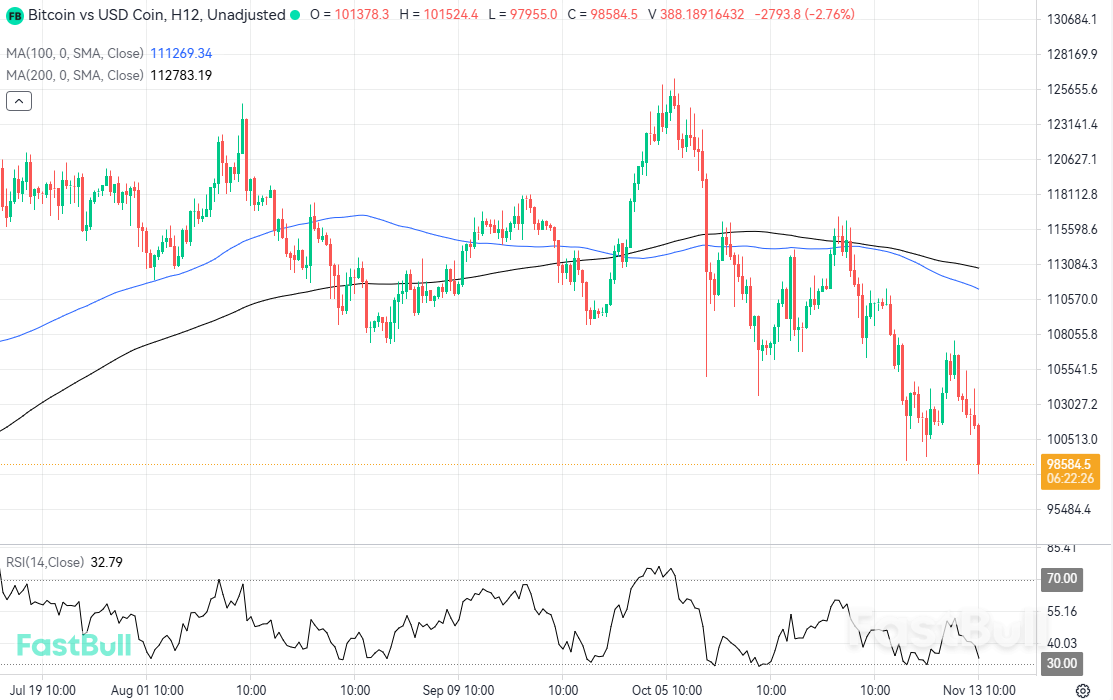
          Bitcoin (BTC) dropped 3% to $98,550.33 as of press time, falling below the psychological $100,000 threshold for the third time this month amid cascading leverage liquidations, persistent ETF outflows, and a broader risk-off posture across digital assets.
          The slide accelerated after Bitcoin broke support at $100,000, triggering over $190 million in long liquidations in the past hour, per Coinglass data.
          Bitcoin failed to break through the support-turned-resistance level at $106,400 earlier this week, raising concerns about what was to come. However, every time it lost that level, it has always rebounded around the psychological $100,000 support or at least the $99,000 support created back in June.Bitcoin Loses its Last Line of Defense: $98k Breakdown Sparks Cascade not Seen Since May_1
          Total liquidations across the past 24 hours reached $655 million, amplifying downward momentum as over-leveraged positions unwound.
          Ethereum declined 5.75% to $3,218.37, Solana dropped 5.2% to $145.55, and BNB fell 3.2% to $922.90, reflecting synchronized selling pressure across major tokens.

          ETF flows turn negative as institutional demand softens

          US spot Bitcoin ETFs recorded net outflows of $278 million on Nov. 12, contributing to roughly $961 million in cumulative redemptions this month, according to Farside Investors.
          The shift from net inflows to modest withdrawals removes a key stabilizing force that supported prices through mid-2025, leaving spot markets more vulnerable to derivatives-driven volatility.
          Historical patterns suggest that ETF flow reversals often coincide with consolidation phases rather than periods of directional conviction.
          Glassnode’s Nov. 12 analysis confirms that Bitcoin has traded below the short-term holder cost basis of $111,900 since early October, establishing a bearish regime characterized by low liquidity and weak conviction.
          The network’s short-term holder realized profit-loss ratio fell below 0.21 near $98,000, indicating that over 80% of the realized value came from coins sold at a loss, representing a capitulation intensity exceeding that of the last three major washouts of the current cycle.
          Glassnode identifies the sub-$100,000 zone as a critical battleground where seller exhaustion is beginning to take shape. However, a sustained recovery requires Bitcoin to reclaim the $111,900 cost basis as a level of support.

          Sentiment deteriorates as leverage dries up

          Bitcoin perpetual futures funding rates remain subdued across major exchanges, with both funding rates and open interest drifting lower since October’s leverage flush.
          The absence of aggressive positioning reflects market hesitation, with traders avoiding directional bets as volatility expectations remain elevated.
          Options market data reinforces this defensive stance. Put protection trades are priced at an 11% implied volatility premium over calls for short-term expiries, indicating that traders continue to pay for downside insurance.
          Open interest concentrates heavily around the $100,000 strike for end-of-November expiries, making this level a critical threshold where dealer hedging flows could amplify volatility if breached.
          Recent option flows have focused on puts between the $108,000 and $95,000 strikes, structured as outright protection or calendar spreads that capture expectations of near-term turbulence.
          Glassnode’s cost basis distribution heatmap reveals a dense supply cluster between $106,000 and $118,000, representing investors positioned to exit near breakeven.
          This supply overhang creates natural resistance where rallies may stall unless renewed inflows absorb distribution pressure.
          The firm notes demand from short-term holders, a proxy for new investor momentum, has remained notably weak since June 2025, reflecting an absence of fresh capital entering the market.
          Broader risk sentiment deteriorated alongside crypto declines, with higher real yields and persistent funding stress pressuring speculative assets despite the recent resolution of the US government shutdown.
          Morgan Stanley’s recent “fall season” note advised clients to harvest gains rather than chase upside during this phase of the four-year cycle, contributing to reduced risk appetite among institutional allocators.
          The combination of heavy leverage positioning, soft ETF demand, and structural resistance above current prices transformed each breach below $100,000 into a self-reinforcing cascade.

          Source: Cryptoslate

          Risk Warnings and Disclaimers
          You understand and acknowledge that there is a high degree of risk involved in trading. Following any strategies or investment methods may lead to potential losses. The content on the site is provided by our contributors and analysts for information purposes only. You are solely responsible for determining whether any trading assets, securities, strategy, or any other product is suitable for investing based on your own investment objectives and financial situation.
          Add to Favorites
          Share

          European Union Moves to Revoke Duty-Free Status for Parcel Imports

          Manuel

          Political

          European Union ministers on Thursday voted to eliminate duty-free status for small parcel imports, joining the United States in upending a popular mechanism for e-commerce platforms to directly ship orders across borders to households at low cost.
          The agreement would eliminate the 150 euro customs threshold, equivalent to $174, below which shipments are exempt for paying duties in 2028, dependent on the successful completion of a centralized EU customs data hub that would replace fragmented national systems for processing trade flows. The online portal would be able to calculate and transmit customs debt owed on a per-item basis for packages entering the European Union.
          Officials will now work on a temporary way to collect duties on low-value goods as soon as possible in 2026, according to the EU announcement.
          The U.S. threshold for charging customs duties was $800 per individual shipment.
          “We ensure that duties are paid from the first euro, creating a level playing field for European businesses and limiting the influx of low-cost goods,” said Stephanie Lose, Denmark’s minister for economic affairs.
          The agreement on de minimis follows a European Council decision in June to collect a flat e-commerce handling fee of 2 euros, starting in November 2026, aimed at addressing the influx of inexpensive imports from Alibaba, Shein, Temu and other platforms in China.
          The so-called de minimis rule has been under fire in the U.S. and Europe for giving foreign sellers an unfair advantage over domestic producers and traditional bulk imports of retail goods. European officials have also raised environmental concerns from extra packaging and vehicle emissions used to transport individual shipments instead of consolidated ones designed for store distribution. U.S. authorities have also criticized the trade-facilitation program as enabling the smuggling of illegal drugs and counterfeit products because e-commerce shipments can bypass regular customs checks.
          The European Union received 4.6 billion parcel imports in 2024. According to estimates, up to 65% of small parcels entering the region are undervalued to avoid import duties and 91% of all e-commerce shipments valued below 150 euros came from China last year. Collecting duties on these shipments is expected to bring in $1.2 billion in customs revenue.
          Although parcels valued below 150 euros are exempt from customs duties they are still subject to value-added tax and customs declarations in the EU.
          Airfreight demand from China and Hong Kong to the U.S. has declined since May, when the Trump administration banned favorable customs treatment for small-dollar shipments. But e-commerce volumes from China to European countries have surged this year. In August, the U.S. government revoked the de minimis exemption for shipments from all countries.
          Large online sellers have responded to the new rules by shifting much of their inbound inventory to ocean containers and fulfilling e-commerce orders from U.S. warehouses.

          Source: FreightWaves

          Risk Warnings and Disclaimers
          You understand and acknowledge that there is a high degree of risk involved in trading. Following any strategies or investment methods may lead to potential losses. The content on the site is provided by our contributors and analysts for information purposes only. You are solely responsible for determining whether any trading assets, securities, strategy, or any other product is suitable for investing based on your own investment objectives and financial situation.
          Add to Favorites
          Share

          Dow Falls 650 Points and Tech Stocks Slide as Traders Dial Back Expectations for Fed Rate Cuts

          Manuel

          Stocks

          Central Bank

          US stocks were lower Thursday as investors sold shares in technology companies and assessed how long it might take for economic data releases to be rebooted after the end of the government shutdown.
          The Dow was down 650 points, or 1.35%. The broader S&P 500 fell 1.67%, and the tech-heavy Nasdaq Composite slid 2.57%.
          The House on Wednesday evening approved a funding measure that had been passed by the Senate. The bill was signed by President Donald Trump in the late evening, officially ending the longest US government shutdown in history.
          Now Wall Street is focused on the backlog of government data that was delayed because of the shutdown — and how it might impact the Federal Reserve’s outlook for the economy.
          “Lacking fresh economic data, markets have become increasingly jittery in recent weeks,” Seema Shah, chief global strategist at Principal Asset Management, said in a note. “Now, as the government shutdown ends, each long-awaited data release or policy announcement will have the potential to move markets dramatically.”
          CNN’s Fear and Greed index moved from “fear” into “extreme fear.” Wall Street’s fear gauge, the VIX, jumped 17% as volatility picked up.
          “The gears of the government should be working again soon, and while that is a relief for markets and the economy, there is still plenty of uncertainty, particularly around the missed inflation and jobs data and how these fronts have been faring,” Carol Schleif, chief market strategist at BMO Private Wealth, said in an email.
          Traders on Thursday were pricing in roughly a 47% chance the Fed cuts rates in December, according to CME FedWatch. That’s down from a 63% chance on Wednesday and a 96% chance one month ago.
          “The data blackout has made the Federal Reserve’s job difficult, but we still expect them to cut interest rates again in December,” Schleif said. “We expect markets to grind higher — though likely with continued volatility.”

          Tech woes continue

          Tech stocks have come under pressure in recent weeks as investors have voiced concerns about relatively expensive valuations and nerves about the foundations of the artificial intelligence boom.
          The Nasdaq on Thursday was set for its worst day in a month. Tesla shares (TSLA) fell 7.7%. Palantir shares (PLTR) fell 6.9%, and Nvidia shares (NVDA) fell 5%.
          After a strong tech rally in recent months, investors have been taking profits and rotating into sectors that have lagged behind and look relatively affordable.
          Sameer Samana, head of global equities and real assets at Wells Fargo Investment Institute, said he recently trimmed some of his exposure to tech.
          “It just had such a monstrous run that it just made sense to take the profits and find other opportunities,” Samana said.
          The Dow pulled back on Thursday after back-to-back days of record highs. The blue-chip index closed above 48,000 points for the first time ever on Wednesday as investors moved into sectors including financials and health care.
          Walt Disney shares (DIS) fell 7.9% on Thursday after the company reported earnings that did not impress Wall Street.

          Fed back in focus

          Investors are also trying to discern the Federal Reserve’s outlook for the economy ahead of the central bank’s policy meeting in December.
          The Fed’s rate cuts in September and October helped provide a tailwind for stocks. Investors could get spooked if central bankers hold rates steady in December due to delayed data and a cloudy view of the economy.
          “If sticky inflation forces the Fed to maintain restrictive policy, the cost of capital remains a headwind for valuations,” David Miller, CIO at Catalyst Funds, said in an email.

          Source: CNN

          Risk Warnings and Disclaimers
          You understand and acknowledge that there is a high degree of risk involved in trading. Following any strategies or investment methods may lead to potential losses. The content on the site is provided by our contributors and analysts for information purposes only. You are solely responsible for determining whether any trading assets, securities, strategy, or any other product is suitable for investing based on your own investment objectives and financial situation.
          Add to Favorites
          Share

          US Government Opens Back up but Deep Political Divisions Remain

          Manuel

          Political

          Economic

          The U.S. government is due to lumber back to life on Thursday after the longest shutdown in U.S. history snarled air traffic, cut food assistance to low-income Americans and forced more than 1 million workers to go unpaid for more than a month.
          But the deep political divisions that caused the 43-day shutdown in the first place remain unresolved.
          The funding package contains few guardrails to restrain Republican President Donald Trump from withholding spending, in an administration that has regularly challenged Congress' constitutional authority over money. And it does not address the soon-to-expire health subsidies that led Senate Democrats to begin the shutdown in the first place.
          The shutdown also exposed divides within the Democratic Party between its liberal base, which has demanded its leaders do whatever necessary to rein in Trump, and moderates who feel their options are limited so long as Republicans hold majorities in both chambers of Congress. Senate Democratic Leader Chuck Schumer is facing calls to step down, even though he voted against the deal.
          Roughly 1.4 million federal workers, who had toiled without pay through the shutdown, will begin to receive back pay on Saturday with all payments due to be completed by Wednesday, the White House said. Trump's White House had threatened to withhold pay for some of those workers, though there was no indication that it would do so.
          "I'm happy to see all my coworkers again. I brought in some pastries for everybody so we can enjoy our first day back," said federal employee Stanley Stocker as he arrived at the Department of the Interior.
          Trump fired several thousand workers during the shutdown, but the funding deal that reopened the government specified that they would keep their jobs. Trump's administration ordered agencies to revoke their dismissals within five days.

          AMERICANS BLAME REPUBLICANS AND DEMOCRATS ALMOST EQUALLY

          Neither party appears to have emerged as a clear winner. A Reuters/Ipsos poll released on Wednesday found that 50% of Americans blamed Republicans for the shutdown while 47% blamed Democrats.
          The return to normality could be short-lived, as the deal only funds the government until January 30, raising the prospect of another shutdown early next year.
          This shutdown also stood out for what was largely absent: debate over the $38 trillion national debt, which Congress for now leaves on a path to keep growing by about $1.8 trillion per year.
          Democrats secured no guarantees on health subsidies, only a promise that the Republican-controlled Senate will hold a vote on the matter, with no assurances that it would pass or that the House would even vote on it.
          But they argued that they managed to elevate the issue at a time when polls show Americans are concerned about the rising cost of living, and Republicans could face political blowback if they do not act to prevent insurance costs from spiking. The subsidies benefit 24 million Americans, disproportionately residents of Republican-controlled states.
          "The healthcare of the American people is a fight worth having, and I'm proud that Democrats held together for this long to fight this battle," Representative Hank Johnson of Georgia told Reuters. "The American people are more aware of the high stakes."
          Republicans, meanwhile, argued that the shutdown had been a pointless exercise that caused needless damage - an argument Democrats have made in 2013 and 2019, when Republicans forced shutdowns over health and immigration issues.
          "This is just absolutely insane, insane that we're now using government shutdowns as leverage for policy. That can never happen," Republican Representative Brian Fitzpatrick told Reuters.

          FLIGHTS AND FOOD BENEFITS TO RESUME

          The nation's air travel system has begun returning to normal, after thousands of flight cancellations brought on by high absentee rates among the nation's air traffic controllers.
          And 42 million Americans will no longer have to worry whether the SNAP subsidies that help them pay for groceries will run out. A spokesperson for the Agriculture Department said most states would receive funds for full SNAP benefits within 24 hours of the government reopening.
          The deal that ends the shutdown also pauses Trump's broader downsizing campaign until the end of January. Trump is on track to reduce the 2.2 million-strong civil service by 300,000 workers by the end of the year.
          The shutdown has prevented the government from releasing an array of economic data, forcing investors and the Federal Reserve to operate in the dark as they tried to assess the state of the world's largest economy.
          It also spooked consumers ahead of the year-end holiday shopping season. The nonpartisan Congressional Budget Office estimated it would delay roughly $50 billion in spending and lower U.S. GDP by 1.5 percentage points. The CBO said the economy will largely bounce back when the shutdown ends, though up to $14 billion in lost activity will not be recovered.

          Source: Reuters

          To stay updated on all economic events of today, please check out our Economic calendar
          Risk Warnings and Disclaimers
          You understand and acknowledge that there is a high degree of risk involved in trading. Following any strategies or investment methods may lead to potential losses. The content on the site is provided by our contributors and analysts for information purposes only. You are solely responsible for determining whether any trading assets, securities, strategy, or any other product is suitable for investing based on your own investment objectives and financial situation.
          Add to Favorites
          Share

          Fed's December Rate Cut Looks Increasingly Like A Toss-up

          Justin

          Central Bank

          Citing worries about inflation and signs of relative stability in the labor market after two U.S. interest rate cuts this year, a growing number of Federal Reserve policymakers are signaling reticence on further easing, helping push financial market-based odds of a reduction in borrowing costs in December to below 50%.

          As if to underscore the knife-edge decision, San Francisco Fed President Mary Daly - until now a firm supporter of the Fed's rate cuts - said on Thursday any decision about four weeks ahead of the next policy meeting is "premature."

          "I have an open mind, but I haven't made a final decision on what I think, and I'm looking forward to debating with my colleagues," Daly said during an event in Dublin, Ireland.

          Minneapolis Fed President Neel Kashkari, who, like Daly, said just a couple months ago that he felt a third rate cut by the end of this year would be warranted, called the latest signals from the economy "mixed," a possible indication that he too is now on the fence.

          "We have inflation that's still too high running at about 3%," he said in brief welcoming remarks at a conference hosted by his regional Fed bank. "Some sectors of the U.S. economy look like they're doing great. Some sectors of the labor market look like they're under pressure."

          Short-term interest rate futures, the best real-time gauge of financial market expectations for Fed policy, now reflect a 47% chance that the rate-setting Federal Open Market Committee will lower borrowing costs on December 10, when the Fed wraps up its last policy meeting of 2025. Earlier this week the contracts indicated a 67% likelihood of a cut.

          COLLINS SAYS SHE IS HESITANT ON FURTHER EASING

          The latest nod to the need for a rate-cutting pause came from Boston Fed President Susan Collins, who on Wednesday said she sees a "relatively high bar" for additional easing in the near term.

          "Absent evidence of a notable labor market deterioration, I would be hesitant to ease policy further, especially given the limited information on inflation due to the government shutdown," Collins told a bankers conference in Boston, adding that the policy rate will likely need to stay on hold "for some time."

          The unusually blunt remarks from Collins, who voted for both of the Fed's rate cuts this year, suggest deepening divisions at the U.S. central bank and point to the lack of consensus around another reduction in borrowing costs. Fed Chair Jerome Powell flagged those challenges two weeks ago after the central bank cut its policy rate to the 3.75%-4.00% range.

          Another rate cut at the December 9-10 policy meeting, he said, is "far from" assured, especially when the lack of official data means less visibility on the true state of the economy.

          After Collins' remarks, and guidance from the White House on Wednesday that, even with the reopening of the U.S. government, official inflation and labor market data may not be published in time for the Fed's next meeting, if ever, financial markets backed away from previously firm bets on another quarter-percentage-point reduction in the policy rate next month.

          MORE DISSENTS POSSIBLE AT DECEMBER MEETING

          Whatever the decision in December, Powell may face more than the two dissents cast against the rate cut last month, when Kansas City Fed President Jeffrey Schmid said elevated inflation argued against further easing and Fed Governor Stephen Miran, opens new tab called for a bigger half-percentage-point cut because he felt inflation was falling faster than is widely appreciated.

          Since then, others among the 12 Fed policymakers who vote on rates have signaled their caution about further cuts. They include St. Louis Fed President Alberto Musalem, who worried about policy becoming too easy, opens new tab, and Fed Vice Chair Philip Jefferson, who said proceeding slowly, opens new tab is particularly prudent given the official data vacuum.

          Non-voting Fed policymakers, including Atlanta Fed President Raphael Bostic and Cleveland Fed President Beth Hammack, have also expressed a preference for holding rates steady, opens new tab.

          "Boston Fed President Collins' decision to speak out clearly against a December cut raises our level of concern about Powell's struggle to manage deep divisions within the FOMC and creates additional uncertainty over the path of rates," Evercore ISI Vice Chairman Krishna Guha wrote in a note on Thursday.

          Should the Powell-led Fed cut rates, he wrote, Schmid could be joined in a dissent by Collins and Musalem and even additionally by Chicago Fed President Austan Goolsbee or Fed Governor Michael Barr.

          If the FOMC decides to hold rates steady, Miran could be joined in a dissent by the Fed's other Trump-appointed governors, Christopher Waller and Michelle Bowman, both of whom have argued for easier policy.

          ECONOMIC DATA NOT DECISIVE

          Data published by the private sector and derived from the Fed's own surveys since October may boost arguments for either side.

          U.S. firms were shedding more than 11,000 jobs a week through late October, payroll processor ADP said on Tuesday. Meanwhile TLR Analytics says its sales tax diffusion index is not throwing off economic warning signs. "Sales tax receipts are quite strong, and the two-month average is above 50%," analysts there said.

          Private data on inflation is harder to come by.

          Torsten Slok, chief economist at Apollo, estimates the prices on 55% of items that make up the Consumer Price Index, the best-known measure of inflation, are rising faster than 3%.

          The Fed has a 2% inflation target.

          "This is the reason why it is difficult for the Fed to cut interest rates in December," Slok wrote on Wednesday.

          Source: Kitco

          Risk Warnings and Disclaimers
          You understand and acknowledge that there is a high degree of risk involved in trading. Following any strategies or investment methods may lead to potential losses. The content on the site is provided by our contributors and analysts for information purposes only. You are solely responsible for determining whether any trading assets, securities, strategy, or any other product is suitable for investing based on your own investment objectives and financial situation.
          Add to Favorites
          Share

          Crude Oil’s Price Action Confirms Bearish Control With $50 Target Back on Radar

          Adam

          Commodity

          Oil prices have fallen over the past two sessions due to several key factors. The market reacted negatively to the latest OPEC+ outlook, which now expects demand and supply to stay balanced next year instead of showing a drop in global reserves.
          In addition, US inventories came in much higher than expected, signaling that production remains strong under President Donald Trump. WTI crude has dropped below $60 a barrel again, and sellers seem ready to push prices to new long-term lows.

          Oil Remains a Strategic Commodity

          Even though the global shift toward renewable energy continues, it appears the world will depend on oil for much longer. A recent report from the International Energy Agency suggests that demand for oil and natural gas will peak only around 2050. This makes it unlikely that climate goals, especially in Europe, will be achieved on time, and oil will remain a key strategic resource.
          In the near term, both the IEA and OPEC+ expect a larger surplus in oil supply than they did a few months ago. The IEA estimates that supply could exceed demand by up to 4 million barrels a day — a record level. OPEC+, on the other hand, has shown little sign of planning deeper production cuts, and rising output from countries outside the group, such as the US and Brazil, is likely to keep pressure on prices.
          US sanctions on major Russian oil companies Rosneft and Lukoil did little to affect the prices of WTI or Brent, even though they could have raised concerns about global supply. In fact, Russia’s main oil grade, Urals, has fallen sharply, trading below $60 a barrel with a record discount of about $19 to Brent.
          Following the cancellation of the planned Budapest summit between Trump and Putin, there is little sign of progress in peace talks unless the balance of power shifts significantly on the key battlefronts.

          WTI Oil Faces Clear Downside Target

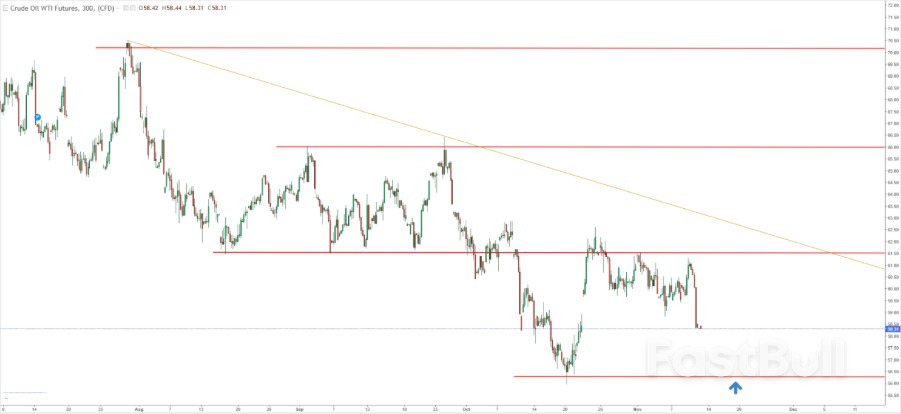
          After several failed attempts to break higher, oil prices have stalled around $62 per barrel. The recent downward move, consistent with the broader trend, shows that the market remains tilted to the downside.
          Crude Oil’s Price Action Confirms Bearish Control With $50 Target Back on Radar_1
          Given the current setup, the next target appears to be around $56 per barrel. With supply expected to exceed demand and no major shift in sight, prices could fall toward $50 per barrel before the year ends.

          Source: investing

          Risk Warnings and Disclaimers
          You understand and acknowledge that there is a high degree of risk involved in trading. Following any strategies or investment methods may lead to potential losses. The content on the site is provided by our contributors and analysts for information purposes only. You are solely responsible for determining whether any trading assets, securities, strategy, or any other product is suitable for investing based on your own investment objectives and financial situation.
          Add to Favorites
          Share
          FastBull
          Copyright © 2025 FastBull Ltd

          728 RM B 7/F GEE LOK IND BLDG NO 34 HUNG TO RD KWUN TONG KLN HONG KONG

          TelegramInstagramTwitterfacebooklinkedin
          App Store Google Play Google Play
          Products
          Charts

          Chats

          Q&A with Experts
          Screeners
          Economic Calendar
          Data
          Tools
          Membership
          Features
          Function
          Markets
          Copy Trading
          Latest Signals
          Contests
          News
          Analysis
          24/7
          Columns
          Education
          Company
          Careers
          About Us
          Contact Us
          Advertising
          Help Center
          Feedback
          User Agreement
          Privacy Policy
          Business

          White Label

          Data API

          Web Plug-ins

          Poster Maker

          Affiliate Program

          Risk Disclosure

          The risk of loss in trading financial instruments such as stocks, FX, commodities, futures, bonds, ETFs and crypto can be substantial. You may sustain a total loss of the funds that you deposit with your broker. Therefore, you should carefully consider whether such trading is suitable for you in light of your circumstances and financial resources.

          No decision to invest should be made without thoroughly conducting due diligence by yourself or consulting with your financial advisors. Our web content might not suit you since we don't know your financial conditions and investment needs. Our financial information might have latency or contain inaccuracy, so you should be fully responsible for any of your trading and investment decisions. The company will not be responsible for your capital loss.

          Without getting permission from the website, you are not allowed to copy the website's graphics, texts, or trademarks. Intellectual property rights in the content or data incorporated into this website belong to its providers and exchange merchants.

          Not Logged In

          Log in to access more features

          FastBull Membership

          Not yet

          Purchase

          Become a signal provider
          Help Center
          Customer Service
          Dark Mode
          Price Up/Down Colors

          Log In

          Sign Up

          Position
          Layout
          Fullscreen
          Default to Chart
          The chart page opens by default when you visit fastbull.com