Markets
News
Analysis
User
24/7
Economic Calendar
Education
Data
- Names
- Latest
- Prev


Signal Accounts for Members
All Signal Accounts
All Contests


Canada Unemployment Rate (SA) (Nov)A:--
F: --
P: --
Canada Full-time Employment (SA) (Nov)A:--
F: --
P: --
Canada Labor Force Participation Rate (SA) (Nov)A:--
F: --
P: --
U.S. PCE Price Index MoM (Sept)A:--
F: --
P: --
U.S. Personal Income MoM (Sept)A:--
F: --
P: --
U.S. Core PCE Price Index MoM (Sept)A:--
F: --
P: --
U.S. PCE Price Index YoY (SA) (Sept)A:--
F: --
P: --
U.S. Core PCE Price Index YoY (Sept)A:--
F: --
P: --
U.S. Personal Outlays MoM (SA) (Sept)A:--
F: --
U.S. 5-10 Year-Ahead Inflation Expectations (Dec)A:--
F: --
P: --
U.S. Real Personal Consumption Expenditures MoM (Sept)A:--
F: --
U.S. Weekly Total Rig CountA:--
F: --
P: --
U.S. Weekly Total Oil Rig CountA:--
F: --
P: --
U.S. Consumer Credit (SA) (Oct)A:--
F: --
China, Mainland Foreign Exchange Reserves (Nov)A:--
F: --
P: --
Japan Trade Balance (Oct)A:--
F: --
P: --
Japan Nominal GDP Revised QoQ (Q3)A:--
F: --
P: --
China, Mainland Imports YoY (CNH) (Nov)A:--
F: --
P: --
China, Mainland Exports (Nov)A:--
F: --
P: --
China, Mainland Imports (CNH) (Nov)A:--
F: --
P: --
China, Mainland Trade Balance (CNH) (Nov)A:--
F: --
P: --
China, Mainland Exports YoY (USD) (Nov)A:--
F: --
P: --
China, Mainland Imports YoY (USD) (Nov)A:--
F: --
P: --
Germany Industrial Output MoM (SA) (Oct)A:--
F: --
Euro Zone Sentix Investor Confidence Index (Dec)A:--
F: --
P: --
Canada National Economic Confidence IndexA:--
F: --
P: --
U.K. BRC Like-For-Like Retail Sales YoY (Nov)A:--
F: --
P: --
U.K. BRC Overall Retail Sales YoY (Nov)A:--
F: --
P: --
Australia Overnight (Borrowing) Key RateA:--
F: --
P: --
RBA Rate Statement
RBA Press Conference
Germany Exports MoM (SA) (Oct)--
F: --
P: --
U.S. NFIB Small Business Optimism Index (SA) (Nov)--
F: --
P: --
Mexico 12-Month Inflation (CPI) (Nov)--
F: --
P: --
Mexico Core CPI YoY (Nov)--
F: --
P: --
Mexico PPI YoY (Nov)--
F: --
P: --
U.S. Weekly Redbook Index YoY--
F: --
P: --
U.S. JOLTS Job Openings (SA) (Oct)--
F: --
P: --
China, Mainland M1 Money Supply YoY (Nov)--
F: --
P: --
China, Mainland M0 Money Supply YoY (Nov)--
F: --
P: --
China, Mainland M2 Money Supply YoY (Nov)--
F: --
P: --
U.S. EIA Short-Term Crude Production Forecast For The Year (Dec)--
F: --
P: --
U.S. EIA Natural Gas Production Forecast For The Next Year (Dec)--
F: --
P: --
U.S. EIA Short-Term Crude Production Forecast For The Next Year (Dec)--
F: --
P: --
EIA Monthly Short-Term Energy Outlook
U.S. API Weekly Gasoline Stocks--
F: --
P: --
U.S. API Weekly Cushing Crude Oil Stocks--
F: --
P: --
U.S. API Weekly Crude Oil Stocks--
F: --
P: --
U.S. API Weekly Refined Oil Stocks--
F: --
P: --
South Korea Unemployment Rate (SA) (Nov)--
F: --
P: --
Japan Reuters Tankan Non-Manufacturers Index (Dec)--
F: --
P: --
Japan Reuters Tankan Manufacturers Index (Dec)--
F: --
P: --
Japan Domestic Enterprise Commodity Price Index MoM (Nov)--
F: --
P: --
Japan Domestic Enterprise Commodity Price Index YoY (Nov)--
F: --
P: --
China, Mainland PPI YoY (Nov)--
F: --
P: --
China, Mainland CPI MoM (Nov)--
F: --
P: --
Italy Industrial Output YoY (SA) (Oct)--
F: --
P: --
BOE Gov Bailey Speaks
ECB President Lagarde Speaks
Brazil IPCA Inflation Index YoY (Nov)--
F: --
P: --
U.S. Labor Cost Index QoQ (Q3)--
F: --
P: --


No matching data
Latest Views
Latest Views
Trending Topics
Top Columnists
Latest Update
White Label
Data API
Web Plug-ins
Affiliate Program
View All

No data
The dollar got off on the front foot on Wednesday following two days of gains as traders awaited the Federal Reserve's Jackson Hole annual symposium later this week for clues on the path for monetary policy.
A speech on Friday by Fed Chair Jerome Powell is the main focus, with the market watching for any push back against market pricing of a rate reduction next month.
Traders currently place 84% odds on a cut next month, and expect around 54 basis points of reductions by year-end.
The dollar index , which measures the currency against six major counterparts, edged up to 98.393 early on Wednesday, the highest since August 12. It had gained about 0.4% in the first two days of this week.
"Given the relatively high bar for Powell to meet, there's a bit of risk being baked into the markets that he leans to the hawkish side and the proverbial rug gets pulled from beneath investors," said Kyle Rodda, an analyst at Capital.com.
In Asian hours, the Reserve Bank of New Zealand sets policy later in the day, with a large majority of economists predicting a quarter-point cut to the cash rate.
The New Zealand dollar drooped close to Tuesday's nearly two-week low, last changing hands at $0.5895.
"There's little reason for RBNZ to keep rates on hold," said Rodda.
"Inflation is within its target band, and although it is no longer mandated to target the labour market, the unemployment rate is at a post-COVID high."
For the Fed, traders ramped up bets for a cut on September 17 after a surprisingly weak payrolls report at the start of this month, and were further encouraged after consumer price data showed limited upward pressure from tariffs.
However, a hotter-than-expected producer price reading last week complicated the policy picture.
Powell has said he is reluctant to cut rates due to expected tariff-driven price pressures this summer.
The Fed will release minutes from its July 29-30 meeting later on Wednesday, when the central bank held rates steady, although they may offer limited insight as the meeting came before the weak jobs numbers.
Japan's exports dropped 2.6% year over year in July, their steepest drop since February 2021.
The fall was sharper than the 2.1% contraction expected by economists polled by Reuters and compared to the 0.5% drop seen in June.
Imports to the world's fourth-largest economy sank 7.5%, compared to the 10.4% fall expected by the Reuters poll.
Exports to the U.S. also continued to fall, dropping 10.1% in July and slightly softer than June's decline of 11.4%.
Japan reached a deal with Washington on July 22 that saw its so-called "reciprocal tariff" lowered to 15% from the 25% threatened by U.S. President Donald Trump earlier that month.
The trade readings come after Japan reported its second-quarter GDP figures, which saw the country beat expectations as net exports drove growth.
Japan's economy grew by 0.3% quarter over quarter and 1.2% on a yearly basis in the second quarter as exports remained resilient, even as imports fell.
Hirofumi Suzuki, Chief FX Strategist at Sumitomo Mitsui Banking Corporation, told CNBC after the GDP release that while exports have been volatile, there was a higher level of automobile shipments in April to June.
This may be due to an increase in catch-up shipments after production recovered from an accident at an automobile parts manufacturer in March, Suzuki said.
Tariffs on automobiles were cut from 25% to 15% as part of Japan's trade deal. Autos are one of Japan's largest exports, and make up its largest export to the U.S. in 2024.
The value of auto exports — which includes cars, buses and trucks — to the U.S. plunged 28.4% year over year in July, a steeper fall compared to the 26.7% decline in June.
While the effects of the 15% tariffs will not show up until the August data, analysts have warned about their impact on the Japanese economy.
Senior economist Masato Koike at Sompo Institute Plus said in an Aug 14 note that there was a possibility that Japan could enter a recession, depending on the magnitude of the impact of tariffs.
Key points:
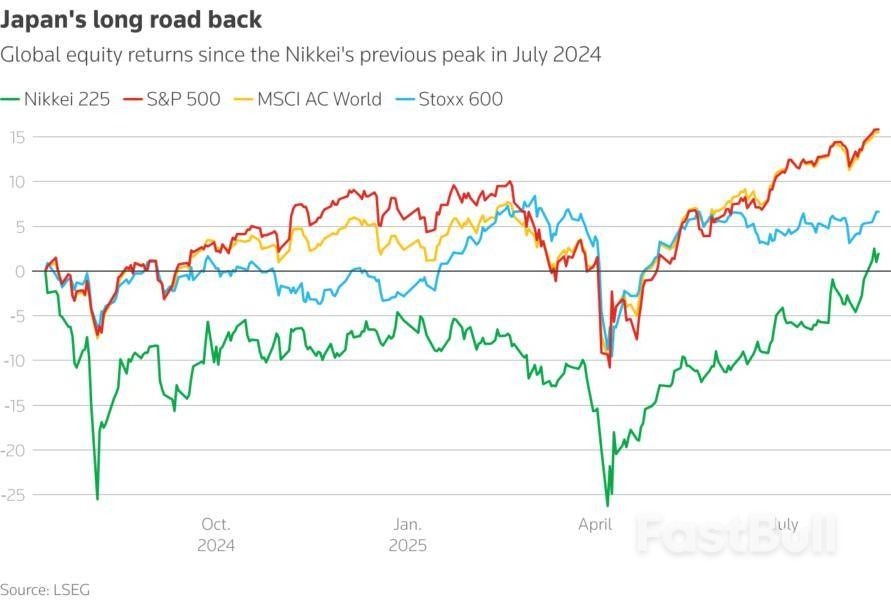
Japan's Nikkei share averagewill likely ease off recent record highs toward year-end, according to strategists in a Reuters poll, though much depends on a fragile trade agreement with the United States.
Japan's benchmark stocks index last week surpassed its previous intraday record, and traded as high as 43,876.42 this week.
The index is up more than 9% so far this year, but is forecast to slip back to 42,000 at the end of December, according to the median estimate of 18 analysts polled August 8-18.
The Nikkei joined global equity bourses in a steep dive in April after U.S. President Donald Trump announced sweeping tariffs on imports. As Trump backed down on deadlines and his administration worked out bilateral trade deals, many benchmarks recovered.
Japanese equities jumped around 11% after the U.S. agreed last month to reduce tariffs on Japanese auto imports to 15% from 27.5%, though a timeframe for the change and other details remain nebulous.
"The 15% tariff is relatively low compared to the one on China, so Japanese companies may be able to gain a competitive advantage," said Masayuki Kubota, chief strategist at Rakuten Securities. "However, there is growing uncertainty about whether President Trump will actually uphold this agreement."
Japan's economy remains largely reliant on exports. Data last week showed that the country's gross domestic product, the fourth biggest globally, grew much faster than expected in the second quarter.
A major theme behind the Nikkei's gains in recent years has been the Tokyo Stock Exchange's push to boost corporate governance. Under pressure to improve returns and corporate value, companies have bought back shares in droves, and go-private deals have proliferated.
The Nikkei early last year finally broke through the key high of 38,957.44 that had stood since 1989 during Japan's heady bubble economy. The gauge of blue-chip shares went on to set an intraday high of 42,426.77 on July 11, 2024, before the momentum petered out.

With the tariff turmoil diminishing and the domestic economy resilient, nine of 12 analysts in the Reuters poll expect Japanese corporate earnings to be higher in the second half of 2025 than the first.
"If the U.S. economy is solid, it becomes easier for Japanese firms to raise prices for their exported goods to cover the cost of the tariffs," said Yugo Tsuboi, chief strategist at Daiwa Securities. "That will underpin corporate earnings."
Median forecasts predict the Nikkei will trade at 43,000 by mid-2026 and 45,500 by end 2026.
Improving domestic wages, along with looser monetary policy by the U.S. Federal Reserve, will continue to make Japan a destination for foreign investors, said Oanda senior market analyst Kelvin Wong.
"An increase in global liquidity due to a weaker U.S. dollar and an impending dovish Fed pivot is likely to trigger a positive feedback loop back into the Japanese stock market," said Wong.
Within the country, the major events investors are looking out for are a long-delayed rate hike by the Bank of Japan and the potential for political upheaval.
Prime Minister Shigeru Ishiba is under pressure to step aside after an electoral drubbing last month. Expectations that his replacement will be more fiscally expansive have added to tailwinds for stocks, said IG analyst Tony Sycamore.
"We do see the market continue to run higher into year-end, and then after that I'd expect to see a pullback as we get close to the BOJ rate-hiking cycle taking effect," he added.
White Label
Data API
Web Plug-ins
Poster Maker
Affiliate Program
The risk of loss in trading financial instruments such as stocks, FX, commodities, futures, bonds, ETFs and crypto can be substantial. You may sustain a total loss of the funds that you deposit with your broker. Therefore, you should carefully consider whether such trading is suitable for you in light of your circumstances and financial resources.
No decision to invest should be made without thoroughly conducting due diligence by yourself or consulting with your financial advisors. Our web content might not suit you since we don't know your financial conditions and investment needs. Our financial information might have latency or contain inaccuracy, so you should be fully responsible for any of your trading and investment decisions. The company will not be responsible for your capital loss.
Without getting permission from the website, you are not allowed to copy the website's graphics, texts, or trademarks. Intellectual property rights in the content or data incorporated into this website belong to its providers and exchange merchants.
Not Logged In
Log in to access more features

FastBull Membership
Not yet
Purchase
Log In
Sign Up