
• Trade
  • Markets
  • Copy
  • Contests
  • News
  • 24/7
  • Calendar
  • Q&A
  • Chats
Trending
Screeners
SYMBOL
LAST
BID
ASK
HIGH
LOW
NET CHG.
%CHG.
SPREAD
SPX
S&P 500 Index
6846.50
6846.50
6846.50
6878.28
6827.18
-23.90
-0.35%
--
DJI
Dow Jones Industrial Average
47739.31
47739.31
47739.31
47971.51
47611.93
-215.67
-0.45%
--
IXIC
NASDAQ Composite Index
23545.89
23545.89
23545.89
23698.93
23455.05
-32.22
-0.14%
--
USDX
US Dollar Index
98.970
99.050
98.970
99.070
98.960
-0.070
-0.07%
--
EURUSD
Euro / US Dollar
1.16460
1.16467
1.16460
1.16485
1.16322
+0.00096
+ 0.08%
--
GBPUSD
Pound Sterling / US Dollar
1.33296
1.33303
1.33296
1.33344
1.33140
+0.00091
+ 0.07%
--
XAUUSD
Gold / US Dollar
4192.20
4192.58
4192.20
4198.63
4185.89
+2.50
+ 0.06%
--
WTI
Light Sweet Crude Oil
58.556
58.593
58.556
58.706
58.517
+0.001
0.00%
--

Community Accounts

Signal Accounts
--
Profit Accounts
--
Loss Accounts
--
View More

Become a signal provider

Sell trading signals to earn additional income

View More

Guide to Copy Trading

Get started with ease and confidence

View More

Signal Accounts for Members

All Signal Accounts

Best Return
  • Best Return
  • Best P/L
  • Best MDD
Past 1W
  • Past 1W
  • Past 1M
  • Past 1Y

All Contests

  • All
  • Trump Updates
  • Recommend
  • Stocks
  • Cryptocurrencies
  • Central Banks
  • Featured News
Top News Only
Share

Bank Of Japan Offers To Supply 800 Billion Yen In Funds At A Fixed Rate For 12/10-12/24 At All Offices

Share

India's Nifty 50 Index Extends Losses, Last Down 0.5%

Share

India's Nifty Bank Futures Down 0.26% In Pre-Open Trade

Share

India's Nifty 50 Futures Down 0.25% In Pre-Open Trade

Share

India's Nifty 50 Index Down 0.36% In Pre-Open Trade

Share

Reserve Bank Of Australia: Uncertainty In The Global Economy Remains Significant But So Far There Has Been Minimal Impact On Overall Growth And Trade In Australia's Major Trading Partners

Share

Reserve Bank Of Australia: There Are Uncertainties About The Outlook For Domestic Economic Activity And Inflation And The Extent To Which Monetary Policy Remains Restrictive

Share

Reserve Bank Of Australia: Economic Activity Continues To Recover

Share

Reserve Bank Of Australia: Board Is Focused On Its Mandate To Deliver Price Stability And Full Employment And Will Do What It Considers Necessary To Achieve That Outcome

Share

Reserve Bank Of Australia: Board's Judgement Is That Some Of The Recent Increase In Underlying Inflation Was Due To Temporary Factors

Share

Reserve Bank Of Australia: Board Therefore Judged That It Was Appropriate To Remain Cautious, Updating Its View Of The Outlook As The Data Evolve

Share

Indian Rupee Opens Down 0.06% At 90.1275 Per USA Dollar, Versus 90.07 Previous Close

Share

Reserve Bank Of Australia: Private Demand Is Recovering. Labour Market Conditions Still Appear A Little Tight But Further Modest Easing Is Expected

Share

Reserve Bank Of Australia: Recent Data Suggest The Risks To Inflation Have Tilted To The Upside, But It Will Take A Little Longer To Assess The Persistence Of Inflationary Pressures

Share

Reserve Bank Of Australia : At Its Meeting Today, The Board Decided To Leave The Cash Rate Unchanged At 3.60 Per Cent

Share

China's Li Says Tariff Consequences Increasingly Evident

Share

China's Premier Li Qiang, At '1+10' Dialogue: Emergence Of Models Like Deepseek Driving Transformation Of Traditional Industries

Share

China's Premier Li Qiang, At '1+10' Dialogue: Artificial Intelligence Also Becoming Central To Global Trade Discussions

Share

China's Premier Li Qiang, At '1+10' Dialogue: Calls For Free Trade Growing Louder

Share

China's Premier Li Qiang, At '1+10' Dialogue: Global Economy In 2025 Marked By Turbulence, Twists

TIME
ACT
FCST
PREV
Canada Unemployment Rate (SA) (Nov)

A:--

F: --

P: --

Canada Full-time Employment (SA) (Nov)

A:--

F: --

P: --

Canada Labor Force Participation Rate (SA) (Nov)

A:--

F: --

P: --

U.S. PCE Price Index MoM (Sept)

A:--

F: --

P: --

U.S. Personal Income MoM (Sept)

A:--

F: --

P: --

U.S. Core PCE Price Index MoM (Sept)

A:--

F: --

P: --

U.S. PCE Price Index YoY (SA) (Sept)

A:--

F: --

P: --

U.S. Core PCE Price Index YoY (Sept)

A:--

F: --

P: --

U.S. Personal Outlays MoM (SA) (Sept)

A:--

F: --

P: --
U.S. 5-10 Year-Ahead Inflation Expectations (Dec)

A:--

F: --

P: --

U.S. Real Personal Consumption Expenditures MoM (Sept)

A:--

F: --

P: --
U.S. Weekly Total Rig Count

A:--

F: --

P: --

U.S. Weekly Total Oil Rig Count

A:--

F: --

P: --

U.S. Consumer Credit (SA) (Oct)

A:--

F: --

P: --
China, Mainland Foreign Exchange Reserves (Nov)

A:--

F: --

P: --

Japan Trade Balance (Oct)

A:--

F: --

P: --

Japan Nominal GDP Revised QoQ (Q3)

A:--

F: --

P: --

China, Mainland Imports YoY (CNH) (Nov)

A:--

F: --

P: --

China, Mainland Exports (Nov)

A:--

F: --

P: --

China, Mainland Imports (CNH) (Nov)

A:--

F: --

P: --

China, Mainland Trade Balance (CNH) (Nov)

A:--

F: --

P: --

China, Mainland Exports YoY (USD) (Nov)

A:--

F: --

P: --

China, Mainland Imports YoY (USD) (Nov)

A:--

F: --

P: --

Germany Industrial Output MoM (SA) (Oct)

A:--

F: --

P: --
Euro Zone Sentix Investor Confidence Index (Dec)

A:--

F: --

P: --

Canada National Economic Confidence Index

A:--

F: --

P: --

U.K. BRC Like-For-Like Retail Sales YoY (Nov)

A:--

F: --

P: --

U.K. BRC Overall Retail Sales YoY (Nov)

A:--

F: --

P: --

Australia Overnight (Borrowing) Key Rate

A:--

F: --

P: --

RBA Rate Statement
RBA Press Conference
Germany Exports MoM (SA) (Oct)

--

F: --

P: --

U.S. NFIB Small Business Optimism Index (SA) (Nov)

--

F: --

P: --

Mexico 12-Month Inflation (CPI) (Nov)

--

F: --

P: --

Mexico Core CPI YoY (Nov)

--

F: --

P: --

Mexico PPI YoY (Nov)

--

F: --

P: --

U.S. Weekly Redbook Index YoY

--

F: --

P: --

U.S. JOLTS Job Openings (SA) (Oct)

--

F: --

P: --

China, Mainland M1 Money Supply YoY (Nov)

--

F: --

P: --

China, Mainland M0 Money Supply YoY (Nov)

--

F: --

P: --

China, Mainland M2 Money Supply YoY (Nov)

--

F: --

P: --

U.S. EIA Short-Term Crude Production Forecast For The Year (Dec)

--

F: --

P: --

U.S. EIA Natural Gas Production Forecast For The Next Year (Dec)

--

F: --

P: --

U.S. EIA Short-Term Crude Production Forecast For The Next Year (Dec)

--

F: --

P: --

EIA Monthly Short-Term Energy Outlook
U.S. API Weekly Gasoline Stocks

--

F: --

P: --

U.S. API Weekly Cushing Crude Oil Stocks

--

F: --

P: --

U.S. API Weekly Crude Oil Stocks

--

F: --

P: --

U.S. API Weekly Refined Oil Stocks

--

F: --

P: --

South Korea Unemployment Rate (SA) (Nov)

--

F: --

P: --

Japan Reuters Tankan Non-Manufacturers Index (Dec)

--

F: --

P: --

Japan Reuters Tankan Manufacturers Index (Dec)

--

F: --

P: --

Japan Domestic Enterprise Commodity Price Index MoM (Nov)

--

F: --

P: --

Japan Domestic Enterprise Commodity Price Index YoY (Nov)

--

F: --

P: --

China, Mainland PPI YoY (Nov)

--

F: --

P: --

China, Mainland CPI MoM (Nov)

--

F: --

P: --

Italy Industrial Output YoY (SA) (Oct)

--

F: --

P: --

BOE Gov Bailey Speaks
ECB President Lagarde Speaks
Brazil IPCA Inflation Index YoY (Nov)

--

F: --

P: --

U.S. Labor Cost Index QoQ (Q3)

--

F: --

P: --

Q&A with Experts
    • All
    • Chatrooms
    • Groups
    • Friends
    Connecting
    .
    .
    .
    Type here...
    Add Symbol or Code

      No matching data

      All
      Trump Updates
      Recommend
      Stocks
      Cryptocurrencies
      Central Banks
      Featured News
      • All
      • Russia-Ukraine Conflict
      • Middle East Flashpoint
      • All
      • Russia-Ukraine Conflict
      • Middle East Flashpoint
      Search
      Products

      Charts Free Forever

      Chats Q&A with Experts
      Screeners Economic Calendar Data Tools
      Membership Features
      Data Warehouse Market Trends Institutional Data Policy Rates Macro

      Market Trends

      Market Sentiment Order Book Forex Correlations

      Top Indicators

      Charts Free Forever
      Markets

      News

      News Analysis 24/7 Columns Education
      From Institutions From Analysts
      Topics Columnists

      Latest Views

      Latest Views

      Trending Topics

      Top Columnists

      Latest Update

      Signals

      Copy Rankings Latest Signals Become a signal provider AI Rating
      Contests
      Brokers

      Overview Brokers Assessment Rankings Regulators News Claims
      Broker listing Forex Brokers Comparison Tool Live Spread Comparison Scam
      Q&A Complaint Scam Alert Videos Tips to Detect Scam
      More

      Business
      Events
      Careers About Us Advertising Help Center

      White Label

      Data API

      Web Plug-ins

      Affiliate Program

      Awards Institution Evaluation IB Seminar Salon Event Exhibition
      Vietnam Thailand Singapore Dubai
      Fans Party Investment Sharing Session
      FastBull Summit BrokersView Expo
      Recent Searches
        Top Searches
          Markets
          News
          Analysis
          User
          24/7
          Economic Calendar
          Education
          Data
          • Names
          • Latest
          • Prev

          View All

          No data

          Scan to Download

          Faster Charts, Chat Faster!

          Download App
          English
          • English
          • Español
          • العربية
          • Bahasa Indonesia
          • Bahasa Melayu
          • Tiếng Việt
          • ภาษาไทย
          • Français
          • Italiano
          • Türkçe
          • Русский язык
          • 简中
          • 繁中
          Open Account
          Search
          Products
          Charts Free Forever
          Markets
          News
          Signals

          Copy Rankings Latest Signals Become a signal provider AI Rating
          Contests
          Brokers

          Overview Brokers Assessment Rankings Regulators News Claims
          Broker listing Forex Brokers Comparison Tool Live Spread Comparison Scam
          Q&A Complaint Scam Alert Videos Tips to Detect Scam
          More

          Business
          Events
          Careers About Us Advertising Help Center

          White Label

          Data API

          Web Plug-ins

          Affiliate Program

          Awards Institution Evaluation IB Seminar Salon Event Exhibition
          Vietnam Thailand Singapore Dubai
          Fans Party Investment Sharing Session
          FastBull Summit BrokersView Expo

          Bond Traders Defy Fed and Spark Heated Debate on Wall Street

          Adam

          Bond

          Summary:

          Treasury yields are rising despite Fed rate cuts, sparking debate over recession risks, inflation, debt concerns, and political pressure on the Fed. Traders doubt cuts will lower long-term borrowing costs as structural forces lift yields.
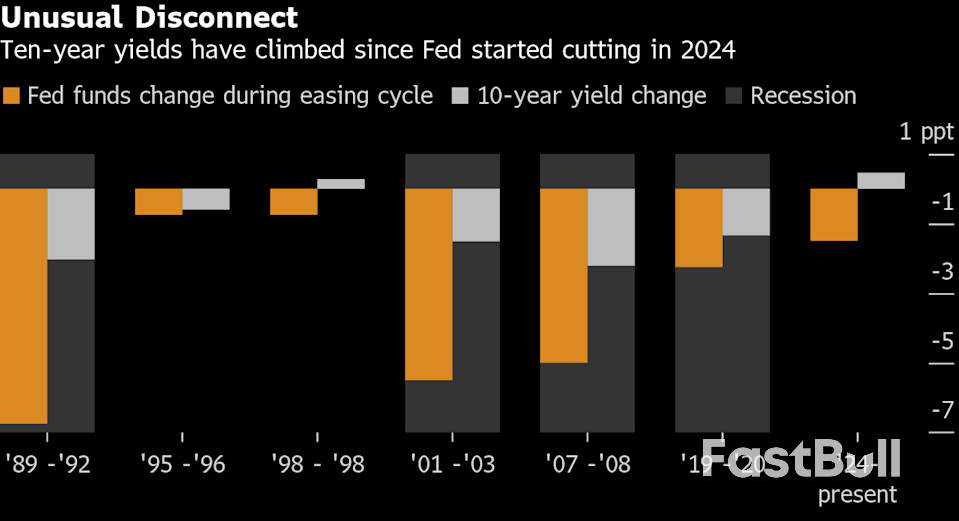
          The bond market’s reaction to the Federal Reserve’s interest-rate cuts has been highly unusual. By some measures, a disconnect like this, with Treasury yields climbing as the central bank lowers rates, hasn’t been seen since the 1990s.
          What the divergence indicates is a matter of heated debate. Opinions are all over the place, from the bullish (a sign of confidence that recession will be averted) to the more neutral (a return to pre-2008 market norms) to the favorite culprit of the so-called bond vigilantes (investors are losing confidence the US will ever rein in the constantly swelling national debt).
          But one thing is clear: the bond market isn’t buying President Donald Trump’s idea that faster rate cuts will send bond yields sliding down and, in turn, slash the rates on mortgages, credit cards and other types of loans.
          With Trump soon able to replace Chair Jerome Powell with his own nominee, on top of everything else is the risk of the Fed squandering its credibility by caving to political pressure to ease policy more aggressively — which could backfire by fanning already elevated inflation and pushing yields higher.
          “Trump 2.0 is all about getting long-term yields down,” said Steven Barrow, head of G10 strategy at Standard Bank in London. “Putting a political figure at the Fed will not get bond yields down.”
          Bond Traders Defy Fed and Spark Heated Debate on Wall Street_1
          The Fed started pulling its benchmark rate down from a more than two-decade high in September 2024 and has since cut it by 1.5 percentage points to a range of 3.75% to 4%. Traders see another quarter point cut after the next meeting on Wednesday as virtually assured and are pricing in two more such moves next year, which would bring its rate to around 3%.
          Yet, key Treasury yields — which serve as the main baseline for the borrowing costs paid by American consumers and corporations — haven’t come down at all. Ten-year yields have risen nearly half a percentage point to 4.1% since the Fed started easing policy and 30-year yields are up over 0.8 percentage point.
          Normally, when the Fed moves short-term policy rates up and down, long-term bond yields tend to follow. Even in the only two easing cycles outside of recessions over the past four decades – in 1995 and 1998, when the Fed cut only 75 basis points each time — the 10-year yield dropped outright or rose less than they have during the current episode.
          Jay Barry, head of global rates strategy at JPMorgan Chase & Co., sees two factors behind it. The scale of the Fed’s hikes during the post-pandemic inflation surge was so steep that markets started pricing-in the Fed’s about-face well before it started, with 10-year yields peaking in late 2023. That blunted the impact once it began.
          Moreover, by slashing interest rates even when inflation remains elevated, he said, the Fed is lessening the risk of a recession, limiting the scope for yields to fall.
          “The Fed is looking to sustain this expansion, not end it,” said Barry. “That’s why rates have not moved aggressively lower.”
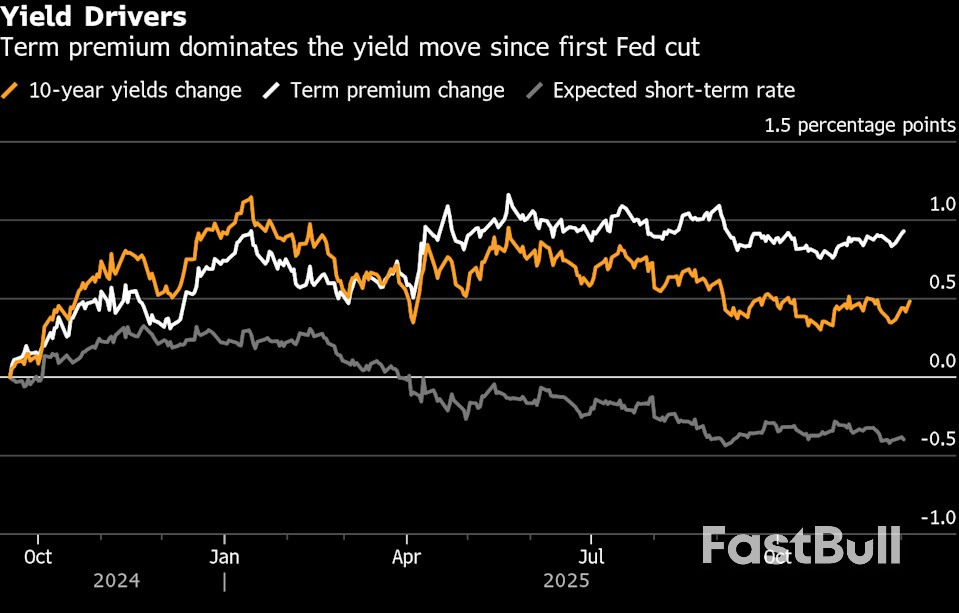
          Others see a less benign interpretation in the so-called term premium, a measure of the extra yield investors demand in return for holding long-term bonds.
          That compensates them for potential risks down the line — like elevated inflation or an unsustainable federal debt load. And that premium has risen nearly a full percentage point since the rate-cut cycle began, according to the New York Fed estimates.
          Bond Traders Defy Fed and Spark Heated Debate on Wall Street_2
          For Jim Bianco, president of Bianco Research, it’s a signal that bond traders are worried that the Fed is cutting rates even as inflation remains stubbornly above its 2% target and the economy keeps defying recession fears.
          “The market is really concerned about the policy,” said Bianco. “The concern is that the Fed has gone too far.”
          If the Fed continues to cut rates, the mortgage rates will go “vertical,” he added.
          There’s also angst that Trump — after breaking sharply from his predecessor’s deference to the Fed’s independence — will succeed in pressuring policymakers to continue cutting rates. Kevin Hassett, the White House National Economic Council Director and a Trump loyalist, is the betting market’s favorite to succeed Powell when his term ends in May.
          What Bloomberg Strategists say...
          If rate cuts increase the likelihood of stronger growth, they won’t be met with lower yields. We’ll end up with higher ones. In many respects, this is because we’re going back to a normal interest rate regime, where 2% real returns and a 2% Fed inflation target produces a 4% floor for long-term yields. Add in stronger growth and the numbers go higher from there.
          So far, though, the broader bond market has remained relatively stable, with 10-year yields hovering not far from 4% over the past few months. And breakeven rates — a main gauge of the bond market’s inflation expectations — have been stable as well, indicating that fears of a Fed-fueled inflation surge down the line may be overstated.
          Treasury Secretary Scott Bessent told CBS’ Face the Nation that the “bond market just had the best year since 2020” and that he expects inflation to “roll down strongly” next year.
          The yield on 10-year Treasuries rose one basis point to 4.15% at 5:45 a.m. in New York
          Robert Tipp, chief investment strategist fixed income at PGIM, said it looks more than anything like a return to the normal levels seen before the Global Financial Crisis, which ushered in a long era of unusually low interest rates that abruptly ended after the pandemic.
          “We’re back at the normal level of rates world,” he said.
          Standard Bank’s Barrow said the Fed’s lack of control over the longer-term yields reminds him of a similar — if opposite — bind the central bank faced in the mid-2000s that became known as the Greenspan conundrum.
          At that time, Chair Alan Greenspan was puzzled why the long-term yields remained low even as he jacked up the short-term policy rate. Greenspan’s successor Ben Bernanke later attributed the conundrum to too much savings from overseas flooding into Treasuries.
          Today, Barrow said, that dynamic is reversed as governments around major economies are borrowing too much. That saving glut, in other words, has turned into a bond-supply glut that’s keeping consistently upward pressure on yields.
          “It’s possibly a structural move that bond yields are not going down,” Barrow said. “At the end of the day, central banks don’t determine the long term rate.”

          Source: Bloomberg

          Risk Warnings and Disclaimers
          You understand and acknowledge that there is a high degree of risk involved in trading. Following any strategies or investment methods may lead to potential losses. The content on the site is provided by our contributors and analysts for information purposes only. You are solely responsible for determining whether any trading assets, securities, strategy, or any other product is suitable for investing based on your own investment objectives and financial situation.
          Add to Favorites
          Share

          Global Brands Fight Legality of Trump’s 'Liberation Day' Tariffs

          Warren Takunda

          Economic

          A number of well-known consumer and industrial groups — including Costco, Revlon, Kawasaki Motors, and Bumble Bee Foods — are mounting a wave of legal challenges to Donald Trump’s sweeping “Liberation Day” tariffs. The goal is to seek refunds for the duties they have paid so far and prevent further costs.
          Court records from the US Court of International Trade show that more than 70 companies have now filed lawsuits asking judges to declare the tariffs unlawful, order refunds, and block the administration from levying the duties in the future.
          Many of the filings have been lodged in recent weeks, as the US Supreme Court deliberates on whether Trump had the authority to impose the measures under the International Emergency Economic Powers Act (IEEPA).
          The IEEPA is a 1977 US law that lets the president declare a national emergency over an external threat and then use broad economic tools — like sanctions and asset freezes — against foreign countries, entities, or individuals.
          The companies filing the lawsuits believe the IEEPA is designed for targeted sanctions in emergencies, not classic, across-the-board tariffs on imports.
          These recent filings mark a shift in the corporate response to the tariff regime, with earlier cases being brought mainly by smaller importers. The stakes have significantly shifted now that major multinationals with global supply chains are joining in, arguing that the duties have distorted trade flows and driven up costs across multiple markets.
          Costco, the US-based warehouse retailer with operations in Asia and Europe, sued the administration in November, demanding a full refund of tariffs it has paid and an injunction against future collections.
          It argued that the IEEPA does not clearly authorise the White House to set customs duties and that the tariffs, imposed via emergency powers, should therefore be struck down.
          Revlon, the cosmetics group with production and distribution hubs in North America, Europe and Asia, is also seeking reimbursement and a ruling that Trump’s use of IEEPA is unlawful.
          In its filing, the company warned that some of the entries on which it has paid duties could be finalised or liquidated as early as mid-December, which would sharply limit its ability to seek refunds later.
          Multinational manufacturers in the automotive and industrial sectors are heavily represented among the plaintiffs.
          Court filings show that subsidiaries of Japan’s Toyota Group are suing US Customs and Border Protection over higher levies on car parts and metals, while Kawasaki Motors and a cluster of auto suppliers argue that the tariffs on vehicles, steel, and aluminium have significantly increased their costs.
          Aluminium producer Alcoa, packaging group Berlin Packaging, fitness equipment maker iFit and plumbing supplier Ferguson Enterprises have also joined the fray.
          Food companies with far-flung sourcing networks say they have been hit particularly hard. Bumble Bee Foods, which buys seafood from Brazil, Ecuador, Panama, Mexico, Indonesia, China and India for its global brands, contends that its import costs increased when the tariffs took effect.
          The Supreme Court has already heard arguments on the core legal question, namely whether a president can rely on IEEPA to levy broad, country-wide tariffs.
          Three lower courts have already ruled against the Trump administration. Several Supreme Court justices also signalled scepticism about the administration’s position during the hearing, but raised concerns about the complexity of any refund process if the duties are overturned, warning that unwinding years of collections could be disruptive.
          Costco’s case has drawn additional attention after the retailer recently nominated Gina Raimondo, who served as commerce secretary under President Joe Biden, to its board of directors.
          Raimondo’s appointment will be put to a shareholder vote in January, while the Supreme Court’s ruling on the legality of Trump’s tariff strategy is due no later than the end of its term in June 2026.

          Source: Euronews

          To stay updated on all economic events of today, please check out our Economic calendar
          Risk Warnings and Disclaimers
          You understand and acknowledge that there is a high degree of risk involved in trading. Following any strategies or investment methods may lead to potential losses. The content on the site is provided by our contributors and analysts for information purposes only. You are solely responsible for determining whether any trading assets, securities, strategy, or any other product is suitable for investing based on your own investment objectives and financial situation.
          Add to Favorites
          Share

          Todd Combs Leaves Berkshire Hathaway for JPMorgan, Signaling Strategic Shift in Security and Resiliency Investment

          Gerik

          Economic

          Strategic Transition: Combs Exits Berkshire for JPMorgan Leadership Role

          In a significant shift that marks the beginning of a new era at both Berkshire Hathaway and JPMorgan Chase, Todd Combs one of Warren Buffett’s most trusted investment officers and CEO of Geico is stepping down to join JPMorgan. His new role will be to head the firm’s newly launched Security and Resiliency Initiative, a large-scale investment program aimed at strengthening national and economic infrastructure across key sectors including defense, aerospace, energy, and healthcare.
          Combs, 54, has been a central figure in Berkshire Hathaway’s investment strategy since joining in 2010 from his hedge fund Castle Point. Alongside Ted Weschler, he was groomed to help manage and eventually oversee the sprawling equity portfolio that includes blue-chip holdings such as Apple, Coca-Cola, and Bank of America. His sudden departure comes as Warren Buffett, now 95, prepares to hand over the CEO role to Greg Abel in 2026, leaving the firm’s investment succession plan less defined.

          JPMorgan’s $1.5 Trillion Security Initiative Targets Strategic Growth Sectors

          Combs’ new role places him at the helm of one of JPMorgan’s most ambitious ventures. Initially seeded with $10 billion in deployable capital, the Security and Resiliency Initiative is ultimately projected to channel $1.5 trillion in investments toward sectors deemed critical for long-term stability and global competitiveness.
          This strategic program represents more than just capital deployment it is part of a broader economic doctrine JPMorgan is cultivating, aimed at driving public-private alignment in high-stakes industries. With geopolitical risks rising and national security threats becoming increasingly complex, JPMorgan is positioning itself as a major force in building and securing the infrastructure of the future.
          The initiative will be guided by a high-profile advisory council that includes Amazon founder Jeff Bezos, Dell Technologies Chairman Michael Dell, former Secretary of Defense Robert Gates, and former Secretary of State Condoleezza Rice. This blend of tech, policy, and defense leadership underscores the program’s comprehensive, cross-sector mandate.

          Buffett and Dimon Signal Mutual Confidence in Leadership Realignment

          Warren Buffett praised Combs in Berkshire’s announcement, noting that the executive “made many great hires at GEICO and broadened its horizons.” The Oracle of Omaha’s endorsement implies a cordial and mutually beneficial departure, though it inevitably raises questions about how Berkshire will manage its equity positions moving forward.
          JPMorgan CEO Jamie Dimon, in turn, celebrated Combs’ move as a strategic gain for the bank, stating: “Todd Combs is one of the greatest investors and leaders I’ve known.” Dimon emphasized Combs’ deep understanding of JPMorgan, honed over his nine years on the board, and praised his ability to align financial strategy with broader societal goals “to make the world more secure.”
          Combs will also serve as a special advisor to Dimon, highlighting the strategic importance of this hire beyond just investment management.

          Implications for Berkshire Hathaway’s Investment Future

          Combs’ exit places renewed focus on the internal structure of Berkshire’s future investment management. With Buffett stepping down from the CEO role in 2026 and Ted Weschler remaining as the other senior portfolio manager, questions linger over whether Weschler will assume full responsibility or if a new leadership figure will be introduced to help steward the firm’s enormous equity portfolio.
          As Berkshire’s investment decisions carry weight not just for shareholders but also for market sentiment broadly, continuity and clarity in its investment team are critical. Combs’ departure introduces uncertainty at a delicate time for succession planning.

          A Redefinition of Strategic Investment Leadership

          Todd Combs’ move to JPMorgan signals a major leadership realignment within U.S. financial and investment circles. It not only leaves a notable gap at Berkshire Hathaway but also reinforces JPMorgan’s aggressive push into long-horizon, security-focused investing. By recruiting a seasoned investor with experience under Buffett’s tutelage, JPMorgan is underscoring its strategic intent to align finance with national resilience and global influence.
          As traditional finance adapts to a new geopolitical and technological landscape, the intersection of investment, security, and innovation may well define the next phase of capital deployment and Combs is now positioned at the forefront of that transformation.

          Source: CNBC

          To stay updated on all economic events of today, please check out our Economic calendar
          Risk Warnings and Disclaimers
          You understand and acknowledge that there is a high degree of risk involved in trading. Following any strategies or investment methods may lead to potential losses. The content on the site is provided by our contributors and analysts for information purposes only. You are solely responsible for determining whether any trading assets, securities, strategy, or any other product is suitable for investing based on your own investment objectives and financial situation.
          Add to Favorites
          Share

          EUR/USD, GBP/USD And EUR/GBP Forecasts – Currencies Continue to See Choppiness

          Blue River

          Forex

          Technical Analysis

          EUR/USD Technical Analysis

          The euro initially rallied a bit during the trading session here on Monday, but it is starting to give back gains again, just like it did on Friday. All things being equal, this is a market that I think is essentially on hold at the moment, as we have the Federal Reserve interest rate decision on Wednesday. But the dynamics of this pair are interesting because the ECB is expected to hold rates, so that has helped firm the euro slightly. And the Federal Reserve is expected to cut rates on Wednesday, but the question then becomes, what did they say during the press conference?

          It is because of this, I think the next day or two is probably going to be very choppy and very sideways. As traders wait for the next data point that truly matters, we are in the middle of a consolidation area. That being said, all things being equal, I still favor the downside. But I think we need something to get us going to the downside, such as Jerome Powell giving us a cut, but maybe suggesting that the Fed is hesitant to cut rapidly.

          GBP/USD Technical Analysis

          The British pound looks like it is rolling over a little bit. And that's not a huge surprise because we had that explosive move a couple of days back due to the budget. The question is, will that budget change the trajectory of the economy? The answer, of course, is no. And recently, the Bank of England came within a whisker of cutting the rate. So, I think the market is starting to focus on that again.

          At this point, we'll be watching 1.32 to see if we can break down below it. If we can, then that's a very negative sign. If we bounce from there, then we could head back into the previous consolidation. And just like in the case of the euro, I think it's the Federal Reserve that determines the next move.

          EUR/GBP Technical Analysis

          The euro rallied slightly during the trading session on Monday, but it's hanging around the 50-day EMA. And I think this is an area that is going to continue to be somewhat noisy. All things being equal, I think we're just killing time here. But if we were to break down below the 0.87 level, then I think the market really starts to drop. If we rally from here and clear the 0.875 level, then I think we go looking at the 0.8850 level again. That being said, this is a very choppy market. It always is choppy. So, I'm not looking for rapid or quick moves.

          Source: FX Empire

          Risk Warnings and Disclaimers
          You understand and acknowledge that there is a high degree of risk involved in trading. Following any strategies or investment methods may lead to potential losses. The content on the site is provided by our contributors and analysts for information purposes only. You are solely responsible for determining whether any trading assets, securities, strategy, or any other product is suitable for investing based on your own investment objectives and financial situation.
          Add to Favorites
          Share

          Silicon Valley Defense Startups Confront Growing Pains as Pentagon Integration Challenges Mount

          Gerik

          Economic

          From Drones to Defense Contracts: Startups Hit Scaling Roadblocks

          After a meteoric rise in attention and valuations, Silicon Valley–backed defense startups are entering a new, more difficult phase. Once admired for agile innovation and cutting-edge AI-driven military technologies, these companies are now grappling with the structural and operational challenges of building weapons at scale. Their recent success, amplified by the effectiveness of drones in the Russia-Ukraine war, brought a surge of Pentagon interest and funding. However, that same spotlight has exposed their limited manufacturing capabilities and unfamiliarity with the defense sector’s rigid procurement systems.
          Startups such as Saronic Technologies and Anduril Industries exemplify the sector’s explosive growth. Saronic, which develops unmanned naval drones, reached a $4 billion valuation in February and is building a shipyard in Louisiana. Anduril, founded by Oculus creator Palmer Luckey, doubled its valuation to $30 billion by June. Meanwhile, Chaos Industries, a sensor and radar tech firm, also saw its valuation double to $4.5 billion after a recent funding round. But turning these valuations into long-term defense supply contracts requires more than technological innovation.

          Pentagon Contracts Rise, but the Path to Scale Remains Elusive

          According to Govini, a defense analytics firm, startup firms now command 1.3% of U.S. defense contracts, up from 0.6% last year a clear sign of growing inclusion in Pentagon procurement. Despite this, the traditional defense "primes" like Lockheed Martin, Boeing, RTX, and Northrop Grumman still dominate, holding over 92% of contract value. This contrast illustrates a fundamental bottleneck: while the Department of Defense is experimenting with startups, the bulk of major programs continues to flow to legacy contractors.
          Christopher Calio, CEO of RTX (formerly Raytheon Technologies), emphasized this barrier: “It’s one thing to design and innovate. It’s another thing to build a prototype, and then it’s an entirely different ball game to scale manufacturing.” This sentiment reflects the causal relationship between scale and institutional trust: without demonstrating the ability to mass-produce and deliver reliably, startups will remain confined to small, exploratory contracts.

          Cultural Divide and Pentagon Resistance to Change

          The annual Reagan National Defense Forum, held this week in Simi Valley, California, revealed a telling juxtaposition: traditional defense CEOs in suits exchanging ideas with hoodie-wearing startup founders. U.S. Defense Secretary Pete Hegseth acknowledged the urgency of evolving the system, pledging to “transform the entire acquisition system to rapidly accelerate the fielding of capabilities and focus on results.”
          However, deep-rooted obstacles persist. Entrenched political interests, legacy project backlogs, and a bureaucratic acquisition system designed around multibillion-dollar programs present systemic resistance. According to Zach Shore, chief revenue officer at Hermeus (a hypersonic aircraft startup), most firms struggle to move from $10–30 million prototype awards to full production-scale programs. This reveals a persistent structural barrier: despite policy rhetoric, the Pentagon’s procurement architecture remains largely inaccessible to newcomers beyond the pilot stage.

          New Partnerships Signal a Shifting Landscape

          While challenges remain, some large defense players are beginning to recognize the innovation edge that startups bring. L3Harris Technologies CEO Chris Kubasik highlighted the need for collaboration: “We need to leverage the established companies and the new entrants.” Recent partnerships support this idea. For example, Shield AI has partnered with HII, America’s largest military shipbuilder, to co-develop autonomous naval vessels. Anduril has also joined forces with South Korea’s HD Hyundai Heavy Industries for military and commercial shipbuilding.
          These collaborations could serve as a bridge over the “valley of death” many startups face a term referring to the phase between innovation and sustainable revenue from large-scale contracts. JPMorgan CEO Jamie Dimon, who recently committed $10 billion in equity investments to defense tech and manufacturing, warned that legacy firms are not immune to stagnation. “There’s a valley of death for big companies too, driven by complacency, arrogance, bureaucracy,” he stated, underscoring the risk of institutional inertia in both old and new players.

          A Tipping Point in U.S. Defense Innovation

          Silicon Valley’s growing presence in U.S. defense contracting marks a significant cultural and technological shift. Yet, despite impressive valuations and media attention, the challenge remains deeply structural. Scaling up to meet Pentagon demands requires more than technical prowess it demands long-term manufacturing capabilities, patient capital, and systemic procurement reform.
          As innovation pressure builds particularly with geopolitical concerns such as China’s military expansion the Pentagon’s ability to integrate nimble startups into its traditionally slow-moving system could determine the future shape of U.S. military competitiveness. In the words of Anduril’s strategy head Zach Mears, “The light switch is in the middle of being flipped.” Whether it stays on will depend on whether startups can transition from flashy prototypes to full-fledged defense partners and whether Washington lets them.

          Source: Reuters

          To stay updated on all economic events of today, please check out our Economic calendar
          Risk Warnings and Disclaimers
          You understand and acknowledge that there is a high degree of risk involved in trading. Following any strategies or investment methods may lead to potential losses. The content on the site is provided by our contributors and analysts for information purposes only. You are solely responsible for determining whether any trading assets, securities, strategy, or any other product is suitable for investing based on your own investment objectives and financial situation.
          Add to Favorites
          Share

          Australian Firefighter Killed As Bushfires Destroy Homes In Two States

          Samantha Luan

          Political

          Economic

          Key points:

          · Firefighter dies after struck by tree
          · Sixteen homes lost on Central Coast region in New South Wales
          · Tasmania blaze destroys 19 homes at Dolphin Sands

          An Australian firefighter was killed overnight after he was struck by a tree while trying to control a bushfire that had destroyed homes and burnt large swathes of bushland north of Sydney, authorities said on Monday.

          Emergency crews rushed to bushland near the rural town of Bulahdelah, 200 km (124 miles) north of Sydney, after reports that a tree had fallen on a man. The 59-year-old suffered a cardiac arrest and died at the scene, officials said.

          Prime Minister Anthony Albanese said the "terrible news is a sombre reminder" of the dangers faced by emergency services personnel as they work to protect homes and families.

          "We honour that bravery, every day," Albanese said in a statement.

          More than 50 bushfires were burning across the state of New South Wales as of Monday morning. A fast-moving fire over the weekend destroyed 16 homes in the state's Central Coast, home to about 350,000 people and a commuter region just north of Sydney.

          Resident Rouchelle Doust, from the hard-hit town of Koolewong, said she and her husband tried to save their home as flames advanced.

          "He's up there in his bare feet trying to put it out, and he's trying and trying, and I'm screaming at him to come down," Doust told the Australian Broadcasting Corp.

          "Everything's in it: his grandmother's stuff, his mother's stuff, all my stuff - everything, it's all gone, the whole lot."

          Conditions eased overnight, allowing officials to downgrade alerts to the advice level, the second-lowest danger rating.

          On the island state of Tasmania, a 700-hectare (1,729 acres) blaze at Dolphin Sands, about 150 km (93 miles) northeast of the state capital of Hobart, destroyed 19 homes and damaged 40. The fire has been contained, but residents have been warned not to return as conditions remain dangerous, officials said.

          Authorities have warned of a high-risk bushfire season during Australia's summer months from December to February, with increased chances of extreme heat across large parts of the country following several relatively quiet years.

          New South Wales is among Australia's most wildfire-prone regions, with some experts saying climate change is increasing the danger. Australia's "Black Summer" fires of 2019-2020 destroyed an area the size of Turkey and killed 33 people.

          Source: TradingView

          To stay updated on all economic events of today, please check out our Economic calendar
          Risk Warnings and Disclaimers
          You understand and acknowledge that there is a high degree of risk involved in trading. Following any strategies or investment methods may lead to potential losses. The content on the site is provided by our contributors and analysts for information purposes only. You are solely responsible for determining whether any trading assets, securities, strategy, or any other product is suitable for investing based on your own investment objectives and financial situation.
          Add to Favorites
          Share

          U.S. stock futures steady as Fed meeting looms large

          Adam

          Stocks

          U.S. stock futures were little changed Monday, consolidating after two straight weekly gains with investors turned their attention to this week’s Federal Reserve meeting, which is widely expected to deliver an interest-rate cut.
          At 05:35 ET (10:35 GMT), Dow Jones Futures slipped 3 points, or 0.1%, while S&P 500 Futures inched 8 points, or 0.1%, higher and Nasdaq 100 Futures gained 65 points, or 0.3%.
          All three major U.S. stock indexes recorded positive weeks last week, their second in a row, with the S&P 500 and NASDAQ Composite also notched four-day winning streaks on Friday, while the Dow Jones Industrial Average has been positive in three of the last four sessions.

          Caution ahead of Fed decision

          This positive tone exists as many investors expect the Fed to ease monetary policy on Wednesday, especially after the delayed release of September’s core personal consumption expenditures price index — the Fed’s preferred inflation gauge — came in softer than expected on Friday.
          That cooler inflation reading, combined with signs of a softening labor market and fragile consumer spending, has reinforced the case for the Fed to provide more policy support.
          There’s little in the way of economic data to change the narrative Monday, although Tuesday’s JOLTS job openings data could take on additional importance given the monthly official jobs report is now being released after the Fed meeting.
          Fed funds futures are pricing in a roughly 88% chance of a Fed cut, according to CME’s FedWatch tool.
          The language used by the Fed officials, especially in the post-meeting statement and the projections for 2026, will be closely watched.
          "The key question is what will the Fed signal for next year, given that we will be getting a new forecast update from them," ING analysts said in a note.
          "As such, the most dovish they could possibly be is to put a second rate cut for their 2026 forecast, but they will be reluctant," they added.

          Lululemon, Costco earnings awaited

          Corporate earnings are also set to play a role in market direction, with results due from the likes of Lululemon , Costco , Broadcom, Oracle, and Adobe this week.
          Separately, S&P Global said Carvana Co, CRH PLC , and Comfort Systems will join the S&P 500 index on Dec. 22, a change that typically sparks repositioning among index-tracking funds.

          Crude hand back some gains

          Oil prices slipped lower Monday, falling from near two-week highs on Monday as investors look to the Federal Reserve for guidance.
          Brent futures dropped 0.9% to $63.20 a barrel, and U.S. West Texas Intermediate crude futures fell 0.9% to $59.54 a barrel.
          Both contracts closed Friday’s trading session at their highest levels since November 18.
          Aside from the Fed meeting, progress towards peace in Ukraine remains slow, and Reuters reported that the Group of Seven countries and the European Union are in talks to replace a price cap on Russian oil exports with a full maritime services ban, which would likely further curb supply from the world’s second-largest oil producer.

          Source: investing

          Risk Warnings and Disclaimers
          You understand and acknowledge that there is a high degree of risk involved in trading. Following any strategies or investment methods may lead to potential losses. The content on the site is provided by our contributors and analysts for information purposes only. You are solely responsible for determining whether any trading assets, securities, strategy, or any other product is suitable for investing based on your own investment objectives and financial situation.
          Add to Favorites
          Share
          FastBull
          Copyright © 2025 FastBull Ltd

          728 RM B 7/F GEE LOK IND BLDG NO 34 HUNG TO RD KWUN TONG KLN HONG KONG

          TelegramInstagramTwitterfacebooklinkedin
          App Store Google Play Google Play
          Products
          Charts

          Chats

          Q&A with Experts
          Screeners
          Economic Calendar
          Data
          Tools
          Membership
          Features
          Function
          Markets
          Copy Trading
          Latest Signals
          Contests
          News
          Analysis
          24/7
          Columns
          Education
          Company
          Careers
          About Us
          Contact Us
          Advertising
          Help Center
          Feedback
          User Agreement
          Privacy Policy
          Business

          White Label

          Data API

          Web Plug-ins

          Poster Maker

          Affiliate Program

          Risk Disclosure

          The risk of loss in trading financial instruments such as stocks, FX, commodities, futures, bonds, ETFs and crypto can be substantial. You may sustain a total loss of the funds that you deposit with your broker. Therefore, you should carefully consider whether such trading is suitable for you in light of your circumstances and financial resources.

          No decision to invest should be made without thoroughly conducting due diligence by yourself or consulting with your financial advisors. Our web content might not suit you since we don't know your financial conditions and investment needs. Our financial information might have latency or contain inaccuracy, so you should be fully responsible for any of your trading and investment decisions. The company will not be responsible for your capital loss.

          Without getting permission from the website, you are not allowed to copy the website's graphics, texts, or trademarks. Intellectual property rights in the content or data incorporated into this website belong to its providers and exchange merchants.

          Not Logged In

          Log in to access more features

          FastBull Membership

          Not yet

          Purchase

          Become a signal provider
          Help Center
          Customer Service
          Dark Mode
          Price Up/Down Colors

          Log In

          Sign Up

          Position
          Layout
          Fullscreen
          Default to Chart
          The chart page opens by default when you visit fastbull.com