


- USDX
- XAUUSD
- XAGUSD
- WTI


マーケット情報
分析
ユーザー
7x24
経済カレンダー
教育
データ
- 名前
- 最新値
- 戻る








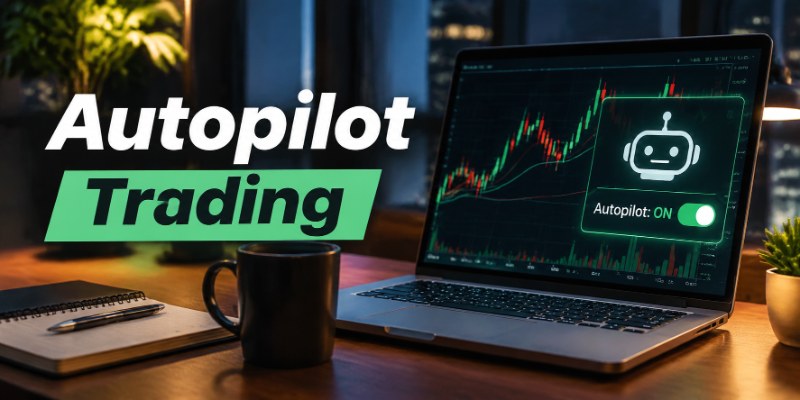
自動取引とは何か、自動取引システムはどのように機能するのか、そのメリットとリスク、そしてソフトウェアに取引を任せる前に考慮すべき点について学びましょう。
自動取引とは、投資家やトレーダーが、あらかじめ定義されたルール、アルゴリズム、または人工知能を用いて、売買の意思決定を自動化できる仕組みです。市場を監視し、すべての注文を手動で発注する代わりに、特定の条件が満たされたときにソフトウェアが取引を実行するように設定できます。自動化によって時間を節約し、取引の一貫性を高めることはできますが、利益を保証したり、取引リスクを排除したりするものではありません。
目次
自動取引の仕組み、利用可能なツール、そして自動化戦略に実際のお金を投入する前に、自動化がどのような点で問題を引き起こす可能性があるかを理解しておくことが不可欠です。
オートパイロット取引とは、金融市場における取引手法の一つで、ソフトウェアが事前に定義された指示に基づいて注文を自動的に実行するものです。これらの指示には、テクニカル指標、価格変動、市場状況、リスク制限、あるいはアルゴリズムによって生成されたシグナルなどが含まれます。
これは一般的に、自動取引、アルゴリズム取引、取引ボットと関連付けられます。これらの用語は重複する部分もありますが、必ずしも同一ではありません。
基本的な考え方はシンプルだ。トレーダーは戦略を定義し、それを取引プラットフォームまたはブローカーに接続し、ソフトウェアに執行を任せる。
自動取引は、外国為替、株式、仮想通貨、商品、その他の金融市場で利用できます。
自動取引システムは、一連の手順に従って取引機会を特定し、取引を実行します。
1. 取引ルールを設定する
トレーダーはポジションのエントリーとエグジットの条件を設定します。例えば、ある戦略では、50日移動平均線が200日移動平均線を上回ったときに株式を購入する、といったことが考えられます。
2. 市場データを分析する
このソフトウェアは、価格、取引量、テクニカル指標、その他の関連シグナルなど、リアルタイムまたは遅延された市場情報を監視します。
3. 取引シグナルを生成する
市場状況が戦略のルールに合致すると、システムは潜在的な買いまたは売りの機会を特定します。
4. 注文を実行する
自動執行が有効になっている場合、ソフトウェアは接続されているブローカーまたは取引所を通じて注文を送信します。
5. 空席の管理
Depending on the system, it can also set stop-loss orders, take-profit levels, trailing stops, and position sizes.
6. Monitor performance
The software records trading activity and performance data. Traders can review results and adjust their strategies when necessary.
The exact process depends on the platform, broker, strategy, and level of automation.
Not all automated trading systems work in the same way. Some follow simple technical rules, while others use complex models to analyze market conditions.
| System | How It Works | Common Use |
|---|---|---|
| Rule-based bots | Follow predefined trading conditions | Stocks and forex |
| Algorithmic trading | Use mathematical models to identify opportunities | Stocks, futures and forex |
| AI-powered trading | Analyze data using machine learning models | Multiple markets |
| Copy trading | Automatically replicate another trader's positions | Forex and crypto |
| Grid trading bots | Place buy and sell orders at predefined price intervals | Cryptocurrency and forex |
| Portfolio rebalancing | Automatically adjust asset allocations | Long-term investing |
Rule-based systems are generally easier to understand because their trading logic is transparent. AI-powered systems may process larger amounts of information, but their decisions can be harder to interpret.
Copy trading is slightly different from conventional algorithmic trading because the system follows another trader's actions rather than independently generating every trading signal.
Automated trading has become increasingly popular because it addresses several challenges associated with manual trading.
Traders do not need to watch charts throughout the day. Once configured, an automated system can monitor markets and execute trades without requiring constant manual intervention.
This can be particularly useful in markets such as forex and cryptocurrency, where trading opportunities may appear outside traditional working hours.
Fear, greed, and impatience can affect trading decisions. Automated systems follow programmed rules rather than reacting emotionally to short-term price movements.
However, automation only reduces emotional interference during execution. Traders can still make emotional decisions when designing or modifying their strategies.
Automated systems can respond to predefined market conditions and submit orders quickly. This can help traders execute strategies that require consistent timing.
Actual execution speed still depends on the broker, platform, internet connection, and market liquidity.
A trading system can apply the same rules repeatedly without becoming distracted or changing its approach because of fatigue.
This makes it easier to evaluate whether a strategy performs as expected over time.
Depending on the platform, one system can monitor several currency pairs, stocks, or cryptocurrency markets simultaneously.
This gives traders more flexibility than manually tracking every market.
Despite its advantages, autopilot trading introduces risks that traders should understand before using it with real capital.
An automated system cannot predict every market movement. Even a strategy with strong historical results can lose money when market conditions change.
A profitable backtest does not guarantee future performance.
Software errors, server outages, internet disruptions, and API connection problems can interrupt automated execution.
In some cases, a system may fail to close a position or submit an order as intended.
Some trading strategies are adjusted repeatedly until they perform exceptionally well on historical data. This is known as overfitting.
The problem is that the strategy may have learned patterns specific to the historical period rather than identifying conditions that are likely to continue.
Automated systems may struggle during sudden price movements, unexpected economic announcements, or periods of reduced liquidity.
A strategy designed for stable market conditions may behave very differently during periods of high volatility.
Not every platform advertising autopilot trading is legitimate. Some services promote unrealistic returns, guaranteed profits, or completely hands-free income.
Traders should verify the provider, understand how funds are held, and avoid giving account credentials or API permissions to untrusted services.
Both approaches have advantages, and the better choice depends on trading experience, strategy, and personal preferences.
| Feature | Autopilot Trading | Manual Trading |
|---|---|---|
| Trade execution | Automated | Trader places orders |
| Market monitoring | Software-based | Usually manual |
| Emotional influence | Reduced during execution | Can be significant |
| Flexibility | Limited by programmed rules | Can adapt immediately |
| Time commitment | Lower after setup | Usually higher |
| Strategy control | Depends on system configuration | Direct trader control |
| Technical requirements | Software and connectivity | Trading platform and analysis skills |
Autopilot trading is useful for strategies with clear, repeatable rules. Manual trading may be more suitable when decisions require interpretation of unusual events, changing market sentiment, or discretionary analysis.
Some traders combine both approaches by using automated execution while retaining control over strategy selection and risk management.
Getting started with autopilot trading requires more than choosing a bot and connecting a brokerage account. A reliable setup should begin with a clearly defined strategy and a controlled testing process.
First, decide which financial market you want to trade.
Each market has different trading hours, liquidity conditions, transaction costs, and volatility.
Choose a platform that supports your preferred market and offers the automation features you need.
Important features include:
Avoid choosing a platform simply because it advertises high returns or claims to use advanced AI technology.
Your trading strategy determines how the system identifies opportunities.
Common approaches include trend following, moving average crossovers, breakout trading, and mean reversion.
Before enabling automatic execution, understand the conditions that trigger trades and the circumstances in which the strategy may perform poorly.
Backtesting allows you to evaluate a strategy using historical market data. It can help identify weaknesses, although historical results do not guarantee future performance.
A demo account provides another testing opportunity by allowing you to observe automated trades without risking real money.
Pay attention to transaction fees, spreads, slippage, maximum drawdown, and losing streaks rather than focusing only on the win rate.
Risk management should be established before activating an automated system.
Consider setting:
Also, establish conditions that automatically stop trading if the system behaves unexpectedly.
Autopilot trading does not mean leaving your account unattended indefinitely.
Review trading history, account balances, execution quality, and strategy performance. Check for unusual activity and confirm that the system continues to follow your intended rules.
The best autopilot trading software depends on your experience, preferred market, and trading objectives. Instead of looking for a system that promises the highest returns, focus on transparency, reliability, and risk controls.
| Evaluation Factor | What to Look For |
|---|---|
| Regulation | A properly registered broker or service provider where required |
| Security | Secure authentication and controlled account permissions |
| Transparency | Clear explanation of trading strategies |
| Backtesting | Historical performance analysis |
| Risk management | Stop-loss and exposure limits |
| Fees | Transparent subscription, trading, and performance fees |
| Customer support | Accessible technical assistance |
| Compatibility | Support for your broker and preferred market |
One particularly important consideration is account access.
If a trading bot connects through an API, use the minimum permissions necessary. Avoid granting withdrawal permissions unless there is a compelling and independently verified reason.
For third-party auto-trading services, check the provider's registration and background. FINRA specifically warns investors about unregistered services advertising unrealistic returns and recommends checking firms through BrokerCheck.
Autopilot trading can be suitable for beginners, but it is not necessarily an easier or safer way to enter financial markets.
Beginners may benefit from automated execution because it reduces the need to monitor charts constantly. However, they still need to understand market movements, trading costs, leverage, and risk management.
A common mistake is assuming that automation removes the need for trading knowledge. In reality, a trader who does not understand the strategy may struggle to recognize when a system is producing unexpected results.
For beginners, a sensible approach is to start with a demo account, use a simple strategy, and avoid leverage until the risks are fully understood.
Autopilot trading itself is a legitimate trading method. Banks, institutional investors, hedge funds, and individual traders all use automated systems.
However, the industry also attracts fraudulent services.
Warning signs include:
The Commodity Futures Trading Commission (CFTC) has specifically warned that AI trading bots cannot predict the future or guarantee investment returns. Its advisory, AI Won't Turn Trading Bots into Money Machines, explains how scammers use AI-related claims to attract investors.
Investors should also review the FINRA guidance on auto-trading services and the SEC's information on automated investment tools before giving a third party access to their accounts.
はい、自動取引戦略は利益を生み出すこともありますが、損失を出す可能性もあります。結果は、戦略、市場状況、執行コスト、リスク管理によって異なります。
市場とプラットフォームによって異なります。仮想通貨市場は24時間体制で取引されていますが、株式市場は一般的に取引所の取引スケジュールに従います。外国為替取引は、平日はほぼ24時間利用可能です。
どちらの方法も、必ずしも優れているとは言えません。自動取引は一貫性と利便性を提供しますが、手動取引は異常な市場状況を判断する際に、より高い柔軟性を提供します。
必ずしもそうとは限りません。多くのプラットフォームでは、既製のトレーディングボット、ビジュアル戦略構築ツール、プリセットされたトレーディングルールを提供しています。ただし、よりカスタマイズされたシステムを開発する際には、プログラミングの知識が役立ちます。
最低入金額は一律ではありません。ブローカー、プラットフォーム、市場、戦略によって異なります。まずはデモ口座を開設し、資金を投入する前に最低入金額とポジションサイズの要件を確認してください。
自動取引は、市場分析、注文執行、ポジション管理を自動化することで、金融市場へのアクセスを容易にします。時間の節約、感情的な判断の軽減、そしてトレーダーが一貫した戦略に従うことを可能にします。
しかし、自動化によって市場リスクが排除されたり、より良い結果が保証されるわけではありません。戦略の質、プラットフォームの信頼性、リスク管理の有効性が依然として最も重要な要素です。
自動取引を検討している人にとって、最適な出発点は、透明性の高いシステム、適切にテストされた戦略、そしてデモ口座です。自動化は、情報に基づいた取引判断を支援するものであり、代替するものではありません。

728 RM B 7/F GEE LOK IND BLDG NO 34 HUNG TO RD KWUN TONG KLN HONG KONG


株式、FX、コモディティ、先物、債券、ETF、仮想通貨などの金融資産を取引する際の損失のリスクは大きなものになる可能性があります。ブローカーに預け入れた資金が完全に失われる可能性があります。したがって、お客様の状況と財政的資源に照らして、そのような取引が適しているかどうかを慎重に検討していただく必要があります.
十分なデューデリジェンスを実施するか、ファイナンシャルアドバイザーに相談することなく、投資を検討するべきではありません。お客様の財務状況や投資ニーズを把握していないため、当社の ウェブコンテンツはお客様に適しない可能性があります。当社の財務情報には遅延があったり、不正確な情報が含まれている可能性があるため、取引や投資に関する決定については、お客様が全責任を負う必要があります。当社はお客様の資本の損失に対して責任を負いません。
ウェブサイトから許可を得ずに、ウェブサイトのグラフィック、テキスト、または商標をコピーすることはできません。このウェブサイトに組み込まれているコンテンツまたはデータの知的財産権は、そのプロバイダーおよび交換業者に帰属します。




