


- USDX
- XAUUSD
- XAGUSD
- WTI


マーケット情報
分析
ユーザー
7x24
経済カレンダー
教育
データ
- 名前
- 最新値
- 戻る








ペーパートレーディングとは何か、その仕組み、メリットとデメリット、そして初心者が実際のお金をリスクにさらすことなく取引戦略を練習する方法について学びましょう。
ペーパートレーディングとは、実際のお金を使わずに金融資産の売買を練習する方法です。トレーダーは、ブローカーに実際に注文を出す代わりに、仮想資金を使って取引をシミュレーションし、自分の判断が市場でどのような結果をもたらすかを追跡します。
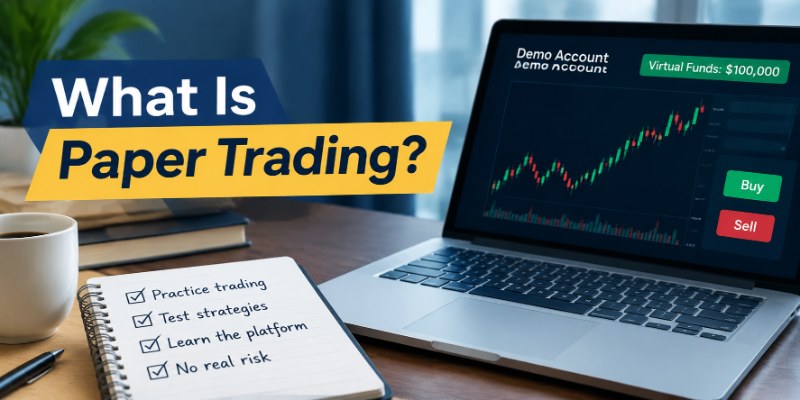
これは、資金を投入する前に取引の仕組みを理解したい初心者にとって特に役立ちます。経験豊富なトレーダーも、新しい戦略を試したり、リスク管理を練習したり、取引プラットフォームに慣れるために、デモ取引を利用しています。
しかし、シミュレーション結果は必ずしも実際の市場の動きを反映するとは限りません。ペーパートレーディングの仕組み、そこから学べること、そして限界を理解することで、より効果的に活用できるようになります。
目次
ペーパートレーディングとは、実際のお金をリスクにさらすことなく、金融市場での取引をシミュレーションする手法のことである。この用語は元々、架空の売買注文を紙に書き留め、その結果を追跡することを指していた。
現在、ほとんどのペーパートレーディングはオンライン証券取引プラットフォームやトレーディングシミュレーターを通じて行われている。これらのツールは、一定額の仮想資金を備えた仮想口座を提供し、ユーザーは実際の市場価格または遅延市場価格を用いて仮想取引を行うことができる。
例えば、仮想資金として5万ドルを持っていて、株式取引の練習をしたいとします。その残高のうち5000ドルを使って、1株100ドルの株を50株購入するシミュレーションを行うことができます。
株価が110ドルまで上昇した場合、取引手数料控除前のシミュレーションでは500ドルの利益が計上されます。株価が90ドルまで下落した場合は、500ドルの損失が計上されます。
どちらの結果も、あなたの実際の銀行口座には影響しません。
ペーパートレーディングは、以下のような様々な金融商品の練習に利用できます。
利用できる具体的な取引手段は、取引シミュレーターまたは証券会社のプラットフォームによって異なります。
ペーパートレーディングは、取引に実際の資金ではなく仮想通貨を使用する点を除けば、一般的にライブトレーディングと同じ基本的なプロセスに従います。
Most platforms provide a simulated trading account with an initial balance. Users can then select assets, place hypothetical orders, and monitor their positions.
Here is how the process typically works:
1. Open a paper trading account
Choose a broker or trading platform that offers a demo or paper trading account. Some platforms provide access without requiring an initial deposit.
2. Receive virtual funds
The platform assigns a simulated balance, such as $10,000, $50,000, or $100,000. This money is used exclusively for practice.
3. Select an asset
Choose a stock, currency pair, ETF, cryptocurrency, or another supported instrument that you want to trade.
4. Place simulated orders
You can practice different order types, including:
The platform processes these hypothetical orders according to its simulation rules.
5. Monitor performance
Track your open positions, account balance, unrealized gains and losses, and completed transactions.
6. Review and improve
Analyze your trades to identify mistakes, evaluate strategies, and improve your decision-making.
The objective is not simply to generate virtual profits. It is to develop a repeatable trading process that can be evaluated under different market conditions.
Although paper trading attempts to replicate real market activity, several important differences can affect the results.
| Feature | Paper Trading | Live Trading |
|---|---|---|
| Capital | Virtual funds | Real money |
| Financial risk | No direct capital loss | Actual financial losses possible |
| Execution | Simulated | Real market execution |
| Emotions | Usually less intense | Fear and greed affect decisions |
| Slippage | May be simplified | Can affect actual execution prices |
| Commissions | May be excluded or simulated | Depend on broker and instrument |
| Market impact | Usually not reflected | Can affect execution |
| Profits and losses | Hypothetical | Real financial outcomes |
One of the biggest differences is execution quality.
In a simulated account, an order may be filled at the displayed market price. In live trading, prices can change before an order is executed, particularly during periods of high volatility.
Liquidity also matters. A simulated platform may allow a trader to enter or exit a position easily, even when a real market would have limited buyers or sellers.
For this reason, profitable paper trading results should not be treated as proof that the same strategy will make money with real capital.
Paper trading offers several advantages, especially for people who are new to financial markets.
Beginners can learn how to read price charts, understand market movements, and place different types of orders without worrying about losing money.
It also provides an opportunity to become familiar with trading platforms, technical indicators, and other tools.
Traders can experiment with different approaches, such as:
For example, a trader could test whether buying a stock when its 50-day moving average crosses above its 200-day moving average produces consistent results.
By recording multiple trades, they can evaluate whether the strategy performs well across different market conditions.
Paper trading allows users to practice setting stop-loss and take-profit levels, calculating position sizes, and managing exposure.
A trader can also test how much of their simulated account they are willing to risk on a single position.
These habits can help establish a more disciplined approach before real money is involved.
Placing the first trade can feel intimidating, particularly for beginners unfamiliar with order execution and market volatility.
A simulated account provides an opportunity to become comfortable with the process. Traders can make mistakes, review them, and try different approaches without losing capital.
Paper trading can also help users evaluate brokerage platforms before opening or funding a live account.
They can explore charting features, available order types, watchlists, research tools, and the overall trading interface.
For example, Interactive Brokers provides a paper trading environment that allows users to practice with many of its trading tools. Its paper trading guide also explains some differences between simulated and live executions.
Despite its benefits, paper trading has limitations that traders should understand.
This is arguably the biggest limitation.
When trading with virtual money, a $1,000 loss may feel insignificant. When the same amount comes out of a real account, the emotional impact can be very different.
Fear, greed, hesitation, and overconfidence can influence decisions in live markets. A simulator cannot fully reproduce these psychological pressures.
Paper trading platforms do not always replicate real-world execution.
For example, a simulated order might be filled immediately at the displayed price, even when a live order could experience slippage or partial execution.
Some platforms also simplify liquidity, order-book depth, and transaction costs.
A trader who earns consistent simulated profits may assume they are ready to trade with substantial capital.
However, good results in a demo account do not guarantee similar performance in live markets.
A strategy that works under simulated conditions may struggle when execution costs, changing liquidity, and emotional pressure are introduced.
Depending on the platform, certain order types, financial instruments, and account functions may not be supported.
For example, complex options strategies or specialized order types may behave differently from their live-market equivalents.
Traders should check the simulator's limitations before using its results to evaluate a strategy.
Getting started does not require a large investment or advanced financial knowledge. A basic simulator and a clear practice plan are usually enough.
Follow these steps:
Step 1: Choose a trading simulator
Find a platform that supports the financial instruments you want to practice. Check whether it provides real-time market data, realistic order types, and performance tracking.
Step 2: Set a realistic virtual balance
Choose an amount similar to the capital you might eventually use in live trading.
For example, if you expect to start with $2,000, practicing with $100,000 in virtual funds may create unrealistic expectations about position sizing and risk.
Step 3: Develop a trading strategy
Before placing trades, establish clear rules for:
Step 4: Record every trade
Maintain a trading journal with the entry price, exit price, position size, trading reason, and outcome.
You should also record whether you followed your original trading plan.
Step 5: Review your performance
After completing a reasonable number of trades, evaluate your results.
Useful metrics include:
Looking at these metrics together provides a better picture of performance than focusing on profits alone.
There is no universal period for paper trading. The appropriate duration depends on your experience, strategy, and ability to follow a consistent trading plan.
Beginners may benefit from practicing for several weeks or months. More experienced traders might need less time when testing a familiar strategy on a new platform.
Rather than focusing exclusively on the number of days, consider whether you can demonstrate the following:
A strategy that produces a few profitable trades is not necessarily reliable. A larger sample of consistently executed trades provides more useful information.
Moving from paper trading to live trading should be based on preparation rather than excitement about simulated profits.
Before making the transition, make sure you understand the risks of the instruments you intend to trade and have demonstrated discipline in your simulated account.
If you decide to start trading live, consider these precautions:
It is also important to remember that live trading can involve commissions, spreads, financing charges, and other costs that reduce returns.
Paper trading should prepare you for these realities, not create the expectation that trading will be easy.
Paper trading and backtesting are both used to evaluate trading strategies, but they work differently.
| Feature | Paper Trading | Backtesting |
|---|---|---|
| Market data | Live or delayed prices | Historical prices |
| Trading process | Simulated trades | Historical simulation |
| Main purpose | Practice and strategy testing | Evaluate past strategy performance |
| Market conditions | Current or simulated | Previously recorded |
| Main limitation | Unrealistic execution and emotions | Overfitting and historical bias |
Paper trading evaluates how a strategy performs in a simulated trading environment as market prices change.
Backtesting applies trading rules to historical market data to estimate how the strategy would have performed in the past.
Both methods can be useful. Backtesting helps identify potentially promising strategies, while paper trading provides an opportunity to test them under current market conditions.
Yes. Paper trading is a useful starting point for beginners and a practical testing tool for experienced traders.
It helps users understand trading platforms, practice order execution, test strategies, and develop risk management habits without risking actual capital.
However, it should not be treated as a guarantee of future trading success. Simulated accounts cannot fully reproduce the financial pressure, execution challenges, and emotional decisions involved in live markets.
The best approach is to treat paper trading as a training environment. Focus on developing a consistent process, measuring performance, and learning from mistakes rather than chasing virtual profits.
Once you can follow your trading rules consistently, you will have a stronger foundation for deciding whether to move into live trading.
Many brokers and trading platforms offer free paper trading accounts. However, some platforms may require registration, a funded brokerage account, or a subscription to access certain features.
No. Paper trading uses virtual funds, so profits are simulated rather than withdrawable. To earn or lose actual money, you must place trades in a live account.
Yes. It allows beginners to learn market basics, practice placing orders, and understand trading strategies without risking their savings.
これらの用語はしばしば同義語として使われます。デモ口座とは、ブローカーやプラットフォームが提供する模擬取引環境のことで、ペーパートレーディングとは、実際の資金を使わずに取引をテストするより広範な手法を指します。
一部のプラットフォームはリアルタイム価格を提供していますが、他のプラットフォームは遅延データや過去のデータを使用しています。シミュレーション結果に頼る前に、プラットフォームの市場データポリシーを確認してください。
いいえ。ペーパートレーディングは戦略の評価に役立ちますが、シミュレーションによるパフォーマンスは将来の利益を保証するものではありません。実際の取引コスト、流動性、心理的要因によって結果は異なる可能性があります。

728 RM B 7/F GEE LOK IND BLDG NO 34 HUNG TO RD KWUN TONG KLN HONG KONG


株式、FX、コモディティ、先物、債券、ETF、仮想通貨などの金融資産を取引する際の損失のリスクは大きなものになる可能性があります。ブローカーに預け入れた資金が完全に失われる可能性があります。したがって、お客様の状況と財政的資源に照らして、そのような取引が適しているかどうかを慎重に検討していただく必要があります.
十分なデューデリジェンスを実施するか、ファイナンシャルアドバイザーに相談することなく、投資を検討するべきではありません。お客様の財務状況や投資ニーズを把握していないため、当社の ウェブコンテンツはお客様に適しない可能性があります。当社の財務情報には遅延があったり、不正確な情報が含まれている可能性があるため、取引や投資に関する決定については、お客様が全責任を負う必要があります。当社はお客様の資本の損失に対して責任を負いません。
ウェブサイトから許可を得ずに、ウェブサイトのグラフィック、テキスト、または商標をコピーすることはできません。このウェブサイトに組み込まれているコンテンツまたはデータの知的財産権は、そのプロバイダーおよび交換業者に帰属します。




