


- WTI
- XAUUSD
- XAGUSD
- USDX


マーケット情報
分析
ユーザー
7x24
経済カレンダー
教育
データ
- 名前
- 最新値
- 戻る








次のビットコイン半減期はいつ?予想される2028年の日付、マイニング報酬の変更、過去の価格動向、そして次の半減期がBTCにどのような影響を与える可能性があるのかを探ってみましょう。
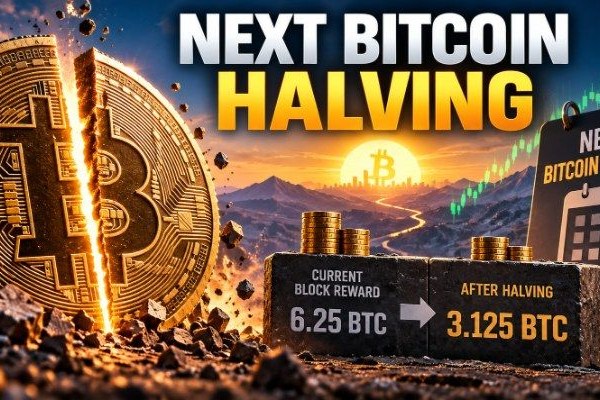
次回のビットコイン半減期は2028年4月に予定されており、マイニング報酬は1ブロックあたり3.125BTCから1.5625BTCに減少します。これは2024年4月のイベントに続く、ビットコインにとって5回目の半減期となります。過去の半減期はしばしば価格の大幅な上昇に先行してきましたが、次回の半減期は機関投資家、ETF、そして世界経済情勢の影響をますます受ける市場環境で発生するでしょう。
目次
次回のビットコイン半減期は、ブロック高1,050,000の時点で2028年4月に発生すると予想されています。ビットコインのブロックチェーンは半減期を暦日ではなくブロック数で計測するため、正確な日付は確定していません。
ビットコインは、およそ10分ごとに新しいブロックを生成するように設計されています。しかし、実際のブロック生成時間は変動するため、ネットワークの発展に伴い、半減期の予定日も変化する可能性があります。
今後のイベントに関する主な詳細は以下のとおりです。
| 詳細 | 次回のビットコイン半減期 |
|---|---|
| 予定日 | 2028年4月 |
| 半減数 | 5番目 |
| ブロックの高さ | 1,050,000 |
| 現在のブロック補助金 | 3.125 BTC |
| 新たなブロック補助金 | 1.5625 BTC |
| 削減 | 50% |
| 前回の半減 | 2024年4月20日 |
| 半減期後 | 2032年に予定 |
最も重要な数字は1,050,000です。ビットコインがこのブロック高に達すると、ネットワークのコンセンサスルールに基づいて補助金の削減が自動的に行われます。
ビットコインの半減期は予測可能ですが、その日付はあくまでも推定値です。
ネットワークは、平均ブロック生成時間を約10分に保つため、2,016ブロックごとにマイニング難易度を調整します。そのため、マイニング能力の変化やブロック生成時間の短期的な変動によって、予定日が前後する可能性があります。
イベントが近づくにつれて、予測はより正確になるはずです。
ビットコインの半減期とは、マイナーがブロックチェーンにブロックを追加することに成功した際に付与される新規ビットコインの数を減らすことである。
このプロセスは21万ブロックごとに自動的に実行され、およそ4年に1回程度です。これはビットコインの供給量を制御するメカニズムの一つです。
ビットコインが2009年に誕生した当初、マイナーは1ブロックあたり50BTCを受け取っていた。この報酬はその後4回半減され、現在は3.125BTCとなっている。
2028年の半減期により、ブロック補助金は1.5625 BTCに減少します。
ビットコインの目標とする1日144ブロックのペースでは、変化は以下のようになります。
| 供給指標 | 半減期前 | 半減後 |
|---|---|---|
| ブロックあたりのBTC | 3.125 BTC | 1.5625 BTC |
| 1日あたりの新規BTC | 450 BTC | 225 BTC |
| 年間新規BTC | 約164,250 BTC | 約82,125 BTC |
| 年間発行額の削減 | — | 50% |
これらの数値は概算値であり、実際の1日のブロック生産量は変動します。
The halving does not reduce the Bitcoin already held by investors. It only slows the creation of new coins.
Miners also continue collecting transaction fees, which are separate from the block subsidy.
Bitcoin has a maximum supply of 21 million coins. Halving gradually reduces new issuance until the final fraction of a bitcoin is expected to be mined around 2140.
After the 2028 event, annual new issuance will represent a smaller percentage of the circulating supply.
That increasing scarcity is central to Bitcoin's investment narrative. However, a slower supply increase does not automatically translate into higher prices. Demand still determines whether buyers are willing to pay more.
Bitcoin has experienced four halvings since its launch. Each reduced mining rewards by 50%, but the surrounding market conditions were very different.
| Halving Date | Block Height | Reward Before | Reward After |
|---|---|---|---|
| November 28, 2012 | 210,000 | 50 BTC | 25 BTC |
| July 9, 2016 | 420,000 | 25 BTC | 12.5 BTC |
| May 11, 2020 | 630,000 | 12.5 BTC | 6.25 BTC |
| April 20, 2024 | 840,000 | 6.25 BTC | 3.125 BTC |
| April 2028 (estimated) | 1,050,000 | 3.125 BTC | 1.5625 BTC |
Historical halving dates and reward changes can be checked against the Bitcoin blockchain explorer.
Bitcoin's first three halvings were followed by substantial bull markets, although the gains did not occur immediately.
These figures illustrate a historical pattern rather than a reliable formula for future returns.
The 2024 cycle was particularly important because the launch of US spot Bitcoin ETFs in January 2024 gave investors a new route into the market.
Bitcoin's price was no longer responding only to its traditional four-year supply cycle. Institutional flows, monetary policy, and broader financial-market conditions were also playing significant roles.
Will Bitcoin rise after the next halving?
A lower issuance rate could support prices if demand remains stable or increases. However, the halving itself does not guarantee a rally, and investors should be cautious about treating previous cycles as a forecast.
The impact will depend on how much buying demand exists when the new supply reduction takes effect.
In a bullish environment, strong ETF inflows, growing institutional adoption, and favorable financial conditions could amplify the impact of reduced issuance.
After the halving, miners will collectively receive approximately 225 fewer newly created BTC per day than before.
If demand rises while new supply falls, Bitcoin could face upward price pressure.
The strongest bullish case would involve sustained investment inflows rather than speculation around the halving date alone.
Bitcoin could also experience a relatively muted reaction.
Because the halving is known years in advance, some of its expected impact may already be reflected in market prices.
ETF inflows, interest rates, liquidity, and investor positioning could matter more than the mechanical supply reduction over shorter periods.
In this scenario, Bitcoin might trade sideways or experience substantial volatility before establishing a longer-term trend.
A halving cannot protect Bitcoin from falling demand.
If financial conditions tighten, investors reduce risk exposure, or institutional funds experience sustained outflows, Bitcoin could decline despite slower issuance.
Mining companies could also face financial pressure as their block subsidy revenue falls.
The important distinction is that Bitcoin's supply schedule is predictable, but its future demand is not.
A new all-time high is possible, but there is no dependable price target that can be calculated from the halving alone.
Bitcoin's historical cycles suggest that major rallies can develop over the months following a halving. Yet the sample size is small, and each cycle has involved different economic conditions.
Rather than relying on a specific prediction, investors should watch whether institutional demand, market liquidity, and broader risk appetite support a sustained increase in Bitcoin's market capitalization.
The fifth Bitcoin halving will occur in a more mature market than the early events of 2012 and 2016.
Three factors deserve particular attention.
Spot Bitcoin ETFs have made Bitcoin accessible through conventional brokerage and investment accounts.
By 2028, ETF flows could have a significant influence on Bitcoin demand. Large inflows might absorb newly issued coins and existing market supply, while outflows could create selling pressure.
Investors can follow US spot Bitcoin ETF developments through official SEC filings.
Bitcoin often reacts to changes in financial conditions.
Lower interest rates and improving liquidity may encourage investment in risk assets, including cryptocurrencies. Conversely, tighter monetary policy can weaken demand.
A halving that coincides with favorable economic conditions may produce a different market response from one occurring during a recession or financial crisis.
Mining companies will face another sharp reduction in block subsidy revenue in 2028.
Miners with expensive electricity, older equipment, or heavy debt may struggle if Bitcoin's price and transaction-fee revenue do not compensate for the decline.
Some could shut down equipment or sell BTC reserves to cover operating costs.
Bitcoin's difficulty adjustment helps the network adapt to changes in mining participation, but the transition may still affect mining profitability and industry competition.
Investors do not need to wait until the halving date to understand its potential impact.
Several indicators can provide a clearer picture of market conditions as 2028 approaches:
For long-term investors, the halving may be more useful as a supply milestone than as a precise trading signal.
Trying to buy immediately before the event or sell at an assumed cycle peak carries significant timing risk.
The next Bitcoin halving is expected in April 2028, at block height 1,050,000. The exact date will depend on how quickly new blocks are mined.
No. Bitcoin's next scheduled halving is in 2028. There was no halving in 2025 either; the previous event took place in April 2024.
The block subsidy will fall from 3.125 BTC to 1.5625 BTC. Miners will still receive transaction fees in addition to the subsidy.
Bitcoin has historically experienced major rallies following several halvings, but future gains are not guaranteed. Demand, institutional investment, and economic conditions will be crucial.
The following halving is expected around 2032, at block height 1,260,000, when the block subsidy will fall to 0.78125 BTC.
The next Bitcoin halving in April 2028 will cut new BTC issuance in half, reducing the block subsidy to 1.5625 BTC. It is a predictable change to Bitcoin's supply, not a guaranteed catalyst for higher prices.
より重要な問題は、投資家の需要が十分に増加し、供給量の減少が意味を持つようになるかどうかだ。2028年までに、ETFの資金流入、機関投資家の参加、そして世界的な流動性が、半減期そのものと同じくらいビットコインの価格に影響を与える可能性がある。
投資家にとって、このイベントは注目に値するが、開催日そのものよりも、それを取り巻くより広範な市場環境の方が重要になるだろう。

728 RM B 7/F GEE LOK IND BLDG NO 34 HUNG TO RD KWUN TONG KLN HONG KONG


株式、FX、コモディティ、先物、債券、ETF、仮想通貨などの金融資産を取引する際の損失のリスクは大きなものになる可能性があります。ブローカーに預け入れた資金が完全に失われる可能性があります。したがって、お客様の状況と財政的資源に照らして、そのような取引が適しているかどうかを慎重に検討していただく必要があります.
十分なデューデリジェンスを実施するか、ファイナンシャルアドバイザーに相談することなく、投資を検討するべきではありません。お客様の財務状況や投資ニーズを把握していないため、当社の ウェブコンテンツはお客様に適しない可能性があります。当社の財務情報には遅延があったり、不正確な情報が含まれている可能性があるため、取引や投資に関する決定については、お客様が全責任を負う必要があります。当社はお客様の資本の損失に対して責任を負いません。
ウェブサイトから許可を得ずに、ウェブサイトのグラフィック、テキスト、または商標をコピーすることはできません。このウェブサイトに組み込まれているコンテンツまたはデータの知的財産権は、そのプロバイダーおよび交換業者に帰属します。




