


- WTI
- XAUUSD
- XAGUSD
- USDX


マーケット情報
分析
ユーザー
7x24
経済カレンダー
教育
データ
- 名前
- 最新値
- 戻る








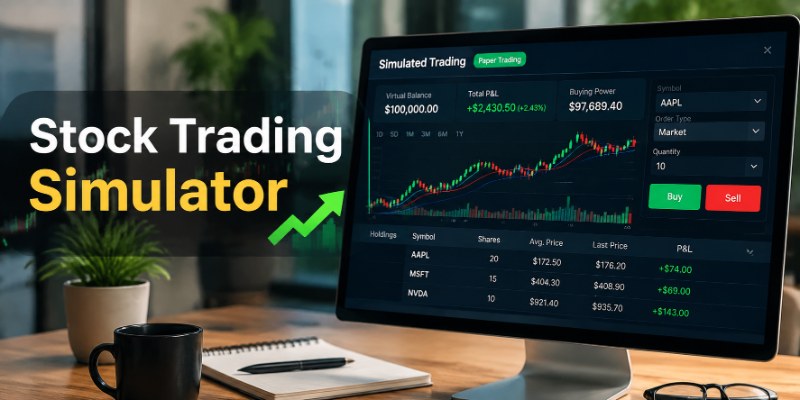
株式取引シミュレーターの仕組みを学び、その利点と限界を探り、実際のお金をリスクにさらすことなく取引戦略を練習する方法を発見しましょう。
株式取引シミュレーターを使えば、投資家は実際の資金ではなく仮想通貨を使って株式の売買を行うことができます。株価の変動、注文の発注、ポートフォリオのパフォーマンスなど、株式市場の多くの側面を再現しており、初心者が取引の仕組みを実践的に学ぶことができます。
目次
投資初心者の方でも、新しい戦略を試したい方でも、シミュレーターは実際のお金を投入する前に経験を積むのに役立ちます。しかし、シミュレーターの使い方を学ぶことと同じくらい、その限界を理解することも重要です。
株式取引シミュレーターとは、仮想資金を使って現実世界の株式取引を再現するプラットフォームです。ユーザーは、実際のお金をリスクにさらすことなく、仮想ポートフォリオを作成し、売買注文を出し、パフォーマンスを追跡することができます。
ほとんどのシミュレーターは、株価の変動を反映するために、リアルタイムまたは遅延された市場データを使用します。また、指値注文、ストップ注文、成行注文、ポートフォリオ配分といった取引機能を再現するものもあります。
例えば、仮想資金として10万ドルを持っているとします。1株150ドルで取引されている会社の株を20株購入することにしました。シミュレーターは仮想残高から3,000ドルを差し引き、その株をポートフォリオに追加します。
株価が165ドルまで上昇した場合、シミュレーション上のポジションは300ドルの利益を得ます。株価が135ドルまで下落した場合、ポジションは300ドルの損失となります。
結果は仮想的なものですが、このプロセスを通して、価格変動がポートフォリオにどのような影響を与えるかを理解することができます。
ほとんどの株式取引シミュレーターは、シンプルな手順で操作できます。プラットフォームによってインターフェースは異なりますが、基本的な操作感はオンライン証券口座の利用と似ています。
まず、模擬取引を提供するプラットフォームに登録しましょう。専用のデモ取引口座を提供するサービスもあれば、通常の証券取引プラットフォームにシミュレーション機能を組み込んでいるサービスもあります。
1万ドル、5万ドル、10万ドルなど、あらかじめ決められた仮想残高を受け取る場合があります。
アカウントの準備ができたら、企業名またはティッカーシンボルを使って株式を検索してください。
シミュレーターの種類に応じて、個別企業、上場投資信託(ETF)、またはその他のサポートされている金融商品を選択できます。
購入または売却したい株式数を選択し、注文の種類を選択してください。
一般的な注文の種類は以下のとおりです。
After placing an order, the simulator updates your virtual holdings and cash balance.
You can monitor unrealized gains and losses, completed trades, portfolio allocation, and overall performance.
The final step is evaluating your decisions. Look at which trades performed well, where you made mistakes, and whether your strategy followed its original rules.
Keeping a trading journal can make this process more useful by recording entry prices, exit prices, reasons for entering trades, and lessons learned.
A stock trading simulator offers several advantages, particularly for beginners who want to understand the market before investing their savings.
The most obvious benefit is that you do not lose real money when a simulated trade goes wrong.
You can experiment with different stocks, order types, and strategies without worrying about losing your initial capital.
This makes simulators useful for learning basic trading mechanics and understanding how market movements affect investments.
Brokerage platforms can be confusing for new investors. Charts, order tickets, watchlists, indicators, and portfolio tools may take time to understand.
A simulator provides an opportunity to become familiar with these features before placing actual orders.
You can use simulated accounts to experiment with various approaches, including:
Comparing results across different strategies helps you understand which approaches deserve further research.
Successful trading involves more than choosing stocks that might rise. Position sizing, stop-loss placement, and portfolio diversification also matter.
A simulator allows you to practice these techniques and see how different risk levels affect your overall results.
Repeated practice can help beginners become more comfortable with market terminology, price fluctuations, and order execution.
However, confidence should come from consistent decision-making rather than a few profitable simulated trades.
Not every simulator provides the same experience. Some focus on basic investing education, while others offer advanced charting and realistic order execution.
The following features are worth considering:
| Feature | Why It Matters |
|---|---|
| Virtual starting balance | Provides capital for simulated trades |
| Real-time market data | Helps reflect current market movements |
| Advanced charts | Supports technical analysis |
| Multiple order types | Allows realistic order practice |
| Portfolio tracking | Measures gains, losses, and allocation |
| Trading history | Helps review previous decisions |
| Performance reports | Identifies strengths and weaknesses |
| Mobile access | Allows practice across devices |
For beginners, an easy-to-use interface and reliable price data are usually more important than a large collection of advanced indicators.
More experienced traders may prefer platforms with customizable charts, technical indicators, and detailed performance statistics.
Although simulators recreate many brokerage functions, simulated trading is not identical to trading with real money.
| Category | Stock Trading Simulator | Real Trading |
|---|---|---|
| Capital | Virtual money | Actual money |
| Financial risk | No direct trading loss | Possible loss of capital |
| Emotional pressure | Usually lower | Often higher |
| Order execution | Simulated | Subject to market conditions |
| Slippage | May be simplified | Can affect actual execution |
| Trading fees | May be excluded | May apply |
| Dividends | Depends on platform | Actual eligible payments |
| Market impact | Usually not modeled | Can affect execution |
One important difference is emotional pressure.
When using virtual funds, it is easier to hold a losing position or take an aggressive trade because there is no real financial consequence. With actual money, fear and greed can influence decisions.
Execution quality is another limitation. Simulators may not fully reproduce bid-ask spreads, liquidity constraints, partial fills, or rapid price changes.
As a result, strong simulated performance does not guarantee similar results in a live account.
Different simulators are designed for different trading styles and experience levels.
These platforms run directly in a web browser and generally do not require installing desktop software.
They are convenient for beginners who want to practice buying and selling stocks, monitor virtual portfolios, and learn basic market concepts.
Some online brokers provide simulated accounts alongside their regular brokerage services.
For example, Interactive Brokers offers a paper trading environment that allows users to explore trading tools and strategies without executing actual exchange transactions. Its simulator also has certain differences from live trading. Learn about paper trading.
These platforms can be particularly useful for traders who eventually plan to use the same broker for real investments.
Mobile simulators allow users to practice trading through smartphones or tablets.
They are suitable for people who want to monitor virtual positions, check stock prices, and learn how trading applications work while away from their computers.
Some simulators are designed primarily for financial education rather than professional trading.
For example, The Stock Market Game provides a virtual investment portfolio that helps participants learn about stocks, bonds, diversification, and investment decisions.
Its official website provides information about its educational programs and simulated investing activities.
Simply placing virtual trades is not enough to develop good trading habits. A structured approach makes practice more valuable.
Here are five steps to get better results.
Choose a virtual balance that reflects the amount you could reasonably afford to invest.
For example, if you expect to start investing with $5,000, avoid practicing with $500,000 in virtual funds.
A realistic balance encourages more practical decisions about position sizing, diversification, and risk exposure.
Decide what type of trading you want to practice before placing your first order.
For example:
Each approach requires different research methods and risk management techniques.
Practice using the same risk controls you would apply to a real account.
For example, you might decide not to risk more than 1% of your simulated portfolio on a single trade.
If your virtual portfolio contains $10,000, that would mean limiting the planned loss on an individual trade to $100.
The exact percentage depends on your strategy and risk tolerance. The important point is to establish rules and follow them consistently.
Maintain a trading journal that includes:
This information helps you identify recurring mistakes and evaluate whether your strategy is actually working.
Do not judge a strategy based on two or three successful trades.
Instead, review a meaningful sample of trades across different market conditions.
Pay attention to metrics such as:
A strategy with a high win rate is not necessarily profitable if its occasional losses are significantly larger than its gains.
Simulated trading can create bad habits if users focus only on virtual profits.
Here are several mistakes worth avoiding.
1. Taking excessive risks: Virtual money can encourage traders to make oversized bets or use aggressive strategies. These habits can become dangerous when real capital is involved.
2. Ignoring trading costs: Some simulators do not accurately account for commissions, spreads, financing costs, or other expenses. Include realistic estimated costs when evaluating performance.
3. Overtrading: Making frequent trades simply because there is no financial risk can encourage impulsive decisions. Every trade should have a clear reason.
4. Changing strategies too frequently: Switching approaches after every losing trade makes it difficult to determine whether a strategy has a genuine advantage.
5. Confusing simulated profits with real trading ability: A profitable virtual portfolio does not prove that a trader can consistently make money in live markets.
6. Ignoring market conditions: A strategy that performs well during a strong bull market may struggle during periods of volatility or prolonged declines.
A stock trading simulator and a backtesting tool are related but serve different purposes.
A stock trading simulator allows you to practice placing trades in a simulated market environment, often using current or delayed market data.
Backtesting evaluates a trading strategy against historical market data to estimate how it would have performed in the past.
| Category | Stock Trading Simulator | Backtesting |
|---|---|---|
| Data | Live, delayed, or simulated | Historical |
| Main purpose | Practice trading | Evaluate strategies |
| Order placement | Simulated orders | Historical trade calculations |
| Decision-making | Often manual | Usually rule-based |
| Market conditions | Current or simulated | Past market conditions |
| Main benefit | Develop practical skills | Identify historical strategy performance |
For example, if you have a moving-average crossover strategy, backtesting can show how it performed over the previous five years.
A simulator can then help you practice applying the same rules to current market conditions.
Using both tools provides a more complete approach to trading preparation.
There is no universal period that determines when someone is ready to trade with real money.
Some beginners practice for several weeks, while others need several months to understand market behavior and develop consistent habits.
Rather than focusing entirely on time, consider whether you can meet the following conditions:
これらの条件を満たした後でも、貯蓄の大部分をすぐに投入するのではなく、少額から始めることを検討してください。
段階的な移行を行うことで、シミュレーションと実環境での実行の違いを理解しやすくなります。
多くの株式取引シミュレーターは、基本的な仮想取引機能を無料で提供しています。一部の証券会社と連携したプラットフォームではアカウント登録が必要となり、高度なツールや市場データ購読には追加料金が発生する場合があります。
いいえ。標準的な株式取引シミュレーターは仮想資金を使用するため、シミュレーションで得た利益を現金として引き出すことは通常できません。その目的は、練習環境を提供することです。
はい。ペーパートレーディングは、シミュレーション取引の別称です。どちらも、実際の資金を投入することなく、金融商品の売買練習を行うことができます。
リアルタイムの市場データを使用するものもあれば、遅延価格やシミュレーションされた市場情報に依存するものもあります。取引戦略を評価するためにプラットフォームを使用する前に、そのプラットフォームのデータポリシーを確認してください。
はい。初心者は、シミュレーターを使って株式注文の仕組みを学び、ポートフォリオ管理を理解し、資金を投入した証券口座を開設する前に基本的な投資戦略を練習することができます。
これらは市場活動の有用な近似値を提供するが、必ずしも実際の執行状況を再現するとは限らない。流動性、スリッページ、注文の約定状況、感情的なプレッシャーの違いは、実際の取引結果に影響を与える可能性がある。
株式取引シミュレーターは、実際のお金をリスクにさらすことなく、株式市場を理解し、取引スキルを磨きたい人にとって、実践的な出発点となる。
ここは、注文執行を学び、戦略をテストし、リスク管理を実践し、投資判断を評価するための場を提供する。
しかし、仮想的な利益は将来の成功の証明として捉えるべきではありません。シミュレーターの最も価値のある使い方は、可能な限り高い収益を上げることではなく、実際のお金が投入される前に評価・改善できる、一貫性のあるプロセスを開発することです。

728 RM B 7/F GEE LOK IND BLDG NO 34 HUNG TO RD KWUN TONG KLN HONG KONG


株式、FX、コモディティ、先物、債券、ETF、仮想通貨などの金融資産を取引する際の損失のリスクは大きなものになる可能性があります。ブローカーに預け入れた資金が完全に失われる可能性があります。したがって、お客様の状況と財政的資源に照らして、そのような取引が適しているかどうかを慎重に検討していただく必要があります.
十分なデューデリジェンスを実施するか、ファイナンシャルアドバイザーに相談することなく、投資を検討するべきではありません。お客様の財務状況や投資ニーズを把握していないため、当社の ウェブコンテンツはお客様に適しない可能性があります。当社の財務情報には遅延があったり、不正確な情報が含まれている可能性があるため、取引や投資に関する決定については、お客様が全責任を負う必要があります。当社はお客様の資本の損失に対して責任を負いません。
ウェブサイトから許可を得ずに、ウェブサイトのグラフィック、テキスト、または商標をコピーすることはできません。このウェブサイトに組み込まれているコンテンツまたはデータの知的財産権は、そのプロバイダーおよび交換業者に帰属します。




