


- WTI
- XAUUSD
- XAGUSD
- USDX


マーケット情報
分析
ユーザー
7x24
経済カレンダー
教育
データ
- 名前
- 最新値
- 戻る








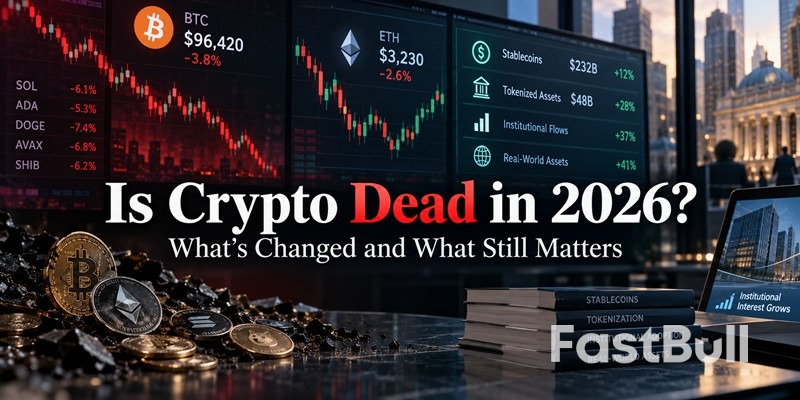
仮想通貨は2026年に終焉を迎えるのか?アルトコインが苦戦している理由、ステーブルコインとウォール街が市場をどのように変えているのか、そして仮想通貨は復活できるのかを探ります。
2026年に仮想通貨は復活を遂げたものの、誰もがそう感じたわけではなかった。価格は回復したものの、多くの小規模コインは依然として高値を大きく下回り、取引量も回復に追いつかなかった。一方、ステーブルコインやトークン化された資産は着実に勢力を拡大し続けた。仮想通貨は衰退に向かっているのか、それとも業界は投資家の予想以上に速いスピードで変化しているのか?
目次
いいえ、仮想通貨は終わっていません。しかし、価格が回復したからといって、すべてが正常に戻ったわけではありません。
CoinGeckoの2026年第3四半期レポートによると、仮想通貨市場全体は第3四半期に39.6%増加し、9月末までに約3兆ドルに達した。これは2024年末以来、最も好調な四半期パフォーマンスとなった。
しかし、多くの小規模な仮想通貨は以前の高値を回復するのに苦戦し、主要取引所での取引活動は価格上昇に追いつかなかった。
同時に、ステーブルコイン決済、トークン化された投資商品、ブロックチェーンベースの金融サービスも発展を続けた。
仮想通貨が消滅するわけではない。しかし、あらゆる仮想通貨を保有することが必ずしも利益につながるのかどうかは、ますます不確実になってきている。
小規模な仮想通貨を保有する投資家にとって、市場の回復はもどかしく感じられるかもしれない。ビットコインは上昇し、いくつかの主要なトークンは注目を集めるものの、ポートフォリオの大部分はほとんど改善されないからだ。
問題の一部は、お金がどこに使われているかにある。
ビットコインには確立された市場と規制されたETFがあり、投資家が容易に投資機会を得られるようになっている。一方、規模の小さい仮想通貨は、注目度、流動性、そしてより大きなリスクを負う意思のある買い手を求めて競争しなければならない。
彼らはまた、増え続けるトークンの供給量との競争にも直面している。新しいプロジェクトが絶えず立ち上げられる一方で、既存のプロジェクトも定期的なロック解除を通じて追加のコインをリリースしている。
需要が回復しても、供給過剰は価格に重くのしかかる可能性がある。
一部のアルトコインは依然として好調で、特に活発な取引が行われているものはそうだ。しかし、ビットコインの上昇が他のすべてのコインの上昇を保証するものではなくなった。
暗号資産市場が回復しているからといって、必ずしもアルトコインポートフォリオが回復するとは限らない。
2026年に関して特に興味深い点の1つは、価格と取引活動がこれまでとは全く異なる動きを見せていることだ。
第3四半期において、暗号資産の時価総額は39.6%増加した。しかしながら、上位10の中央集権型取引所における現物取引量は、前四半期比14.2%減の1兆6500億ドルとなった。
一方、主要な中央集権型取引所における無期限先物取引の未決済ポジションは40.6%増加した。
言い換えれば、市場価格は上昇し、現物取引の活動は弱まり、レバレッジをかけたエクスポージャーは増加していた。
That doesn't prove fewer people were trading. The figures measure trading value and outstanding positions, not the number of investors.
But they do explain why a strong rally doesn't always feel like a full-blown bull market.
Prices can rise sharply without the same broad excitement that defined earlier crypto booms.
Remember when almost every new meme coin, NFT collection, or blockchain launch seemed to promise the next big opportunity?
That excitement hasn't vanished. Meme coins still attract traders, and new tokens can still deliver spectacular short-term gains.
What's changed is how selective the attention has become.
Investors have watched countless tokens collapse, NFT collections lose most of their value, and projects disappear once the initial excitement faded.
There is still plenty of speculation in crypto. But the assumption that almost everything will eventually rise together is harder to justify.
And for anyone who bought near the top of a previous cycle, even a strong market rebound may not feel like much of a comeback.
Stablecoins used to be discussed mainly as a convenient way to move money between crypto exchanges.
That's still an important use, but their role is expanding.
As of October 28, 2026, the stablecoin market was worth approximately $299 billion, according to DefiLlama.
One practical example comes from Visa. The payments company reported more than 160 stablecoin-linked card programs worldwide, with payment volume across those programs growing nearly 200% year over year in its fiscal second quarter.
These cards can allow people to spend funds held in stablecoins through familiar payment networks, without merchants needing to accept cryptocurrency directly.
Businesses are also exploring stablecoins for international transfers, supplier payments, and managing funds across borders.
That doesn't mean stablecoins have replaced banks. Most stablecoin activity still involves trading and financial transfers rather than ordinary retail purchases.
But their usefulness no longer depends entirely on people speculating about crypto prices.
Someone might use a stablecoin to move dollars across borders without having any interest in whether Bitcoin will rally next week.
Another change is happening away from the usual crypto trading headlines.
Traditional financial assets, including government bonds and investment funds, are increasingly being brought onto blockchains.
According to RWA.xyz, the market value of distributed tokenized real-world assets reached approximately $39.7 billion on October 28, 2026. Tokenized U.S. Treasury products accounted for around $14.6 billion.
A useful example is Franklin Templeton's OnChain U.S. Government Money Fund.
Instead of issuing an ordinary cryptocurrency with no underlying asset, the fund uses blockchain technology to record ownership of a traditional investment product. Each BENJI token represents one share of the fund.
Investors are buying into a money market fund, not betting on the price of a new speculative coin.
Blockchain technology helps manage ownership records and eligible transfers, while the investment itself remains subject to financial rules and risks.
That's why asset tokenization matters. It offers another way to handle existing financial products, rather than inventing entirely new ones.
There's also an important difference for crypto investors: a tokenized fund can succeed without creating much demand for unrelated cryptocurrencies.
Institutional participation has become a bigger part of crypto, especially through Bitcoin and Ethereum ETFs.
But institutional money isn't an endless source of buying pressure.
On October 21, U.S. spot Bitcoin ETFs recorded approximately $524.8 million in net inflows. The following day, they saw $635.6 million in net outflows, according to Farside Investors.
Those figures reflect net fund share creations and redemptions, not the amount of Bitcoin traded on exchanges. Still, the sharp reversal shows how quickly demand for ETF exposure can change.
Financial institutions are interested in Bitcoin, tokenized funds, stablecoin settlement, and other blockchain services.
That doesn't mean they're interested in buying every altcoin.
A bank can use blockchain technology without holding a large portfolio of speculative tokens. A company can adopt stablecoin payments without investing in the cryptocurrency associated with the network.
Wall Street adopting crypto technology is not the same as Wall Street buying every crypto token.
Bitcoin and Ethereum remain important, although for different reasons.
Bitcoin's appeal comes from its limited supply, global network, and ability to transfer value without relying on a single central issuer.
Supporters see it as a long-term store of value. Critics point to its volatility and question how reliable that role really is.
Ethereum serves a different purpose. It supports smart contracts, stablecoins, decentralized exchanges, lending platforms, and other blockchain applications.
But Ethereum isn't without challenges. Competing networks offer cheaper or faster transactions, while activity moving to layer-2 networks raises questions about how much value ultimately benefits ETH itself.
Neither Bitcoin nor Ethereum is guaranteed to keep its position forever.
What separates them from many smaller projects is that they already have established networks and reasons for people to use them beyond short-term speculation.
This may be the biggest misunderstanding in crypto investing.
A blockchain can become more useful without its token becoming a better investment.
Imagine a financial company launches a successful tokenized investment fund.
Customers use it because they want access to an investment product. The fund manager earns fees, while blockchain technology handles ownership records and transfers.
But does that success require investors to buy and hold a separate cryptocurrency?
Not necessarily.
The same issue appears across crypto. A network might process millions of transactions, yet its token could struggle if transaction fees are tiny, new supply keeps entering circulation, or users have little reason to hold it.
Even growing protocol revenue doesn't automatically solve the problem. Investors still need to understand who receives that revenue and whether the token benefits from it.
That's why partnership announcements and impressive transaction numbers don't always lead to higher prices.
The question isn't simply whether people use a blockchain.
It's how that usage creates lasting demand for the token.
There's a popular belief that investors only need to survive the bear market and wait for the next bull run.
Unfortunately, that doesn't work for every cryptocurrency.
Some tokens reached extraordinary prices because buyers expected even higher prices, not because the projects had built something people needed.
Once the excitement disappears, there may be little reason for buyers to return.
Other projects face more practical problems: declining users, poor liquidity, large upcoming token unlocks, or competitors offering better services.
A token that falls 90% needs a 900% gain just to return to its starting price.
And surviving as a project isn't the same as recovering as an investment.
A development team can keep building while its token continues losing value.
Before assuming a beaten-down coin is a bargain, it's worth checking whether people still use the product without token rewards, how much supply remains locked, and whether growing activity actually benefits the token.
The next bull market may create new winners. It doesn't have to rescue the old ones.
Crypto doesn't necessarily need another groundbreaking invention to rally.
Improving market confidence, easier financial conditions, and stronger demand could be enough to bring buyers back.
Sustained ETF inflows might support major cryptocurrencies, while clearer regulations could make certain crypto products more accessible to financial institutions.
Real-world applications also matter, particularly if stablecoins and blockchain-based financial services continue attracting users.
But these developments won't necessarily move together.
ブロックチェーンが日常的に広く普及する前に、暗号資産市場は再び投機的な強気相場を迎える可能性がある。同様に、トークン価格が低迷する中でも、ブロックチェーンの普及は進む可能性がある。
再び大幅な上昇局面が訪れる可能性はある。しかし、それが2021年と同じような展開になるとは限らず、また、同じ仮想通貨が上昇を牽引するとも限らない。
価格が下がるだけでは十分ではないだろう。
より懸念すべき兆候は、人々が仮想通貨を使う理由を徐々に失っていくことだろう。
ステーブルコインの送金が何年も減少し続け、主要なブロックチェーンネットワークが開発者を失い、トークン化された金融商品が放棄され、市場環境が改善した後でもアプリケーションがユーザーを維持できなくなる状況を想像してみてください。
それは単なる弱気相場以上の、より深刻な事態を示唆しているだろう。
数ヶ月間、取引が低迷したり価格が下落したりすることは、ほぼすべての投機市場で起こり得る。
しかし、実際のユーザー数、有用なアプリケーション、開発、流動性の持続的な低下は、無視するのがはるかに難しくなるだろう。
今のところ、ステーブルコインの動向、トークン化された投資商品、そして確立されたブロックチェーンネットワークは、この業界が依然として果たすべき役割を持っていることを示唆している。
2026年においても仮想通貨は検討に値する可能性があるが、価格が大幅に下落したという理由だけで仮想通貨を購入するのはリスクの高い戦略である。
ビットコイン、イーサリアム、そしてその他の小規模なトークンは、それぞれ用途、市場構造、リスクが異なります。すべてを同じように評価すべきではありません。
仮想通貨を購入する前に、次の3つの質問を自問してみる価値があります。
これらの質問は、次にどのコインが値上がりするかを教えてくれるものではありません。
しかし、それらは存在意義のあるプロジェクトと、ほぼ完全に新規購入者に依存しているプロジェクトを区別するのに役立つ。
価格も依然として重要です。たとえ有用な仮想通貨であっても、高すぎる価格で購入すれば、投資としては不向きです。
暗号資産市場は多くの投資家にとって今年も厳しい年となったが、業界が消滅する兆しは全く見られない。ビットコインとイーサリアムは依然として重要な存在であり、ステーブルコインは実用的な用途を見出しつつあり、従来の金融資産もブロックチェーンへと移行しつつある。
変化したのは、業界の成長とトークン価格の関係性だ。ブロックチェーンが成功したからといって、投資が成功するとは限らない。2026年に問われるのは、仮想通貨が生き残るかどうかではなく、ブームが去った後もどの部分が重要であり続けるかということだ。

728 RM B 7/F GEE LOK IND BLDG NO 34 HUNG TO RD KWUN TONG KLN HONG KONG


株式、FX、コモディティ、先物、債券、ETF、仮想通貨などの金融資産を取引する際の損失のリスクは大きなものになる可能性があります。ブローカーに預け入れた資金が完全に失われる可能性があります。したがって、お客様の状況と財政的資源に照らして、そのような取引が適しているかどうかを慎重に検討していただく必要があります.
十分なデューデリジェンスを実施するか、ファイナンシャルアドバイザーに相談することなく、投資を検討するべきではありません。お客様の財務状況や投資ニーズを把握していないため、当社の ウェブコンテンツはお客様に適しない可能性があります。当社の財務情報には遅延があったり、不正確な情報が含まれている可能性があるため、取引や投資に関する決定については、お客様が全責任を負う必要があります。当社はお客様の資本の損失に対して責任を負いません。
ウェブサイトから許可を得ずに、ウェブサイトのグラフィック、テキスト、または商標をコピーすることはできません。このウェブサイトに組み込まれているコンテンツまたはデータの知的財産権は、そのプロバイダーおよび交換業者に帰属します。