


- WTI
- XAUUSD
- XAGUSD
- USDX


マーケット情報
分析
ユーザー
7x24
経済カレンダー
教育
データ
- 名前
- 最新値
- 戻る









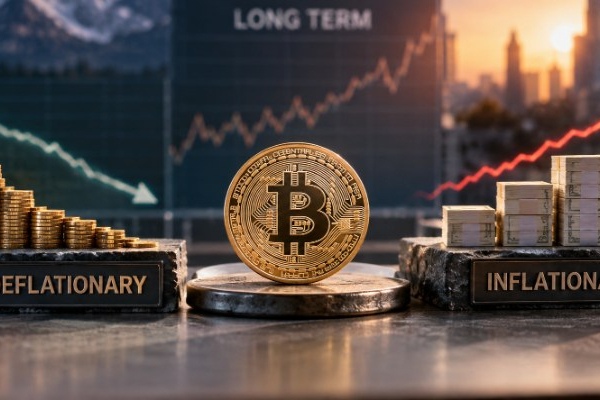
ビットコインは長期的に見てデフレ型なのか、それともインフレ型なのか?その固定供給量、半減期、インフレ対策、そしてそれらが将来の価値に及ぼす影響について探ってみましょう。
ビットコインには供給量の上限が定められているにもかかわらず、新たなコインが流通し続けている。では、ビットコインは長期的に見てインフレ的かデフレ的か?答えは、供給量、購買力、市場価格のどれに着目するかによって異なる。この違いは、ビットコインの長期的な投資可能性を評価する上で重要となる。
目次
ビットコインは現在、流通量という点ではインフレ的ですが、そのインフレ率は低下し続けています。長期的には、ビットコインは供給量が永続的に増加する資産ではなく、供給量が固定される資産となるように設計されています。
中央銀行が大量に発行できる従来の通貨とは異なり、ビットコインの最大供給量は約2100万BTCに制限されている。新たなコインはマイニング報酬によって流通するが、その報酬は約4年ごとに半減される。
これは重要な違いを生み出す。ビットコインの供給量は依然として増加しているが、その増加ペースは鈍化しているのだ。
2026年10月現在、ビットコインマイナーは、マイニングに成功したブロックごとに、取引手数料を除いて3.125BTCを受け取ります。この報酬は、2024年4月の半減期時に設定されました。
約10分ごとにブロックが生成されるため、ネットワークは平均して1日に約450BTCの新規発行を行っている。
つまり、ビットコインは依然として通貨インフレの影響を受けているということだ。しかし、その年間供給量の増加率は現在1%を大きく下回っており、初期の頃と比べて大幅に低い。
ビットコインがデフレ的な評判を得ているのは、その供給量が厳しく制限されており、新規発行量が継続的に減少しているためである。
しかし、インフレ率の低下と実際のデフレには技術的な違いがある。
ビットコインは、供給量の上限が固定されたディスインフレ資産と表現するのが最も適切だろう。
そのプロトコルは、既存のコインを定期的に破棄するものではありません。しかし、秘密鍵を紛失すると、ビットコインが有効な流通から永久に失われ、取引可能な量が減少する可能性があります。
ビットコインの通貨構造は、法定通貨やトークン発行が継続的に行われている暗号通貨とは大きく異なっている。
| 特徴 | ビットコイン | Inflationary Fiat Currency | Inflationary Cryptocurrency |
|---|---|---|---|
| Supply limit | Approximately 21 million BTC | Generally no fixed limit | Depends on protocol |
| New issuance | Declines through halvings | Controlled by monetary authorities | Set by token economics |
| Inflation rate | Programmatically declines | Changes with policy and economic conditions | May be fixed or variable |
| Supply flexibility | Highly restricted | Flexible | Depends on governance |
| Long-term value | Depends on demand and scarcity | Depends on purchasing power and economic conditions | Depends on utility, demand, and supply |
Bitcoin's advantage is predictability. Investors can estimate how many new coins will enter circulation years in advance.
However, predictable supply does not guarantee price appreciation.
A cryptocurrency with an expanding supply can still outperform Bitcoin if demand grows faster than issuance. Likewise, Bitcoin can lose value despite its limited supply if investor demand weakens.
Fiat currency supply is influenced by central bank policies, commercial bank lending, and broader financial conditions.
Bitcoin operates differently. Its issuance schedule does not respond to recessions, inflation reports, unemployment, or interest rate decisions.
This makes Bitcoin less flexible as a monetary system, but it also removes the possibility of discretionary monetary expansion under its existing consensus rules.
For investors concerned about currency debasement, that predictability is part of Bitcoin's appeal.
Bitcoin's halving mechanism is central to its long-term supply outlook.
Approximately every 210,000 blocks, the mining reward is reduced by 50%. This gradually lowers the number of new coins entering the market.
| Halving | Block Reward | Supply Impact |
|---|---|---|
| 2012 | 25 BTC | First reduction in issuance |
| 2016 | 12.5 BTC | Further slowdown |
| 2020 | 6.25 BTC | Lower annual supply growth |
| 2024 | 3.125 BTC | Current reward as of October 2026 |
| 2028 (expected) | 1.5625 BTC | Another 50% reduction |
| 2032 (expected) | 0.78125 BTC | Issuance slows further |
The exact dates of future halvings depend on block production, but the reward reductions themselves are built into Bitcoin's protocol.
By approximately 2140, nearly all 21 million BTC are expected to have been mined. Miners would then rely primarily on transaction fees rather than newly issued Bitcoin.
The original Bitcoin white paper explains the system's underlying monetary and transaction design.
Not necessarily.
Halving reduces new supply, but Bitcoin's price depends on the relationship between available supply and market demand.
Previous halvings have been followed by major bull markets, although those periods also involved changes in liquidity, investor participation, and broader economic conditions.
As Bitcoin matures, each halving removes a smaller amount of new issuance relative to the existing supply.
That could reduce the direct market impact of future halvings, especially as institutional trading and macroeconomic forces become more influential.
Bitcoin's limited supply may support its long-term value, but scarcity alone is not enough.
The key question is whether demand for Bitcoin will remain strong or increase as new issuance approaches zero.
Bitcoin's fixed supply means it cannot be expanded simply because demand rises.
If more investors, institutions, and businesses want to hold Bitcoin while available supply remains constrained, its price could increase.
That is the foundation of the digital gold argument.
However, Bitcoin is not guaranteed to gain purchasing power over time. Its price can decline substantially during periods of weak demand, even while its supply growth continues slowing.
Bitcoin's monetary scarcity is predictable. Its future purchasing power is not.
Bitcoin is frequently described as an inflation hedge because its supply cannot be increased in response to government spending or monetary policy.
But being resistant to supply inflation is different from reliably protecting investors against consumer price inflation.
During periods of rising inflation, Bitcoin may appreciate if investors seek alternatives to traditional currencies. It may also fall if central banks raise interest rates and financial conditions tighten.
Research and commentary from the Federal Reserve provide broader context on inflation, monetary policy, and interest rates.
Bitcoin's long-term inflation-hedge argument is therefore stronger as a monetary design principle than as a consistently demonstrated short-term market relationship.
A limited supply cannot support prices indefinitely without sufficient demand.
If adoption slows, institutional interest weakens, or investors shift toward competing assets, Bitcoin could experience prolonged price declines.
This is why comparing Bitcoin with inflationary assets requires looking beyond token issuance.
Network security, liquidity, adoption, regulation, and investor confidence all matter.
Bitcoin's supply schedule is independent of central banks, but its market price is not independent of monetary policy.
Interest rates influence how investors allocate capital between cash, bonds, equities, and riskier assets such as cryptocurrencies.
When central banks raise interest rates, government bonds and cash-like investments may offer more attractive returns.
Higher borrowing costs can also reduce liquidity and discourage speculative investment.
Bitcoin does not generate contractual interest or dividends. As a result, higher yields on traditional assets can increase the opportunity cost of holding it.
This helps explain why Bitcoin can struggle during periods of monetary tightening, despite its limited supply.
Falling interest rates can make risk assets more attractive, particularly when investors expect easier financial conditions and greater liquidity.
Bitcoin may benefit from those conditions, although the relationship is not automatic.
If rates are falling because the economy is entering a severe recession, investors may initially sell Bitcoin alongside equities to raise cash.
The reason behind an interest rate change can matter as much as the change itself.
No.
Bitcoin's issuance is unaffected by monetary policy, but its price is determined in markets where investors respond to economic conditions.
A fixed supply can protect against arbitrary increases in Bitcoin issuance. It cannot protect against changes in demand, liquidity, or risk appetite.
Bitcoin's supply outlook is relatively straightforward. Its price outlook is much less certain.
Over the next decade, new issuance will continue declining through scheduled halvings. That makes Bitcoin increasingly scarce in terms of new supply entering the market.
Whether this translates into higher prices depends on adoption and demand.
| Scenario | Main Assumptions | Potential Long-Term Outcome |
|---|---|---|
| Bullish | Institutional adoption expands, demand rises, and supply remains constrained | Scarcity supports sustained price appreciation |
| Base | Adoption grows gradually, while macroeconomic cycles continue | Long-term growth with substantial volatility |
| Bearish | Demand weakens, regulation restricts adoption, or confidence deteriorates | Extended stagnation or significant price declines |
These are qualitative scenarios, not numerical price targets.
The bullish case depends on Bitcoin becoming a more widely held store of value. The bearish case highlights the possibility that scarcity alone may not sustain demand.
Bitcoin's protocol does not include a standard mechanism that permanently reduces the total issued supply.
However, coins can become inaccessible when private keys are lost or when funds are sent to addresses that cannot be spent from.
As new issuance approaches zero, continued losses could theoretically cause the effectively accessible supply to decline.
That would make Bitcoin deflationary in a practical sense, even though its recorded supply would not necessarily decrease.
The extent of permanently lost Bitcoin is difficult to measure accurately.
Bitcoin's supply structure gives it a distinctive investment case, but it should not be confused with a guarantee of long-term returns.
For investors considering Bitcoin over five, ten, or twenty years, several factors deserve attention.
米国証券取引委員会( SEC )が2024年1月に発表した声明は、米国における現物ビットコイン上場投資商品(ETP)の承認を確認する一方で、この承認はビットコインそのものへの支持を意味するものではないことを強調している。
ビットコインには重大なリスクも伴う。
その価格は大幅な下落に見舞われる可能性があり、投資家は損失を相殺するための契約上の収入源を持たない。規制の変更、保管機関の不備、競争の激化、市場心理の変化など、あらゆる要因がその価値に影響を与える可能性がある。
マイニングのインセンティブをめぐる長期的な問題も存在する。ブロック報酬が減少するにつれ、取引手数料はビットコインのセキュリティモデルにおいてますます重要な役割を果たすようになるだろう。
手数料収入が、非常に長期にわたって健全な鉱業エコシステムを維持するのに十分かどうかは、依然として重要な検討事項である。
長期投資家にとって最も有効なアプローチは、半減期サイクルだけに頼るのではなく、ビットコインの希少性、価格変動性、普及の見込み、ポートフォリオにおける役割などを総合的に評価することである。
ビットコインは現在も新規発行が続いているため、技術的にはインフレ的な性質を持っています。しかし、発行が実質的に終了する2140年頃まで、インフレ率は徐々に低下していくようにプログラムされています。
つまり、ビットコインは供給量が積極的に減少していく暗号通貨ではなく、供給量が固定されたディスインフレ資産ということになる。
長期的に見れば、この希少性は、普及と需要が拡大し続ける限り、ビットコインの価値を支える可能性がある。しかし、価格上昇、インフレ対策、あるいは優れた投資収益を保証するものではない。
その違いは単純だ。ビットコインの将来の供給量はほぼ予測可能である。しかし、将来の価格は予測不可能だ。

728 RM B 7/F GEE LOK IND BLDG NO 34 HUNG TO RD KWUN TONG KLN HONG KONG


株式、FX、コモディティ、先物、債券、ETF、仮想通貨などの金融資産を取引する際の損失のリスクは大きなものになる可能性があります。ブローカーに預け入れた資金が完全に失われる可能性があります。したがって、お客様の状況と財政的資源に照らして、そのような取引が適しているかどうかを慎重に検討していただく必要があります.
十分なデューデリジェンスを実施するか、ファイナンシャルアドバイザーに相談することなく、投資を検討するべきではありません。お客様の財務状況や投資ニーズを把握していないため、当社の ウェブコンテンツはお客様に適しない可能性があります。当社の財務情報には遅延があったり、不正確な情報が含まれている可能性があるため、取引や投資に関する決定については、お客様が全責任を負う必要があります。当社はお客様の資本の損失に対して責任を負いません。
ウェブサイトから許可を得ずに、ウェブサイトのグラフィック、テキスト、または商標をコピーすることはできません。このウェブサイトに組み込まれているコンテンツまたはデータの知的財産権は、そのプロバイダーおよび交換業者に帰属します。