


- WTI
- XAUUSD
- XAGUSD
- USDX



マーケット情報
分析
ユーザー
7x24
経済カレンダー
教育
データ
- 名前
- 最新値
- 戻る










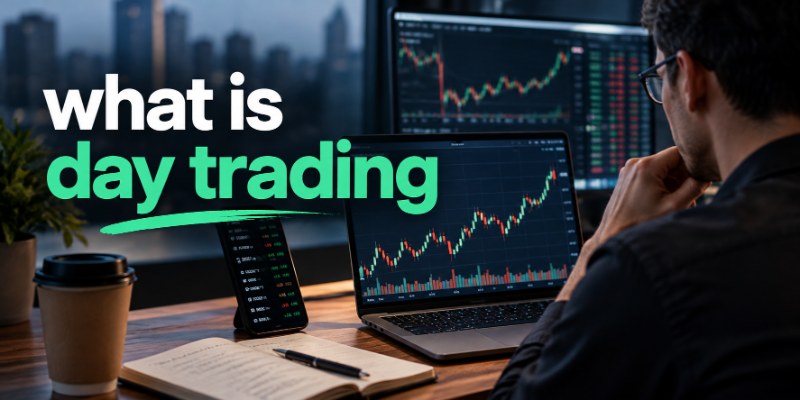
デイトレードとは?デイトレーダーがどのように利益を上げているのか、一般的な戦略、事例、リスク、そしてデイトレードを始める方法について学びましょう。
デイトレードとは、通常、短期的な価格変動から利益を得るために、金融資産を同一取引日内に売買することを指します。長期投資とは異なり、デイトレーダーは数年単位ではなく、数分または数時間単位の変動に注目します。短期間で大きな利益を得られる可能性は魅力的ですが、損失も同様に短時間で発生する可能性があります。
目次
デイトレードとは、同じ取引日中にポジションを建てて決済する取引手法です。トレーダーは通常、ポジションを翌日まで持ち越すことを避け、市場が閉まっている間に発生する予期せぬニュースや価格変動によるリスクを軽減します。
デイトレードは、株式、外国為替、仮想通貨、先物、その他の流動性の高い市場で広く行われています。基本的な考え方は単純明快です。短期的な価格変動の機会を見つけ、取引を開始し、取引セッションが終了する前に決済するのです。
しかし、デイトレードは単に資産を購入して価格上昇を期待するだけではありません。市場状況や取引口座によっては、トレーダーは価格下落から利益を得るために空売りを行うこともあります。
デイトレーダーは、価格チャート、取引量、市場ニュース、テクニカル指標などを監視し、潜在的なエントリーポイントとエグジットポイントを特定します。
例えば、トレーダーは株価が重要な抵抗線を突破した後に、価格がさらに上昇すると予想して株を購入するかもしれません。予想通り上昇すれば、トレーダーは利益を上げて売却します。価格が予想と反対方向に動いた場合は、あらかじめ決められた損失で決済することになります。
ほとんどのデイトレーダーは、次のような手順に従います。
目的は、あらゆる市場の動きを予測することではない。潜在的な利益がリスクに見合う機会を見つけることである。
あるトレーダーが1株50ドルで100株の株式を購入したとしましょう。
| 取引詳細 | 額 |
|---|---|
| エントリー価格 | 50.00ドル |
| 購入した株式 | 100 |
| 合計ポジション値 | 5,000ドル |
| 出口価格 | 50.80ドル |
| 粗利益 | 80ドル |
| ポジション価値のリターン | 1.6% |
株価が50.80ドルまで上昇し、ポジションを決済した場合、トレーダーは80ドルの総利益を得る。
しかし、その逆のことも起こり得る。株価が49.20ドルまで下落した場合、同じ取引でも80ドルの損失が発生する。
These figures exclude commissions, spreads, slippage, financing charges, and taxes.
Yes, day trading can be profitable, but consistent profitability is difficult.
A trader might make money on several trades and lose those gains in one poorly managed position. Frequent trading also increases transaction costs, while leverage can magnify losses.
Successful trading depends on more than identifying the right direction. Entry timing, position size, risk management, and execution all affect the outcome.
A profitable day is not necessarily evidence of a profitable trading strategy. Results over many trades matter much more.
Day traders use different strategies depending on market conditions, volatility, and their trading experience.
Scalping involves opening and closing trades over very short periods, sometimes within seconds or minutes.
Scalpers target small price movements and may place numerous trades throughout a session. Because each profit target is relatively small, transaction costs and execution speed can significantly affect results.
Momentum traders look for assets experiencing strong price movements, often following earnings announcements, economic reports, or other market news.
The goal is to enter while momentum remains strong and exit before the movement loses strength.
Momentum trading can be particularly risky when prices reverse suddenly.
Breakout traders watch important support and resistance levels.
For example, if a stock repeatedly struggles to move above $100, a trader might consider buying when the price breaks above that level with strong volume.
However, not every breakout continues. False breakouts can quickly turn profitable-looking trades into losses.
Reversal traders attempt to identify when an existing price trend may be ending.
A trader might look for signs that a sharp decline is losing momentum before entering a long position.
This approach requires caution because prices can continue moving against a position longer than expected.
The biggest difference between these approaches is how long positions are held and what drives trading decisions.
| Feature | Day Trading | Swing Trading | Long-Term Investing |
|---|---|---|---|
| Holding period | Minutes to hours | Days to weeks | Months to years |
| Main focus | Intraday price movements | Short-term market trends | Long-term asset value and growth |
| Trading frequency | Usually high | Moderate | Usually low |
| Overnight exposure | Usually avoided | Common | Expected |
| Time commitment | High during active sessions | Moderate | Generally lower |
| Typical analysis | Technical and market activity | Technical and fundamental | Primarily fundamental |
Day trading generally requires more active monitoring than swing trading or long-term investing.
It also involves more frequent decisions, which can increase both transaction costs and the likelihood of emotional mistakes.
Day trading offers flexibility and frequent opportunities, but it carries substantial financial risks.
Prices can move sharply within seconds, particularly during major economic announcements or company earnings releases.
Even a carefully planned trade can lose money when prices move unexpectedly. Stop-loss orders can help manage risk, but they do not guarantee execution at the requested price.
Some day traders borrow money or use leveraged products to increase their market exposure.
Leverage magnifies both profits and losses.
For example, a 2% adverse price movement on a position with five times leverage can produce a loss equivalent to roughly 10% of the trader's initial exposure-backed capital, before costs.
Depending on the product and account structure, losses can exceed the initial amount committed.
Frequent transactions can create substantial costs through spreads, commissions, slippage, and financing fees.
Psychological pressure is another challenge. Traders may chase rising prices, hold losing positions too long, or increase their position sizes after losses in an attempt to recover quickly.
The Financial Industry Regulatory Authority (FINRA) warns that day trading can be extremely risky, particularly for people with limited resources or trading experience.
Getting started requires more than opening a brokerage account. A trading plan and an understanding of the market are equally important.
Start by selecting the market you want to trade.
Stocks, forex, and cryptocurrencies operate differently in terms of trading hours, liquidity, volatility, and regulation.
Choose a broker that offers appropriate market access, transparent fees, reliable execution, and regulatory protections relevant to your jurisdiction.
Day traders commonly use candlestick charts, trading volume, support and resistance levels, moving averages, and the Relative Strength Index (RSI).
These tools can help identify market conditions, but none can consistently predict future prices.
It is also important to understand market orders, limit orders, stop orders, and how slippage affects execution.
A demo account allows traders to practice placing orders without risking real money.
Use it to test a strategy, become familiar with the trading platform, and track results.
Keep in mind that simulated trading may not accurately reproduce real-market execution, costs, or emotional pressure.
Before entering a trade, determine how much you are prepared to lose.
For example, a trader with a $5,000 account who limits planned risk to 1% per trade would set a $50 risk budget.
That does not guarantee a maximum loss of $50. Price gaps, slippage, and unexpected volatility can cause larger losses.
A trading plan should also define position sizes, entry conditions, exit rules, and a daily loss limit.
If you decide to trade with real money, begin with an amount you can afford to lose.
Record each trade, including the reason for entering, the outcome, transaction costs, and whether you followed your plan.
Reviewing results can help identify recurring mistakes and whether a strategy has performed consistently after costs.
There is no universal minimum amount required for day trading. The amount depends on the market, broker, account type, and applicable regulations.
For US stock margin accounts, the pattern day trader (PDT) framework has historically applied when a customer makes four or more day trades within five business days, provided those trades account for more than 6% of total trading activity during that period.
Under the traditional framework, designated pattern day traders generally must maintain at least $25,000 in account equity.
However, US day-trading margin requirements are subject to regulatory changes. Traders should check the latest applicable rules and their broker's requirements before relying on a particular threshold.
The FINRA day trading guidance provides information on regulatory requirements.
It may be possible to place certain trades with $100, depending on the broker, product, and jurisdiction.
However, a small account provides limited flexibility, and trading costs can consume a meaningful portion of potential profits.
Using high leverage to compensate for limited capital can make the account especially vulnerable to rapid losses.
For beginners, practicing with a demo account is generally a more practical starting point than trying to generate meaningful income from a very small balance.
Day trading may appeal to people who enjoy analyzing financial markets, making quick decisions, and actively managing risk.
But it is not an easy alternative to a regular income or a reliable way to build wealth quickly.
Unlike long-term investing, day trading demands frequent attention, disciplined execution, and the ability to accept losses without abandoning a strategy.
For people who cannot monitor markets regularly or tolerate substantial losses, swing trading or diversified long-term investing may be more suitable.
The key question is not whether day trading can make money, but whether the potential returns justify the time, costs, and financial risks involved.
Day trading is not automatically gambling, but trading without a tested strategy or risk controls can resemble gambling. Even disciplined traders face uncertainty and losses.
デイトレードは米国を含む多くの法域で合法ですが、ブローカーや規制当局は市場や口座の種類に応じて特定の要件を課す場合があります。
トレーダーの中には、市場が開いてから最初の1~2時間に集中する人もいれば、一日を通して価格を監視する人もいる。取引の準備や見直しにも、それに加えて時間がかかる場合がある。
デイトレードは、そのスピード、価格変動の激しさ、そして金銭的なリスクの高さから、初心者にとっては一般的に難しいものです。実際の資金を使わずに市場の基本を学び、練習を重ねてから、本格的な取引を始めるのが良いでしょう。
経験豊富なトレーダーの中にはデイトレードで収入を得ている人もいますが、収益は予測不可能で、損失も大きくなる可能性があります。実績が証明され、持続的な収入源として扱うべきではありません。
デイトレードとは、短期的な価格変動を利用するために、金融資産を同日中に売買する取引手法です。スキャルピング、モメンタムトレード、ブレイクアウトトレードといった戦略は、市場へのアプローチ方法に多様性をもたらしますが、いずれも損失の可能性を完全に排除するものではありません。
デイトレードを検討している人にとって、リスクを理解し、ポジションサイズを管理し、一貫したプロセスを確立することは、短期的な利益を追い求めることよりも重要です。
この記事は教育目的のみであり、投資助言を構成するものではありません。

728 RM B 7/F GEE LOK IND BLDG NO 34 HUNG TO RD KWUN TONG KLN HONG KONG


株式、FX、コモディティ、先物、債券、ETF、仮想通貨などの金融資産を取引する際の損失のリスクは大きなものになる可能性があります。ブローカーに預け入れた資金が完全に失われる可能性があります。したがって、お客様の状況と財政的資源に照らして、そのような取引が適しているかどうかを慎重に検討していただく必要があります.
十分なデューデリジェンスを実施するか、ファイナンシャルアドバイザーに相談することなく、投資を検討するべきではありません。お客様の財務状況や投資ニーズを把握していないため、当社の ウェブコンテンツはお客様に適しない可能性があります。当社の財務情報には遅延があったり、不正確な情報が含まれている可能性があるため、取引や投資に関する決定については、お客様が全責任を負う必要があります。当社はお客様の資本の損失に対して責任を負いません。
ウェブサイトから許可を得ずに、ウェブサイトのグラフィック、テキスト、または商標をコピーすることはできません。このウェブサイトに組み込まれているコンテンツまたはデータの知的財産権は、そのプロバイダーおよび交換業者に帰属します。