• Trade
  • Markets
  • Copy
  • Contests
  • News
  • 24/7
  • Calendar
  • Q&A
  • Chats
Trending
Screeners
SYMBOL
LAST
BID
ASK
HIGH
LOW
NET CHG.
%CHG.
SPREAD
SPX
S&P 500 Index
6870.39
6870.39
6870.39
6895.79
6858.28
+13.27
+ 0.19%
--
DJI
Dow Jones Industrial Average
47954.98
47954.98
47954.98
48133.54
47871.51
+104.05
+ 0.22%
--
IXIC
NASDAQ Composite Index
23578.12
23578.12
23578.12
23680.03
23506.00
+72.99
+ 0.31%
--
USDX
US Dollar Index
98.950
99.030
98.950
99.060
98.740
-0.030
-0.03%
--
EURUSD
Euro / US Dollar
1.16426
1.16443
1.16426
1.16715
1.16277
-0.00019
-0.02%
--
GBPUSD
Pound Sterling / US Dollar
1.33312
1.33342
1.33312
1.33622
1.33159
+0.00041
+ 0.03%
--
XAUUSD
Gold / US Dollar
4197.91
4197.91
4197.91
4259.16
4191.87
-9.26
-0.22%
--
WTI
Light Sweet Crude Oil
59.809
60.061
59.809
60.236
59.187
+0.426
+ 0.72%
--

Community Accounts

Signal Accounts
--
Profit Accounts
--
Loss Accounts
--
View More

Become a signal provider

Sell trading signals to earn additional income

View More

Guide to Copy Trading

Get started with ease and confidence

View More

Signal Accounts for Members

All Signal Accounts

Best Return
  • Best Return
  • Best P/L
  • Best MDD
Past 1W
  • Past 1W
  • Past 1M
  • Past 1Y

All Contests

  • All
  • Trump Updates
  • Recommend
  • Stocks
  • Cryptocurrencies
  • Central Banks
  • Featured News
Top News Only
Share

Government Spokesperson: Fourteen Arrested Over Benin Coup Attempt

Share

French President Macron: Nigeria Seeks French Help To Combat Insecurity

Share

Industry Source: EU Commission May Announce Package To Support Auto Industry On December 16

Share

Israel Foreign Currency Reserves $231.425 Billion In November Versus$231.954 Billion In October -Bank Of Israel

Share

[Moodeng Surges Over 43% In The Last 24 Hours, With A Current Market Cap Of $104 Million.] December 7Th, According To Gmgn Market Data, The Solana-Based Meme Coin Moodeng Surged Over 43% In The Past 24 Hours, With A Market Capitalization Currently Standing At 104 Million USD

Share

Jerusalem-German Chancellor Merz: We Have Not Discussed A Visit To Germany By Israeli Prime Minister Benjamin Netanyahu, Not An Issue At The Moment

Share

Israeli Prime Minister Netanyahu: We're Close To The Second Phase Of Trump's Gaza Plan

Share

West Africa's ECOWAS Bloc: 'Strongly Condemns' Attempted Military Coup In Benin

Share

Israeli Prime Minister Netanyahu: Political Annexation Of The West Bank Remains A Subject Of Discussion

Share

Israeli Prime Minister Netanyahu: Sovereign Power Of Security From The Jordan River To The Mediterranean Will Always Remain In Israel's Hands

Share

Israeli Prime Minister Netanyahu: We Believe There Is A Path To A Workable Peace With Our Palestinian Neighbors

Share

Israeli Prime Minister Netanyahu: I Will Meet Trump This Month

Share

Egypt's Net Foreign Reserves Rise To $50.216 Billion In November From $50.071 Billion In October

Share

Uganda Opposition Candidate Says He Was Beaten By Security Forces

Share

Benin's Foreign Minister Bakari:Large Part Of The Army And National Guard Still Loyalist And Are Controlling The Situation

Share

Russian Defence Ministry: Russian Troops Complete Capture Of Rivne In Ukraine's Donetsk Region

Share

Russian Defence Ministry: Russian Troops Carried Out Group Strike Overnight On Ukraine's Transport Infrastructure Facilities, Fuel And Energy Complexes, And Long-Range Drone Complexes

Share

Russian Defence Ministry: Russian Forces Capture Kucherivka In Ukraine's Kharkiv Region

Share

US Envoy Kellogg Says Ukraine Peace Deal Is Really Close

Share

US Embassy In India- US Under Secretary Of State For Political Affairs Allison Hooker Will Visit New Delhi And Bengaluru, India, From December 7 To 11

TIME
ACT
FCST
PREV
Euro Zone Employment YoY (SA) (Q3)

A:--

F: --

P: --

Euro Zone GDP Final YoY (Q3)

A:--

F: --

P: --

Euro Zone GDP Final QoQ (Q3)

A:--

F: --

P: --

Euro Zone Employment Final QoQ (SA) (Q3)

A:--

F: --

P: --

Euro Zone Employment Final (SA) (Q3)

A:--

F: --

P: --
Brazil PPI MoM (Oct)

A:--

F: --

P: --

Mexico Consumer Confidence Index (Nov)

A:--

F: --

P: --

Canada Unemployment Rate (SA) (Nov)

A:--

F: --

P: --

Canada Labor Force Participation Rate (SA) (Nov)

A:--

F: --

P: --

Canada Employment (SA) (Nov)

A:--

F: --

P: --

Canada Part-Time Employment (SA) (Nov)

A:--

F: --

P: --

Canada Full-time Employment (SA) (Nov)

A:--

F: --

P: --

U.S. Personal Income MoM (Sept)

A:--

F: --

P: --

U.S. PCE Price Index YoY (SA) (Sept)

A:--

F: --

P: --

U.S. PCE Price Index MoM (Sept)

A:--

F: --

P: --

U.S. Personal Outlays MoM (SA) (Sept)

A:--

F: --

P: --

U.S. Core PCE Price Index MoM (Sept)

A:--

F: --

P: --

U.S. Core PCE Price Index YoY (Sept)

A:--

F: --

P: --

U.S. UMich 5-Year-Ahead Inflation Expectations Prelim YoY (Dec)

A:--

F: --

P: --

U.S. Real Personal Consumption Expenditures MoM (Sept)

A:--

F: --

P: --

U.S. 5-10 Year-Ahead Inflation Expectations (Dec)

A:--

F: --

P: --

U.S. UMich Current Economic Conditions Index Prelim (Dec)

A:--

F: --

P: --

U.S. UMich Consumer Sentiment Index Prelim (Dec)

A:--

F: --

P: --

U.S. UMich 1-Year-Ahead Inflation Expectations Prelim (Dec)

A:--

F: --

P: --

U.S. UMich Consumer Expectations Index Prelim (Dec)

A:--

F: --

P: --

U.S. Weekly Total Rig Count

A:--

F: --

P: --

U.S. Weekly Total Oil Rig Count

A:--

F: --

P: --

U.S. Unit Labor Cost Prelim (SA) (Q3)

--

F: --

P: --

U.S. Consumer Credit (SA) (Oct)

A:--

F: --

P: --

China, Mainland Foreign Exchange Reserves (Nov)

A:--

F: --

P: --

China, Mainland Exports YoY (USD) (Nov)

--

F: --

P: --

China, Mainland Imports YoY (CNH) (Nov)

--

F: --

P: --

China, Mainland Imports YoY (USD) (Nov)

--

F: --

P: --

China, Mainland Imports (CNH) (Nov)

--

F: --

P: --

China, Mainland Trade Balance (CNH) (Nov)

--

F: --

P: --

China, Mainland Exports (Nov)

--

F: --

P: --

Japan Wages MoM (Oct)

--

F: --

P: --

Japan Trade Balance (Oct)

--

F: --

P: --

Japan Nominal GDP Revised QoQ (Q3)

--

F: --

P: --

Japan Trade Balance (Customs Data) (SA) (Oct)

--

F: --

P: --

Japan GDP Annualized QoQ Revised (Q3)

--

F: --

P: --
China, Mainland Exports YoY (CNH) (Nov)

--

F: --

P: --

China, Mainland Trade Balance (USD) (Nov)

--

F: --

P: --

Germany Industrial Output MoM (SA) (Oct)

--

F: --

P: --

Euro Zone Sentix Investor Confidence Index (Dec)

--

F: --

P: --

Canada Leading Index MoM (Nov)

--

F: --

P: --

Canada National Economic Confidence Index

--

F: --

P: --

U.S. Dallas Fed PCE Price Index YoY (Sept)

--

F: --

P: --

U.S. 3-Year Note Auction Yield

--

F: --

P: --

U.K. BRC Overall Retail Sales YoY (Nov)

--

F: --

P: --

U.K. BRC Like-For-Like Retail Sales YoY (Nov)

--

F: --

P: --

Australia Overnight (Borrowing) Key Rate

--

F: --

P: --

RBA Rate Statement
RBA Press Conference
Germany Exports MoM (SA) (Oct)

--

F: --

P: --

U.S. NFIB Small Business Optimism Index (SA) (Nov)

--

F: --

P: --

Mexico Core CPI YoY (Nov)

--

F: --

P: --

Mexico 12-Month Inflation (CPI) (Nov)

--

F: --

P: --

Mexico PPI YoY (Nov)

--

F: --

P: --

Mexico CPI YoY (Nov)

--

F: --

P: --

U.S. Weekly Redbook Index YoY

--

F: --

P: --

Q&A with Experts
    • All
    • Chatrooms
    • Groups
    • Friends
    Connecting
    .
    .
    .
    Type here...
    Add Symbol or Code

      No matching data

      All
      Trump Updates
      Recommend
      Stocks
      Cryptocurrencies
      Central Banks
      Featured News
      • All
      • Russia-Ukraine Conflict
      • Middle East Flashpoint
      • All
      • Russia-Ukraine Conflict
      • Middle East Flashpoint

      Search
      Products

      Charts Free Forever

      Chats Q&A with Experts
      Screeners Economic Calendar Data Tools
      Membership Features
      Data Warehouse Market Trends Institutional Data Policy Rates Macro

      Market Trends

      Market Sentiment Order Book Forex Correlations

      Top Indicators

      Charts Free Forever
      Markets

      News

      News Analysis 24/7 Columns Education
      From Institutions From Analysts
      Topics Columnists

      Latest Views

      Latest Views

      Trending Topics

      Top Columnists

      Latest Update

      Signals

      Copy Rankings Latest Signals Become a signal provider AI Rating
      Contests
      Brokers

      Overview Brokers Assessment Rankings Regulators News Claims
      Broker listing Forex Brokers Comparison Tool Live Spread Comparison Scam
      Q&A Complaint Scam Alert Videos Tips to Detect Scam
      More

      Business
      Events
      Careers About Us Advertising Help Center

      White Label

      Data API

      Web Plug-ins

      Affiliate Program

      Awards Institution Evaluation IB Seminar Salon Event Exhibition
      Vietnam Thailand Singapore Dubai
      Fans Party Investment Sharing Session
      FastBull Summit BrokersView Expo
      Recent Searches
        Top Searches
          Markets
          News
          Analysis
          User
          24/7
          Economic Calendar
          Education
          Data
          • Names
          • Latest
          • Prev

          View All

          No data

          Scan to Download

          Faster Charts, Chat Faster!

          Download App
          English
          • English
          • Español
          • العربية
          • Bahasa Indonesia
          • Bahasa Melayu
          • Tiếng Việt
          • ภาษาไทย
          • Français
          • Italiano
          • Türkçe
          • Русский язык
          • 简中
          • 繁中
          Open Account
          Search
          Products
          Charts Free Forever
          Markets
          News
          Signals

          Copy Rankings Latest Signals Become a signal provider AI Rating
          Contests
          Brokers

          Overview Brokers Assessment Rankings Regulators News Claims
          Broker listing Forex Brokers Comparison Tool Live Spread Comparison Scam
          Q&A Complaint Scam Alert Videos Tips to Detect Scam
          More

          Business
          Events
          Careers About Us Advertising Help Center

          White Label

          Data API

          Web Plug-ins

          Affiliate Program

          Awards Institution Evaluation IB Seminar Salon Event Exhibition
          Vietnam Thailand Singapore Dubai
          Fans Party Investment Sharing Session
          FastBull Summit BrokersView Expo

          How Can You Use The Ascending Triangle In Trading?

          FXOpen

          Economic

          Cryptocurrency

          Stocks

          Forex

          Commodity

          Summary:

          An ascending triangle is a chart pattern traders rely on to identify potential breakouts and further price movements. Recognised for its versatility, this pattern can signal trend continuations across

          An ascending triangle is a chart pattern traders rely on to identify potential breakouts and further price movements. Recognised for its versatility, this pattern can signal trend continuations across all types of markets, including stocks, forex, commodities, and cryptocurrencies*. In this article, we’ll break down how to spot and trade this formation.

          What Is an Ascending Triangle?

          An ascending or rising triangle is a bullish chart pattern that usually signals a trend continuation. It is framed by two trendlines. The upper line connects highs placed at almost the same level, while the lower line is angled and connects higher lows.The triangle’s appearance is explained as follows: buyers try to push the price up, but they meet a strong resistance level, so the price rebounds. Still, buyers have strength, which is reflected in higher lows. Therefore, they continue pushing the price until it breaks above the resistance level. The period during which the price bounces back and forth between the two lines depends on the timeframe. On daily charts, the triangle can be in place for over a week.

          Note: The ascending triangle is a continuation chart pattern but sometimes it can be used as a reversal signal. It happens when the ascending triangle occurs in a downtrend. It’s the biggest challenge of all the triangles.The rising triangle is one of the setups in the triangle group. There are also descending and symmetrical formations.

          Ascending, Descending, and Symmetrical Triangles: The Differences

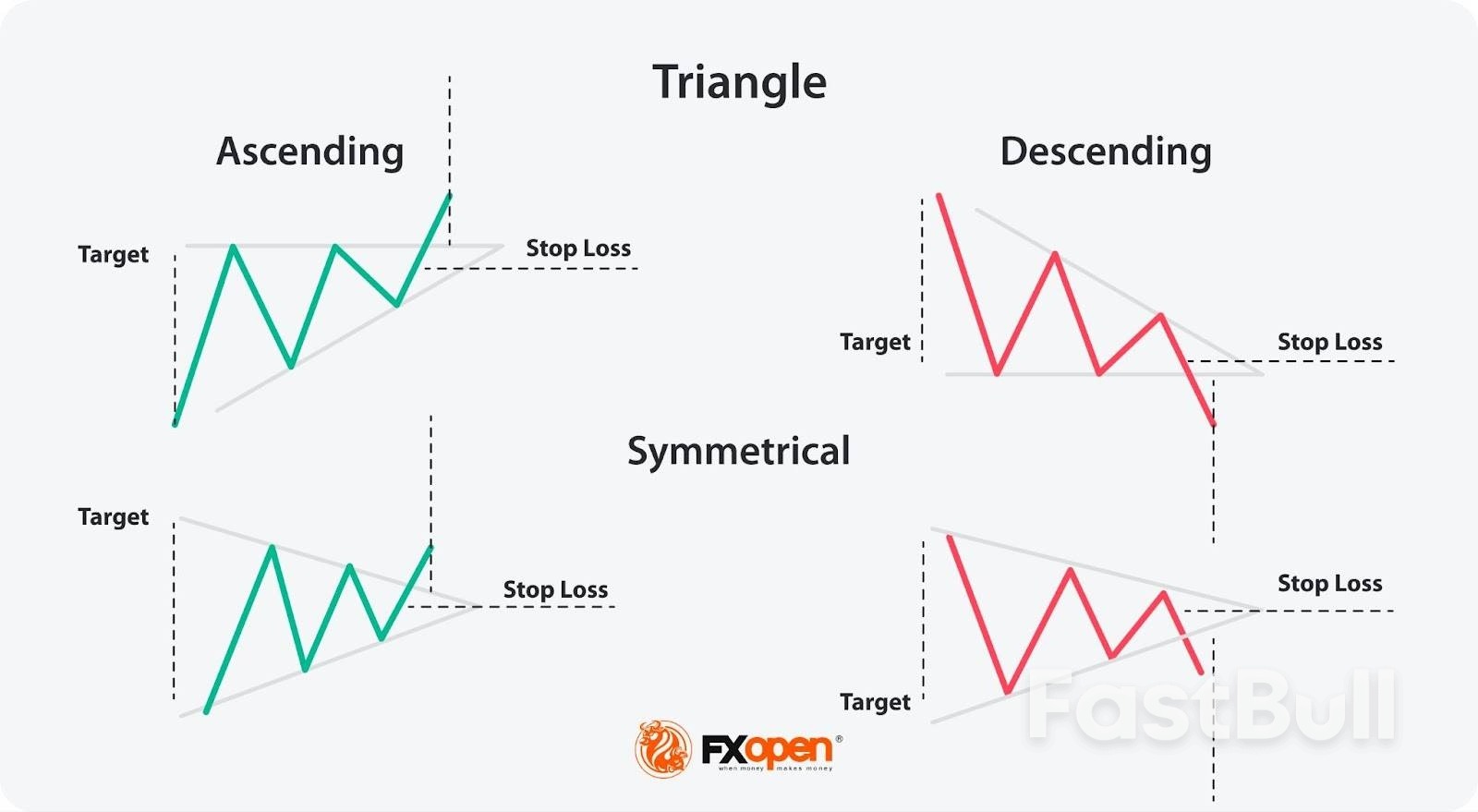
          The triangle group of patterns comprises ascending, descending, and symmetrical formations.The ascending triangle is a bullish formation and the descending triangle is bearish. At the same time, the symmetrical triangle is a bilateral setup that signals a rise and a fall in the price.To distinguish between them, traders draw trendlines. In a rising triangle pattern, an upper trendline is horizontal and connects equal or almost equal highs, while the lower trendline is rising as it connects higher lows. In a descending or falling triangle pattern, the lower trendline is horizontal and connects equal or almost equal lows, while the upper trendline declines, going through lower highs. A symmetrical triangle has a falling upper line that connects lower highs and a rising lower line that connects upper lows.
          How Traders Spot the Ascending Triangle

          It’s quite easy to identify the formation on a chart. Still, there are a few rules that may help a trader determine its strength.

          ● The trend strength. Although the setup may appear on any timeframe, traders look for strong long-term trends as risks of a fakeout on low charts are higher.
          ● Consolidation. Triangles appear when the market consolidates within an overall trend.
          ● Trendlines. Trendlines must be drawn through at least two points. Still, the larger the number of points, the higher the possibility the setup works.
          ● Breakout. Can the ascending triangle pattern be bearish? No. It is a bullish formation that appears in a bullish and a bearish trend but always signals a potential price rise.

          How Can You Trade Ascending Triangles?

          The rising triangle pattern is usually considered a continuation setup formed in an uptrend. Still, if the ascending triangle is in a downtrend, it may signal a trend reversal. The trading rules will be the same in both cases.

          As with most chart patterns, triangles have specific rules that help traders place entry and exit points.

          Entry

          The theory suggests trades go long when the price breaks above the setup's upper boundary. In a conservative approach, traders wait for the price to form at least several candles before entering the market. In a risky strategy, traders open a position as soon as the breakout occurs, and the breakout candlestick closes.

          It's worth considering trading volumes as breakouts often turn into fakeouts, meaning the market returns to its previous trend. The chance of a strong breakout is higher if the volumes are high.However, increased volumes aren't the only tool used to confirm a breakout. Many traders consider trend indicators and oscillators to potentially limit the risks of bad trading decisions.

          ● If the triangle serves as a continuation setup, it may be helpful to look at the signals of trend-strength indicators, including the average directional index.
          ● If traders use the ascending triangle as a reversal setup, they usually implement indicators that may signal a trend reversal, including the moving average, the relative strength index, the moving average convergence divergence, and the stochastic oscillator.

          Take Profit

          A standard take-profit target equals the size of the largest part of the setup and is measured just from the breakout trendline.

          Stop Loss

          Traders consider several options when placing stop-loss levels. In a conservative approach, they implement the risk/reward ratio, which is usually 1:2 or 1:3 but depends on the trader's willingness to take risks. Also, traders utilise the upper trendline as a threshold and place the stop-loss order just under it.

          Note: these are general rules. However, traders can develop their own trading strategies and adjust the pattern's parameters and rules according to their trading approach.

          Ascending Triangle: Trading Example
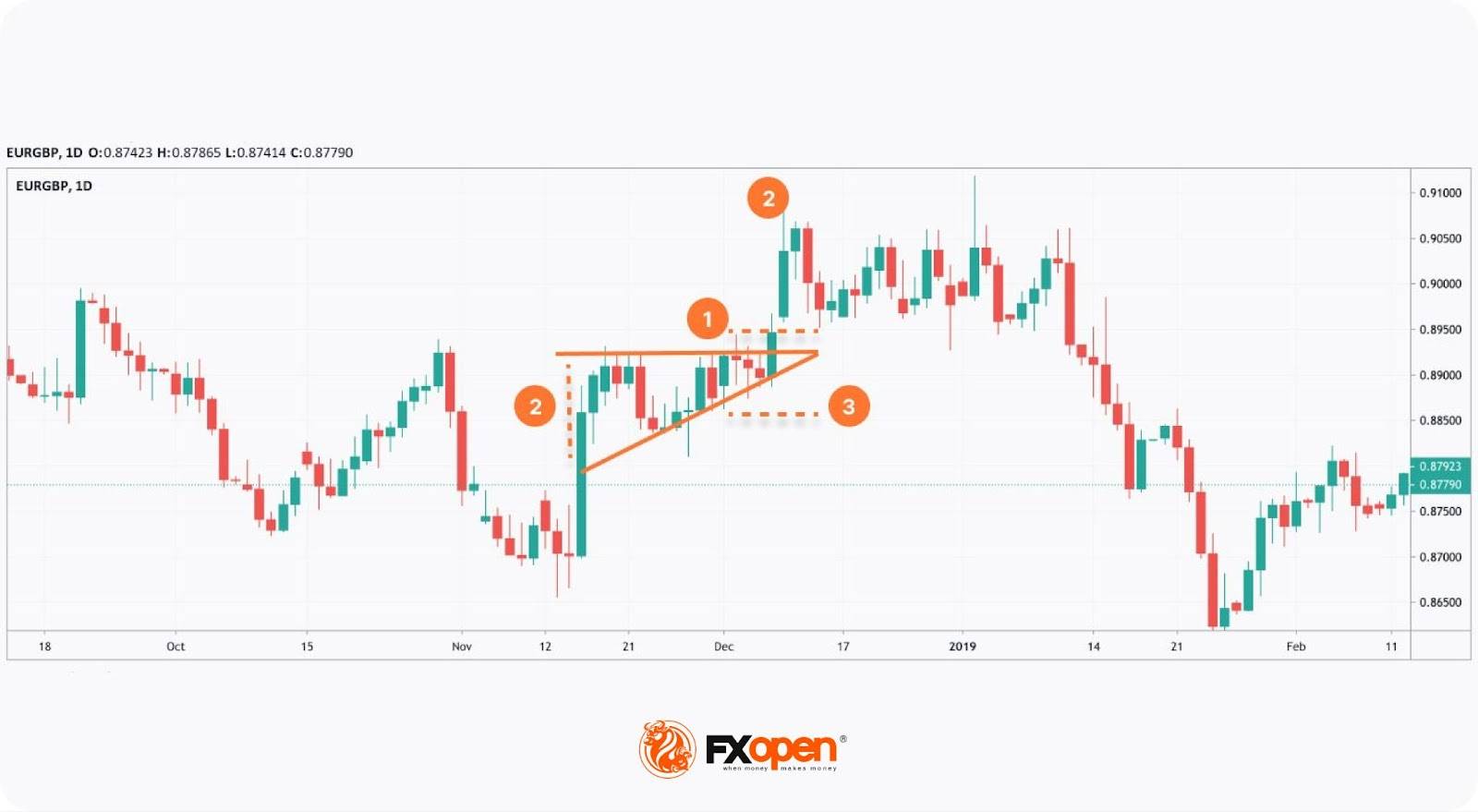
          A bullish ascending triangle pattern formed on the daily chart of the EUR/GBP pair. The price skyrocketed, and as a result, the rising triangle formed, allowing bulls to take a break. As the trend wasn’t solid, a trader could go long as soon as the breakout candle closed (1). Otherwise, the trade would fail. A take-profit target would equal the size of the triangle’s widest part (2) and be measured just from the upper trendline. A stop-loss level of 1:2 or 1:3 risk/reward ratio would work (3).
          Ascending Triangle: Strategy

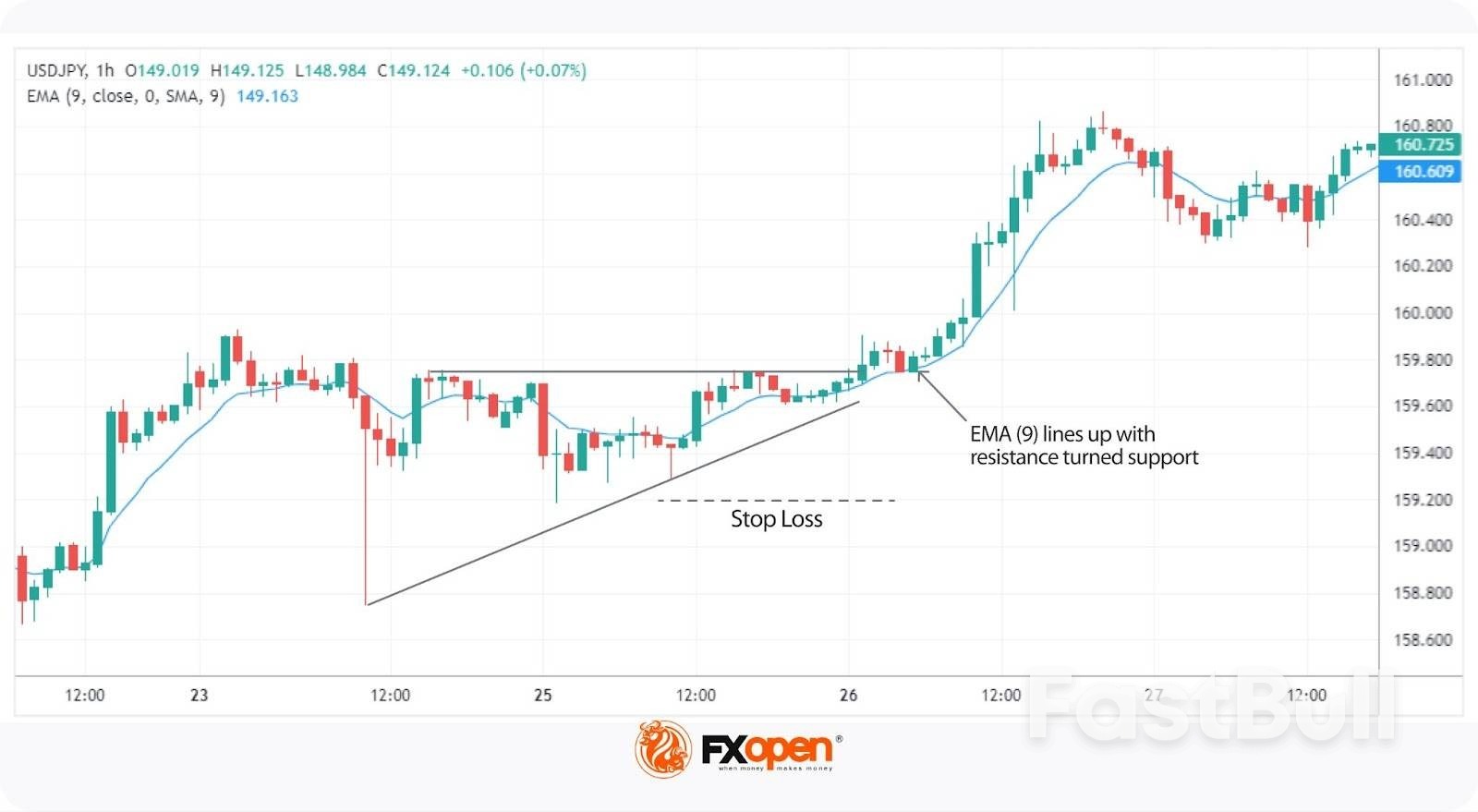
          In this strategy, traders observe an existing bullish trend and the formation of an ascending triangle, which suggests the potential for a continuation pattern. Incorporating a short-term moving average, such as a 9-period EMA, provides dynamic support, aligning with the trendline to strengthen the setup.

          Entries

          ● Traders typically wait for the price to break through the top trendline of the ascending triangle.
          ● A strong candle breaking the resistance level adds confidence, though any move above the top trendline can serve as an entry signal.
          ● The price should also trade above the moving average, offering additional confirmation.
          ● An order is often placed at the top trendline, anticipating a retracement to this level, which now acts as support.

          Stop Loss

          ● Traders place a stop-loss below the most recent swing low within the triangle.
          ● For more conservative traders, the stop may be set at any prior swing low, depending on risk tolerance.

          Take Profit

          ● Many traders aim for a risk-reward ratio of 1:2 or 1:3.
          ● Profits might also be taken at the next strong resistance level, aligning with the market structure.

          Rising Triangle: Benefits and Drawbacks

          This formation has advantages and pitfalls that traders consider when developing their strategies.

          Benefits

          ● It can be used on any timeframe. Triangles are formed on charts of any period. Still, they might be more effective if the setup appears in a solid trend on a high timeframe.
          ● It can be used for any asset. Another advantage is that the ascending triangle pattern is used for stock, commodity, cryptocurrency*, and Forex trading.
          ● Easy to spot. A trader only needs to draw two trendlines to define this setup on the chart.
          ● Exact entry and exit points. Although traders can develop their entry and exit points, the setup assumes there are specific rules traders with any experience utilise.

          Drawbacks

          ● It can confuse traders. As the rising triangle is used as a reversal and continuation formation, traders with less experience may be confused with its signals.
          ● False breakouts. The setup works when a price breakout occurs. However, there is a high risk the breakout will appear to be a fakeout, and the price will return.
          ● The pattern may fail. Aside from a fakeout, there is another risk when trading with triangles. The price may break another side of the formation, and the formation will fail.
          ● The trading rules may not work. Although specific rules indicate where a trader should place entry and exit points, buyers may be too weak to push the price to the take-profit target.

          Final Thoughts

          The ascending triangle is one of the more common chart patterns traders use when trading various assets. Still, there is no 100% guarantee that it will work every time you spot it on a price chart. It's vital to remember that every signal must be confirmed with other indicators, chart patterns, and candlesticks. Also, it's a well-known fact that any trade involves risks that should be considered every time a trader enters the market. Improve your skills by practising on different assets and timeframes.

          FAQ

          How Do You Form an Ascending Triangle?

          An ascending triangle is formed when the price action creates a series of higher lows while facing a resistance level, resulting in a horizontal upper trendline and a rising lower trendline. The price consolidates between these two lines before potentially breaking out above the resistance, signalling a bullish continuation.

          Is an Ascending Triangle Bullish or Bearish?

          The ascending triangle is a bullish pattern. It suggests that buyers are gaining strength as higher lows form, increasing the likelihood of a breakout above the resistance level. There is a descending triangle pattern that usually appears in a downtrend, signalling a downward movement.

          How to Enter an Ascending Triangle?

          According to the theory, in triangle pattern trading, it’s common to enter the market when the price breaks above the upper trendline of the triangle. In a conservative approach, traders wait for confirmation through several closing candles after the breakout. The increased volume also adds confidence to the trade.

          What Is the Ascending Triangle Pattern Retest?

          A retest occurs when the price breaks out of the triangle but then briefly falls back to test the former resistance level. A successful retest confirms the breakout and can provide an additional entry point.

          How Long Does an Ascending Triangle Pattern Take to Form?

          The formation of a bullish triangle pattern can vary based on the timeframe. On daily charts, it can take several days to weeks, while on shorter timeframes, it might form within hours.

          What Is the Difference Between an Ascending Triangle and a Rising Wedge?

          In comparing the ascending triangle vs. the rising wedge, it’s key to recognise that the rising wedge has converging trendlines, signalling a possible weakening trend, often leading to a bearish reversal. In contrast, an ascending triangle trading pattern typically signals a continuation of the uptrend.

          Source: FXOpen

          To stay updated on all economic events of today, please check out our Economic calendar
          Risk Warnings and Disclaimers
          You understand and acknowledge that there is a high degree of risk involved in trading. Following any strategies or investment methods may lead to potential losses. The content on the site is provided by our contributors and analysts for information purposes only. You are solely responsible for determining whether any trading assets, securities, strategy, or any other product is suitable for investing based on your own investment objectives and financial situation.
          Add to Favorites
          Share

          EURUSD pulls back into a key trendline: has the US dollar already run out of energy?

          Adam

          Forex

          Fundamental Overview

          The USD rallied across the board last week after a slate of strong US data. The focus was mainly on Jobless Claims which beat expectations by a big margin with Initial Claims falling to the lowest level since July and Continuing Claims improving further. This triggered a hawkish repricing in interest rates expectations since the Fed started cutting rates solely due to weaker labour market data.
          This means that if we continue to get stronger labour market data, the Fed could start turning more hawkish again and we might not get another cut in October, or more probably in December. Therefore, there’s still plenty of room for the US dollar to appreciate in case of strong data as the market’s pricing remains too dovish. The Fed projected 75 bps of easing by the end of 2026, while the market is still pricing 104 bps.
          The greenback erased all the gains triggered by last week’s data in the meantime as we are likely experiencing a pullback after a very strong rally. Other possible reasons include the government shutdown fears and quarter-end flows.
          On the EUR side, nothing has changed in the meantime. The ECB left interest rates unchanged at the last meeting as widely expected with limited forward guidance other than the usual data-dependent approach. President Lagarde made it clear that the central bank finished cutting rates after she said that growth risks are balanced and the disinflationary process was over. The ECB is not expected to adjust rates for a long time unless we get significant deviation from their inflation target.

          EURUSD Technical Analysis – Daily Timeframe

          EURUSD pulls back into a key trendline: has the US dollar already run out of energy?_1EURUSD daily

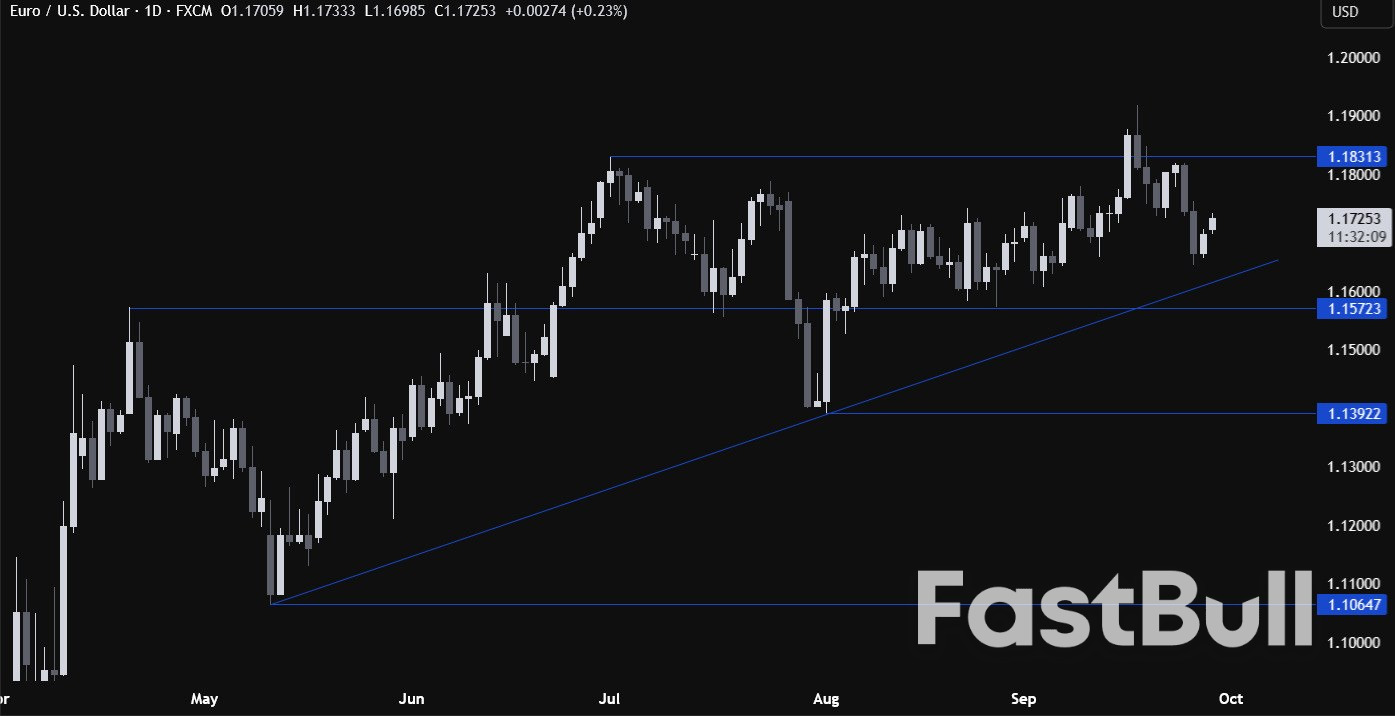
          On the daily chart, we can see that EURUSD fell further into new lows last week with the sellers targeting the major upward trendline. That’s where we can expect the buyers to step in with a defined risk below the 1.16 support to position for a rally into a new cycle high. The sellers, on the other hand, will look for downside breaks to increase the bearish bets into the 1.1392 level next.

          EURUSD Technical Analysis – 4 hour Timeframe

          EURUSD pulls back into a key trendline: has the US dollar already run out of energy?_2EURUSD 4 hour

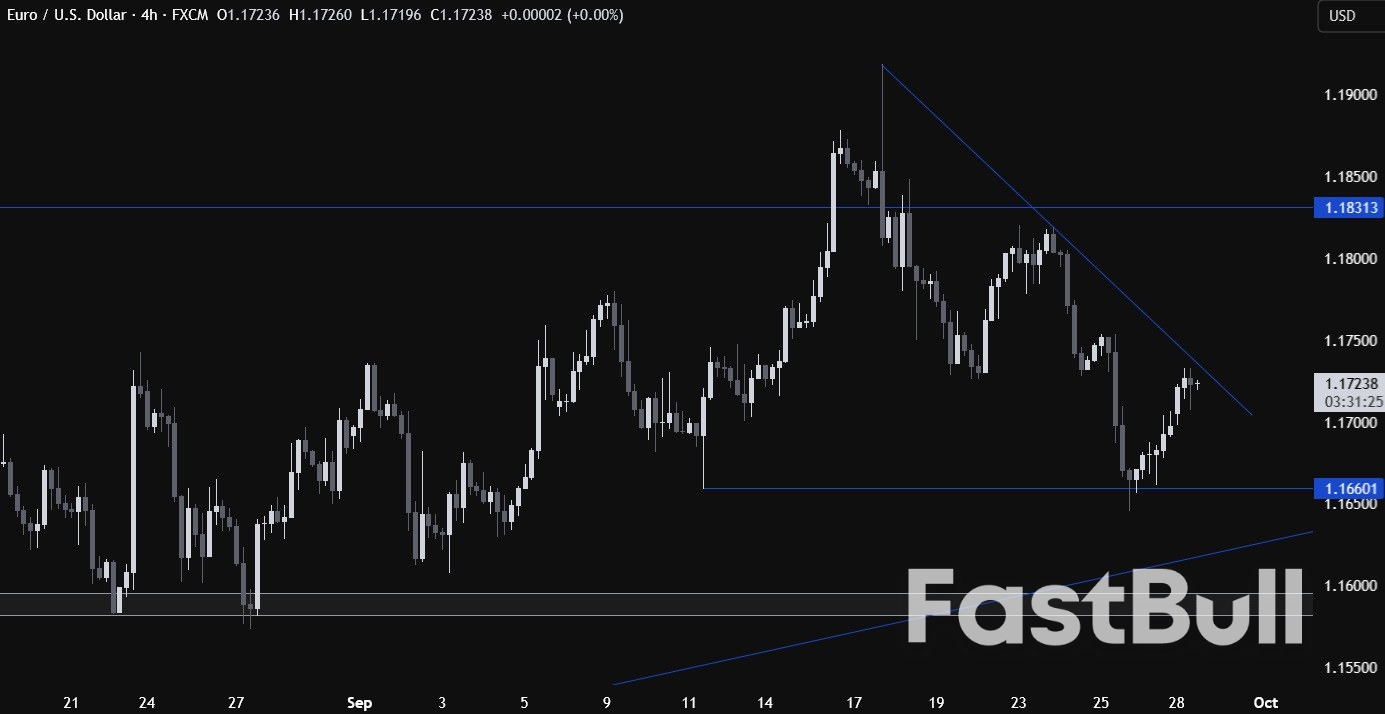
          On the 4 hour chart, we can see that we have a minor downward trendline defining the bearish momentum on this timeframe. The sellers will likely lean on the trendline with a defined risk above it to position for a drop into the 1.16 support. The buyers, on the other hand, will look for a break higher to increase the bullish bets into the 1.1830 level next.

          EURUSD Technical Analysis – 1 hour Timeframe

          EURUSD pulls back into a key trendline: has the US dollar already run out of energy?_3EURUSD 1 hour

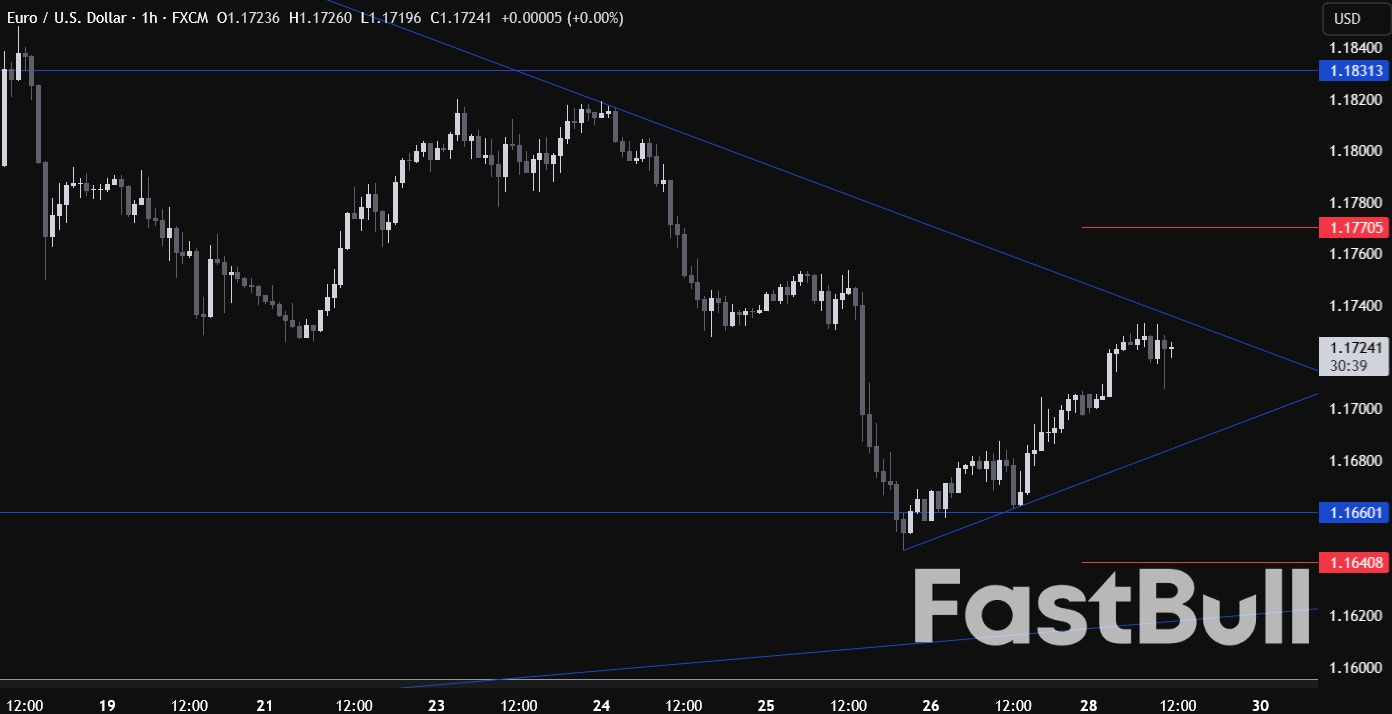
          On the 1 hour chart, we can see that we have a minor upward trendline defining the current pullback. If the price falls into it, we can expect the buyers to step in with a defined risk below it to keep pushing into new highs, while the sellers will look for a break lower to increase the bearish bets into the 1.16 support. The red lines define the average daily range for today.

          Upcoming Catalysts

          Tomorrow we get the French and German inflation reports, the US Job Openings data and the US Consumer Confidence report. On Wednesday, we have the Flash Eurozone CPI, the US ADP and the US ISM Manufacturing PMI. On Thursday, we get the latest US Jobless Claims figures. On Friday, we conclude the week with the US NFP report and the US ISM Services PMI. Keep also an eye on Fed speakers.

          source : investinglive

          Risk Warnings and Disclaimers
          You understand and acknowledge that there is a high degree of risk involved in trading. Following any strategies or investment methods may lead to potential losses. The content on the site is provided by our contributors and analysts for information purposes only. You are solely responsible for determining whether any trading assets, securities, strategy, or any other product is suitable for investing based on your own investment objectives and financial situation.
          Add to Favorites
          Share

          Markets Price 90% Odds of Fed Rate Cut at October Meeting

          Michelle

          Economic

          Forex

          According to the latest market reports, traders are pricing in a quarter-point rate cut at the October 29 FOMC meeting with 90% probability according to CME’s FedWatch tool. This is a turn from recent rate-hike anxiety.

          Prediction markets like Polymarket and Kalshi are also betting the Fed will cut from 4.00-4.25% to 3.75-4.00%. If they do, rate-sensitive assets like Bitcoin, tech stocks, and high-yield credit could breathe a sigh of relief.

          How Big Is the Fed rate Cut Odds?

          CME’s FedWatch tool shows 90.8% chance that the Fed will lower rates by a 25 bps cut, with only 9.2% chance of no change. Other platforms show 91.9% implied probability. Some sources show slightly lower but still dominant odds around 89.8% for the cut.

          These odds define how far the markets have leaned into this expectation. They’ve priced in a near-certainty for a 25 bps move, leaving little room for surprises.

          What’s Driving the Consensus?

          Several factors are driving the consensus. First, fed futures markets have moved sharply and expectations for future rates have shifted towards easing.

          Second, Fed officials have said they have room to ease. Chicago Fed’s Austan Goolsbee recently said the Fed has “room to cut rates,” in response to softening labor signals.

          Third, many analysts and institutions now expect multiple cuts this year. Some updated their forecasts to expect cuts in both October and December.

          Fourth, the Fed’s own dot plot and statements have hinted at room for further easing to support a soft landing.

          What It Would Mean Across Markets

          According to market experts; if the Fed cuts rates by 25 bps, it would lower borrowing costs, ease pressure on credit-sensitive sectors and potentially re-ignite inflows into equities, growth sectors and crypto. Rate-sensitive markets react quickly, although it might not be uniform.

          The forward guidance which refers to how the Fed signals the future path, could matter more than the cut itself. Markets are set to watch the post-meeting press conference and dot plot update for clues on more easing.

          Conversely, a decision to hold rates would likely spook markets, increase volatility and force risk assets to adjust downward quickly. With odds at 90%, surprises would be amplified.

          Risks That Could Upend the View

          Despite the strong consensus, there are still risks. A hot economic print (e.g. CPI, PCE, jobs) before or after the meeting could change the math.

          The Fed might sound dovish but hold back on action, preferring flexibility in the face of inflation uncertainty. Internal FOMC disagreement could lead to dissent or a more cautious cut. External shocks ike geopolitical, fiscal or credit events, could blow up policy confidence.

          Powell has warned to be cautious; if inflation is sticky the Fed might not cut too fast.

          Conclusion

          Based on the latest research; Markets are fully pricing in a 25 bps Fed rate cut in October with 90% probability. This has big implications for equities, credit and crypto. But the Fed’s discretion is not gone.

          A surprise twist from inflation prints, internal disagreement or cautious tone, could shock markets. Market participants are to be prepared for both the expected and the unexpected.

          Summary

          A Fed rate cut in October is highly likely but not guaranteed. Markets are fully on board with a quarter-point move. What matters next is how the Fed frames its path forward and whether data forces a rethink. Though consensus is clear, history shows central banks can still surprise.

          Source: CryptoSlate

          To stay updated on all economic events of today, please check out our Economic calendar
          Risk Warnings and Disclaimers
          You understand and acknowledge that there is a high degree of risk involved in trading. Following any strategies or investment methods may lead to potential losses. The content on the site is provided by our contributors and analysts for information purposes only. You are solely responsible for determining whether any trading assets, securities, strategy, or any other product is suitable for investing based on your own investment objectives and financial situation.
          Add to Favorites
          Share

          Gold Reached a New Record High

          Adam

          Commodity

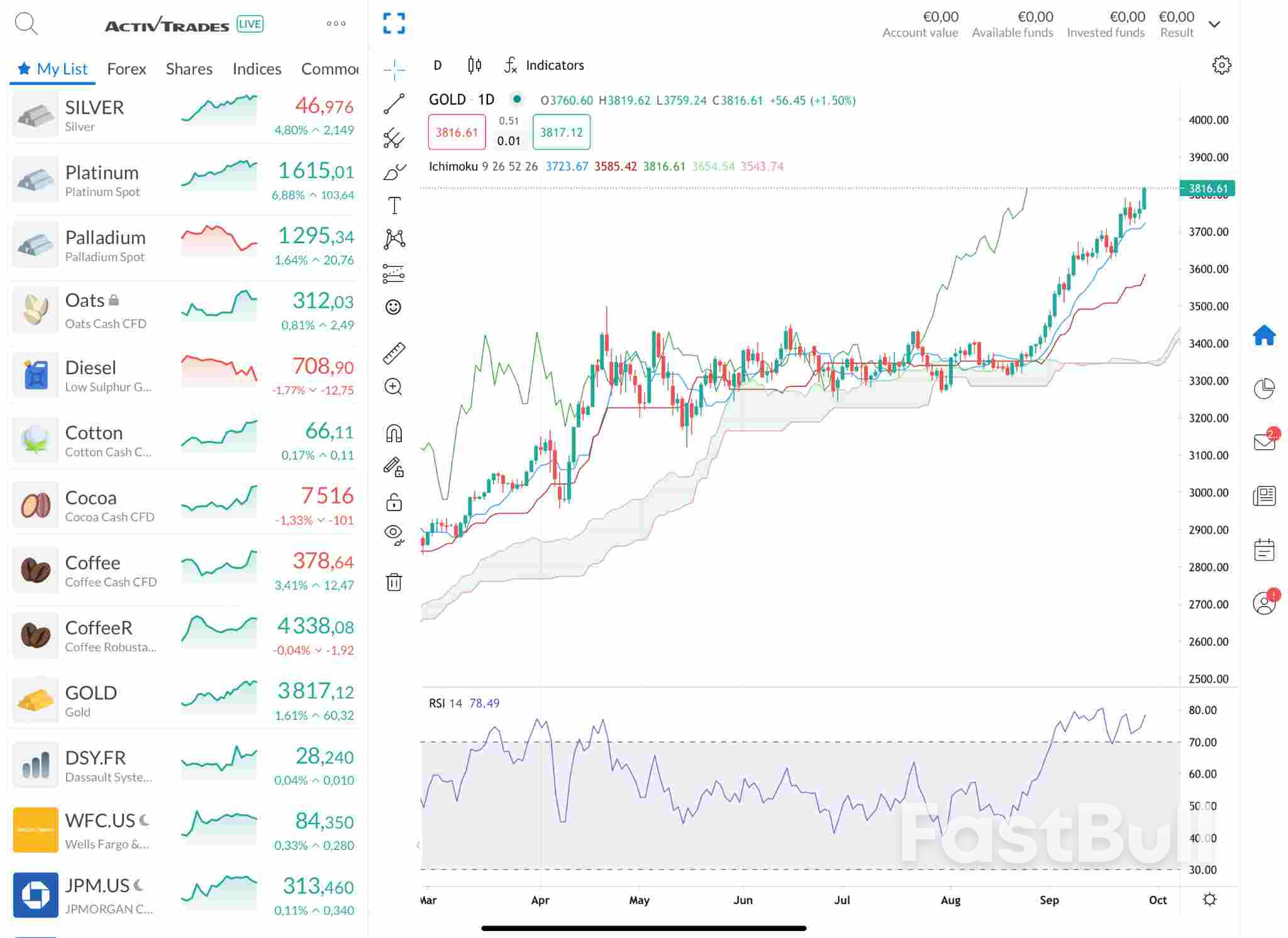
          According to ActivTrades trading data, gold climbed 1.50% today, reaching $3,816.61 at the time of writing, with an intraday peak of $3,819.62. The precious metal is now on pace for its largest annual gain since 1979, having surged more than 45% in 2025. This rally has been driven primarily by Fed rate cuts, sustained central bank purchases, and strong inflows into gold-backed ETFs. But on Monday, investor attention is squarely focused on the possible economic and market impacts of a U.S. shutdown.
          Gold Reached a New Record High_1

          Daily Gold Chart

          How Is The Potential U.S. Shutdown Influencing Gold Prices?

          The U.S. federal government is once again on the brink of a shutdown, as funding is set to expire at midnight on September 30 unless Congress finalizes a budget agreement before the start of the new fiscal year on October 1. A government shutdown happens when lawmakers fail to pass the required appropriations bills, leaving federal agencies without the legal authority to spend money. As a result, many departments must halt operations and place staff on furlough, while only essential functions—such as national security and air traffic control—remain operational.
          The current standoff in Washington reflects deep political divisions. Democrats insist that any short-term funding measure must include provisions such as extended health care subsidies, restored Medicaid funding, and support for public media. Republicans, who control both chambers of Congress, have rejected these demands as unrealistic. The result is a deadlock, with both parties trading blame as the deadline approaches.
          Shutdown threats have become a recurring feature of U.S. budget politics, but the consequences can still be severe. The most notable example came in 2018 during Donald Trump’s first term, when a dispute over border wall funding triggered a 34-day shutdown—the longest in modern history. Around 800,000 federal employees went without pay, and many government services ground to a halt.
          What makes the current standoff even more alarming is the White House’s directive for agencies to prepare not just for temporary furloughs, but also for the possibility of permanent layoffs in programs most at risk of losing funding.
          So, how is this potential shutdown affecting Gold prices?
          As the risk of a U.S. government shutdown intensifies, investors are seeking protection from growing uncertainty. This behavior is often described as a “flight to quality”—a shift of capital away from riskier assets, such as equities or corporate bonds, into perceived safe-haven assets that are better able to preserve value during periods of stress.
          Flights to quality typically occur in moments of political dysfunction, financial instability, or geopolitical shocks—events that raise doubts about economic growth, government reliability, or the security of traditional investments. In such times, Gold has historically stood out as one of the most reliable hedges. Unlike paper assets that depend on political agreements or corporate balance sheets, Gold carries no counterparty risk and is seen as a universal store of value.
          That dynamic is now playing out again. The looming shutdown is shaking investor confidence in Washington’s ability to manage fiscal policy. Memories of past shutdowns—such as the record 34-day closure in 2018—have reinforced fears of disruption to federal services, unpaid government workers, and broader economic drag. This time, warnings of permanent layoffs and deeper cuts have only heightened anxiety.
          At the same time, the political standoff is unfolding against a backdrop of other destabilizing forces: Trump’s renewed tariff policies, ongoing geopolitical tensions, and global economic headwinds. Taken together, these risks have amplified safe-haven demand, pushing Gold to new record highs as traders hedge against the possibility of prolonged instability in the world’s largest economy.

          What Are Other Factors Influencing Gold Prices Right Now?

          While the looming U.S. government shutdown is a major catalyst behind Gold’s surge, several broader forces are also shaping demand for the metal. Together, they reinforce the safe-haven appeal of Gold at a time of heightened global uncertainty.

          The Federal Reserve’s Shift Toward Lower Interest Rates

          A weakening U.S. labor market has already prompted the Federal Reserve to cut interest rates, and markets expect further easing in the months ahead. Lower rates reduce the returns on cash holdings and fixed-income investments, making them less attractive compared with Gold, which pays no yield but retains its value over time. Historically, Gold prices tend to rise when interest rates fall, as investors rebalance portfolios toward assets that provide protection rather than income.

          Rising Political Pressure on the Federal Reserve and the U.S. Dollar

          Gold is also benefiting from concerns over U.S. monetary credibility. President Trump’s growing criticism of the Federal Reserve, and his calls to limit its independence, have unsettled investors. Any perception that central bank policy is being influenced by political agendas undermines confidence in the stability of the U.S. dollar and the Treasury market—both of which are cornerstones of the global financial system. In such an environment, Gold becomes an appealing alternative store of value outside the reach of domestic politics.

          Central Banks Building Strategic Gold Reserves

          In addition to private investors, central banks themselves have been major buyers of Gold in recent years. China, in particular, has been aggressively expanding its holdings as part of a broader strategy to diversify reserves away from the dollar and reduce reliance on Western financial hubs like New York, London, and Zurich.
          This trend is not limited to China. According to the World Gold Council’s 2025 Central Bank Gold Reserves Survey, 43% of central bankers expect their institutions to increase Gold holdings, while 95% believe global official reserves will continue to rise over the next year. Their reasoning is clear: Gold’s long-standing role as a hedge against crisis, inflation, and currency volatility. Similarly, the OMFIF Global Public Investor 2025 report found that nearly one-third of central banks plan to increase Gold purchases over the next 12–24 months.
          By adding Gold to their balance sheets, central banks send a powerful signal to markets: that Gold is not only a financial hedge but also a geopolitical tool, reinforcing its role as a core reserve asset in an increasingly fragmented global economy.

          Geopolitical Tensions and Trade Conflicts

          Finally, persistent geopolitical risks are adding fuel to Gold’s rally. Trade disputes sparked by Trump’s tariff policies, ongoing conflicts in Eastern Europe and the Middle East, and concerns over energy security have heightened global instability. Such risks push investors to diversify away from assets tied to specific regions or political systems and into Gold, which is universally recognized as a safe store of value. Historically, geopolitical crises have been among the most powerful triggers for Gold rallies, as investors hedge against sudden market shocks, capital controls, or disruptions in global trade.

          Bottom Line

          Taken together, these forces—falling interest rates, political pressure on the Fed and the dollar, sustained central bank demand, potical and intensifying geopolitical tensions—form a powerful backdrop for Gold. Each on its own would support higher prices, but their convergence in late 2025 has created a perfect storm for the metal. That is why Gold is not only testing new highs but also being revalued as a cornerstone asset in portfolios seeking protection against economic, political, and financial instability.

          Source: fxempire

          Risk Warnings and Disclaimers
          You understand and acknowledge that there is a high degree of risk involved in trading. Following any strategies or investment methods may lead to potential losses. The content on the site is provided by our contributors and analysts for information purposes only. You are solely responsible for determining whether any trading assets, securities, strategy, or any other product is suitable for investing based on your own investment objectives and financial situation.
          Add to Favorites
          Share

          Oil News: Crude Oil Futures Dip as OPEC Production and Kurdistan Supply Weigh

          Adam

          Commodity

          Oil prices dip as supply concerns resurface

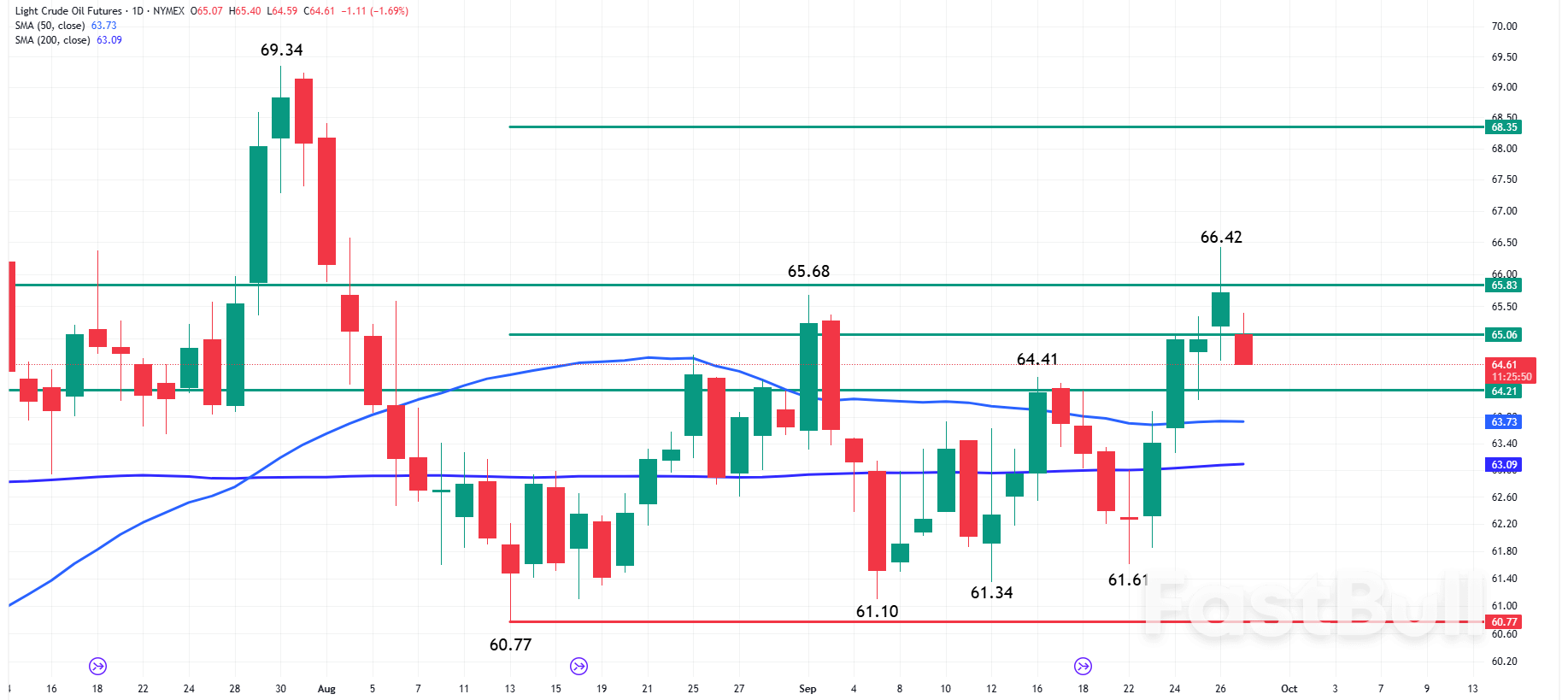
          Crude oil futures slipped in early Monday trade, pulling back from a new seven-week high at $66.42. Traders attributed the move to increasing concerns around global supply growth. The resumption of crude exports from Iraq’s Kurdistan region and expectations for another OPEC+ production hike weighed on sentiment.
          At 10:05 GMT, Light Crude Oil Futures are trading $64.69, down $1.03 or -1.57%.

          Kurdistan pipeline restart and OPEC+ output plan weigh on sentiment

          Iraq’s oil ministry confirmed the weekend restart of pipeline flows from the semi-autonomous Kurdistan region to Turkey’s Ceyhan port, marking the first crude movement in 2.5 years. The deal could return up to 230,000 barrels per day (bpd) to the market.
          Meanwhile, three sources told Reuters that OPEC+ is expected to approve another production increase of at least 137,000 bpd this weekend, continuing its efforts to reclaim market share.

          Technical levels in focus as WTI pullback eyes key support zone

          Oil News: Crude Oil Futures Dip as OPEC Production and Kurdistan Supply Weigh_1Daily Light Crude Oil Futures

          Despite Monday’s retreat, the uptrend remains intact with a higher-high, higher-low formation. Traders are eyeing technical support around the long-term 50% retracement at $64.21, followed by the 50-day moving average at $63.73 and the 200-day moving average at $63.09. A sustained move above the $66.42 peak could trigger a push toward a major resistance zone between $68.35 and $69.34.

          Russia, Iran sanctions and China stockpiling add upside risk

          While supply additions dominate headlines, traders remain cautious about geopolitical risks. Ukraine’s drone campaign has disrupted up to 25% of Russia’s refining capacity in recent weeks, and Russia has responded with a partial diesel export ban. Simultaneously, the United Nations has reinstated sanctions on Iran, raising concerns over potential supply constraints.
          China’s continued crude stockpiling may also support the market. Reuters reports that China imported roughly 990,000 bpd above domestic needs through the first eight months of the year, suggesting ample buying capacity remains.

          Saudi Aramco to raise Asia crude prices but hikes may be limited

          Saudi Arabia is expected to raise November official selling prices (OSPs) for Asia by 20–40 cents per barrel across its crude grades, reflecting recent strength in Middle East benchmarks. However, rising supply and higher freight costs are expected to limit the scale of those increases. The cash Dubai premium recently hit a six-month high of $3.63 per barrel before easing on the Kurdistan export news.

          Oil prices forecast: Bullish trend intact, but upside capped by supply headwinds

          While short-term supply pressure from Kurdistan and OPEC+ output hikes has tempered bullish momentum, the technical setup still favors buyers on dips into the $63.73–$63.09 range.
          With geopolitical tensions and China’s buying still in play, crude remains supported. A sustained breakout above $66.42 could spark an upside run toward $69.34. The outlook remains cautiously bullish pending OPEC+ execution and any escalation in supply risks.

          Source: fxempire

          Risk Warnings and Disclaimers
          You understand and acknowledge that there is a high degree of risk involved in trading. Following any strategies or investment methods may lead to potential losses. The content on the site is provided by our contributors and analysts for information purposes only. You are solely responsible for determining whether any trading assets, securities, strategy, or any other product is suitable for investing based on your own investment objectives and financial situation.
          Add to Favorites
          Share

          Yen Leads As BoJ Hawkish Signals Build, Focus Turns to RBA

          Blue River

          Forex

          Technical Analysis

          Yen held firm as the strongest performer heading into the US session, supported by mounting speculation that the BoJ is moving closer to a rate hike. Traders seized on a hawkish shift from a known dove on the Policy Board, a sign that internal momentum is building for further normalization.

          This shift in tone from the BoJ was partly balanced by a cautious note from the Japanese government. In its September monthly report, the Cabinet Office kept its basic economic assessment unchanged, describing the recovery as “moderate” while highlighting the drag from US trade policies, particularly in the automotive sector. Officials also warned that attention should remain on downside risks linked to external headwinds.

          Still, the currency’s next major driver will be global risk sentiment. Heavyweight US releases this week — highlighted by Friday’s non-farm payrolls — will be decisive for both stocks, bonds and currencies. Any data surprise strong enough to sway Fed expectations will inevitably spill over into USD/JPY and broader Yen crosses.

          In the upcoming Asian session, attention is shifting to the RBA’s policy decision. The RBA is expected to keep rates on hold at 3.60%, but the outcome carries added weight after August CPI accelerated to 3.0% from 2.8%. While consensus sees a year-end rate of 3.35%, a handful of analysts have delayed their calls for a November cut in light of the firmer inflation print.

          Australia’s largest banks are split: ANZ, CBA, and Westpac forecast a 25bps reduction in November, while NAB expects no easing until May. A Reuters poll found more than 80% of respondents still see a cut to 3.35% by year-end, though the number expecting no change has risen since August.

          For the day so far, Dollar is the weakest major currency, followed by Swiss Franc and Loonie. Yen sits at the top of the ladder, ahead of Sterling and Aussie, with the Kiwi and Euro trading in the middle of the pack.

          In Europe, at the time of writing, FTSE is up 0.54%. DAX is up 0.02%. CAC is up 0.26%. UK 10-year yield is down -0.038 at 4.72. Germany 10-year yield is down -0.023 at 2.731. Earlier in Asia, Nikkei fell -0.69%. Hong Kong HSI rose 1.89%. China Shanghai SSE rose 0.90%. Singapore Strait Times rose 0.09%. Japan 10-year JGB yield fell -0.013 to 1.647.

          Eurozone economic sentiment inches higher to 95.5, jobs outlook softer

          Economic sentiment in the Eurozone improved slightly in September, with the Economic Sentiment Indicator rising 0.2 points to 95.5. The broader EU also gained 0.6 points to the same level. Despite the uptick, sentiment remains below the long-term average of 100.

          The modest gains were driven by stronger confidence in industry, services, and among consumers, offset partly by weaker retail sentiment and stable conditions in construction.

          By contrast, labor market expectations slipped, with the Employment Expectations Indicator dropping -0.9 points in the EU and -1.3 points in the euro area, suggesting hiring momentum is fading.

          Country-level trends were uneven. Spain led with a notable 3-point jump, followed by Italy (+0.7), while sentiment weakened in the Netherlands (-0.7) and Germany (-0.4). France (+0.3) and Poland (+0.1) saw little change.

          BoJ dove Noguchi signals hawkish shift

          BoJ board member Asahi Noguchi, long seen as one of the most dovish voices on the Board, struck a notably hawkish tone today. He argued that Japan is making steady progress toward its 2% inflation goal, citing stronger wage momentum and greater corporate willingness to pass on rising costs.

          Noguchi said the “need to adjust the policy interest rate is increasing more than ever,” highlighting that upside risks to prices and growth now outweigh the downside. He noted the labor market is “close to full employment” and the output gap has “almost reached zero”, warranting a shift in policy perspective to address rising inflation risks.

          His comments mark a significant departure from his usual stance, adding to expectations that the BoJ could deliver another rate hike in the near future. Noguchi did caution that U.S. tariffs remain a source of downside risk, but the overall message suggests growing consensus within the Board for normalization.

          USD/JPY Mid-Day Outlook

          Daily Pivots: (S1) 149.28; (P) 149.62; (R1) 149.83;

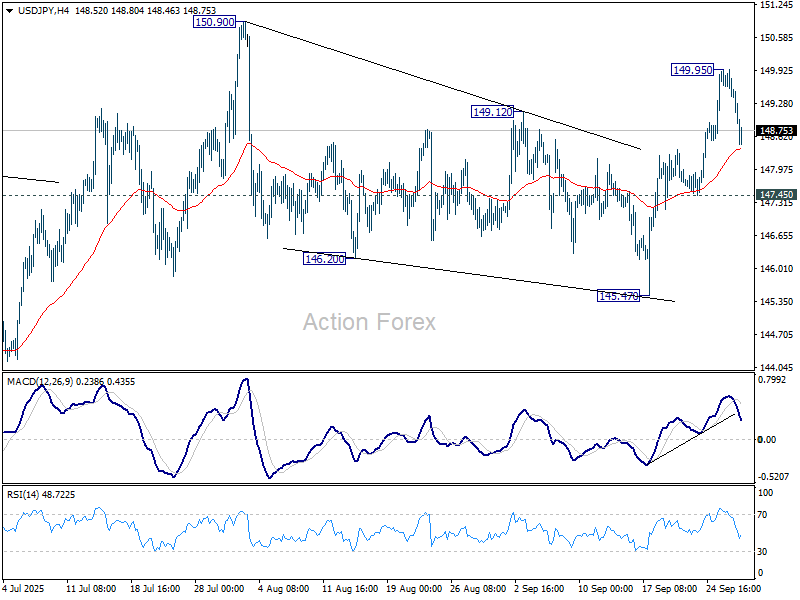
          Intraday bias in USD/JPY stays neutral for the moment and some more consolidations could be seen below 149.95 temporary top. Further rally is expected as long as 147.45 support holds. Corrective pattern from 150.90 should have completed at 145.47. Above 149.95 will bring retest of 150.90 first. Firm break there will target 151.22 fibonacci level. However, sustained break of 147.45 will dampen this bullish view and bring deeper fall back to 145.47 support instead.

          In the bigger picture, price actions from 161.94 (2024 high) are seen as a corrective pattern to rise from 102.58 (2021 low). Decisive break of 61.8% retracement of 158.86 to 139.87 at 151.22 will argue that it has already completed with three waves at 139.87. Larger up trend might then be ready to resume through 161.94 high. In case the corrective pattern extends with another fall, strong support is expected from 38.2% retracement of 102.58 to 161.94 at 139.26 to bring rebound.

          Source: ACTIONFOREX

          Risk Warnings and Disclaimers
          You understand and acknowledge that there is a high degree of risk involved in trading. Following any strategies or investment methods may lead to potential losses. The content on the site is provided by our contributors and analysts for information purposes only. You are solely responsible for determining whether any trading assets, securities, strategy, or any other product is suitable for investing based on your own investment objectives and financial situation.
          Add to Favorites
          Share

          EMU Data Most Likely Won’t Challenge A Prolonged ECB Status-Quo

          Samantha Luan

          Economic

          Forex

          Political

          Markets

          Consensus-matching August PCE deflators (headline 0.3% M/M and 2.7% Y/Y from 2.6%, core 0.2% and 2.9%) halted a technical rebound both in US yields and of the dollar last Friday. Personal income (0.4% M/M) and spending (0.6%) remained solid. Even so, with markets looking forward to this week’s labour data, the PCE provided little reason to further price out Fed rate cuts this year and early next year. US yields changed one bp or less across the curve. US yields in the meantime have created some ‘breathing space’ vis-à-vis the technical levels that were tested around the time of the September 17 Fed meeting (2-y 3.64% vs 3.50% area, 10-y 4.15% vs 4% support area). German yields in technical trading slightly outperformed with yields easing up to 2.7 bps at the belly of the curve. Risk sentiment remained constructive, with little overall impact from the new sector tariffs the US announced on Thursday. The S&P 50 gained 0.59%. The Eurostoxx 50 even added 1%. The (yield-driven) USD rebound on Wednesday and Thursday ran into resistance. DXY failed to test 98.83 resistance and even made a small step back to close the week in the established ST trading range (close 98.15). USD/JPY approached the 150 barrier (close 149.49). EUR/USD finished the week near the 1.17 big figure (vs a week low of 1.1646 on Thursday).

          Asian risk sentiment stays constructive this morning. Aside from key eco data, markets also keep a close eye at a meeting between president Trump and Congressional leaders as they seek to reach an agreement on a short-term spending bill (by October 01) to avoid a government shutdown. Regarding the data, first national EMU CPI data will be published today (Spain, Belgium) and tomorrow (France, Germany, Italy …) to be summarized into Wednesday’s EMU release (expected 0.1% M/M and 2.2% Y/Y for headline, 2.3% for core). The EMU data most likely won’t challenge a prolonged ECB status-quo. In the US, the focus evidently stays on labour market data (JOLTS , tomorrow), ADP on Wednesday, jobless claims on Thursday and the payrolls on Friday (if they are not delayed by a US government shutdown). The picture from the labour data will be complemented by the ISM’s (Wednesday manufacturing, Friday services) and by the conference board consumer confidence release. Data probably will have to be materially stronger than expected for markets to leave the idea of a follow-up Fed rate cut end next month. A halt in the US yields’ rebound and maybe some noise on a US government shutdown might also abort the most recent USD rebound. EUR/USD could return higher in the 1.1574/1.1919 range. In Japan, we keep an eye at the Tankan survey, as the BOJ MPC internally debates the timing of the next rate hike, potentially coming as soon as the October 30 meeting. The yen last week tested key support near USD/JPY 150, with EUR/JPY (currently 174.5) only a whisker away from the 175.43 2024 multi-year top. In the UK, the Labour Party Congress in Liverpool will highlight the difficult fiscal balancing act of Chancellor Reeves, with key EUR/GBP resistance at 0.8769 still within reach.

          News & Views

          People familiar with the plans said that OPEC+ is likely to raise oil output again in November. The oil cartel is considering adding the same amount as they plan to do in October, i.e. 137k barrels a day. It’s technically restoring a layer of previous output curbs (of 1.66 million b/d) that was originally planned to remain in place through the end of this year. It has prompted warnings of a supply glut from the oil industry. So far, though, oil prices withstood the extra supply relatively well with OPEC+ delegates saying that the actual restored output is less than the amounts announced due to production constraints in some countries. Brent this morning holds steady around a two-month high just shy of $70. OPEC+ meets this Sunday.

          Moldova’s pro-European ruling Party of Action and Solidarity secured 50% of the votes in yesterday’s ballot, putting president Maia Sandu on track for a second term in office. With the projected 54 seats in the 101-seat parliament, PAS doesn’t rely on support from other parties to form a government. The pro-Russian Patriotic Electoral Bloc won a little over 24% of the votes. Moldova, squeezed between Romania and Ukraine, has a population of just 2.4 mln but with an outsized geopolitical importance. The former Soviet state was granted EU candidate status, along with Ukraine, four months after the Russian invasion in 2022. Its goal is to join the EU by the end of the decade.

          Source: ACTIONFOREX

          To stay updated on all economic events of today, please check out our Economic calendar
          Risk Warnings and Disclaimers
          You understand and acknowledge that there is a high degree of risk involved in trading. Following any strategies or investment methods may lead to potential losses. The content on the site is provided by our contributors and analysts for information purposes only. You are solely responsible for determining whether any trading assets, securities, strategy, or any other product is suitable for investing based on your own investment objectives and financial situation.
          Add to Favorites
          Share
          FastBull
          Copyright © 2025 FastBull Ltd

          728 RM B 7/F GEE LOK IND BLDG NO 34 HUNG TO RD KWUN TONG KLN HONG KONG

          TelegramInstagramTwitterfacebooklinkedin
          App Store Google Play Google Play
          Products
          Charts

          Chats

          Q&A with Experts
          Screeners
          Economic Calendar
          Data
          Tools
          Membership
          Features
          Function
          Markets
          Copy Trading
          Latest Signals
          Contests
          News
          Analysis
          24/7
          Columns
          Education
          Company
          Careers
          About Us
          Contact Us
          Advertising
          Help Center
          Feedback
          User Agreement
          Privacy Policy
          Business

          White Label

          Data API

          Web Plug-ins

          Poster Maker

          Affiliate Program

          Risk Disclosure

          The risk of loss in trading financial instruments such as stocks, FX, commodities, futures, bonds, ETFs and crypto can be substantial. You may sustain a total loss of the funds that you deposit with your broker. Therefore, you should carefully consider whether such trading is suitable for you in light of your circumstances and financial resources.

          No decision to invest should be made without thoroughly conducting due diligence by yourself or consulting with your financial advisors. Our web content might not suit you since we don't know your financial conditions and investment needs. Our financial information might have latency or contain inaccuracy, so you should be fully responsible for any of your trading and investment decisions. The company will not be responsible for your capital loss.

          Without getting permission from the website, you are not allowed to copy the website's graphics, texts, or trademarks. Intellectual property rights in the content or data incorporated into this website belong to its providers and exchange merchants.

          Not Logged In

          Log in to access more features

          FastBull Membership

          Not yet

          Purchase

          Become a signal provider
          Help Center
          Customer Service
          Dark Mode
          Price Up/Down Colors

          Log In

          Sign Up

          Position
          Layout
          Fullscreen
          Default to Chart
          The chart page opens by default when you visit fastbull.com