


- EURUSD
- XAUUSD
- XAGUSD
- WTI
- USDX


أسعار السوق
تحليل التداول
مستخدم
24/7
التقويم الاقتصادي
تعليم
البيانات
- الاسم
- أحدث قيمة
- السابق







تعرف على ماهية التداول الورقي، وكيف يعمل، وفوائده وحدوده، وكيف يمكن للمبتدئين ممارسة استراتيجيات التداول دون المخاطرة بأموال حقيقية.
التداول الوهمي هو وسيلة للتدرب على شراء وبيع الأصول المالية دون استخدام أموال حقيقية. فبدلاً من تقديم أوامر فعلية لدى وسيط، يستخدم المتداولون أموالاً افتراضية لمحاكاة عمليات التداول وتتبع أداء قراراتهم في السوق.
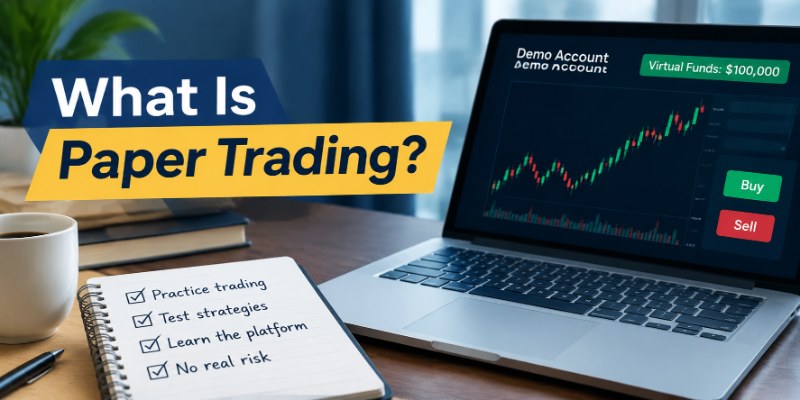
يُعدّ التداول التجريبي مفيدًا بشكل خاص للمبتدئين الراغبين في فهم آلية التداول قبل استثمار رأس مالهم. كما يستخدمه المتداولون ذوو الخبرة لاختبار استراتيجيات جديدة، وممارسة إدارة المخاطر، والتعرف على منصات التداول.
مع ذلك، لا تعكس نتائج المحاكاة دائمًا ما يحدث في الأسواق الحقيقية. إن فهم كيفية عمل التداول الورقي، وما يمكن أن يعلمك إياه، ومواطن قصوره، سيساعدك على استخدامه بفعالية أكبر.
جدول المحتويات
التداول الورقي هو ممارسة محاكاة معاملات السوق المالية دون المخاطرة بأموال حقيقية. يشير المصطلح في الأصل إلى كتابة أوامر بيع وشراء افتراضية على الورق ومتابعة نتائجها.
اليوم، تتم معظم عمليات التداول الوهمي عبر منصات الوساطة الإلكترونية وبرامج محاكاة التداول. توفر هذه الأدوات حسابات افتراضية برأس مال افتراضي محدد، مما يسمح للمستخدمين بإجراء عمليات تداول افتراضية باستخدام أسعار السوق الحقيقية أو المتأخرة.
على سبيل المثال، لنفترض أن لديك 50,000 دولار من الأموال الافتراضية وترغب في التدرب على تداول الأسهم. يمكنك استخدام 5,000 دولار من هذا الرصيد لمحاكاة شراء 50 سهماً من سهم سعره 100 دولار.
إذا ارتفع سعر السهم إلى 110 دولارات، فستُظهر محفظتك الافتراضية ربحًا قدره 500 دولار قبل خصم تكاليف المعاملات. أما إذا انخفض إلى 90 دولارًا، فستُظهر المحفظة خسارة قدرها 500 دولار.
لا تؤثر أي من النتيجتين على حسابك المصرفي الفعلي.
يمكن استخدام التداول الورقي لممارسة أدوات مالية مختلفة، بما في ذلك:
تعتمد الأدوات المتاحة بالضبط على محاكي التداول أو منصة الوساطة.
تتبع عمليات التداول الورقي بشكل عام نفس العملية الأساسية للتداول الحقيقي، باستثناء أن المعاملات تستخدم أموالاً افتراضية بدلاً من رأس المال الحقيقي.
Most platforms provide a simulated trading account with an initial balance. Users can then select assets, place hypothetical orders, and monitor their positions.
Here is how the process typically works:
1. Open a paper trading account
Choose a broker or trading platform that offers a demo or paper trading account. Some platforms provide access without requiring an initial deposit.
2. Receive virtual funds
The platform assigns a simulated balance, such as $10,000, $50,000, or $100,000. This money is used exclusively for practice.
3. Select an asset
Choose a stock, currency pair, ETF, cryptocurrency, or another supported instrument that you want to trade.
4. Place simulated orders
You can practice different order types, including:
The platform processes these hypothetical orders according to its simulation rules.
5. Monitor performance
Track your open positions, account balance, unrealized gains and losses, and completed transactions.
6. Review and improve
Analyze your trades to identify mistakes, evaluate strategies, and improve your decision-making.
The objective is not simply to generate virtual profits. It is to develop a repeatable trading process that can be evaluated under different market conditions.
Although paper trading attempts to replicate real market activity, several important differences can affect the results.
| Feature | Paper Trading | Live Trading |
|---|---|---|
| Capital | Virtual funds | Real money |
| Financial risk | No direct capital loss | Actual financial losses possible |
| Execution | Simulated | Real market execution |
| Emotions | Usually less intense | Fear and greed affect decisions |
| Slippage | May be simplified | Can affect actual execution prices |
| Commissions | May be excluded or simulated | Depend on broker and instrument |
| Market impact | Usually not reflected | Can affect execution |
| Profits and losses | Hypothetical | Real financial outcomes |
One of the biggest differences is execution quality.
In a simulated account, an order may be filled at the displayed market price. In live trading, prices can change before an order is executed, particularly during periods of high volatility.
Liquidity also matters. A simulated platform may allow a trader to enter or exit a position easily, even when a real market would have limited buyers or sellers.
For this reason, profitable paper trading results should not be treated as proof that the same strategy will make money with real capital.
Paper trading offers several advantages, especially for people who are new to financial markets.
Beginners can learn how to read price charts, understand market movements, and place different types of orders without worrying about losing money.
It also provides an opportunity to become familiar with trading platforms, technical indicators, and other tools.
Traders can experiment with different approaches, such as:
For example, a trader could test whether buying a stock when its 50-day moving average crosses above its 200-day moving average produces consistent results.
By recording multiple trades, they can evaluate whether the strategy performs well across different market conditions.
Paper trading allows users to practice setting stop-loss and take-profit levels, calculating position sizes, and managing exposure.
A trader can also test how much of their simulated account they are willing to risk on a single position.
These habits can help establish a more disciplined approach before real money is involved.
Placing the first trade can feel intimidating, particularly for beginners unfamiliar with order execution and market volatility.
A simulated account provides an opportunity to become comfortable with the process. Traders can make mistakes, review them, and try different approaches without losing capital.
Paper trading can also help users evaluate brokerage platforms before opening or funding a live account.
They can explore charting features, available order types, watchlists, research tools, and the overall trading interface.
For example, Interactive Brokers provides a paper trading environment that allows users to practice with many of its trading tools. Its paper trading guide also explains some differences between simulated and live executions.
Despite its benefits, paper trading has limitations that traders should understand.
This is arguably the biggest limitation.
When trading with virtual money, a $1,000 loss may feel insignificant. When the same amount comes out of a real account, the emotional impact can be very different.
Fear, greed, hesitation, and overconfidence can influence decisions in live markets. A simulator cannot fully reproduce these psychological pressures.
Paper trading platforms do not always replicate real-world execution.
For example, a simulated order might be filled immediately at the displayed price, even when a live order could experience slippage or partial execution.
Some platforms also simplify liquidity, order-book depth, and transaction costs.
A trader who earns consistent simulated profits may assume they are ready to trade with substantial capital.
However, good results in a demo account do not guarantee similar performance in live markets.
A strategy that works under simulated conditions may struggle when execution costs, changing liquidity, and emotional pressure are introduced.
Depending on the platform, certain order types, financial instruments, and account functions may not be supported.
For example, complex options strategies or specialized order types may behave differently from their live-market equivalents.
Traders should check the simulator's limitations before using its results to evaluate a strategy.
Getting started does not require a large investment or advanced financial knowledge. A basic simulator and a clear practice plan are usually enough.
Follow these steps:
Step 1: Choose a trading simulator
Find a platform that supports the financial instruments you want to practice. Check whether it provides real-time market data, realistic order types, and performance tracking.
Step 2: Set a realistic virtual balance
Choose an amount similar to the capital you might eventually use in live trading.
For example, if you expect to start with $2,000, practicing with $100,000 in virtual funds may create unrealistic expectations about position sizing and risk.
Step 3: Develop a trading strategy
Before placing trades, establish clear rules for:
Step 4: Record every trade
Maintain a trading journal with the entry price, exit price, position size, trading reason, and outcome.
You should also record whether you followed your original trading plan.
Step 5: Review your performance
After completing a reasonable number of trades, evaluate your results.
Useful metrics include:
Looking at these metrics together provides a better picture of performance than focusing on profits alone.
There is no universal period for paper trading. The appropriate duration depends on your experience, strategy, and ability to follow a consistent trading plan.
Beginners may benefit from practicing for several weeks or months. More experienced traders might need less time when testing a familiar strategy on a new platform.
Rather than focusing exclusively on the number of days, consider whether you can demonstrate the following:
A strategy that produces a few profitable trades is not necessarily reliable. A larger sample of consistently executed trades provides more useful information.
Moving from paper trading to live trading should be based on preparation rather than excitement about simulated profits.
Before making the transition, make sure you understand the risks of the instruments you intend to trade and have demonstrated discipline in your simulated account.
If you decide to start trading live, consider these precautions:
It is also important to remember that live trading can involve commissions, spreads, financing charges, and other costs that reduce returns.
Paper trading should prepare you for these realities, not create the expectation that trading will be easy.
Paper trading and backtesting are both used to evaluate trading strategies, but they work differently.
| Feature | Paper Trading | Backtesting |
|---|---|---|
| Market data | Live or delayed prices | Historical prices |
| Trading process | Simulated trades | Historical simulation |
| Main purpose | Practice and strategy testing | Evaluate past strategy performance |
| Market conditions | Current or simulated | Previously recorded |
| Main limitation | Unrealistic execution and emotions | Overfitting and historical bias |
Paper trading evaluates how a strategy performs in a simulated trading environment as market prices change.
Backtesting applies trading rules to historical market data to estimate how the strategy would have performed in the past.
Both methods can be useful. Backtesting helps identify potentially promising strategies, while paper trading provides an opportunity to test them under current market conditions.
Yes. Paper trading is a useful starting point for beginners and a practical testing tool for experienced traders.
It helps users understand trading platforms, practice order execution, test strategies, and develop risk management habits without risking actual capital.
However, it should not be treated as a guarantee of future trading success. Simulated accounts cannot fully reproduce the financial pressure, execution challenges, and emotional decisions involved in live markets.
The best approach is to treat paper trading as a training environment. Focus on developing a consistent process, measuring performance, and learning from mistakes rather than chasing virtual profits.
Once you can follow your trading rules consistently, you will have a stronger foundation for deciding whether to move into live trading.
Many brokers and trading platforms offer free paper trading accounts. However, some platforms may require registration, a funded brokerage account, or a subscription to access certain features.
No. Paper trading uses virtual funds, so profits are simulated rather than withdrawable. To earn or lose actual money, you must place trades in a live account.
Yes. It allows beginners to learn market basics, practice placing orders, and understand trading strategies without risking their savings.
غالباً ما تُستخدم المصطلحات بشكل متبادل. الحساب التجريبي هو بيئة تداول محاكاة يوفرها وسيط أو منصة، بينما يشير التداول الورقي إلى الممارسة الأوسع لاختبار الصفقات دون رأس مال حقيقي.
تُقدّم بعض المنصات أسعارًا فورية، بينما تستخدم منصات أخرى بيانات متأخرة أو تاريخية. لذا، يُنصح بمراجعة سياسة بيانات السوق الخاصة بالمنصة قبل الاعتماد على نتائج محاكاة.
لا. يمكن أن تساعد التداولات التجريبية في تقييم الاستراتيجية، لكن الأداء المُحاكى لا يضمن الأرباح المستقبلية. فتكاليف التنفيذ الحقيقية والسيولة والعوامل النفسية قد تُؤدي إلى نتائج مختلفة.

728 RM B 7/F GEE LOK IND BLDG NO 34 HUNG TO RD KWUN TONG KLN HONG KONG


يمكن أن تكون مخاطر الخسارة كبيرة عند تداول الأصول المالية مثل الأسهم أو العملات الأجنبية أو السلع أو العقود الآجلة أو السندات أو صناديق الاستثمار المتداولة أو العملات المشفرة. قد تتعرض لخسارة كامل الأموال التي تودعها لدى شركة الوساطة. لذلك، يجب أن تفكر مليًا فيما إذا كانت هذه التجارة مناسبة لك في ضوء ظروفك ومواردك المالية.
لا ينبغي الاقدام على الاستثمار دون إجراء التدقيق و الأبحاث اللاّزمة أو التشاور مع مستشاريك الماليين. قد لا يناسبك محتوى موقعنا ، لأننا لا نعرف حالتك المالية واحتياجاتك الاستثمارية. من المحتمل أن معلوماتنا المالية قد يكون لها زمن انتقال أو تحتوي على معلومات غير دقيقة، لذلك يجب أن تكون مسؤولاً بالكامل عن أي من معاملاتك وقراراتك الاستثمارية. لن تكون الشركة مسؤولة عن خسارة أي من أموالك.
بدون الحصول على إذن من موقع الويب، لا يُسمح لك بنسخ رسومات الموقع أو النصوص أو العلامات التجارية. حقوق الملكية الفكرية في المحتوى أو البيانات المدرجة في هذا الموقع مملوكة لمزوديها و بورصات التداول.
لم تسجّل الدخول
سجل الدخول لعرض المزيد من الميزات


تسجيل الدخول
الاشتراك


